
Category Archives: Prophecy

Itzchak and the Kibbutz: Transforming Israel

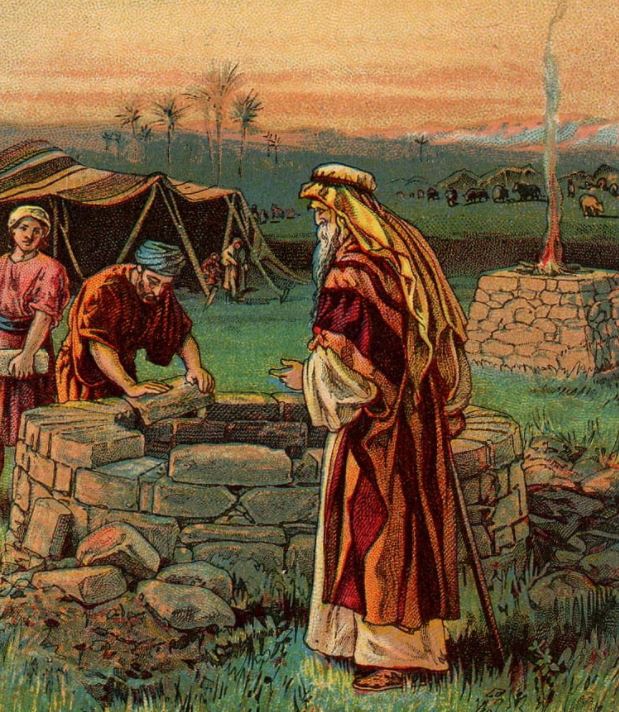
1906 illustration of Isaac, constructing a well.

This week’s parasha, Toldot, is the only one in the Torah that speaks at any length about Isaac. Abraham is introduced at the end of parashat Noach, is the protagonist of Lech Lecha and Vayera, and concludes his story in Chayei Sarah. Isaac, on the other hand, is only briefly discussed in Vayera, reappears only at the end of Chayei Sarah, and fairly quickly makes his exit in this week’s parasha (appearing just once more in Genesis 35, when he passes away). Thereafter, Jacob becomes the subject in the next few parashas. Of the three patriarchs, Isaac is least spoken of—by far.

What we are told of Isaac is that he was a diligent worker; digging wells, sowing seeds, and turning the barren lands of Israel into flourishing oases:

And Isaac sowed in that land, and found in the same year a hundred-fold; and God blessed him. And the man waxed great, and grew more and more until he became very great. And he had possessions of flocks, and possessions of herds, and a great household; and the Philistines envied him. Now all the wells which his father’s servants had dug in the days of Abraham his father, the Philistines had stopped them, and filled them with earth. And Avimelekh said unto Isaac: “Go from us; for you are much mightier than we!” … And Isaac dug again the wells of water… (Genesis 26:12-18)

Reading this passage, one can’t help but sense a certain familiarity with this narrative. A Jew comes to work a difficult land, and finds great prosperity. The Philistine becomes jealous, and seeks to expel the Jew from the land. Instead of trying to build up his own prosperity, the Philistine instead wastes time and effort trying to sabotage the Jew. When this doesn’t work, and the Philistine feels powerless, he continues to protest and shout at the Jew: “Go from us; for you are much mightier than we!” All along, the Jew quietly perseveres, and re-digs the wells. This is the story of Isaac and the Philistines; it is the story of modern Israel and the Palestinians.

In fact, of all the patriarchs and biblical figures, it is Isaac that is most associated with the land of Israel. He was the only patriarch never to leave the Holy Land, spending his entire 180-year lifespan there. The Torah says little of Isaac except for his diligent love and labour of the land. Of course, as we read at the start of the parasha, Isaac and Rebecca literally produced Israel—their son, that is. Every child is the product of three partners: father, mother, and God. Beautifully, the gematria of “Isaac” (יצחק), his wife “Rebecca” (רבקה), and God’s Name (יהוה) add up to 541, the value of “Israel” (ישראל). And just as it was the labour of Isaac and Rebecca that produced the boy Israel, it was their labour that first transformed the land of Israel.

Our Sages explain that the reason Isaac isn’t discussed very much in the Torah is because he actually did not complete his mission (see, for instance, Ba’al HaTurim on Deuteronomy 7:21). The Arizal further notes that the name “Isaac” (יצחק) is an anagram of קץ חי, meaning that his spirit will “live again at the End of Days” (Sha’ar HaPesukim, Lech Lecha). And this is precisely the spirit that guided and infused the Jewish pioneers who re-established modern Israel.

Like Isaac, these pioneers came to a completely barren land. It is worth recalling that when Mark Twain visited the Holy Land in 1869, he wrote:

A desolation is here that not even imagination can grace with the pomp of life and action… We never saw a human being on the whole route… There was hardly a tree or a shrub anywhere. Even the olive and the cactus, those fast friends of the worthless soil, had almost deserted the country… Of all the lands there are for dismal scenery, I think Palestine must be the prince… Can the curse of the Deity beautify a land? Palestine sits in sackcloth and ashes. Over it broods the spell of a curse that has withered its fields and fettered its energies. (The Innocents Abroad)

Similarly, when President Ulysses S. Grant visited in 1878 (becoming the first American president to do so), he described nothing but misery and poverty, concluding that the entire trip was “a very unpleasant one”. Who would ever think that less than a century later, Israel would be a prosperous, flourishing Middle Eastern powerhouse?

When we think of the re-establishment of Israel, we often think of those statesmen and warriors: Herzl and Weizmann, Ben-Gurion and Jabotinsky, Golda Meir, Moshe Dayan, and so on. But the real heroes were those simple Jews who made aliyah against all odds, sacrificing everything they had, working tirelessly to turn a desert into a sanctuary. Like Isaac long before them, they drained swamps and dug wells, sowed seeds and irrigated the land. And soon, like Isaac, they found me’ah she’arim, “hundred-fold” blessings.

Today’s Jerusalem neighbourhood of Mea Shearim was founded in 1874 by a group of religious Jews, at this very time during the week of parashat Toldot, where the name of the neighbourhoud comes from. We often forget that the first Jewish groups to make aliyah were deeply religious folks who yearned to return to the Holy Land, and to usher in the Final Redemption. Long before the Zionist movement, Rabbi Yehuda HaHasid Segal (c. 1660-1700) brought some 1500 Jews to Jerusalem in 1697. Eighty years later, Rabbi Menachem Mendel of Vitebsk (c. 1730-1788), one of the early Hasidic leaders, led a group of 300 Jews. In 1808, Rabbi Menachem Mendel of Shklov (c. 1750-1827), a disciple of the Vilna Gaon, fatefully brought another 150 Jews. This is not to mention the countless Sephardic Jews who settled in Israel in the 16th century following the Spanish Expulsion. (One of them, Don Joseph Nasi, nearly established a Jewish state then, and was granted the title “Lord of Tiberias” by the Ottomans!) These early returnees paved the way for future waves of larger aliyot.

Starting in 1882, those aliyot were primarily composed of thousands of secular Eastern European Jews. Truly, the word “secular” is inappropriate. While they had, for the most part, abandoned traditional Judaism and the old shtetl mindset, they fervently wished to return to their Biblical home, reclaim their Biblical language, work their God-given land, and reinvigorate the Jewish people. It was Rabbi Avraham Itzchak Kook (1865-1935) who best understood them.
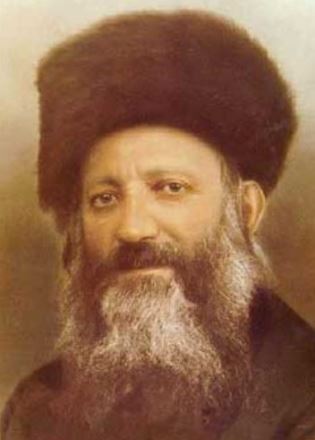
Rav Kook

Rav Kook never critiqued these pioneers, and recognized their old frustrations and resentments. He would say that they were not rebelling against the Torah, but against galut. They were tired of being weak, poor, and downtrodden; exiled and persecuted. He would say that, indeed, Jews had forgotten that they not only possessed a holy soul, but also a holy body. And he would point out that the work of these pioneers—draining swamps, digging wells, sowing seeds—was also holy work, and a fulfillment of the Torah. This is the work of Isaac, described in Jewish mysticism as the very embodiment of Gevurah, “strength”. Gevurah is associated with fire and passion, with self-sacrifice and perseverance, with working hard and overcoming challenges. This is a fitting description of Isaac and—political leanings aside—every one of those early Jewish pioneers. They were all, as Rav Kook described it, “a fiery spirit encased in powerful muscles.”

That these pioneers organized themselves into kibbutzim is no coincidence. In his Eros and the Jews, historian David Biale points out that the earliest origin of the word “kibbutz” is from the Tzfat Kabbalists of the 16th century! These kibbutzim referred to holy, mystical gatherings, with the ultimate aim of hastening the Redemption. Later on, Hasidim would adopt the term to refer to their own religious gatherings. Biale notes how Breslover Hasidim in particular would refer to their congregation as hakibbutz hakadosh. (See pgs. 118 and 270, with footnotes.)
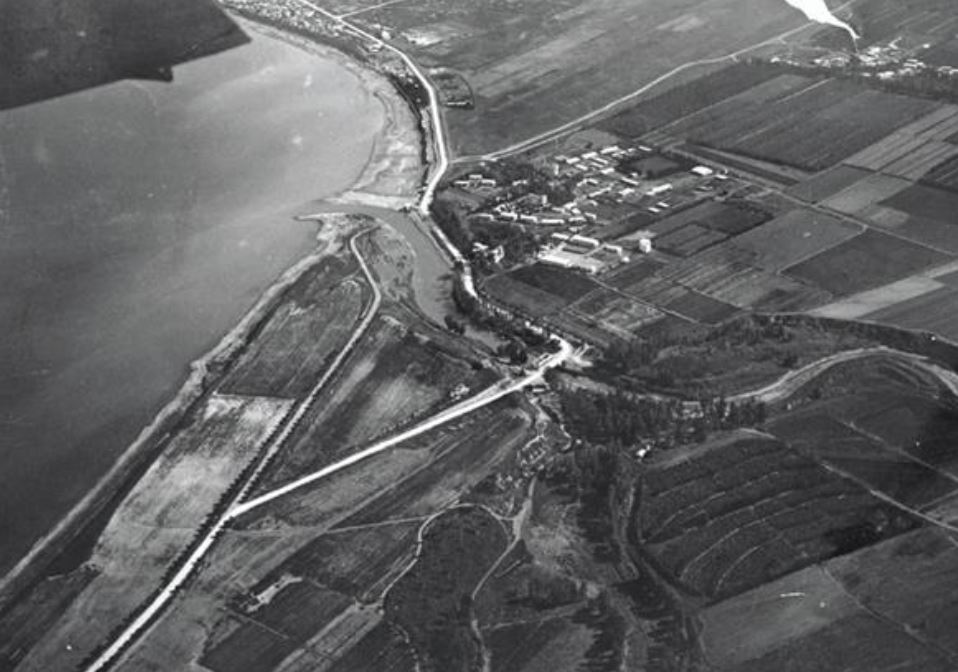
The farms of the first official kibbutz, Degania, in 1939

Certainly, the secular kibbutz could not be described as “religious”, but it definitely had a mysticism to it, and the very same goal of hastening the redemption of the Jewish people. More than anything else, it was the kibbutz that made modern Israel possible. It was the kibbutz, through unceasing collective labour and brotherly unity, that transformed a wasteland into a haven. To this day, Israel’s kibbutzim still produce 10% of its total industrial output (some $8 billion in wealth), and a whopping 40% of its agriculture! Needless to say, Hasidic Jews in Mea Shearim would have had little to eat without kibbutznikim in Degania.

These kibbutznikim still carry the spirit of Isaac, the very first hard-working agrarian, shepherd, hydrologist Jew who tirelessly worked the land of Israel to make it flourish with meah she’arim. And so, it may not be much of a stretch to point out that the gematria of “Isaac” (יצחק) is 208, exactly equivalent with “kibbutz” (קיבוץ). Our Sages explained that the Torah speaks so little of Isaac because his task was not finished. They prophesied that the spirit of Itzchak would return at the End of Days, ketz chai, to complete his work. How fortunate are we to see this prophesy realized right before our very eyes.

Shabbat Shalom
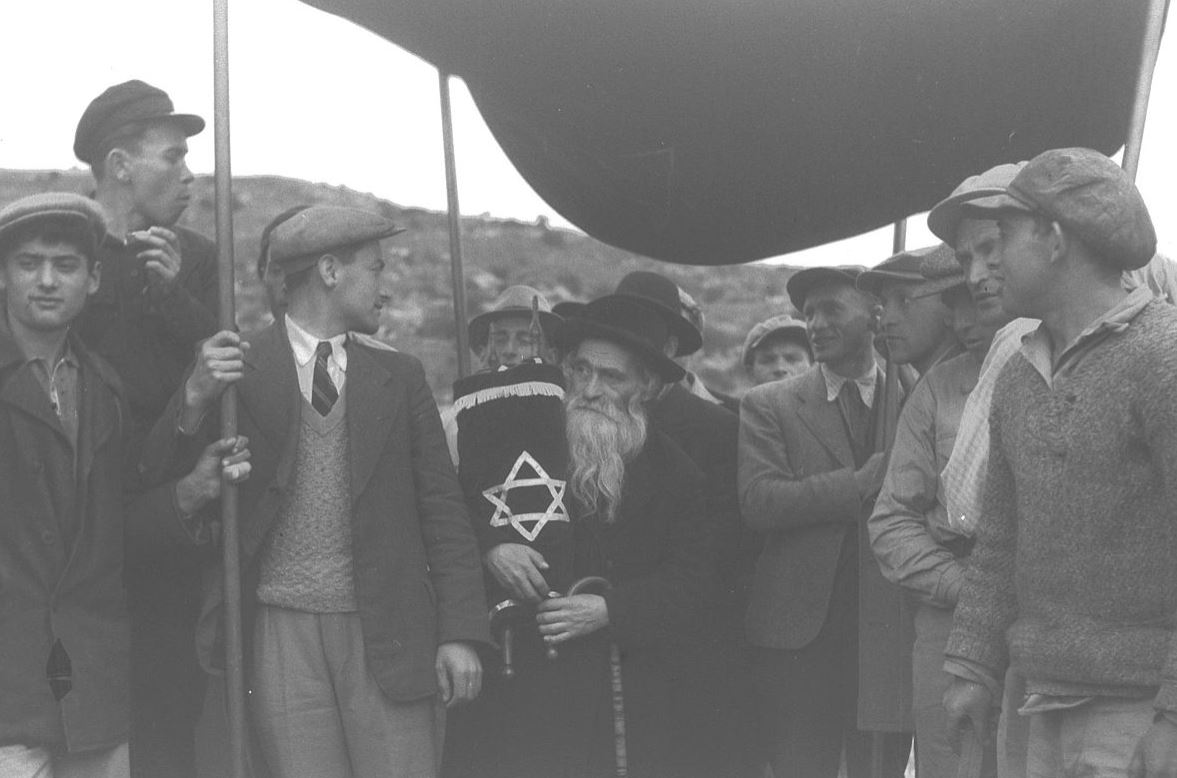
Rabbi Meir Yehezkel Holtzberg (1881-1956), bringing a Torah for the establishment of Kibbutz Hanita in 1938.
The Greatest Proof for the Torah’s Divinity

In this week’s parasha, Re’eh, we read about some of the Torah’s outstanding ethics dealing with finance, charity, and social welfare. The Torah was way ahead of its time in this regard. For instance, every seventh year (the shemittah, or Sabbatical), outstanding loans were cancelled, and every 50th year (the yovel, or Jubilee) rural lands would transfer back to their original ancestral owners. Loans were given out freely, without interest. Every farmer had to leave a corner of his fields unharvested for the poor and needy. There were a series of tithes to support the priesthood, the Holy Temple, and pilgrimages, as well as for the poor, orphaned, and widowed. On top of that, the Torah commands each person to be charitable and to contribute even more whenever the need arises. We read in this week’s parasha:

If there be among you a needy man, one of your brethren, within any of your gates, in your land which the Lord, your God, gives you, you shall not harden your heart, nor shut your hand from your needy brother; but you shall surely open your hand to him… (Deuteronomy 15:7-8)

We find that, of all the mitzvot in the Torah, it is these that deal with charity that Jews have been especially careful with throughout history. Regardless of level of observance or denomination, Jews across the spectrum of time and place have opened their hands generously to help their fellows, both Jewish and gentile. Today, of the world’s top 20 philanthropists, seven are Jews (Michael Dell, James Simons, Mark Zuckerberg, Michael Bloomberg, George Kaiser, Eli Broad, and—gasp—George Soros). Jews make up more than a third of this list, despite Jews making up just 0.2% of the world’s population.

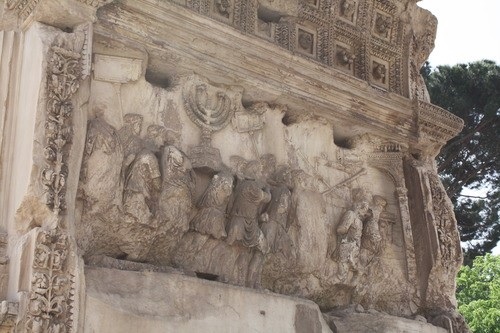
Arch of Titus depicting Jerusalem’s Temple treasures carried back to Rome

In ancient times, Jews from all over the world regularly sent money for the upkeep of Jerusalem and the Temple. The Romans knew this and it was a key reason that they destroyed the Temple when they did. The Romans had just come out of an expensive civil war that ended in 69 CE, and they badly needed funds. The Jerusalem Temple was the place to get them. Jews often overlook the role of economics in this tragedy. The Arch of Titus still standing in Rome today famously commemorates how the Romans took the Temple riches. A lot of those funds (not to mention enslaved Jews) were used to construct the Coliseum!

This didn’t stop Jews sending money to Israel. Throughout history, money was collected and sent to support the Yishuv, the Jewish community in the Holy Land. Jews in exile recognized that their brethren living under foreign rule in the Holy Land were making a huge sacrifice and fulfilling a major mitzvah (perhaps the major mitzvah). By supporting those communities, they would be able to participate in the mitzvah of settling the Holy Land as well.

These charities were eventually organized into a special fund called the halukka, which made sure to distribute the money fairly. One third went to the widows, orphans, and impoverished; one third went to Torah scholars and yeshiva students; and the final third was for other communal needs and building expenses. Special envoys, called meshulachim, were sent out to travel throughout the diaspora and collect for the halukka fund. In the 18th century, they invented the now-famous “tzedakah box”, allowing diaspora Jews to throw in their coins over the course of the year so that the meshulach would have something to take home when he arrives.

There was actually a very interesting halakhic debate regarding where diaspora Jews should contribute funds first: their own diaspora communities, or for the community in Israel. The debate is based on the verse in this week’s parasha, quoted above, that says we should open our hands to the needy “within any of your gates, in your land which the Lord, your God, gives you.” Some rabbinic authorities say this means you should first give charity to those within your gates, in your own community. Others point to the words that follow in the verse saying the charity should go to those in the land that God gave us—meaning Israel. Rav Yosef Karo (1488-1575) ruled with the latter in the Shulchan Arukh, though it should be noted that he lived in Tzfat among the Old Yishuv.

Of course, Jews always made sure the members of their own community were provided for, wherever they lived. The gmach (a contraction of gemilut chassadim, “acts of kindness”) was a key institution for this. The gmach was originally an interest-free loan fund. Such funds still exist in pretty much every major Jewish community in the world (there are over 500 in the USA alone). Over time, gmachs developed for other things as well, including clothes (especially wedding dresses), books, baby needs, and furniture.

Such innovations are a major reason why Jewish communities have always thrived. Despite the external pressures and persecutions, Jews survived and prospered. Whereas other communities were (and still are) plagued by internecine violence, Jews tended to work together—especially when it came to helping the needy. While Jewish views have always been diverse and debate was at the heart of each community, when it came to taking care of each other, Jews did that exceptionally well.

I recall my grandmother telling me how when she was a little girl, her mother would wake her up before dawn every Friday morning to start baking challahs for all the needy in their community (in Kokand, Uzbekistan). They then distributed the loaves and made sure every family had bread for Shabbat. On the other side of my family is Rabbi Shlomo Moussaieff, who co-founded and built much of Jerusalem’s Bukharian Quarter. When he made aliyah and settled in Jerusalem in 1888, he didn’t just build a home for himself, but also for 25 poor families. He went on to construct four synagogues, a mikveh, and even a museum. Today, the Moussaieff Synagogue is still among the most famous in Jerusalem, with eight different minyanim serving 3000 regulars.

Such stories can be heard in every Jewish family. And it is because of this charitable behaviour specifically that God has blessed the Jewish people, as we read multiple times in our parasha (Deuteronomy 14:29, 15:10). We are also told that:

the Lord, your God, will bless you, as He promised you; and you shall lend to many nations, but you shall not borrow; and you shall rule over many nations, but they shall not rule over you. (Deuteronomy 15:6)

The Torah prophesied that Jews would, among other things, be highly successful bankers who lend to many nations. And Jews would become influential in politics as well, holding positions of power. Unfortunately, many gentiles have seen within this development some kind of evil conspiracy, God forbid. In reality, this is simply the fulfilment of ancient prophecy and the realization of God’s blessing. Those wealthy and influential Jews have, for the most part, sought only good for the world. This is particularly true about the Rothschilds, who are at the centre of most anti-Semitic conspiracies.

In fact, the Rothschilds played key roles in financing the Industrial Revolution, laying the first rail networks, building hospitals and schools, investing in science, and supporting the arts. Nathan Rothschild, often vilified for supposedly making money from war speculation, was actually a generous philanthropist who played a key role in the abolition of slavery. His son, Lionel, created the largest private relief fund during the Great Irish Famine. His cousin Edmond invested countless sums to make the Holy Land a habitable place, paying for the drainage of swamps, the laying down of the first plumbing and electrical grids, and building the infrastructure necessary to improve the lives of both Jews and Arabs.

Across the Atlantic, another wealthy Jewish family was making a difference: the Guggenheims. Daniel Guggenheim invested huge sums in the development of aviation technology, while his brother Simon started a scholarship fund that has since given out over $250 million to support education for all. Indeed, American Jews have a long history of philanthropy, dating back to the first Jews that came to the New World. Few remember the incredible story of Haym Solomon (1740-1785).

Solomon was born in Poland, the son of a Sephardic rabbi, and settled in New York as a young man, where he went on to make a fortune. He also joined the Sons of Liberty and was a vital figure in the American Revolution. It is estimated that he gave the equivalent of what would today be $40 billion to help establish the United States of America. This includes the crucial funds for the Battle of Yorktown, which ended the Revolution in America’s favour. He gave so much of his wealth that he died in poverty. Some scholars have suggested the US would not exist without Haym Solomon.

Many Jews in America followed his example. Judah Touro (1775-1854) paid for some of America’s first hospitals, schools, orphanages, and cemeteries. When he died, he left half a million dollars to charity—an unheard-of sum in those days—of which two-thirds went to non-Jewish causes. The Yulee family helped abolish slavery and laid Florida’s railroads. Nathan Strauss (1848-1931, of Macy’s fame) fed millions of hungry mouths and took care of America’s orphans, saying “The world is my country, to do good is my religion.” Levi Strauss (1831-1908, of jeans fame) funded multiple orphanages, synagogues, and universities in California.

The philanthropic tradition of America’s Jews continues to this day. Larry Ellison, once among the richest men in the world, has donated hundreds of millions to charity, including a whopping $200 million donation to the University of Southern California for a new cancer research centre. Bernie Marcus and Arthur Blank, founders of Home Depot, have given over $200 million for environmental causes, and millions more for medical research, military veterans, and children’s causes. The Fishers, founders of clothing giant The Gap, give $20 million each year to Teach for America in support of education.

The same is true all over the world. Mathilde and Arthur Krim played key roles in ending apartheid in South Africa. The Sassoons built an array of public institutions across India and the Far East, while Germany’s Lina Morgenstern (1830-1909) brought the world kindergartens and soup kitchens. The largest private donation to a museum in British history was given by a Jew, Sammy Ofer. In Russia, Wolf Wissotzky (1824-1904, of tea fame) left over a million rubles to charity, the equivalent of about $2 billion today. Sir Isaac Wolfson (1897-1991) of Scotland gave almost everything he had to charity, saying “No man should have more than £100,000. The rest should go to charity.” There are countless other great names in Jewish philanthropy, from Moses Montefiore (who made modern Israel possible) to Sami Rohr (personally paying the salaries of over 500 rabbis) and Lev Leviev (who still supports hundreds of communities around the world).

Of course, Jewish contributions are not only financial, but span the gamut of science, technology, medicine, law, ethics, philosophy, and beyond. Waksman and Schatz discovered the first antibiotics, while Baruch Bloomberg created what is considered the first cancer vaccine, resulting in a reduction of liver cancer deaths by 90%! Like Jonas Salk before him (who developed the polio vaccine), Bloomberg did not patent his vaccine and gave it away freely to save as many lives as possible. No list could be complete without mention of Waldemar Haffkine (1860-1930), who developed the first cholera and bubonic plague vaccines, saving so many lives that Lord Joseph Lister called him the “saviour of humanity”. There are innumerable others.

Here we have focused specifically on monetary charity, which brings us back to this week’s parasha, and God’s blessing to His people. The Torah told us long ago that, despite being constantly persecuted and exiled to the four corners of the globe, the Jewish people would nonetheless prosper and tremendously influence the world. Incredibly, we have seen this ancient prophecy and blessing immaculately realized over the ages. Moses himself instructed the people that, if their faith is ever in doubt:

For ask now of the earliest days, which were before you, since the day that God created man upon the earth, and from the one end of Heaven unto the other, has there ever been such a great thing, or has something even been heard like it? (Deuteronomy 4:32)

This piece of advice is so important that Moses repeats it later on, reminding the nation to “Remember the days of old, understand the years of former generations…” (Deuteronomy 32:7) All it takes is one honest look through history to see the truth. Therein lies the greatest proof.

Shabbat Shalom!

Coronavirus and the Coming of Mashiach

In this week’s parasha, Vayikra, we see the word HaMashiach (המשיח) appear for the first time. In fact, the word only appears a total of four times in the entire Torah, three in this week’s parasha, and once next week. In all four cases, the Torah is not speaking of the messiah, but rather of the High Priest, the anointed kohen gadol. Of course, this is only true on the surface, peshat, level. On a deeper, mystical level the Torah is indeed alluding to the messiah at the End of Days.

It is fitting that we are reading these words now, when the Jewish world is abuzz over what coronavirus means in the grand scheme of things, and whether, perhaps, it is a sign of Mashiach’s coming. Jewish social media is full of posts and reposts affirming that coronavirus is absolutely a sign of Mashiach’s arrival, with all kinds of “proofs” based on gematria and ancient prophecies. While some of these are accurate, others are nonsensical, absurd, or just plain fake, so it is worth checking the sources behind everything you receive.

Many of the posts cite the same verse, Isaiah 26:20: “Go, my people, enter your chambers, and lock your doors behind you. Hide but a little moment, until the fury passes.” This verse is indeed a prophecy for the End of Days. The preceding verse speaks of the Resurrection of the Dead (“Your dead shall live, dead bodies shall arise; those that dwell in the dust will awake and sing…”) while the verse that follows describes God’s final retribution: “Behold, God shall come forth from His place to punish the dwellers of the earth for their iniquity…” Having said that, it isn’t only sinners that perish. On the contrary, Isaiah cautions everyone to hide behind closed doors for, as the Sages teach, in such moments the angel of death is let loose and doesn’t differentiate between the righteous and the wicked. (For a detailed explanation of this, see Alshech on Exodus 12:13.)

Now, what exactly is the nature of the za’am (זעם), “fury”, that Isaiah speaks of? Is it really a virulent plague?

A Plague Before Mashiach

In several places, the Sages speak of a great plague that will befall the world before Mashiach comes. Possibly the earliest mention of this is Tosefta Ta’anit 2:11, where the Sages discuss if a global flood can come upon the Earth again, since God promised it wouldn’t (Genesis 9:15). The Sages qualify that statement:

Rabbi Meir said: A flood of water will not come again, but a flood of fire and brimstone will, like He brought upon the people of Sodom, as it is written, “And God rained upon Sodom and Gomorrah brimstone and fire.” (Genesis 19:24) Rabbi Yehudah said: A flood upon the whole world will not come again, but a flood upon individuals will, such as if a person is at sea and his ship sinks and he dies—this is like a personal flood. Rabbi Yose said: A flood of water will not come again, but a “flood” of plague upon the idolaters in the days of Mashiach will…

A similar statement is found in the Midrash (Shir HaShirim Rabbah 2:13):

“The fig tree puts forth her green figs…” (Song of Songs 2:13) Said Rabbi Chiya bar Abba: before the days of the messiah, a great plague will come to the world, and the sinners will succumb to it “…and the vines in blossom give forth their fragrance…” (ibid.) These are the survivors, of whom it is said: “And it shall be, that he that is left in Zion, and he that remains in Jerusalem [shall be called holy…]” (Isaiah 4:3)

Such passages agree that a devastating plague will come upon the world at the End of Days to strike down idolaters and sinners (though even the righteous will suffer among them). It is interesting to point out how the coronavirus we are dealing with today has, strangely, left the vast majority of children unaffected, with mild symptoms, or none at all. Scientists have yet to find a good explanation for this baffling phenomenon. Perhaps, from a spiritual perspective, it is because innocent children cannot be categorized as “sinners” or “idolaters”, and are being spared.

The Midrash Rabbah quoted above goes on to cite a couple of passages that also appear in the Talmud about the final seven-year period before Mashiach comes, and the state of the world during that time. We’ve written about both of these prophecies on multiple occasions in the past (see, for example, #21 here), so we shall not repeat them. It suffices to say that much of what the Sages predicted has come true. The final sign given in the lengthy midrashic passage is that if you see a generation where people are growing bolder and bolder, love to “rant and rave”, where blasphemy is widespread and people constantly “taunt” God, you should expect Mashiach to be near.

This is one of the factors that distinguish between the current state of the world compared to previous global plagues. For example, the Spanish Flu that started in 1918 certainly qualifies as a great plague that engulfed the entire world, with an estimated 50 million deaths. It came at the same time as World War I, and there were certainly Jews then who expected Mashiach imminently. The critical difference between then and now is the set of prophecies in the Talmud, which are more descriptive of today’s world than, say, 1918, as well as the fact that today we have the State of Israel. The latter is especially significant, since Ezekiel (ch. 37-38) prophesied that Jews would first return to Israel, settle down and build a prosperous country, and only then Mashiach would come. Thus, it is only today that essentially all the prophecies have been fulfilled. And there is at least one more.

Rome and the Enemies of Israel

Another intriguing prophecy that has been brought to light in recent days is the destruction of Rome. The notion that Rome will be crushed before Mashiach comes is found across ancient Jewish texts. This is because, of course, for most of history the biggest oppressor of Israel has been Rome. It was Rome that destroyed the Temple in Jerusalem and thrust the Jewish people into this current, millennia-old exile. From historical records, we know that Rome enslaved countless Jews, far more than any other empire in history (see, for example, Samuel Kurinsky’s The Eighth Day). Later, Rome transformed into the Christian Empire—its seat being the Vatican in Rome—from which horrifying crusades, inquisitions, and other terrors were launched.

For the Sages, the greatest enemy was always Rome, and for Mashiach to come it meant Rome must fall for good. The Talmud (Sanhedrin 98a-b) records how when the students of Rabbi Yose ben Kisma asked him when Mashiach would come, he answered: “When [Rome] falls down, is rebuilt, falls again, and is again rebuilt, and then falls a third time, before it can be rebuilt the son of David will come.” Rabbi Yose predicted that Rome would fall three times. The third would be the last, and then Mashiach would come.*

While the city of Rome has been conquered and sacked multiple times, there have been three major powers that can be called “Rome”. The first was the Roman Empire itself, which formally came to an end in 476 CE. Then, in 800 CE, Pope Leo III resurrected the title and crowned Charlemagne as Roman Emperor once more. What followed was the era of the “Holy Roman Empire”. By 1648, the Holy Roman Empire was dismantled (though the title was carried on by some German powers until 1806). Finally, in 1861 the various kingdoms and states on the Italian peninsula unified to form the modern nation-state of Italy in the hopes of forging a renewed, strong Rome. Today’s Italy can therefore be seen as the third incarnation of ancient Rome. (This is all the more compelling when we remember that Italy was Hitler’s primary ally.)

As it stands currently, Italy has been hardest hit by the coronavirus. They have already had more than double the casualties of China, where the plague began. While we sincerely wish for everyone around the world to be healthy and protected from this dreadful pandemic, it is understandable why some have connected Italy’s unfortunate (and inexplicable) fate to this ancient prophecy. On that note, closely following Italy in terms of casualties are Spain and Iran—probably next in line when it comes to horrible treatment of the Jewish people throughout history. Of course, these numbers will change with time, and we pray for the plague to end immediately so that none more shall perish, no matter where they happen to live.

A Final Prophecy and a Call to Action

The Sages famously state that “in Nisan they were redeemed, and in Nisan they are destined to be redeemed again.” (Rosh Hashanah 11a-b) Just as the Israelites were saved from ancient Egypt in the month of Nisan, the Jewish people in the End of Days will be saved in the same month. The Sages actually debate in these pages whether the Redemption will take place in Nisan or in Tishrei, bringing various Scriptural proofs for both possibilities. The only conclusion is that both must happen: the process will begin in Nisan, and end in Tishrei, with the blowing of the Great Shofar.

Tonight, we usher in the month of Nisan. It is a most auspicious time to bring about the Final Redemption. Now is the time to take this opportunity seriously and prepare. Thankfully, God has made it easy—after all, just about everything is closed. There are no shows, no sports games, no vacations, no activities. There is nowhere to go. For most people, there is no need to even go to work. All distractions are out of the way. Now is the time for Torah and mitzvot, for prayer and repentance.

Finally, the Sages state that the best way to bring Mashiach is for all the Jewish people to keep Shabbat together, and that if the entire nation kept just one Shabbat properly, Mashiach would come (Shemot Rabbah 25:12). The Sefat Emet (Rabbi Yehudah Aryeh Leib Alter, 1847-1905) added that the ideal time for this unified Shabbat is the last Shabbat of the month of Adar, right before the start of Nisan (see his commentary on Parashat Zachor). That Shabbat was just a few days ago, and it just so happened that the parasha we read was Vayakhel-Pekudei, which begins with God’s command to keep the Sabbath! (Exodus 35:2) The timing couldn’t be better. Heck, even the Pope has called for everyone to keep Shabbat like the Jews!

With the State of Israel, and much of the rest of the world, currently on lockdown, God has made it especially easy for us to fulfil one proper, nation-wide Sabbath. This week we have another tremendous opportunity, and the Shabbat that follows is Shabbat HaGadol, the “Great Sabbath” before Pesach. If we do our utmost now then maybe, just maybe, it will be the Great Sabbath that brings the Final Redemption.

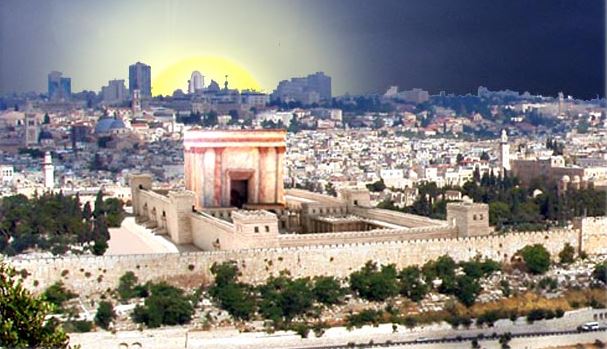
Courtesy: Temple Institute

*Click here to read about the “Three Romes” and the coming of Mashiach from a different perspective.