

Tag Archives: Footsteps of Mashiach

The Talmud on America’s Solar Eclipse

NASA image from the August 21st solar eclipse

Earlier this week, people across America experienced a unique event that has not occurred there in a century: a coast-to-coast, total solar eclipse. While partial solar eclipses are generally visible from somewhere on Earth twice a year, a total eclipse is harder to catch—the last one in the US was forty years ago, and the last to be visible across the entire span of the country was in 1918.

Despite the fact that a solar eclipse is a regular phenomenon, and one that can be predicted long in advance, the Talmud (Sukkah 29a) seems to suggest it is a sign of human misconduct:

Our Rabbis taught: When the sun is in eclipse, it is a bad omen for the whole world. This may be illustrated by a parable: To what can this be compared? To a human being who made a banquet for his servants and put up for them a lamp. When he became angry with them he said to his servant, “Take away the lamp from them, and let them sit in the dark”.

Our Sages suggest that God brings about eclipses (or more accurately, total eclipses, the only kind that would bring about the kind of darkness described above) when He is unhappy with man’s sinful ways. This apparently contradicts the notion that eclipses are a cyclical, recurring event. Yet, the Talmud is full of discussions illustrating the astronomical expertise of our Rabbis, who could perfectly calculate the arrival of new moons, knew the cosmos like the backs of their hands, and accurately estimated the number of stars in the universe centuries before scientists came up with the same numbers (see Berakhot 32b).

In fact, the current Hebrew calendar that we use was affixed by the Talmudic sage known as Hillel II (not to be confused with Hillel the Elder), who calculated the months far into the future, and was only able to accurately do so by taking into account the dates of predicted solar and lunar eclipses. That means that the sages of the Talmud were certainly well aware of the fact that eclipses are a regular, predictable phenomenon. This was also long known by Greek and Roman astronomers. So, how could the Talmud state that eclipses depend on man’s ways?
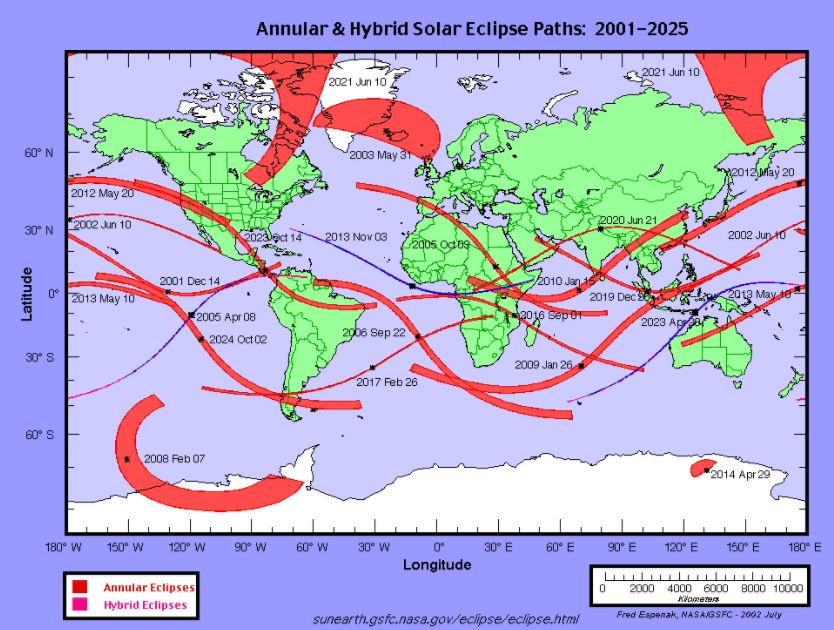
Map showing the paths of solar eclipses over a 25 year period. Most do not pass through inhabited areas.

To deal with this conundrum, multiple answers have been proposed. One of these is that the Sages are referring to visible eclipses only. The Torah tells us that the luminaries were created, in part, to serve as signs for humans (Genesis 1:14). If God wanted to make known that He is unhappy, we would obviously have to be able to see the eclipse. Although eclipses can happen multiple times a year, they are seldom visible from habitable locations. Some 71% of Earth’s surface is covered by water, so eclipses are most likely to be visible only from some marine location in the middle of the ocean. Further still, of the remaining portion of Earth that’s covered by land, only 10% is actually inhabited by humans. There could be other factors as well, like cloudy weather. Or, the moon simply does not cover enough of the sun for people to even notice. (As anyone not in the path of the total eclipse probably learned on Monday, when they were unable to look at the sun for more than a split second because it was still way too bright without eclipse glasses—which no one had in Talmudic times.) This is indeed what the Talmud later clarifies:

Our Rabbis taught: When the sun is in eclipse it is a bad omen for idolaters; when the moon is in eclipse, it is a bad omen for Israel, since Israel reckons by the moon and idolaters by the sun. If it is in eclipse in the east, it is a bad omen for those who dwell in the east; if in the west, it is a bad omen for those who dwell in the west…

An eclipse is a bad sign only for that specific place where the eclipse is visible. In His Infinite Wisdom, God pre-programmed Creation so that eclipses would be visible at the precise time and place where they are necessary to give people a wake-up call. As such, it isn’t surprising that America had a coast-to-coast eclipse precisely at this moment, with everything that’s recently been going on in the country.

What exactly is it that God is unhappy about when an eclipse occurs?

Our Rabbis taught: On account of four things is the sun in eclipse: On account of an av beit din who died and was not mourned properly; on account of a betrothed maiden who cried out loud in the city and there was none to save her; on account of sodomy, and on account of two brothers whose blood was shed at the same time.

The United States has been plagued with all of these things: fellow American citizens—brothers—at each other’s throats, “shedding” each other’s blood for silly ideological reasons; the rampant sexual immorality; the tremendous amount of injustice and apathy, where there is seemingly no one to save a “troubled maiden”.

And what of the av beit din? In early Talmudic times, the leader of the Jews was the nasi, the “president” of the Sanhedrin, and his “vice-president” was the av beit din, literally “head of the court”, the top judge of the land. (Appropriately, this week’s parasha is Shoftim, “judges”.) Last year saw the mysterious sudden death of Supreme Court Justice Antonin Scalia, whose death was unexamined and quickly swept under the rug, triggering a flood of conspiracy theories. This is a sign of far greater societal issues. All of the above is reminiscent of a famous Talmudic prophecy (Sotah 49b) describing the time before Mashiach’s coming:

In the footsteps of Mashiach, insolence will increase and honour will dwindle. The vine will abundantly yield its fruit, yet wine will be dear. The government will turn to heresy, and there will be none to offer them reproof. The meeting places of scholars will be used for immorality. Galilee will be destroyed, and Gablan desolate, and the “people of the border” will go about from place to place without anyone to take pity on them. The wisdom of the learned will degenerate, fearers of sin will be despised, and truth will be lacking. The youth will put the elders to shame; the old will have to stand before the young. A son will revile his father, a daughter will rise up against her mother, a daughter-in-law against her mother-in-law, and a man’s worst enemies will be the members of his own household. The face of the generation will be like the face of a dog; a son will not feel ashamed before his father. And upon whom is there to rely? Only upon our Father in Heaven.

With everything that’s happening around us right now, it certainly feels like there is none left to rely upon but our Father in Heaven. It is quite fitting that the solar eclipse happened at the end of the Hebrew month of Av, literally “father”, which is precisely meant to remind us of our “Father in Heaven”. As long as we recognize this, and take upon ourselves to be good “children”, there is no need to fear, as the Talmudic passage on solar eclipses concludes:

… When Israel fulfils the will of the Omnipresent, they need not have fear of all these [omens] as it is said, “Thus said Hashem: Learn not the way of the nations, and be not dismayed at the signs of heaven, for the nations are dismayed at them”—the idolaters will be dismayed, but Israel will not be dismayed.


Second edition of Secrets of the Last Waters (Mayim Achronim Chova) out now!
Click here to get the newly revised, expanded, and redesigned book. 

When is Mashiach Coming?

This week’s Torah portion is Metzora, loosely translated as “leper”. It begins by detailing the procedures for the purification of one who has been afflicted by leprosy. The Sages famously state (Arachin 15b) that the term metzora comes from “motzi shem ra”, slandering one’s fellow. Thus, a person would be afflicted with skin ailments if they were guilty of slander and evil speech. Since the slanderer is making their fellow look bad in the eyes of the public, they are appropriately punished by becoming visibly unsightly.

The connection between a metzora and a slanderer is seen in the case of Miriam, the sister of Moses. In chapter 12 of Numbers, we read how Miriam confronted Moses about his personal affairs in the presence of others. As a result of this public embarrassment, she was afflicted with leprosy, and became “white as snow” (v. 10).

Strangely, there is one more important figure that is said to be afflicted with leprosy, and for this person, the reasons appear inexplicable. The Talmud (Sanhedrin 98a) recounts the following:

Rabbi Yehoshua ben Levi met Elijah [the Prophet] by the entrance of Rabbi Shimon bar Yochai’s tomb… and asked him:
“When will the Messiah come?”
[Elijah responded:] “Go and ask him yourself.”
“Where is he?”
“At the entrance [of Rome].”
“And how will I recognize him?”
“He is sitting among the poor lepers, who are untying [their bandages] all at once, and retying them all at once, whereas he unties and reties each bandage separately, thinking, Should I be wanted, I must not be delayed.”

This fascinating passage suggests that Mashiach is sitting at the gates of Rome (according to numerous commentators, including the Vilna Gaon) among all the lepers expelled from the city. Unlike all the other lepers, Mashiach treats one bandage at a time, just in case he might be called to his mantle at any moment, and must always be ready. Indeed, the following page of the Talmud asks what Mashiach’s name might be, and after citing several possibilities, the rabbis conclude that he is known as the “Leper Scholar” (or “the Leper of Rebbi’s School”).

Why would Mashiach be a leper?

The Leper Scholar

The Lubavitcher Rebbe offers one interesting answer to the puzzle. He teaches (Likutei Sichot, Vol. 7, pg. 100) that Mashiach is essentially a perfect person on the inside; however, no human being is completely perfect – such a distinction is reserved only for God – and so, his minor spiritual imperfections appear only on his most outer garments – the skin. The Rebbe goes on to say that the leprosy appearing on his skin is actually a sign of Mashiach’s tremendous spiritual powers. Rabbi Eli Touger describes the Rebbe’s teaching like this: “…there are sublime spiritual influences which, because of the lack of appropriate vessels… can produce negative effects. For when powerful energy is released without being harnessed, it can cause injury. This is the reason for the [leprosy] with which Mashiach is afflicted.”

The Midrash writes that Mashiach’s most powerful weapon is his tongue, and he slays evil with his speech. In one passage (Pesikta Rabbati 37), Mashiach is said to be confronted with 140 wicked kingdoms, and God comforts him: “… do not be afraid, for all of them will perish by the breath of your lips.” This is based on the verse in Isaiah 11, where the Messiah is similarly described as destroying the wicked with his speech. The power of speech is perhaps the greatest of all – it is through speech that God created this entire universe (“And God said ‘Let there be light’…”) – one who knows the true powers of speech can create and destroy worlds!

The power of speech is precisely what the metzora abuses in slandering a fellow, and is thoroughly punished for it with leprosy. Meanwhile, Mashiach uses the same power to root out all evil. Yet, his power is so great that containing it in his feeble body inevitably manifests as a leprosy on his skin.

With this definition in mind, we may see the word metzora in a new light. The Sages say that metzora means motzi ra, literally one who brings out evil. While this can be taken to mean one who brings out evil words about others, it can also be read as one who removes evil from the world, which is Mashiach’s ultimate purpose.

When Will Mashiach Come?

The same pages of Talmud quoted above (Sanhedrin 98a-b) record that the students of Rabbi Yose ben Kisma asked him: “‘When will the Messiah come?’… So he answered them: ‘When this gate falls down, is rebuilt, falls again, and is again rebuilt, and then falls a third time, before it can be rebuilt the son of David will come.’” Rashi comments here that the “gate” which Rabbi Yose is referring to is none other than Rome (just as the Vilna Gaon commented above that Mashiach is sitting at the gates of Rome).

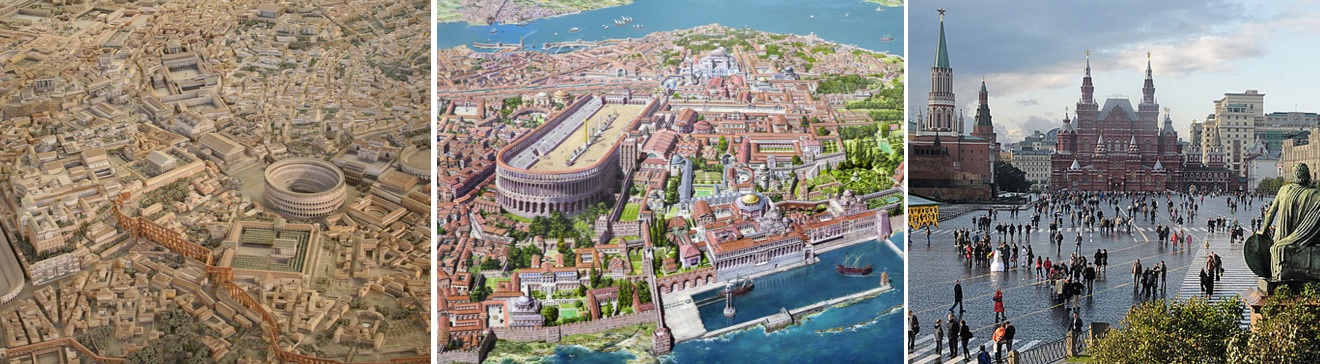
Rabbi Yose is saying that Rome will fall, and will be rebuilt two more times. When the Third Rome falls, one is assured that Mashiach’s arrival is imminent. Amazingly, historians often speak of “Three Romes”. The first Rome was the original Latin Rome. It collapsed in the 5th century CE, and was replaced by the Greek-speaking Constantinople (today’s Istanbul), the capital of the Eastern Roman Empire, later referred to as the Byzantine Empire. When Constantinople fell, the new, “Third Rome” was said to be Moscow. Moscow reached the peak of its global power with the Soviet Union, and collapsed just as dramatically less than 30 years ago.

Three Romes: Ancient Rome, Constantinople, and Moscow

Three Romes: Ancient Rome, Constantinople, and Moscow

Interestingly, Jewish literature commonly referred to Rome as Edom, literally the “red” empire. The Soviet Union, too, was known for its association with that colour; the Communists were commonly referred to as “the Reds”, the Soviet Army as the “Red Army”, with the focal point of their empire being Red Square in Moscow.

It is commonly taught that God created civilization as we know it to last 6000 years, followed by a seventh millennium of a peaceful, cosmic “Sabbath”, mimicking the seven days of Creation (see, for example, Sanhedrin 97a). Throughout the ages, various rabbis attempted to calculate the coming of Mashiach based on this principle. If the Final Era of mankind is the 7th millennium – the Sabbath – then the Messianic Era is the preparatory period that immediately precedes the Sabbath. How long should this period be? Well, how long do we spend preparing for Shabbat?

In Jewish law, one should stop working and start preparing for Shabbat six hours before its onset. If each millennium of human history corresponds to one day, then six hours corresponds to 250 years, which means that the official starting point of the Messianic Era was the year 5750 (since this is 250 years before the start of the 7th millennium). Indeed, 5750 is commonly cited as the beginning of the Ikveta d’Mshicha, the “Footsteps of Mashiach”.

Incredibly, Rosh Hashanah of 5750 was celebrated in September of 1989. The Berlin Wall – and the Soviet Union along with it – came crashing down less than two months after, that same November. The Third Rome had fallen right in line with the prophesized starting point of the “Footsteps of Mashiach”, just as the Talmud records in two brief pages of the tractate Sanhedrin (97a, 98b).

Needless to say, it appears that Mashiach’s arrival may very well be imminent.


The article above is adapted from Garments of Light – 70 Illuminating Essays on the Weekly Torah Portion and Holidays. Click here to get the book!