
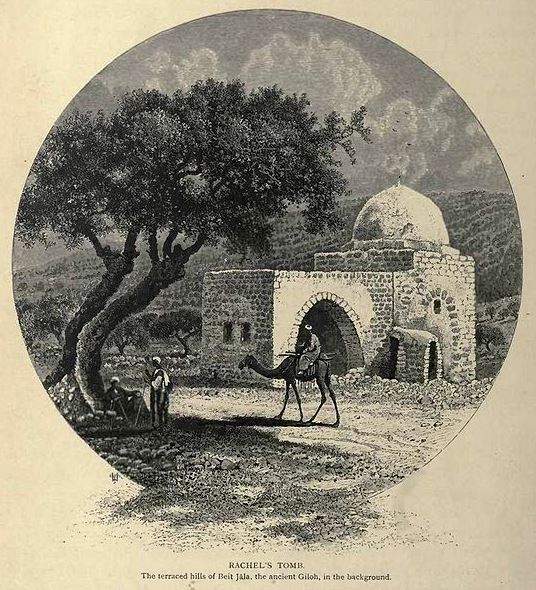
1880 Illustration of Rachel’s Tomb
Towards the end of this week’s parasha, Vayishlach, we read about the untimely death of Rachel as she gave birth to her second son Benjamin. According to Seder Olam, Rachel got married at the age of 22, and passed away at the young age of 36. What was the reason for her early passing?
One classic answer is that when Jacob fled from Laban, Rachel stole her father’s idolatrous teraphim, unbeknownst to anyone. When Laban confronted Jacob over the teraphim, Jacob had said “anyone with whom you find your gods shall not remain alive! … for Jacob did not know that Rachel had stolen them.” (Genesis 31:32) Rashi comments here based on Midrash Rabbah that Jacob inadvertently cursed his own wife, so she died shortly after. This is a great lesson for us about how careful we should be with our words at all times.
It is worth mentioning that at that time, prior to the giving of the Torah, the family would have been expected to follow the Noahide Laws, one of which is not to steal. Violation of the Noahide Laws typically carries the death penalty, so Rachel’s theft may have caused her death as per the Noahide Laws. But why did she steal her father’s idols anyway? Some say she wanted to save Laban from the terrible sin of idolatry, in which case one might reason that she actually did a mitzvah. Others say Laban would have used them to divine where Jacob fled and quickly find them (which he ended up doing anyway, even without his teraphim). And there might be one more, darker reason, to be explored below.
It’s possible that Rachel didn’t die as a result of Jacob’s curse, but as a result of her own curse. Struggling with infertility, she had confronted Jacob and said: “Give me children or I shall die!” (Genesis 30:1) Jacob was incensed and answered: “Can I take the place of God, who has denied you fruit of the womb?” Rebecca had gone 20 years without children and did not get so desperate; Rachel should have been more patient and faithful. Ultimately, she did have children, but also died an early death.
Rabbi Itzchak Arama (c. 1420-1494) writes in his Akedat Itzchak (9:1) that Rachel failed to realize her greater purpose in life. Adam gave his wife two names: First, ishah, implying the woman is equal to a man, ish. Second, chavah, because she is em kol chai, the “mother of all life”. The second is of a lower nature, just like all animals procreate. The higher woman is the ishah who, just like a man, has to fulfil mitzvot, do good deeds, and make the world a better place. Rachel’s mistake was in thinking that she is only a chavah, and her entire worth and purpose is to produce children. Since she didn’t have children, she might as well die. And so, Akedat Itzchak says, Jacob got angry at her, because she failed to see her greater purpose in life. She demanded children, or death, forgetting her true mission as a human being. The tragic irony here is that Rachel ended up dying because she had children!
The Midrash explains why she died specifically in childbirth. According to one tradition, all the sons of Jacob were born with a twin sister. Benjamin was unique in that he had two twin sisters with him, and it seems Rachel had complications from carrying and delivering triplets (Beresheet Rabbah 82:8). A different, Medieval Ashkenazi tradition is that Benjamin may have been a “werewolf”, born with sharp teeth, and Rachel died because he came out of her violently. Rabbeinu Ephraim (c. 12th century) comments that this is why Jacob later referred to Benjamin as a “devouring wolf” (Genesis 49:27). Why Benjamin had to be a werewolf is not explained. (For lots more on this strange Midrash, and its veracity, see the recent class on ‘Fantastic Beasts, Part 2’.)
I think the pshat behind Rachel’s death might be simpler, and more tragic. Rachel’s death is described in chapter 35. Earlier in the same chapter, Hashem appears to Jacob and tells him to go to Beit El and build an altar there. Jacob remembers his promise to God, and uses this opportunity to get rid of all the idols in his own household: “So Jacob said to his household and to all who were with him, ‘Rid yourselves of the alien gods in your midst, purify yourselves, and change your clothes.’” (35:2) We go on to read that “They gave to Jacob all the alien gods that they had, and the rings that were in their ears, and Jacob buried them under the terebinth that was near Shechem.” (35:4) Apparently, Jacob’s household was rife with idolatry! Even the jewellery had idolatrous symbols.
But what about Rachel’s teraphim? Those were also idolatrous implements, too, either for healing (from the root refuah) or for necromancy or divination. All of these forms of idolatry are strictly forbidden, and punishable by death. Could it be that Rachel failed to give up her teraphim when Jacob collected all the idols from his household? Why does the Torah not mention them here? The apocryphal Book of Jubilees (ch. 31) is troubled by this omission, and says that Rachel did come clean to Jacob and give up her father’s teraphim. Yet the Torah itself glaringly omits this important detail. It seems Rachel did not give up her idols, and promptly dies just a few verses later.
Why wouldn’t she give them up? Maybe she was embarrassed to admit that she had stolen them, or, more likely, she may have actually needed them. Rachel was barren, and desperate for more children. Previously, she managed to get pregnant with Joseph, presumably because of the potent dudaim she had received from Leah (Genesis 30:16, 22). So how did she get pregnant the second time, with Benjamin? It is quite likely that she used those very “healing” idols, the teraphim, to conceive. That would explain why she got pregnant after fleeing from Laban and taking the idols.
There would be a great deal of poetic justice if Rachel died because she had used idolatry for fertility. That would justify the punishment, too, for we know that Hashem always works measure for measure. Otherwise, it would be hard to explain why righteous Rachel, the beloved wife of Jacob, had to die so young and in such tragic fashion, by the road. That this all happened right after Jacob cleaned out his household of idols, in the same chapter, adds support to the theory. Of course, everything that Hashem does is ultimately for the good, and Rachel’s passing by the road would go on to serve a positive purpose for Israel.
Rachel Weeps For Her Children
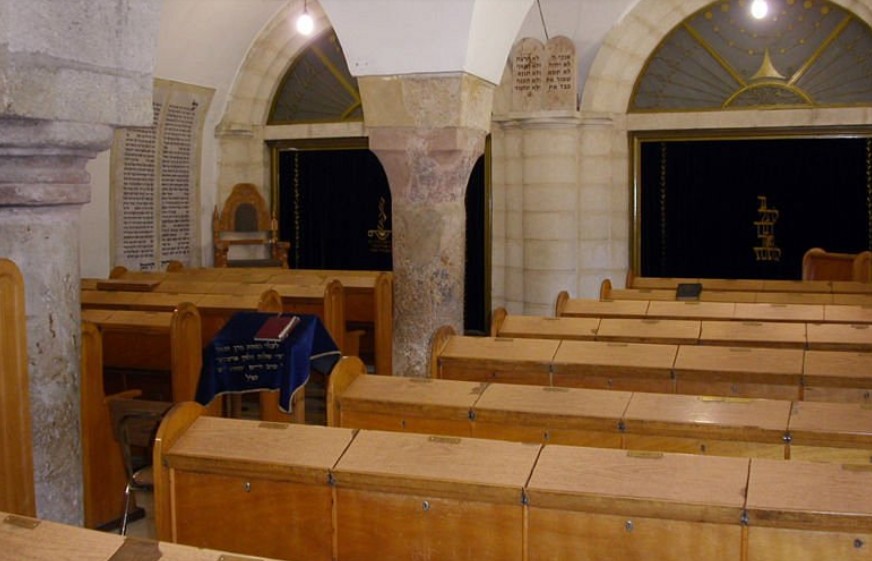 As is well-known, it is said that Rachel was deliberately buried by the side of the road because centuries later, when the Israelites would go into exile, they would pass by her grave and she would pray for them (Beresheet Rabbah 82:10). This is based on Jeremiah 31:15-17, where the prophet quotes God saying “A cry is heard in Ramah—wailing, bitter weeping—Rachel weeping for her children. She refuses to be comforted for her children, who are gone.” The Ramban (Rabbi Moshe ben Nachman, 1194-1270) has a fascinating commentary on this. Recall that the Ramban was from Spain, but was forced into exile following his victory against the Christian monks in the Barcelona Disputation. He ended up settling in Israel, and his synagogue in Jerusalem’s Old City (pictured at right) is said to be the longest, continuously-operating shul in the world. Coming to Israel allowed him to see the terrain first-hand, and report accurately on its geography. He writes:
… This I originally wrote when still in Spain, but now that I was worthy and came to Jerusalem—praise be to God, Who is kind and deals kindly!—I saw with my eyes that there is not even a mile between Rachel’s grave and Bethlehem… And I have also seen that Rachel’s grave is not in Ramah nor near it. Instead, Ramah is in Benjamin, about four Persian miles distant from it, and Ramah of the hill-country of Ephraim is more than two days’ travel from it. Therefore, I say that the verse stating, “A voice is heard in Ramah” is a metaphor, in the manner of rhetorical expression, meaning to say that Rachel wept so loudly and bitterly that her voice was heard from afar in Ramah, which was on top of the mountain of [the territory of] her son Benjamin, because they were not there, and she was desolate of them. Thus, Scripture does not say “In Ramah, Rachel weeps for her children.” but it says that the voice was heard there.
It appears to me that Jacob buried Rachel on the road and did not bring her into Bethlehem in Judah, which was near there, because he saw by the prophetic spirit that Bethlehem Ephrathah will belong to Judah, and he wished to bury her only within the border of her son Benjamin, and the road on which the monument over Rachel’s grave stands is near to Beit El in the border of Benjamin. And so, the Rabbis have said in the Sifre: “Rachel died in the portion of Benjamin,” as it is found in parashat V’zot HaBerakhah. Now I have seen in Targum Yonatan that he discerned this, and he translated: “A voice is heard high in the world” and he thus translated the whole verse as applying to the congregation of Israel rather than Rachel.
So, Jeremiah did not mean that Rachel weeps in Ramah, but that her weeping is heard far away, as far as the heights of Ramah. Ramah itself simply means “heights”, and the Ramban notes that some interpret it metaphorically, not geographically. Indeed, many of the Kabbalists interpreted “Rachel in Ramah” as not referring to the physical Rachel herself, but rather to the “Supernal Rachel”, ie. the Shekhinah, God’s manifestation in this world. This is all a metaphor for the Shekhinah going into exile with “her children”, and weeping with them throughout their oppression. Jeremiah prophesies the oppression will eventually end and all the children will return home. The rest of Jeremiah 31 describes the Messianic Age.
The Zohar (II, 8b) builds on this and suggests that when Mashiach comes down into this world (following a sojourn in the Heavens), his first stop will be the Tomb of Rachel. Amazingly, the Zohar says Rachel will then resurrect and arise anew, and even give Mashiach a kiss. Apparently, he will then be concealed again for about 12 months, after which he will reappear in the Galilee and then bring about the Final Redemption. Interestingly, the Zohar shortly after (10b) says that the righteous might die early for two reasons: either due to the sins of others in their generation, or because Hashem foresees that if they continued to live, they would become sinners, so He spares them. Could we apply either of these reasons to the righteous Rachel?
The Zohar (II, 29b) answers one more important question: why it is that Rachel has to weep for her children? Why not Leah? Technically, Leah is the mother of more of Israel’s children, and the mother of Yehudah—of which nearly all of us are descendants. Shouldn’t she cry for us? Well, we know that Leah had “weak eyes” (Genesis 29:17) because she had already cried so much to avoid marrying Esau. Now, the Zohar says, it is Rachel’s turn to cry. Moreover, Leah represents the hidden world, while Rachel represents the revealed world. (In fact, the gematria of “Leah”, לאה, is 36, alluding to the divine light of Creation that was concealed after 36 hours.) Leah’s crying is in secret, Rachel’s is out in the open. The Zohar adds that Rachel is the quintessential Jewish mother always concerned for her children. And, based on Isaiah 53:7, that “Rachel” (which means “sheep”) is one of the names for the entire people of Israel, who are likened to God’s sheep.
In another place, the Zohar (III, 187a-b) explains why Jacob immediately fell in love with Rachel when he first saw her by the well. What he saw was the “Supernal Rachel”, ie. the Shekhinah. The Maggid (Rabbi Dov Ber of Mezerich, d. 1772) adds that a woman’s beauty here in this lower world stems from the beauty of the Shekhinah above (Maggid Devarav l’Yaakov, 6-7). He then teaches a practical lesson from this: if a man suddenly sees a beautiful woman, he shouldn’t fall into the temptation of physical fantasies, but rather recognize that the woman’s beauty is a reflection of the divine, and he should channel that passionate energy towards love of the divine (אם באה כנגדו פתאום יש לו לדבק ע”י יופי זה ליופי של מעלה).
Dual Identities
To complete the discussion, one might find several more reasons for the untimely death of Rachel. One is that when Jacob revealed he was planning to flee from Laban and informed his wives, it says that Rachel spoke up first (Genesis 31:14). The Midrash (Beresheet Rabbah 74:4) says this was disrespectful to her older sister, who should have been allowed to answer first. Meanwhile, Midrash Tanchuma (Vayishlach 8) says it was because Jacob failed to fulfil his vow to Hashem:
Rabbi Yannai said: The account book of the man who makes a vow which he fails to fulfill is examined in the presence of the Holy One, blessed be He. He asks: Where is that person who made a vow on a certain day? Observe that it is written concerning the time that Jacob went to Aram-Naharaim: “And Jacob vowed a vow, saying: ‘If God be with me…’” (Genesis 28:20). God granted his every request. He went there and became wealthy, but when he returned without fulfilling his vow, He turned Esau against him, and Esau sought to kill him. And though Esau took the two hundred she-goats from him, Jacob did not trouble to perform his vow. Whereupon He turned the angel against him and they wrestled together, but still he did not take note, as it is said: “And Jacob was left alone; and there wrestled a man with him.” (Genesis 32:26) When he still was not persuaded to fulfill his vow, the anguish occasioned by Dinah’s experience befell him, as is said: “And Dinah went out…” When he continued to refrain from carrying out his vow, the tragedy of Rachel’s death occurred, as it is said, “And Rachel died and was buried…” (Genesis 35:19)
The Midrash highlights the juxtaposition of Jacob going to Beit El, and the subsequent death of Rachel. Because Jacob forgot to fulfil his vow in Beit El (and God had to remind him at the start of chapter 25), his beloved Rachel was taken away from him.
Lastly, the Ramban comments (on Leviticus 18:25) that Rachel died when they came to the Land of Israel because it is forbidden by Torah law for a man to marry two sisters. As long as they were in Haran, in galut, this violation of Torah law was tolerated. (Just as the idolatry within Jacob’s household was tolerated, as we saw above.) But as soon as they came to the Holy Land, which “vomits out” those who violate God’s laws, one of them had to die. Of course, why Jacob couldn’t just divorce one of them isn’t clear. The Ramban does note that as soon as they got to the Holy Land, Jacob actually no longer touched Rachel, since she was his second, “forbidden” wife (as he had married Leah first). The Ramban concludes that Rachel must have conceived Benjamin before they crossed into Israel.
That said, there are those who felt that Jacob didn’t violate anything by marrying two sisters. After all, he didn’t do it by choice, and was “tricked” into it. He never even wanted to marry Leah initially, and seemingly only stayed married to her out of his kindness, so that she wouldn’t be left alone. Plus, everything was obviously orchestrated by Hashem, and this is how the holy Twelve Tribes of Israel emerged, so how could it be a sin? The Arizal (Rabbi Itzchak Luria, 1534-1572) provided another answer, saying that Jacob married Rachel, while Israel married Leah (see, for instance, Sha’ar HaPesukim on Vayetze). Jacob had two personas, and he was like two distinct people. When he took Esau’s birthright, he took everything that came with it, including Esau’s task in this world, his inheritance, and yes, his destined wife, Leah. It was all part of the package. Note how Jacob-Israel is the only one who, after getting a name change, is still referred to in the Torah by both names, depending on the situation. When Abram became Abraham, he is never again called “Abram”, just as Sarah is never again called “Sarai”. Jacob alone vacillates between the two personas. (For more on this, see ‘The Real Meaning of Israel’.)
To summarize, the reasons for Rachel’s untimely death are numerous, from possibly violating Noahide Laws (of idolatry and theft) to avoiding Torah prohibitions (marrying two sisters), to improper speech and faithlessness; or through no fault of her own due to Jacob’s failed vows or inadvertent curses. A strong case can be made that it has something to do with those idolatrous teraphim. Ultimately, it served a positive purpose to alleviate the exile of Israel in the future, and it will be Rachel herself at the End of Days who first greets Mashiach in this world. May we merit to see that day soon.