
 This week’s parasha, Va’etchanan, contains a second reading of the Ten Commandments. The third commandment is the prohibition to take the name of God in vain. Some people mistakenly believe that this means we are not allowed to ever pronounce the Tetragrammaton, יהוה, commonly transliterated as YHVH or YHWH. This is not true at all, though it is true that later in history the Sages instituted using other words to be used instead of the Tetragrammaton (such as “Adonai” or “Hashem”) so that people do not accidentally take the name of God in vain, or misuse this powerful name of God. Since the Tetragrammaton is so sacred, it was thought too holy to invoke on a regular basis. Today, no one invokes the proper name at all. It’s gone so far that many believe we have forgotten how to properly pronounce the name. This is false. How can we be God’s people if we don’t even know His name? Continue reading
Category Archives: Mysteries & Origins
Do Torah Verses Prophetically Allude to Historical Years?
This week we begin reading the fifth and final book of the Torah, Sefer Devarim. This book has a total of 955 verses, an important number in Judaism. It is said that there are 955 levels to the Heavens (see Ma’aseh Rokeach on Mishnah, Kinnim). This is based on a verse in Devarim where Moses says: “Behold, to Hashem, your God, belong the Heavens [hashamayim], and the Heaven of Heavens [shmei hashamayim], and the Earth and all that is on it!” (Deuteronomy 10:14) The numerical value of “Heavens” (השמים), when counting the full mem sofit, is 955. Meanwhile, the word “behold”, hen (הן), has a value of 55, to teach that the top 55 levels of Heaven are reserved solely for God. (Ma’aseh Rokeach says that the angel Metatron has access to 900 levels, but it is only Hashem beyond that.)
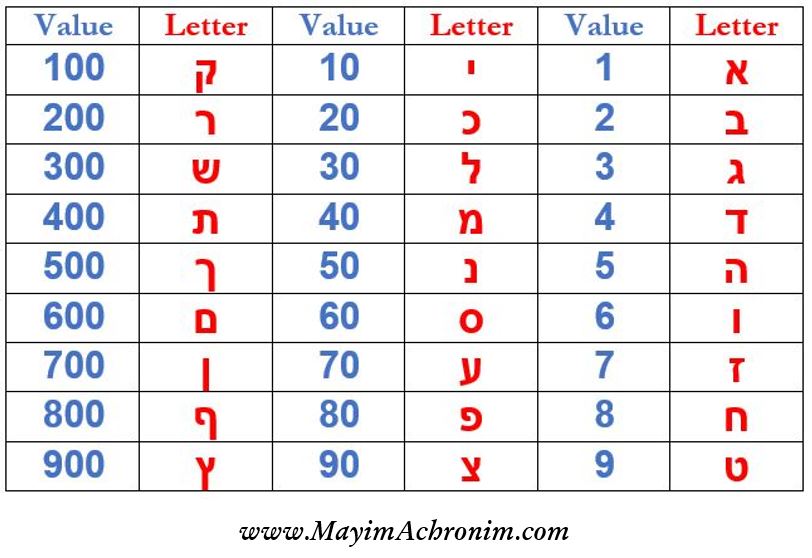
It is most fitting that Devarim has 955 verses, like the levels of Heaven. Indeed, the “Heavens” are a constant motif throughout the final book of the Torah, more so than in any other book. By my count, I found 39 instances of the word shamayim (and its variations) in Sefer Beresheet, 12 in Shemot, none in the next two, and 40 in Devarim. Included in the latter are some of the most critical and famed verses of the Torah, including lo b’shamayim hi, that the Torah “is not in Heaven” (Deuteronomy 30:12) and the Shema passage that we recite multiple times a day saying that God will “stop up the Heavens” if we do not fulfil his commandments (Deuteronomy 11:17), and that He will bless us greatly “like the Heavens” if we do (Deuteronomy 11:21). There’s also Hashem’s promise that He will ingather us back to the Holy Land from the “ends of the Heavens” (Deuteronomy 30:4), and Moses’ final divine song that starts Ha’azinu hashamayim (Deuteronomy 32:1).
Another interesting phenomenon that has been pointed out about Devarim is that its verses seem to allude to the historical years that they would correspond to. We are currently in the Jewish year 5786 AM (Anno Mundi, “year of the world”), and the Torah has a total of 5845 verses. (The Talmud says the Torah should have 5888 verses, and for a solution to that problem, see ‘The Torah’s Missing Verses’ in Garments of Light, Volume Two.) It’s not clear exactly where this concept comes from. Some bring it down in the name of the Vilna Gaon; I believe I first heard it years ago from Rabbi Benjamin Blech.
Before we get into it, it is important to mention that doing this kind of analysis requires lots and lots of counting and a good calculator, along with precision and persistence. I spent hours counting and recounting verses to make sure it’s all lined up correctly. Continue reading
God of Gods, King of Kings
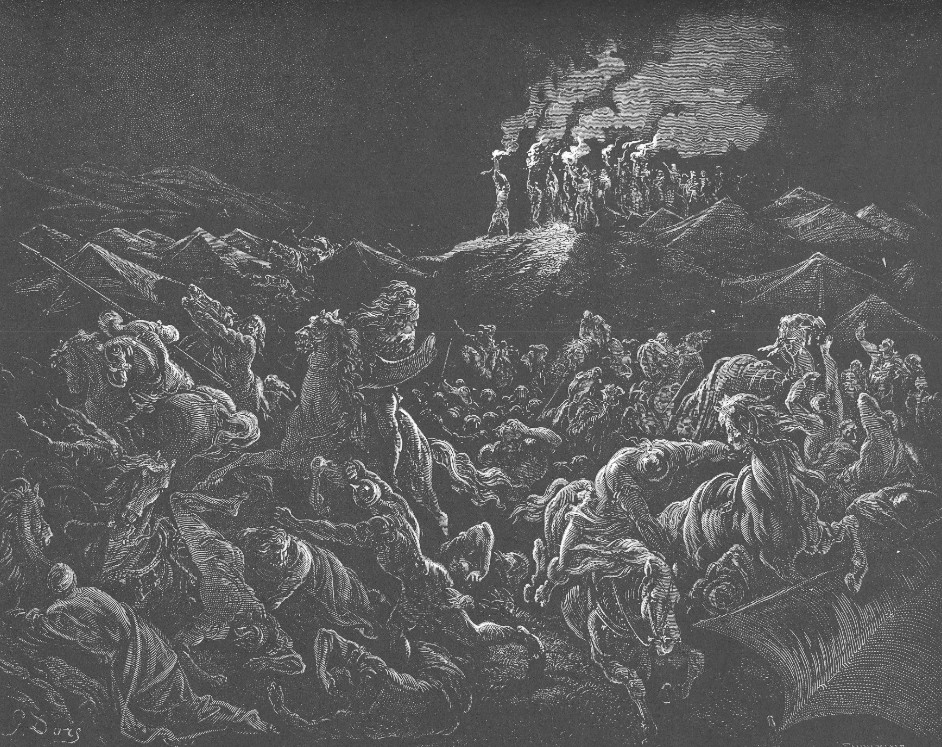
‘The Midianites Put to Flight’ by Gustav Doré
One of the difficult passages in this week’s double parasha, Matot-Massei, which closes the Book of Numbers, is where God seemingly commands a complete massacre of a neighbouring people, the Midianites. This is actually God’s final command to Moses, saying “Take revenge for the Israelites against the Midianites. Afterwards, you will be gathered to your people.” (Numbers 31:2) The next and final book of the Torah is Moses’ own account of his leadership, and was relayed over the last 37 days of his life.
The Israelites go on to slaughter every male Midianite (31:7), take the women and children captive (31:9), then burn down all the cities and take plunder (31:10-11). Still, the Israelites are chastised for letting the adult women live (31:15), as they were the very ones that tempted Israel into various sexual sins beforehand. Understandably, this is one of the most troubling passages in the whole Torah—how could a holy nation seem to behave in a manner more like the violent and bloodthirsty nations we condemn? Unfortunately, passages like this have also turned many away from the Torah, and generated numerous atheists. One such atheist is Richard Dawkins, who summarized it this way in his book, The God Delusion (ch. 2): Continue reading