This week’s parasha, Shlach, begins with the infamous episode of the Spies. Moses sends a dozen spies to scout the Holy Land in preparation for the Israelite conquest. Of the twelve, ten return frightened and pessimistic, convincing their fellow Israelites to abandon any hopes of settling in God’s Promised Land. The result is a delay in the Redemption, and forty years in the Wilderness. After this failure in espionage, one would think we wouldn’t hear of spies in the Torah anymore. Yet, there are at least five more cases of Israelite espionage in Tanakh including, amazingly, one just a few chapters later:
Amidst a series of Israelite conquests on the east side of the Jordan River, we read how Moses himself sends another set of spies in preparation for the capture of Ya’azer (Numbers 21:32). Here, the spies not only do their job properly, but engage in battle behind enemy lines, conquering the city all on their own! Rashi comments here that they did this deliberately to not falter like the previous spies. The Maskil LeDavid (Rabbi David Pardo of Venice, 1719-1792) adds that the spies here did a genuine tikkun, a spiritual rectification, for the sin of the previous spies.
I believe that tradition has continued into the present day, with the incredible work of Israel’s secret service, the Mossad. The operations they have been able to accomplish in recent years in particular have been mind-blowing, whether the Hezbollah pagers last year or the current set of events in the war with Iran. Over the past three years, Mossad agents covertly smuggled into Iran a variety of drones and precision weapons, secretly stationing them near key Iranian military sites and air defense systems. Last week, they were finally activated, knocking out Iran’s ability to defend itself from the air, and laying the stage for Israel’s complete air superiority over the country. Like the spies in Ya’azer, one might similarly see the work of Mossad today as something of a rectification for the old Sin of the Spies. While the first spies in parashat Shlach failed to do what it took to inspire, settle, and protect the people of Israel in their own land, today’s Mossad spies are doing just that. It is therefore quite fitting that the founder of Mossad and its first spy chief was Reuven Shiloach (שילוח) whose name shares a root with this week’s parasha (שלח) of spies!
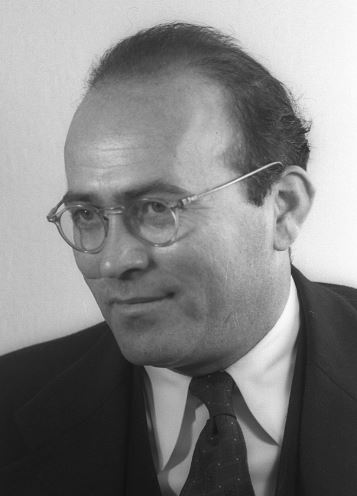
Reuben Shiloach
Reuven Shiloach (1909-1959) was born Reuven Zaslansky in Jerusalem, the son of a Haredi rabbi from Lithuania. In his teenage years, he was drawn to secular Zionism, learned Arabic, and went to teacher’s college. He joined the Haganah and soon started to work for its nascent intelligence service. He was given the code name “Shiloach” and was sent on his first mission in 1932 to Iraq, where he enrolled as a student at the University of Baghdad. After several Iraq missions, he was stationed in Lebanon and Syria, and later assisted British Intelligence and the CIA’s precursor, the OSS, during World War II.
Soon after the State of Israel was established, David Ben-Gurion sought to create an official intelligence agency, and tasked Shiloach with the job. Shiloach put together a plan for a “Coordination Bureau” to work together with Shin Bet and Aman (the IDF’s intelligence unit). It soon evolved into its own distinct institution, one that reports only to the Prime Minister of Israel. The Mossad’s original motto was drawn from King Solomon’s wise words in Proverbs 24:6, “For by stratagems you wage war.” It was later changed to Proverbs 11:14, “Without stratagems, an army falls; but victory comes with much planning.” Indeed, the Mossad’s work has been absolutely instrumental in Israel’s many victories.

Mossad’s logo, with motto from Proverbs.
Remembering Amalek
It’s not only the beginning of this week’s parasha that informs present-day events, but the last passage, too. Here we read of the mitzvah of tzitzit, and the necessity of including a blue thread of tekhelet. The Torah says “and you shall see it, and remember all of God’s commandments” (Numbers 15:39). The Zohar (III, 175b) points out that the same language is used in another place, when the Torah tell us to “remember what Amalek did to you” (Deuteronomy 25:17). What’s the connection?
The Zohar teaches that it is when we do not observe God’s commandments, and break His “fences”, that retribution comes by way of Amalek. Indeed, we read in this week’s parasha that in the immediate aftermath of the Sin of the Spies, “Amalekites and Canaanites, who were dwelling on the mountain, came down and smote them and crushed them, pursuing them until Chormah.” (Numbers 14:45) Failing to heed Hashem led directly to being attacked by Amalek!
Amalek appears several more times in Tanakh, the last and most famous of which is the Purim account. Here, the villain is Haman the Agagite, a direct descendant of Amalek, who takes control of the Persian Empire and seeks to destroy the Jews. We find ourselves in the same situation today, where it is a corrupt, totalitarian Persian government once again seeking the destruction of Israel. Haman, Khameini—even the names haven’t changed much. In the Purim story, everything turned on its head quite suddenly, v’nahafokh hu. And we are on the cusp of the same now. In the Megillah (8:9), we read that it was on the 23rd of Sivan that Mordechai wrote new directives to all the Persian provinces, calling for everyone to rise up against the wicked followers of Haman. In our case, the 23rd of Sivan begins tonight, with reports of Khameini having already fled and in hiding.
Persia in Prophecy
It is worth remembering a couple of ancient prophecies about the Final Redemption: One is Rabbi Shimon bar Yochai’s statement that “when you see Persian horses tied to graves in Israel, expect the footsteps of Mashiach.” (Shir haShirim Rabbah 8:9) In other words, when Persian weaponry is causing deaths in Israel, God forbid, one should know the Geulah is near. And another, more specific and detailed Midrash (explored in a number of shiurim in the past, such as this one), which says that “in the year that the King Mashiach will come” there will be conflict between Persia and Arabia, and then Persia will unleash its forces in an attempt to destroy Israel (Yalkut Shimoni II, 499). The Midrash describes that things will unfortunately get quite terrible, and Israel will cry out to God: “where do we go from here?” But then God will comfort us and remind us that all that happens is part of His master plan, and He did it all for us. The Geulah is indeed right around the corner.
In light of these prophecies being realized right before our eyes, what is there left for us to do, besides strengthening our faith and resolve? First, let us not fail like they did with the Spies in this week’s parasha; let us remain united as a people and take care of each other, with a clear and singular vision. Let us reinforce settlement of our Promised Land, and fully support our brave soldiers, spies, and air force pilots who guarantee it. There is nothing to fear, and things will shift very quickly for the better, as they did with Persia over two millennia ago.
We can draw a few more pieces of advice from this week’s parasha: First is the significance of Shabbat, as we read about the grave consequences of violating God’s holy day. Second is the mitzvah of challah, introduced in this week’s parasha. While in ancient times, challah was specifically a gift to the kohanim who served in the Temple, today we associate “challah” bread with Shabbat, too. Our Sages famously tell us (Shabbat 118b) that if the entire Jewish people kept just one Shabbat collectively, all of Israel’s oppressors would be gone; and if we kept two consecutive Shabbats together, the Final Redemption would come immediately. In fact, the Talmud here echoes the Zohar in pointing out that as soon as Shabbat was first breached in Exodus 16:27, the very next thing is “And Amalek came and fought with Israel…” in Exodus 17:8. We mustn’t forget that our covenant with God is tied directly to Shabbat, so now is the best time to reinforce our commitment to observing Hashem’s holy day. Just one proper Shabbat and Amalek will be defeated for good.
Finally, for those who have not yet taken on wearing tzitzit with tekhelet, now is the opportune time to do so, and to remember daily not only God’s mitzvot but also, as the Zohar says, the tekhelet of God’s sapphire throne, and of King David’s throne, and the throne of Mashiach whom we will hopefully greet very soon.