Tag Archives: Parashat Zachor

Iran in Prophecy

As we witness incredible events in the Middle East, it is worth reviewing and summarizing ancient prophecies that speak of Iran at the End of Days. First is Ezekiel’s prophecy of Gog u’Magog (Ch. 38-39), where he lists Persia (Paras) as the first ally of Gog in the final apocalyptic war against Israel. The Persian regime goes on to be described as the main adversary in many rabbinic prophecies. Nearly two millennia ago, Rabbi Shimon bar Yochai taught that “If you see a Persian horse tied up to the graves of the land of Israel, expect the footsteps of Mashiach.” (Shir haShirim Rabbah 8:9) In other words, when Persian military might is causing deaths in Israel, God forbid, the Final Redemption is near. Tragically, one woman was killed today in Tel-Aviv from an Iranian missile. Let us pray it is the last grave in Israel caused by a “Persian horse”.

In the 7th century Sefer Zerubavel (explored fully and in depth in the recent class on ‘Trump, Iran and the Year of the Horse, Part 2’), Persia again plays a big role. We are told that the king of Persia, referred to as “Seroy”, will launch attacks against Israel: “Seroy the king of Persia will attack Nehemiah ben Hushiel and Israel, and there will be great suffering in Israel.” Here, Nehemiah ben Hushiel is the title given to Mashiach ben Yosef. The suffering won’t last long, though, and Hashem “will place a spirit of confusion upon [the Persian army], and they will kill one another, each (slaying) his companion or his countryman. The wicked one [Seroy] will die.” The Persian king will die early on in the war, perhaps at the very beginning. This is important to keep in mind as we now have reports confirming the death of Supreme Leader Ali Khameini. Meanwhile, Iran’s remaining leadership is in disarray, and some of them are calling for mercy and “de-escalation”. (Incredibly, Sefer Zerubavel begins by stating that the prophecy was relayed on the 11th of Adar—precisely the date on which Khameini was eliminated!)
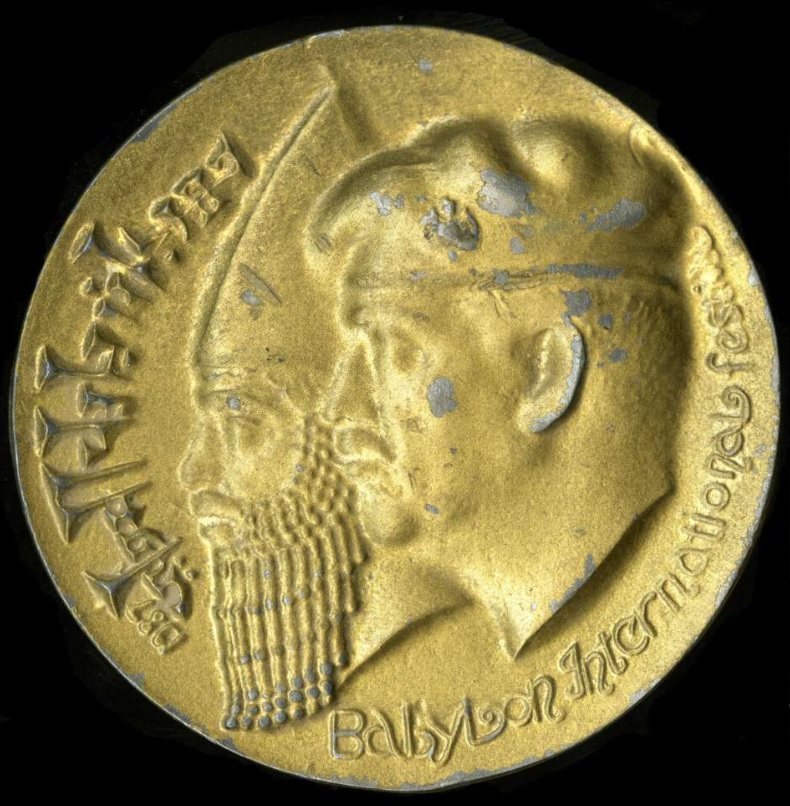
A 1987 gold-plated medal minted by Saddam Hussein, depicting his own face alongside Nebuchadnezzar’s.

The death of Khameini is significant, especially on Shabbat Zachor (when we read about Amalek), and on the cusp of Purim, which commemorates the death of another genocidal Persian figure, the Amalekite Haman. The alliteration of Haman and Khameini is unmissable. Moreover, the Zohar (II, 58b) prophecies that at the End of Days, God will bring back all the old oppressors of Israel and punish them one last time: “The Holy One, blessed be He, shall resurrect those kings that distressed Israel and Jerusalem, such as ‘Adrianus’ [Vespasian] and ‘Lupinus’ [Titus], Nebuchadnezzar and Sancheriv, and all the other kings of the world that took part in the destruction of His House…” In the past, I’ve noted how Saddam Hussein believed himself to be the reincarnation of Nebuchadnezzar. He spoke about it openly, built his palace over the archaeological remains of Nebuchadnezzar’s palace, and minted coins superimposing his face over Nebuchadnezzar’s, among other things. Saddam was president of Iraq, which is modern-day Babylon. It is quite possible that Iran’s Khameini is the modern-day version of ancient Iran’s Haman.

Another well-known prophecy about Persia in the End of Days is in the Talmud (Yoma 10a). Here, the Sages debate whether Rome will ultimately fall to Persia, or will Persia ultimately fall to Rome? Now, it is important to remember that in the time when the Talmud was written, the Roman Empire and the Persian Empire were locked in a centuries-long war. In fact, the Roman-Persian War is one of history’s longest, officially dated from 54 BCE to 628 CE, a whopping 681 years! The peshat here in the Talmud is that the Sages were debating how that Roman-Persian war they were mired in at the time would end. Some thought Rome would win and some thought Persia would win. The debate concludes with Rav Yehuda citing a teaching from Rav (in Sanhedrin 98b) that “The son of David will come only when the wicked kingdom of Rome spreads its dominance throughout the world for nine months.” This implies that Rome would ultimately win over Persia. Right now, we are certainly seeing the modern-day “Roman Empire” displaying its dominance over the whole world, Persia included.
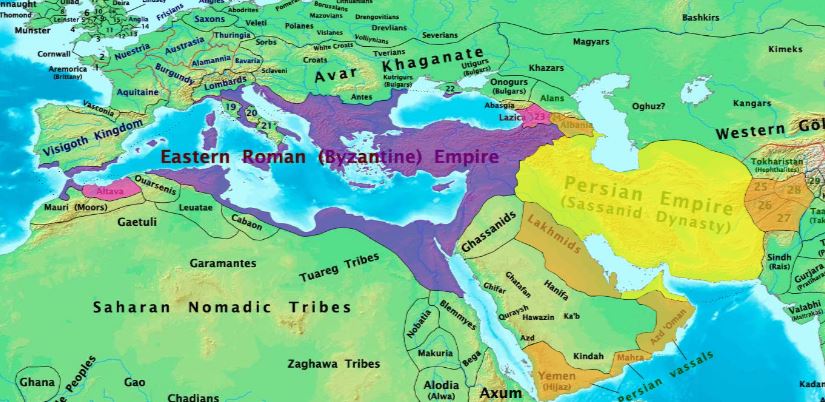
Sasanian and Eastern Roman (Byzantine) Empires in 600 CE, before the rise of Islam

Finally, no discussion of Iran in prophecy would be complete without the well-known Midrash in Yalkut Shimoni II, 499 (worth reading the whole passage!) Amidst a long discussion of the Light of Creation and the Light of Mashiach, we are told that “In the year that King Mashiach will be revealed, all the kings of the nations of the world will taunt each other. The king of Persia will taunt the king of Arabia. And the king of Arabia will go to Aram to get advice from them…” Standard versions of the text today typically say “Aram” (ארם) here, but it is far more likely that original manuscripts said “Edom” (אדם), which makes a lot more sense both then and now. It is interesting to note that Iran responded today by attacking neighbouring Arab countries as well, and one of the first victims (outside Iran) was a citizen in the United Arab Emirates. Also revealed in the news now is that Saudi crown prince Mohammed bin Salman was encouraging Trump to launch the attack on Iran despite presenting himself publicly as being opposed to it.

The prophecy continues to say that in the midst of this war “the king of Persia returns and destroys the entire world…” A desperate Persian regime will, it seems, unleash something terrible upon the world. Not to worry, though, because Hashem says “My children, do not be afraid! All that I have done, I have only done for your sake. Why are you afraid? Do not be afraid, the time of your redemption has arrived!” Shortly after, Mashiach is revealed (referred to here in the Midrash as “Ephraim”) to bring an end to the war and peace and prosperity to Israel: “At that time, the Holy One, blessed be He, will raise up Mashiach to the highest Heavens, and spread upon him some of His glory, before the nations of the world and before the wicked Persians. They tell him: ‘Ephraim, our righteous Mashiach, judge them and do as you wish with them…’”

Here, the Midrash describes that Persian forces are not alone in the area, but that “Not one or two kingdoms come upon him, but one hundred and forty kingdoms surround him.” As I first suggested a couple of years ago in this shiur on Mashiach ben Yosef, this may be referring to the United Nations peacekeeping forces which officially have troops from about 140 nations. In addition, Trump’s “International Stabilization Force” in Gaza (with its headquarters in Kiryat Gat, Israel) will soon bring in troops from all over the world, including 8000 already committed by Indonesia (the world’s largest Muslim country, no less). Just this past week, I spoke to a friend in Indonesia who told me his taxi driver’s soldier son is already on the way to Gaza!

The Midrash does not provide an exact timeline, but does mention one clue: “Our Rabbis taught: The Patriarchs are destined to stand in Nisan and say: ‘Ephraim, our righteous Mashiach, even though we are your forefathers, you are better than us because you suffered the sins of our children and harsh and evil things have befallen you which have not befallen the former ones or the latter ones…’” The Patriarchs are worried that Mashiach will not want to save his people because of all the torment they caused him, but he reassures the Patriarchs that “All that I have done I have only done for you and for your children to enjoy this goodness that the Holy One, blessed be He, has bestowed upon Israel.” The Patriarchs reply: “Ephraim, our righteous Mashiach, rest your mind for you have rested the mind of your Maker and our minds.” Hopefully, the Nisan referenced to here is the forthcoming Nisan next month.
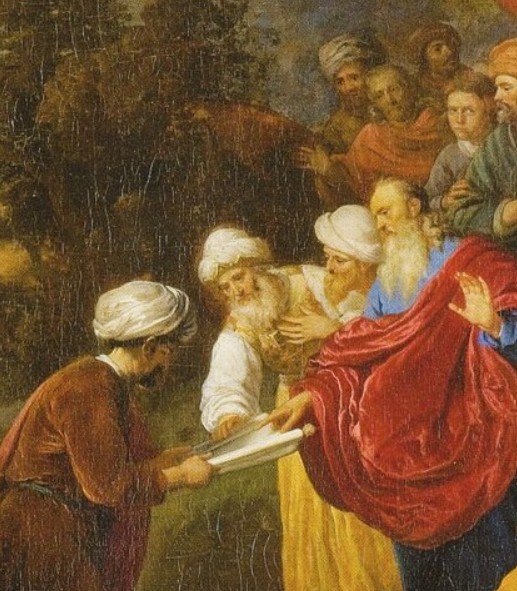
‘Zerubbabel shows Cyrus the Great a plan of the rebuilt Jerusalem’ by Jacob van Loo (1614-1670)

Finally, it is worth remembering that it was the Persian emperor Cyrus who liberated the Jews some 2500 years ago and allowed them to rebuild the Holy Temple in Jerusalem. We read in Isaiah 45:1 that Cyrus is surprisingly referred to as God’s meshicho, “anointed one”. Our Sages (Megillah 12a) discuss this puzzle and conclude that, of course, he was not the Messiah. So what might we learn from it instead? Perhaps it is a prophetic allusion for the present day: that Mashiach has a Persian connection, that we should expect Iran to once again play a big role, and that they will once again pave the way for the rebuilding of the Holy Temple in Jerusalem, speedily and in our days.

Wishing Everyone a Happy & Meaningful Purim!


Purim Learning Resources:
Secrets of Purim (Video)
Who is Ahashverosh?
Queen Esther’s Kabbalah (Video) 
The Secret, Secret Story of Stalin’s Purim Death
A Mystical Peek Into Megillat Esther
The Surprising Story of Russia, Ukraine, and the Jews

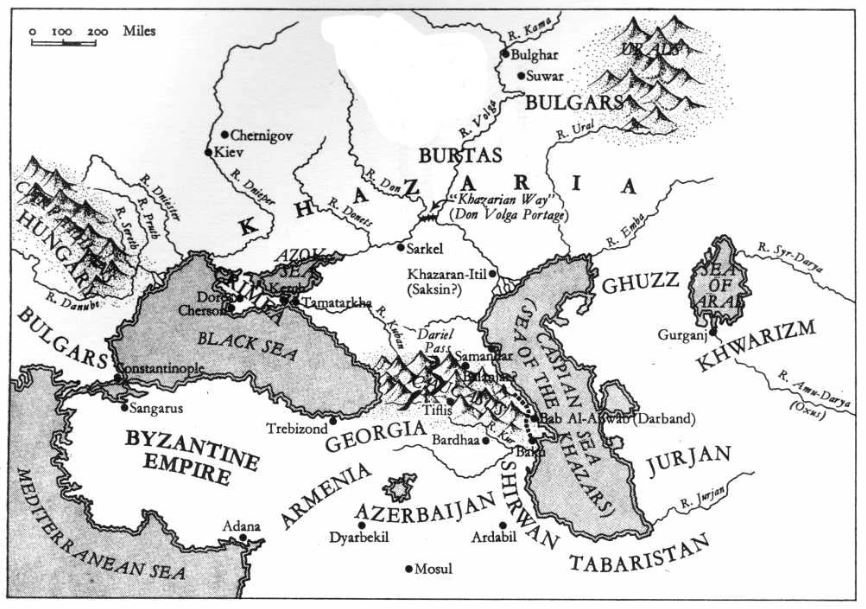
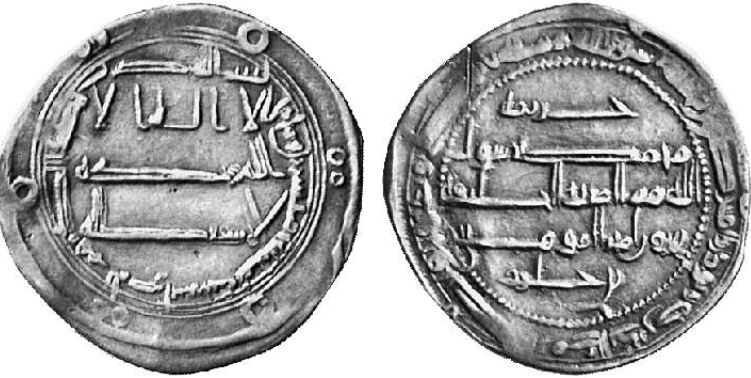
At the turn of the 8th century, a new power arose in the lands between the Black and Caspian Seas. This power was the Turkic people known as the Khazars. Around 740 CE, King Bulan of the Khazars made a fateful decision to convert to Judaism. Many in his royal family converted with him. The Khazar kingdom continued to spread far and wide, and its coins (bearing the inscription “Moses is the [True] Prophet of God”) have been uncovered by archaeologists as far as England to the west and China to the east.

Khazar coin from c. 837 CE, with the inscription “Moses is the prophet of God”.

In their rapid expansion, one of the new towns that the Khazars established was on the Dnieper River, and they called the town “Sambat”. Historians are uncertain what this word means or where it comes from. Considering the Jewish background of the Khazar kings, it is quite likely that the name comes from the legendary Jewish river, the Sambatyon. It was long believed that the Lost Tribes of Israel—exiled back in the middle of the first millennium BCE—had been resettled in distant lands past the mysterious Sambatyon River. The name “Sambatyon” itself comes from “Shabbat”, as it was said the Sambatyon River would only be calm on the Sabbath, when it could not be traversed. It is possible that the Khazars who founded this town were Jews who believed the Dnieper was the Sambatyon. Or it could be that they were Jewish settlers who stopped there one Shabbat to rest, and realized it was a good place to stay, hence the name. Whatever the case, by the 10th century, Sambat was better-known by another name: Kiev.

The Byzantine king Constantine VII Porphyrogenitus (r. 913-959) wrote in his De Administrando Imperio that three Khazar brothers named Kyi, Shchek, and Khoriv established “the stronghold of Kyiv, also called Sambatas.” For some time afterwards, Arabic sources refer to the city as Zanbat. In Russian history, though, the region is always referred to as Kievskaya Rus’, the very birthplace of “Mother Russia”.

Rise of the Third Rome

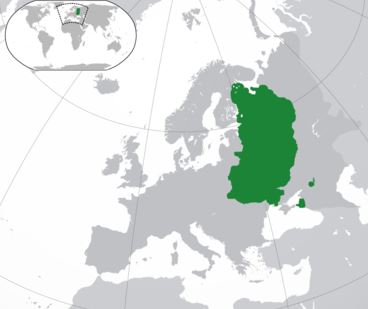
Kievan Rus’ in the 11th Century

In the middle of the 8th century CE, a group of Slavic settlers founded a new city, Novgorod (literally “new city”). However, they could not defend themselves against raids and attacks from surrounding tribes. In 862, they invited the Scandinavian king Rurik to take control. He did, and turned Novgorod into a powerful city, conquering neighbouring towns and tribes. His son, King Oleg, continued the expansion and, in 882, conquered Kiev. The growing kingdom was called Rus’, either in honour of the founder Rurik, or from rootsi, his Viking “rowers” that first came across the Sea to these lands. The name later gave rise to beleya-rus’, “White Russia”, ie. Belarus; to Ruthenia; and to Rossiya, Russia itself.

The Rurik Dynasty continued to wage war with the Khazars to the south for decades. The famed “Schechter Letter”, one of the greatest historical finds for understanding Khazaria, describes the battles fought against the Rus by Khazarian kings and generals with names like Benjamin, Aaron II, and even Pesach! By the end of the 10th century, Khazaria had all but disappeared. Some have posited that its many Jews fled north and west, giving rise to the Ashkenazi Jewish community (for why this is incorrect, read here). Others state that Khazaria continued to exist into the 1200s, until the Mongol invasion of the region that formally put an end to many other political entities. Continue reading

The Secret, Secret Story of Stalin’s Purim Death

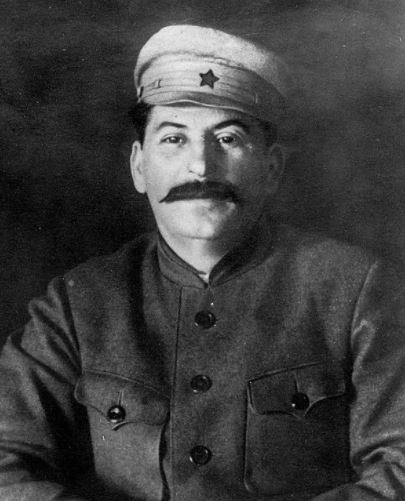
Josef Stalin in 1920

 – לעילוי נשמת אמנון בן אסתר –

On the night of March 1st, 1953, when Jews around the world had just finished celebrating Purim, attendants of Soviet dictator Josef Stalin found him laying semi-conscious on the floor of his bedroom. He was sick and hemorrhaging blood for the next several days until finally dying on the 5th of March. His death was announced to the public the following day. While most Jews around the world were probably jubilant at the news, little could they know of the incredible events—both political and spiritual—which were transpiring in the fateful days before.

A couple of months earlier, on the 9th of January, state-owned mouthpiece Pravda published a propaganda article about a “Doctor’s Plot” to secretly poison top Soviet leaders, including Stalin. Six of the named doctors were Jewish, and the others were supposedly Jewish-Zionist sympathizers, working together with American spies to destroy the Soviet Union. The article said:

The majority of the participants of the terrorist group… recruited by a branch-office of American intelligence, the international Jewish bourgeois-nationalist organization called “Joint”. The filthy face of this Zionist spy organization, covering up their vicious actions under the mask of charity, is now completely revealed…

Not surprisingly, a huge wave of anti-Semitism spread across the Soviet Union. Stalin used this as a pretext to order the construction of four new concentration camps in Kazakhstan and Siberia, arguing that he will gather Soviet Jews there, “for their own protection”, to save them from angry Russian mobs.* Stalin’s real intent was to finish what Hitler had started. Records suggest that the deportations were set to begin on March 6th, 1953—ironically, the same day his death was announced. After his death, Stalin’s successors quickly absolved the doctors of any wrongdoing and buried the Doctors’ Plot for good. Stalin’s impending holocaust was scrapped. Millions of Jews across the Soviet Union (my family included), were saved—a Purim miracle. But there is much, much more to the story.

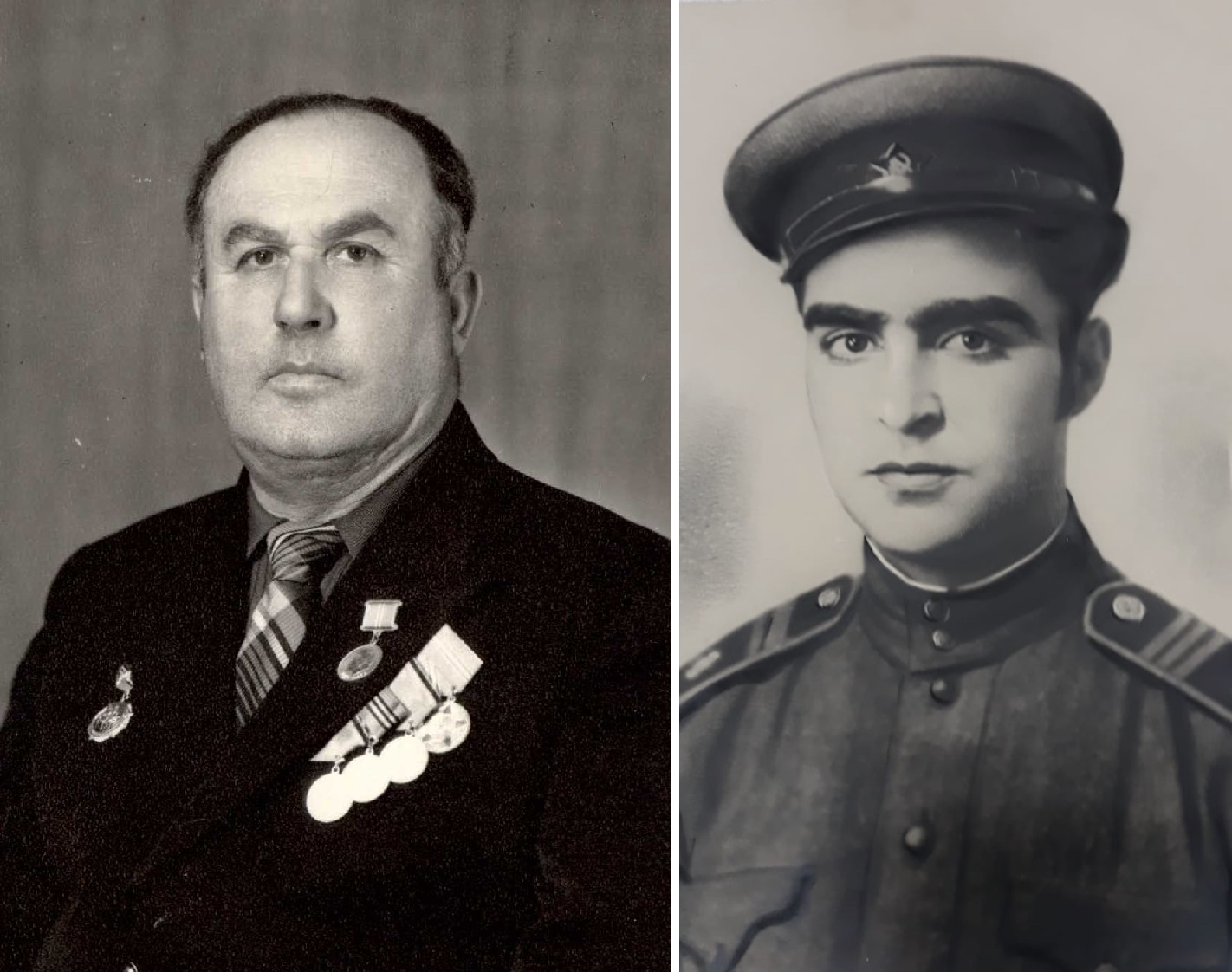
My grandfathers, David Palvanov (1915-1985), left, and Anton Amnon Mirzayev (1923-1981, whose 40th yahrzeit is this Sunday, the 9th of Adar), Red Army veterans of World War II, who served with distinction in both the European and Pacific Theatres.

The Rebbe’s Farbrengen

Back in New York City, on March 1st, 1953, the Lubavitcher Rebbe was starting a motzei-Purim farbrengen. In his discourse, the Rebbe recounted how when the czar was deposed in 1917, the Rebbe Rashab (Sholom Dov Ber, the fifth Lubavitcher Rebbe, 1860-1920) urged his followers to go vote. After voting, one simple Hasid saw some Russians shouting hoora! and joined in as well, thinking they meant hu-ra (הוא רע), “he is evil!”—happy that the evil, anti-Semitic czars that had caused the Jews so much anguish were finally gone. Bizarrely, the Rebbe (the seventh one, that is) started to shout hu-ra, too, and repeated the same story three separate times, each concluding with more hu-ra’s. No one in the room understood what was going on. They assumed the Rebbe had done a spiritual rectification of some sort.

A farbrengen with the Lubavitcher Rebbe in the early 1950s

Nothing more was said of the Rebbe’s strange actions until March 6th, when Stalin’s death was announced. Turns out, at the same time that the Rebbe was making his hu-ra’s—while recounting the fall of an old anti-Semitic Russian dictator—the contemporary anti-Semitic Russian dictator, Stalin, had collapsed in his room and was writhing in pain. It was only then that the Hasidim that were with the Rebbe on the night of March 1st began to piece together what had happened. Did the Rebbe put an end to Stalin? Well, not directly; the Rebbe was no assassin! (Not even a spiritual one.) So, what was really going on that night of March 1st?

Stalin’s Purim Feast

While Jews around the world were enjoying their Purim feast, Stalin was getting together for a feast of his own back in Russia. As recounted in Stalin’s Last Crime (written by Russian historian Vladimir Naumov and Yale professor Jonathan Brent), in his last dinner Stalin was accompanied by secret police chief Lavrentiy Beria, Georgi Malenkov, Nikita Khrushchev (his soon-to-be successor) and Nikolai Bulganin. Later that night, Stalin had mysteriously collapsed in his room. Yet, no doctor was called in to treat him until the following day. Some believe that Stalin’s friends had gotten him drunk, and then Lavrentiy Beria slipped Stalin a poison. High-ranking Soviet diplomat Vyacheslav Molotov (1890-1986, of “Molotov cocktail” fame) would recall in his memoirs that Beria boasted about how he managed to terminate Stalin: “I did him in! I saved all of you!” Others state that Stalin was not much of a drinker, and was unlikely to let himself get drunk. It is more likely that his treatment was purposely delayed until it was too late. Whatever the case, the evidence is very strong that Stalin’s own inner circle killed him. Why?

For Stalin, the Doctor’s Plot was only the start of something much bigger. As we saw from the Pravda article above, Stalin had tied the doctors to American agents in Moscow. His plans were to accuse the US of plotting to nuke Moscow, and he supposedly had proof from a spy captured and interrogated in 1951. Stalin was gearing up to spark World War III (and possibly drawing up plans for an attack on American soil). His inner circle knew that he had absolutely lost it. And Stalin knew that they did not support him anymore, so he planned another purge of the Communist Party to eliminate dissenters. This was confirmed in the 1956 “Secret Speech” given by Khrushchev, who said:

It is not excluded that had Stalin remained at the helm for another several months, Comrades Molotov and Mikoyan would probably have not delivered any speeches at this congress. Stalin evidently had plans to finish off the old members of the political bureau. He often stated that political bureau members should be replaced by new ones… We can assume that this was also a design for the future annihilation of the old political bureau members and in this way a cover for all shameful acts of Stalin, acts which we are now considering.

This is why Beria had boasted that he had saved his comrades. Khrushchev and the others were in on it. They got rid of Stalin just in time to avoid another Jewish holocaust, to save their own skin, and to prevent World War III. What they did was incredibly risky, and no doubt needed help from Above. The Rebbe must have sensed something going on in the Heavens, and perhaps really did play some spiritual role in the plan’s success.

Indeed, it was a great miracle that the plan succeeded. That it happened on Purim specifically is certainly no coincidence.** After all, Purim is all about how the Jews avoided a holocaust in the nick of time: “…on the very day when the enemies of the Jews sought to dominate them, v’nahafokh hu”—everything was turned upside down and the Jews were saved instead. On the very day Stalin planned to start deporting Jews, his death was announced instead.

And Purim is about the defeat of Amalek which, like Communism, is that atheistic force in the universe seeking to undermine Godliness at every opportunity. The Communists tried so hard to expunge religion that they even attempted to change their calendar to a five-day week so that there could be no commemoration of the Sabbath! Thankfully, the Soviet Union collapsed in 1989, right at the moment when the Messianic Age was set to begin according to ancient prophecy (as explained here). However, Communism is not quite dead, and the forces of Amalek continue to rear their ugly heads around the world today. And so, we continue to read Parashat Zachor each year before Purim, as we will this Shabbat, to remind ourselves that there is yet work to be done until we can celebrate Amalek’s final defeat. May we merit to see it soon.


*According to Stalin’s Last Crime (pg. 294-295), the concentration camps were ordered to house foreign criminals captured in World War II, particularly Germans and Austrians. However, there were no more than 5000 such prisoners in the USSR, so why the need for so many large camps? Besides, the war had ended long ago—why the sudden need for new camps? The real reason was surely tied to the Doctor’s Plot and/or a new impending war.

**In Stalin’s Last Crime, Naumov and Brent point out that one of the hidden heroes in the story was Sophia Karpai. She was one of the Jewish doctors that was accused, then arrested, tortured, and kept in a refrigerated cell. Despite this, Karpai refused to “confess” and maintained the innocence of the Jews. By this point, most of the other doctors had already “confessed” under extreme torture. Karpai held out on her own, which frustrated Stalin and the authorities. They couldn’t have even a single doctor claim innocence, for that would ruin the entire conspiracy. Naumov and Brent write that “It satisfies the imagination to think that the fate of the Jews of Russia might have depended on this latter day, unknown Esther.” (Pg. 307)


The above essay is an excerpt from Garments of Light, Volume Three.
Get the book here!