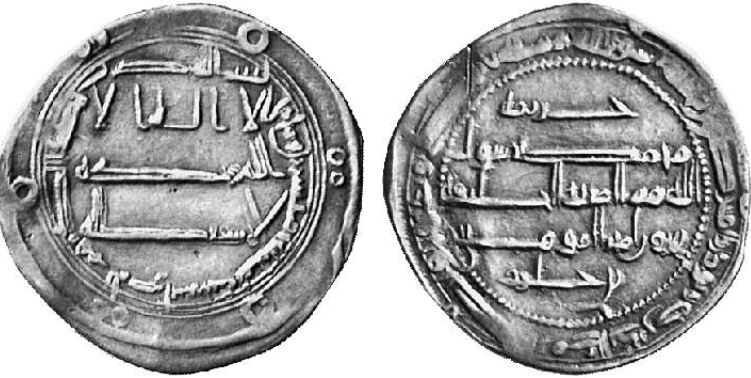
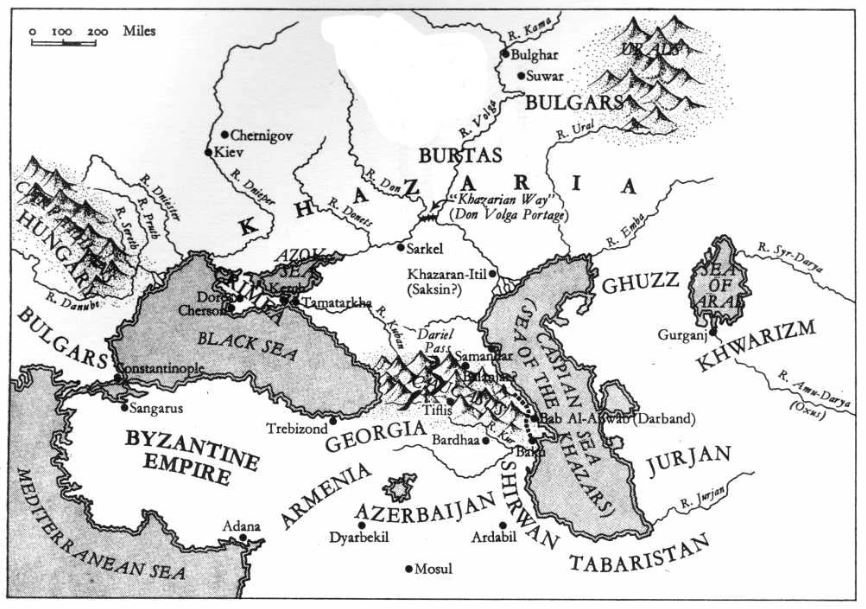
At the turn of the 8th century, a new power arose in the lands between the Black and Caspian Seas. This power was the Turkic people known as the Khazars. Around 740 CE, King Bulan of the Khazars made a fateful decision to convert to Judaism. Many in his royal family converted with him. The Khazar kingdom continued to spread far and wide, and its coins (bearing the inscription “Moses is the [True] Prophet of God”) have been uncovered by archaeologists as far as England to the west and China to the east.
Khazar coin from c. 837 CE, with the inscription “Moses is the prophet of God”.
 In their rapid expansion, one of the new towns that the Khazars established was on the Dnieper River, and they called the town “Sambat”. Historians are uncertain what this word means or where it comes from. Considering the Jewish background of the Khazar kings, it is quite likely that the name comes from the legendary Jewish river, the Sambatyon. It was long believed that the Lost Tribes of Israel—exiled back in the middle of the first millennium BCE—had been resettled in distant lands past the mysterious Sambatyon River. The name “Sambatyon” itself comes from “Shabbat”, as it was said the Sambatyon River would only be calm on the Sabbath, when it could not be traversed. It is possible that the Khazars who founded this town were Jews who believed the Dnieper was the Sambatyon. Or it could be that they were Jewish settlers who stopped there one Shabbat to rest, and realized it was a good place to stay, hence the name. Whatever the case, by the 10th century, Sambat was better-known by another name: Kiev.
The Byzantine king Constantine VII Porphyrogenitus (r. 913-959) wrote in his De Administrando Imperio that three Khazar brothers named Kyi, Shchek, and Khoriv established “the stronghold of Kyiv, also called Sambatas.” For some time afterwards, Arabic sources refer to the city as Zanbat. In Russian history, though, the region is always referred to as Kievskaya Rus’, the very birthplace of “Mother Russia”.
Rise of the Third Rome
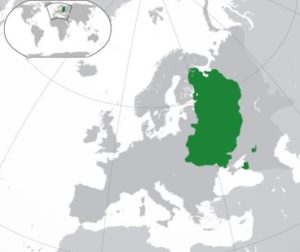
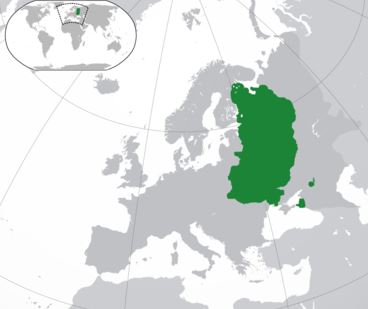
Kievan Rus’ in the 11th Century
In the middle of the 8th century CE, a group of Slavic settlers founded a new city, Novgorod (literally “new city”). However, they could not defend themselves against raids and attacks from surrounding tribes. In 862, they invited the Scandinavian king Rurik to take control. He did, and turned Novgorod into a powerful city, conquering neighbouring towns and tribes. His son, King Oleg, continued the expansion and, in 882, conquered Kiev. The growing kingdom was called Rus’, either in honour of the founder Rurik, or from rootsi, his Viking “rowers” that first came across the Sea to these lands. The name later gave rise to beleya-rus’, “White Russia”, ie. Belarus; to Ruthenia; and to Rossiya, Russia itself.
The Rurik Dynasty continued to wage war with the Khazars to the south for decades. The famed “Schechter Letter”, one of the greatest historical finds for understanding Khazaria, describes the battles fought against the Rus by Khazarian kings and generals with names like Benjamin, Aaron II, and even Pesach! By the end of the 10th century, Khazaria had all but disappeared. Some have posited that its many Jews fled north and west, giving rise to the Ashkenazi Jewish community (for why this is incorrect, read here). Others state that Khazaria continued to exist into the 1200s, until the Mongol invasion of the region that formally put an end to many other political entities. Continue reading →