
In this week’s parasha, Ki Tetze, we learn about the mitzvah of bal tashchit, the prohibition on wasting good products. This is derived from the Torah’s command not to chop down fruit trees in the midst of war (Deuteronomy 20:19-20). The Talmud (Bava Kamma 58b) presents a related case, where a man chopped down a date palm belonging to his neighbour, and had to pay damages for it. The two went for litigation to the reish galuta, or “exilarch”, also known as rosh hagolah, “head of the exile”, who was something like the “chief rabbi” of Babylon. Now, the date palm in question was actually three palms coming out of one root, with a total value of 100 dinars. Since the man only chopped down one of three palms, the reish galuta ruled he was liable to pay 33.3 dinars.
The perpetrator did not like this ruling, exclaiming: “Why should I follow the reish galuta, who rules according to Persian law?” So he went to Rav Nahman instead who ruled a smaller fine, based on the average value of sixty date palms. The Talmud goes on to discuss the nuances of this issue. It concludes on the following page by saying that the halakhah does indeed follow the reish galuta, but only with regards to Persian date palms, since they are more expensive than regular ones. A couple of interesting questions emerge here: First, why did the perpetrator accuse the reish galuta of following Persian law, instead of Jewish law? And second, who was the reish galuta anyway, and what was the origin, history, and function of that office?
According to Seder Olam Zuta (composed in the early 9th century CE), the office of the “exilarch” was established by the Babylonians sometime after the second-to-last king of Judah, Yehoyakhin (“Jeconiah”), was dethroned and taken to Babylon. The Babylonians replaced him with a relative, King Zedekiah, who would go on to be the last king of Judah. Yehoyakhin was imprisoned in Babylon, but was later freed by Evil-Merodach (King Amel-Marduk, r. 562-560 BCE) who succeeded Nebuchadnezzar. We read in Tanakh that Evil-Merodach “lifted up the head of Yehoyakhin, king of Judah, and released him from prison, and spoke with him kindly and placed his throne above the throne of the kings who were with him in Babylon…” (II Kings 25:27-28)
The verses suggest that Yehoyakhin’s throne was semi-restored in exile and he was given some sort of authority in Babylon, at least over the empire’s Jewish subjects. He is thus considered the first “exilarch” (rosh hagolah in Hebrew and reish galuta in Aramaic). The office presumably continued throughout the Babylonian captivity, passed down within the family to preserve Davidic descent. Seder Olam Zuta provides a long list of reish galutas, including the better-known Zerubavel, who served in that role before returning to the Holy Land and becoming the Persian-appointed governor of Judea. (Lots more on Zerubavel, and the prophetic Sefer Zerubavel, in a recent class here.)
Historically, the first mention of a reish galuta comes no earlier than the 2nd century CE. It seems more likely that the position was officially established following the destruction of the Second Temple, not the First. Some scholars say it was even later, after the Bar Kochva Revolt. Recall that this was when Judea was obliterated and erased as a Roman province, renamed to “Palestine” and attached to the neighbouring province of Syria. Many Jews fled east to the Persian Empire, as did numerous rabbis and Torah scholars. The reish galuta thus served as something of a chief rabbi for the exiled community. He had the authority to rule on halakhic matters, and to judge monetary cases. He did not have the authority to mete out corporal or capital punishment. And his greatest power was that of excommunication.
More significantly, the reish galuta served as a political figure, an official representative of the Jewish community to the government and vice versa. He was also the tax collector on behalf of the Jewish community. For these roles, he was given a generous stipend by the government, at one time reported at 700 gold denarii per year! Not surprisingly, the result was a great deal of political intrigue and power struggles (more on that below).
Because the reish galuta was so cozy with the Persian government and nobility, we can understand why the date-palm-chopper above accused him of ruling according to Persian law instead of halakhah. Indeed, as explored in the recent series of videos on ‘Judaism vs. Zoroastrianism’, there was a great deal of overlap between the two religions and their laws, and the two influenced each other heavily. There was also a great deal of “religious competition” between rabbis and Zoroastrian magi. It appears that the reish galutas sometimes leaned too heavily on the Persian-Zoroastrian side, and the Talmud presents numerous stories of the questionable practices of some reish galutas.
In one case, the reish galuta’s men abduct the sage Abba bar Manyomi and torture him. The reish galuta ultimately has pity and orders to let him go (Shabbat 121b). In another case, the reish galuta’s thugs torture a tzadik called Amram Hasida, “Amram the Pious” (Gittin 67b). We also read here a story involving Rav Sheshet, who questioned the kashrut level of the reish galuta’s household. The reish galuta’s men subsequently tried to get him to choke on a bone. Rav Sheshet outsmarted them, but Rav Zevid was not so lucky. When Rav Zevid ruled strictly against consuming eggs cooked by gentiles, the exilarch’s men had him poisoned (Avodah Zarah 38b).
Another question of kashrut came up in a debate between Rav and Levi (Pesachim 76b). Rav ruled that it is forbidden to cook kosher meat in the same oven, at the same time, as non-kosher meat. The aroma of the non-kosher would impart flavour to the kosher. Levi disputed this, saying there is no such prohibition. To prove it, he went to the house of the reish galuta and cooked a kid in the same oven as “something else”—which Rashi says is a pig! The implication is that the reish galuta was okay with this leniency.
We find another leniency in the home of the reish galuta with regards to a knishkanin, a beverage vessel that had several straws coming out of it so that multiple people could drink simultaneously (Avodah Zarah 72b-73a). The beverage was typically wine, which carries additional stringencies. Mar Zutra ruled that it was okay for a Jew and gentile to drink from the same knishkanin, and Rabba bar Rav Huna reported that he once saw Jews and gentiles drinking together this way at the reish galuta residence. The passage concludes with some saying Rabba bar Rav Huna himself participated in such drinking!
Political Intrigue

Mahoza is today known as al-Mada’in in Iraq. It lies on the Tigris River.
We see above that the reish galuta wielded considerable power. Not surprisingly, this resulted in multiple political intrigues. Perhaps most interesting is the case of Mar Zutra II, who served as reish galuta towards the end of the Talmudic era. He became exilarch at just 15 years old. Sometime at the turn of the 6th Century CE, he took advantage of a weak point in the Persian Empire and managed to break off with his own armed forces and create an independent state in Mahoza! His “kingdom” lasted seven years before being crushed. According to some reports, King Kavadh I publicly executed Mar Zutra II. His son fled to Israel and headed the yeshiva in Tiberias. Following this, the exilarchs kept a low profile for a while, and held little authority. This changed with the rise of Islam.
The Muslims conquered the Persian Empire in the seventh century, and restored the prestige of the reish galuta. They generally respected the exilarchs as both Davidic descendants and learned sages. In one 8th century account by an Arab writer, the reish galuta was asked why he commands so much respect in the Jewish world, and he reportedly answered: “Seventy generations have passed between me and King David, yet the Jews still recognize the privileges of my royal descent, and regard it as their duty to protect me; yet you have slain the grandson Husain of your prophet after one single generation!”
Around this time, another power struggle emerged among the exilarch family. Two sons vied for the position, and the Babylonian geonim ultimately elected Yoshiyahu over his brother, Anan ben David. Anan declared himself the “anti-exilarch” and was soon arrested. Disgruntled, he went on to reject rabbinic authority, and eventually started his own branch of Judaism with an anti-Talmudic bent. While it is commonly said that Anan ben David is the founder of Karaite Judaism, scholars say this is not necessarily the case. Karaism seems to have emerged sometime after, and it is likely that the followers of Anan ben David merged with the Karaites because of their similar beliefs.
The office of exilarch continued to decline following this point, for a variety of reasons. One was that Jews migrated to more favourable and tolerant places like the Iberian Peninsula and Egypt. Others went north to Asia Minor, the Caucasus, and Europe. New Torah academies were opening up around the world, and Torah scholarship shifted to other regions. Meanwhile, power struggles and conflicts in Babylon continued. The great Sa’adia Gaon (892-942) was involved in one such controversy, and used his influence to install an anti-exilarch to oppose the exilarch in 930 CE. It didn’t last, and the anti-exilarch was removed.
The last reish galuta we know much about was Hezekiah Gaon. In addition to being the exilarch, he served as gaon of the Pumbedita academy. We know that he was imprisoned by the authorities in 1040 CE, though it’s not entirely clear why. Some say he was later freed, others say he was executed. His sons fled to Spain and became friends with the family of the great Shmuel haNagid. Hezekiah’s great-grandson was the famed Rabbi Avraham bar Chiya of Barcelona (c. 1070-1145), noted for also being a key figure in the history of mathematics and astronomy (as I’ve written about before here.) Hezekiah Gaon is often considered the last of the geonim. However, there were still geonim and an exilarch for nearly two more centuries.
By the time of the Rambam (1138-1204), the geonim and exilarch did not command much respect. The Rambam himself questioned their authority, and in some of his letters mocks the Babylonian scholars and geonim. The last known reference to a reish galuta comes from the Sephardic rabbi, writer, and traveler Yehudah Al-Harizi (born in Castile and died in Aleppo in 1225). Al-Harizi was a rational “Rambamist” and helped produce the first Hebrew translation of Moreh Nevukhim (“Guide for the Perplexed”). He mentions a reish galuta named David, living sometime around 1216. It is believed that the office of reish galuta officially ceased in 1258, when the Mongols crushed the Abbasids and sacked Baghdad. This ties into a fascinating Talmudic prophecy:
Rabbi Yehudah haNasi (president of the Sanhedrin) was once having a meal with the sons of Rabbi Chiya. The sons were quiet so Rabbi Yehudah instructed that more wine be poured for them, to loosen them up. They got drunk and “prophesied” that
The son of David will not come until two fathers’ houses are destroyed from Israel, and they are the exilarch in Babylonia and the nasi in Israel, as it is said: “And he shall be for a sanctuary; but for a stone of stumbling and for a rock of offense to both the houses of Israel.” (Isaiah 8:14)
The two houses mentioned by Isaiah are interpreted as referring to the two Davidic lines that held rabbinic authority: the president of the Sanhedrin (nasi) in Israel and the exilarch in Babylon. Naturally, Rabbi Yehudah haNasi was offended by this statement, and complained to Rabbi Chiya about his sons. Rabbi Chiya reminded him: nichnas yayin yatza sod, “when wine goes in, secrets come out!” The numerical value of both “wine” (יין) and “secret” (סוד) is 70, and drinking wine can cause a person to blurt out what’s deep inside. This can be both an embarrassing personal secret (which is usually the case), or sometimes it could be prophetic, a genuine mystical sod.
The office of nasi ceased to exist sometime in the 4th century CE. The office of exilarch continued for another nine centuries or so. According to the Talmud, the end of both offices is actually a sign of drawing nearer to the era of Mashiach. There is something quite ironic here. In many Ashkenazi shuls, the yekum purkan prayer is still recited on Shabbat mornings, after the Torah reading. The prayer begins with a wish for the coming of the Redemption (literally what “yekum purkan” means). But then it includes a blessing for the wellness of the reish galuta—which the Talmud says has to cease for the Redemption to come!
Why does the Talmud say this? One reason might be because the nasi and reish galuta were both Davidic descendants vying for control and authority, locked in tension and occasional conflict. In fact, there is even one such case in the Mishnaic era, in the infamous story of when Rabbi Meir and Rabbi Nathan launched a coup against the then-nasi Shimon ben Gamliel (see Horayot 13b). One little-known detail is that Rabbi Nathan had come to Israel from Babylon, and was from the family of the reish galuta. Thus, some saw the coup as an attempt by the Babylonian reish galuta to wield more power in Israel’s rabbinate. That rebellion was quashed, and Rabbi Nathan recanted. (Rabbi Meir refused to, and died alone in exile, as explored in this recent shiur on Rabbi Meir.)
Even Rabbi Yehudah haNasi worried about his position. The Talmud (Horayot 11b) records Rabbi Yehudah haNasi asking Rabbi Chiya that if he were to sin, would he be obligated to bring a male goat sin-offering, as a king would, or a female goat, like a commoner would? Rabbi Chiya deflated Rabbi Yehudah by telling him he is not a king, and he does not command unilateral authority since he has a counterpart in Babylon. When Rabbi Yehudah pushed back, Rabbi Chiya concluded by suggesting that the exilarch is actually more powerful and has more authority than the nasi!
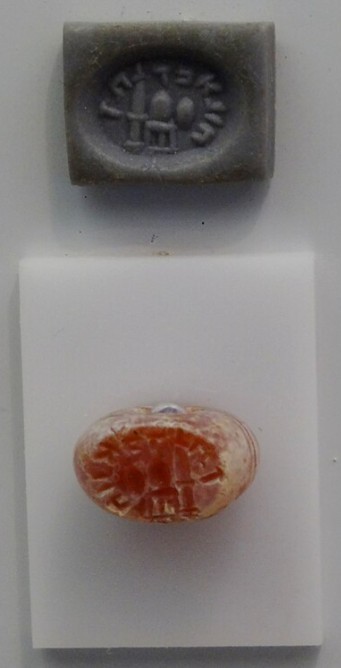
Seal of the reish galuta Rav Huna bar Rav Natan.
In a parallel passage in the Talmud Yerushalmi (Kilayim 9:3), we read Rabbi Yehudah haNasi saying that “If Rav Huna, the reish galuta, would come here I would let him sit higher than myself since he is from the tribe of Judah and I am from Benjamin, he is from the male line [of David] and I am from the female line.” The Yerushalmi goes on to recount that Rabbi Chiya once came into Rabbi Yehudah’s office and told him that Rav Huna was outside, and Rabbi Yehudah immediately turned red. He seemingly tries to avoid the encounter entirely. It turned out, however, that Rav Huna had already passed on, and it was only his coffin that had arrived for burial in the Holy Land.
With all of this in mind, the Talmud’s prophetic statement is understandable. Power struggles between Davidic descendants only serve to delay the Redemption. The truth is that the only Davidic descendant that actually matters—and has true authority—is Mashiach ben David. The Talmud recognizes that as long as there is a nasi and reish galuta, it means Mashiach has still not come. And once Mashiach comes, there is no need for either a nasi or a reish galuta. Today we have neither, and hopefully it means Mashiach will be here soon.