
In the Torah portion of Ha’azinu, we read about the importance of “remembering the days of the world” and “understanding the years of past generations” (Deuteronomy 32:7). It is absolutely vital for each person to have a solid grasp of history. It is only when one knows history that they will be able to properly understand the Scriptures. Reading the Tanakh without its historical context is futile, and will lead to false faith.
Case in point is the Book of Daniel, perhaps the most misunderstood and abused book of Tanakh. Christians often use it to “prove” that Jesus was the Messiah. The reality is that Daniel’s prophecies undoubtedly point to someone else as the “anointed one”, and have nothing at all to do with Jesus, or Christianity, or even the destruction of the Second Temple or the Roman Empire. Once a person understands the historical context of Daniel, everything becomes abundantly clear.
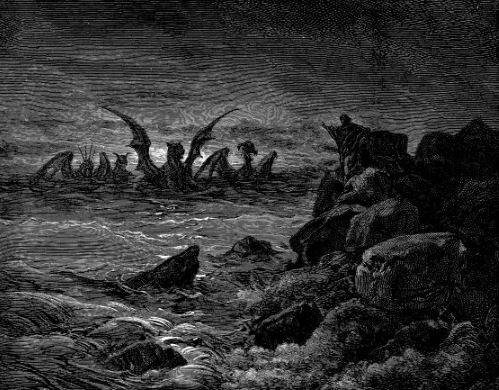
Daniel’s “Vision of the Four Beasts” by Gustave Doré
The critical part of Daniel to understand is the three central prophetic chapters, 7 to 9. Chapter 7 starts with the famous Vision of the Four Beasts. Daniel beholds four great creatures emerge from the sea. The first is a lion with eagle wings and human features (7:4). The second is a bear with three fangs (7:5). Then a leopard with four wings and four heads (7:6). Then the most terrible beast of all, different than the others, with iron teeth and ten horns (7:7). Another little horn emerges from the head of this beast, and it was like a human that spoke arrogantly (7:8).
The next several verses describe a mysterious angelic being, “like a son of man”, whose coming would destroy the terrible fourth beast. Then we are told that the four beasts are symbolic of four kingdoms (7:17). The fourth kingdom would be more powerful than the previous three, and would take over most of the world. The ten horns represent ten kings, and the little horn that emerges after is one last wicked king who would come, and be destroyed by God’s holy forces. God’s people (Israel) will then merit to have an everlasting kingdom.
Here is the critical error that Christian interpreters made: to make the story fit Jesus and stretch into his timeline, they had to set the prophecy in such a way that it ends with the Roman Empire. So, they paralleled the four beasts to Babylon, Persia, Greece, and Rome. Admittedly, this Christian interpretation influenced later Jewish commentators as well, including Rashi (Rabbi Shlomo Itzchaki, 1040-1105) who says the same thing here. A proper historical reading will reveal that this interpretation is impossible.
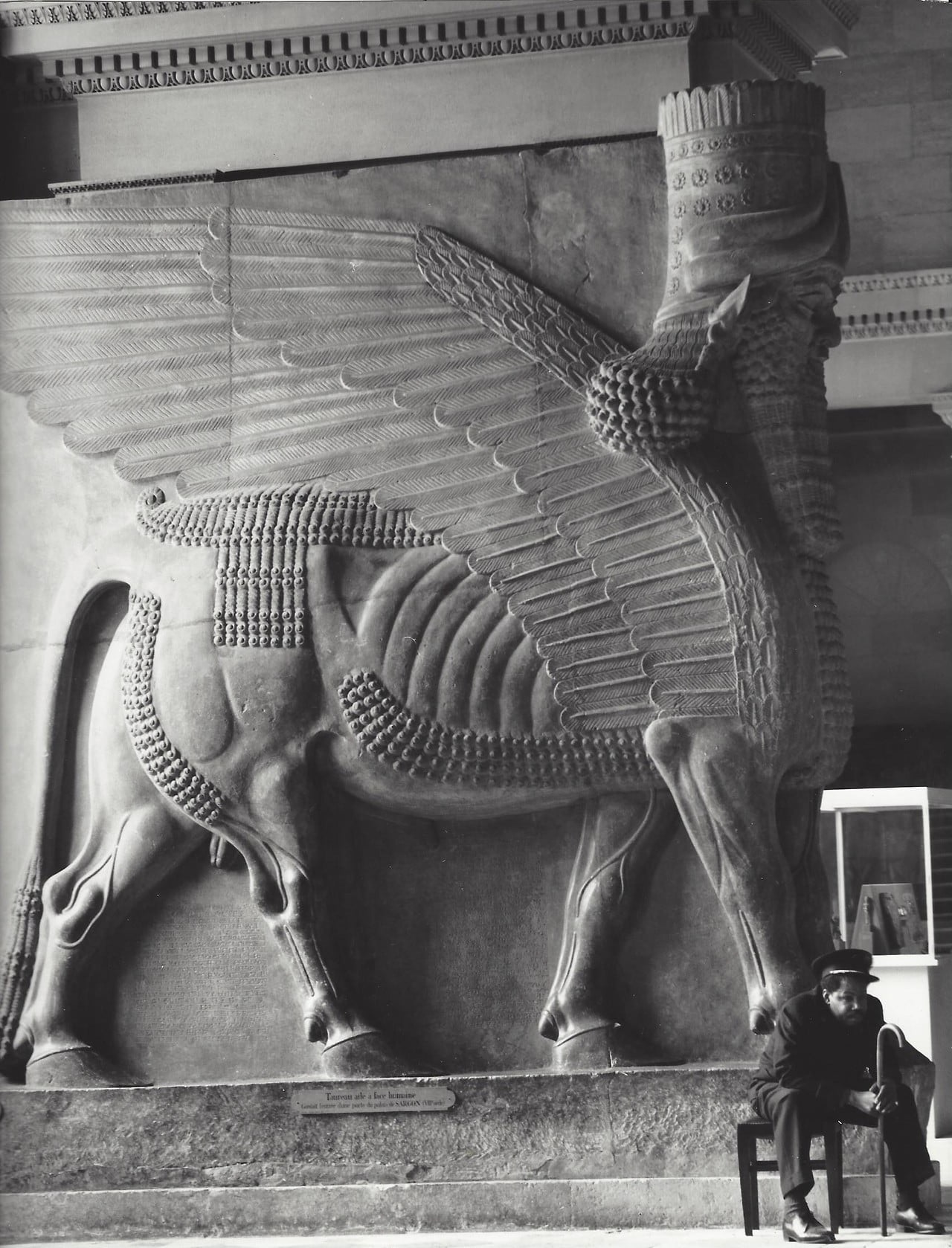
Kuribu were also known as lamassu, with lion bodies, eagle wings, and human faces. This is a photo by Kees Scherer, taken in the Louvre Museum in 1968, of a massive lamassu statue from Assyrian King Sargon II’s palace, dated back to the 8th century BCE, long before Daniel.
Daniel knows of four great kingdoms, yes, but Rome is not one of them. Remember that Daniel lives some 2500 years ago, long before Rome becomes a great empire, back when it is still essentially a little-known territory on the outskirts of the rising Greek power. Who were the four great powers for Daniel? Daniel was, of course, very familiar with the massive Assyrian Empire that had destroyed the northern Kingdom of Israel and exiled the Ten Tribes. The Assyrians had absolutely been a dreaded and terrible beast. In Daniel’s vision, Assyria is represented by the first beast, the humanistic eagle-lion, a clear reference to Assyrian kuribu that they were the first to popularize.
Then came the Babylonian Empire, which destroyed the southern Kingdom of Judah and the Jerusalem Temple, exiling the rest of the Israelites. Also dreaded and feared, and arguably much worse than the Assyrians, Babylon is the fanged bear of Daniel’s vision. Note how this beast is the only one of the four that is specifically commanded to attack and “eat meat” (7:5), reminiscent of God’s command to Babylon to destroy the Temple on account of the sins of Israel. (God even calls Nebuchadnezzar His “servant”! As in Jeremiah 25:9.) God declares that because Israel abandoned Him and forgot Him, “I shall attack them like a bear robbed of her young…” (Hosea 13:8) Meanwhile, in Jeremiah’s description of Jerusalem’s destruction by Babylon, he describes the God-directed attack like “a bear in ambush” (Lamentations 3:10). Daniel’s consuming bear is undoubtedly symbolic of Babylon and its destruction of Judah.
Then came the Persians, who did not attack Israel at all and, on the contrary, liberated the Jews and allowed them to rebuild the Temple. Aside from the brief incident with Haman (which failed), the Persians were good to the Jews. God blessed them with dominion, just as it says about the third beast, to whom “dominion was given” (7:6). Now, Persia was not a singular people but actually a fusion of four major ethnic groups: the Medians, the Elamites, the Achaemenids, and the original Aryans. The four major groups among the Persians are symbolized by the four-headed leopard.
Then comes the most dreaded beast, the most powerful militarily, which conquered nearly the whole world known to the people in that region at the time. This is Alexander the Great, whose empire was far larger and greater than the previous three, stretching all the way from Europe to India. That’s far further east than even the Roman Empire ever went. This explains Daniel 7:23 that “there will be a fourth kingdom upon the Earth that will be different from all the kingdoms; it will devour the whole Earth, tread it down, and crush it.”
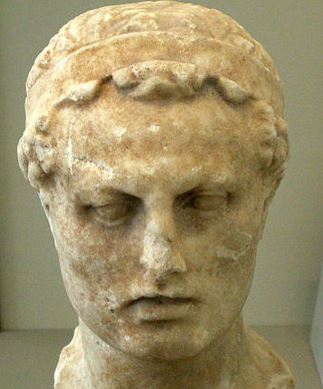
Bust of Antiochus IV Epiphanes, of Chanukah fame, at the Altes Museum in Berlin (Credit-Jniemenmaa)
This final beast has ten horns, which are ten kings (7:24), followed by another king who is different than the previous ones, and he is the one that mocks God and starts a war against God’s people (7:25). This is referring to Antiochus IV who started the Chanukah wars and profaned the sanctuary and sought to obliterate Judaism. He was different from his predecessors, who were generally nice to the Jews. Antiochus III (“the Great”) had been good to the Jews. Josephus writes that he supported the Jewish community, lowered their taxes, allowed more Jews to resettle in Jerusalem, and “let them live according to the laws of their forefathers” (Antiquities of the Jews, XII, 3). Alexander had been good to the Jews, too, and commands great respect in rabbinic texts. Daniel suggests there would be ten emperors that would rule before Antiochus IV. And what do we find in historical records? There were indeed ten before him! They are:
- Alexander the Great, reigned 336-323 BCE
- Philip III Arrhidaeus (Alexander’s half-brother), r. 323–317 BCE
- Alexander IV of Macedon (Alexander’s infant son), r. 323–309 BCE
- Seleucus I Nicator (founder of the Seleucid Greek Empire), r. 305–281 BCE
- Antiochus I Soter, r. 281–261 BCE
- Antiochus II Theos, r. 261–246 BCE
- Seleucus II Callinicus, r. 246–225 BCE
- Seleucus III Ceraunus, r. 225–223 BCE
- Antiochus III the Great, r. 223–187 BCE
- Seleucus IV Philopator, reigned 187–175 BCE
And then comes Antiochus IV (r. 175-164 BCE), a new “horn” unlike the previous kings, who launches an unprovoked religious war against God and His people. Antiochus IV ends up losing the war to the Maccabees, and the Seleucid Empire crumbles. In fact, his successor, nine year-old Antiochus V, was appointed king by the Romans, who needed to step in. Within a century, Seleucia becomes a tiny and powerless state, and is easily annexed by the Roman general Pompey in 64 BCE. Antiochus IV is the cause of Seleucia’s demise, in fulfilment of Daniel’s prophecy.
Note that none of this happened with the Roman Empire. The Roman Empire continued to exist for centuries after Jesus and the destruction of Jerusalem and the Temple. In the decades that followed, it did not weaken, but only grew stronger. There is no clear set of ten Roman emperors or kings to parallel the ten horns. Again, like Christian interpreters, Rashi says there were ten kings before Vespasian, who gave the command to destroy the Temple. But we find no such list in historical records. If we count actual Roman emperors, since the official founding of the empire in 27 BCE, then there were only eight total before Vespasian. If we include the pre-empire period of Rome, then there were dozens of different kings and rulers. And, again, neither Vespasian nor his successor Titus were the last. The Roman Empire continued to flourish for long after. It is impossible that Daniel’s fourth beast is Rome. That identification was nothing but a major stretch concocted by Christians desperate to link Jesus to Daniel’s prophecy.
Daniel’s next vision, in chapter 8, confirms it all. Daniel sees a ram expanding globally and none can stop it at first. But then a goat comes from the far west—Greece—and quickly and effortlessly destroys the ram. This is foretelling Alexander’s rapid conquest of Persia. Mighty Persia that was undefeated for so long fell to Alexander in a blink of an eye. Alexander started his campaign against Persia in 334 BCE, and defeated the Persian emperor Darius III at the Battle of Guagamela at the end of 331 BCE, after which he declared himself “King of Asia”. A few months later, he destroyed the Persian capital Persepolis.

Alexander continued to march eastward and, as is well-known, eventually pushed his soldiers too far and too hard. He had to turn back, and things only went downhill from there. Alexander died unexpectedly in 323 BCE, leaving a power vacuum and no clear successor, resulting in a conflict among his generals to divide up the empire (“the wars of the diadochi“). Four of Alexander’s main generals split his empire between them: Ptolemy took Egypt and Seleucus took Asia, while Cassander and Lysimachus divided up Europe. And this is precisely what Daniel describes, saying that “the he-goat grew very great, but at the peak of his power his big horn was broken. In its place, four conspicuous horns sprouted toward the four winds of Heaven.” (8:8)
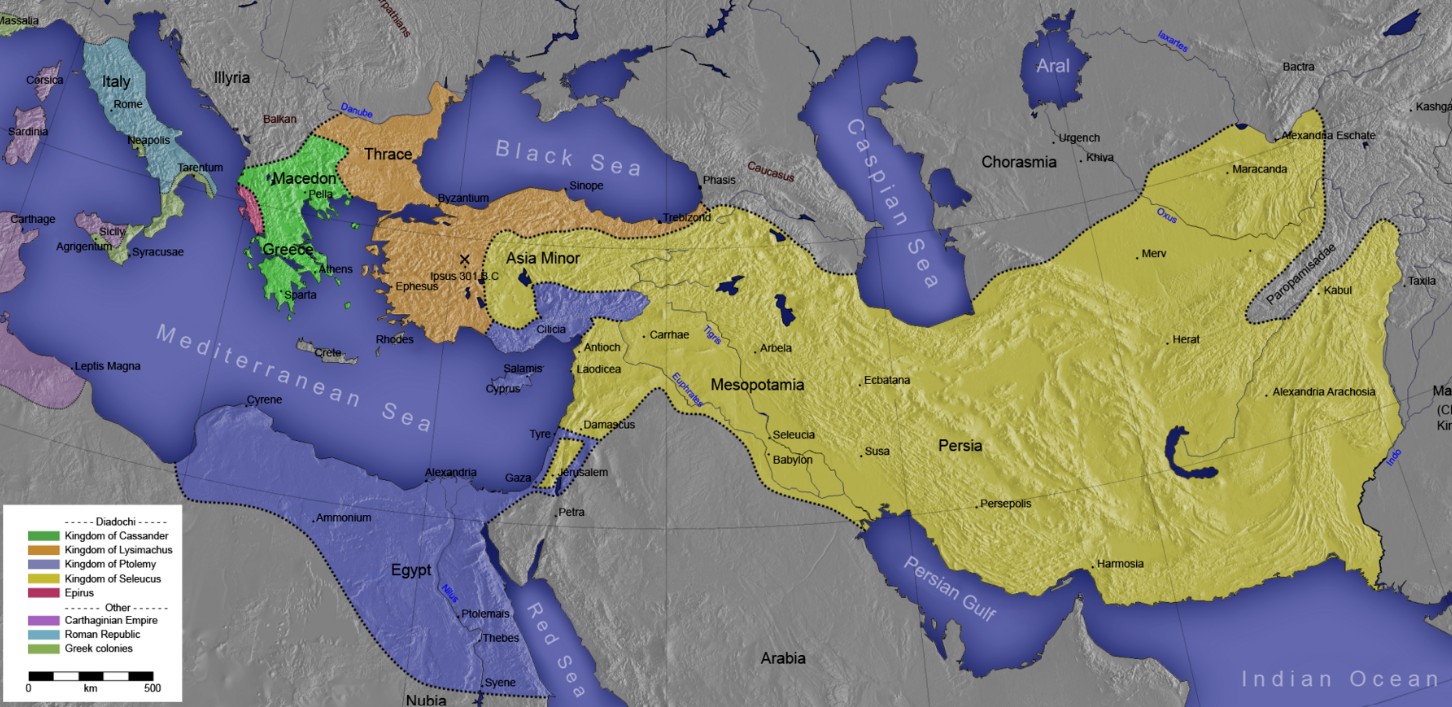
The remains of Alexander’s Empire in 301 BCE, after the wars of the diadochi
Daniel 8:9 then describes how one of the four “horns” starts small before expanding to the south and west and taking over the Holy Land. This is precisely the story of the Seleucid Empire, which became the largest of the four and eventually conquered Israel from the Ptolemaic Kingdom.
As mentioned previously, the Seleucids were originally good to the Jews, until the rise of Antiochus IV and his reforms. He “trampled” on the Temple and halted the Temple services causing “the Holy Sanctuary to be abandoned” while the “regular offering ceased” (8:11-12). Daniel says the Temple will not be destroyed, just disrupted for a short period of time. How long exactly? He suggests 2300 days total (8:14), which is about six years. This fits with the historical account during the Maccabee wars of Chanukah fame. (The Book of I Maccabees says the Temple was entirely in Greek hands for 3 years, II Maccabees says 2 years, and Josephus says 3.5 years. And we know the disruption of services began sometime before the Greeks took over the Temple completely. More on this below.) Note how none of this happened with the Roman Empire—the Temple offerings were not temporarily halted by the Romans; the Romans destroyed the Temple permanently, with no services returning since then, two millennia later.
For those still doubting, Daniel goes on to explicitly confirm that the ram is Persia and the goat is Greece: “The two-horned ram that you saw [signifies] the kings of Media and Persia; and the buck, the he-goat—the king of Greece; and the large horn on his forehead, that is the first king. One was broken and four came in its stead: four kingdoms will arise out of a nation, but without its power.” This is a blatantly obvious reference to Alexander the Great and his four successors. The final few verses of the chapter describe the campaigns of Antiochus IV against the Jews, and his attempt to destroy God’s holy people.
Again, the meaning of Daniel 7 and 8 are perfectly clear and unequivocal: nothing to do with Rome or the destruction of the Second Temple. Everything to do with Greece, Alexander and Antiochus IV, the disruption of Temple services for several years during the failed campaign of Antiochus, and the ultimate triumph of the Maccabees, giving rise to the Chanukah festival, which is made clear in the following chapter:
Daniel 9 starts with Daniel beseeching God to forgive Israel for their sins. The angel Gabriel then comes and says that God decreed 70 weeks of Temple disruption, until the Temple vessels are re-anointed once more. The re-anointing is an obvious reference to the Maccabees and Chanukah, the reanointing and rededication of the Temple! Again, there was no such reanointing with the Romans. The Romans destroyed the Temple permanently. Daniel 9:24 is a reference to Chanukah: “Seventy weeks have been decreed for your people and your holy city until the measure of transgression is filled and that of sin complete, until iniquity is expiated, and eternal righteousness ushered in; and prophetic vision ratified, and the Holy of Holies anointed.”
Note how Daniel says seventy weeks, just over a year. Christians had to reinterpret it as years to make it fit their narrative, so they say seventy weeks of years, to make 490 years, to leap way ahead five centuries into the future in order to fit the Jesus timeline. This is totally contrary to the text. Weeks are weeks, and years are years. In fact, the chapter begins with Daniel speaking of the 70 years of Babylonian Exile. If he had wanted to say “years”, he would have, just as he does at the beginning of the chapter. Daniel says weeks because he means weeks. And Daniel says the Jewish people will suffer a decree of 70 weeks, just under a year and a half, of hopeless persecution. (This fits well with the II Maccabees timeline which says the Greeks were in complete control for about two years.) He then says: “And after sixty-two weeks, the anointed one will disappear and vanish. The army of a leader who is to come will destroy the city and the sanctuary, but its end will come through a flood. Desolation is decreed until the end of war.” (9:26)
The “anointed one” will die after only 62 weeks of leadership, just over a year. Who is this referring to? Who is the anointed leader here, the mashiach? Remember that in the Torah of Moses, the term mashiach appears just four times, all referring to hakohen hamashiach, the anointed high priest (as in Leviticus 4:3, for instance). Who was the high priest that launched the revolt against Antiochus’ oppression? Matityahu! Matityahu was literally the kohen mashiach, the anointed priest. That was his official title, as per the Torah. And he ended the hopeless oppression by launching a large-scale revolt and changing the fortunes of the Jewish people.
Daniel says he leads for just 62 weeks before dying. We know from I Maccabees 2:69-70 that Matityahu led the revolt for just over a year—right in line with Daniel’s prophecy of 62 weeks. After Matityahu died, his son Judah took over and the tides of the war finally turned.
The final verse 9:27 says that the wicked king will place an abomination in the Temple. We know this happened with Antiochus; it did not happen in the time of Jesus, when the Temple was in Jewish hands up until the last moment, and no one put any abomination in the Temple then. On the contrary, a few decades earlier the Jews had revolted when Herod had tried to just place some Roman eagles outside the Temple. Even this was too much of an abomination for the strict Judeans at the time. They would never dare allow any abomination anywhere near the Temple!
And so, it is beyond obvious and clear that Daniel 7-9 has nothing to do with Jesus or Christianity. It is describing the Jewish-Greek wars (and this is explicit in the text itself, which names Greece, and says nothing at all of Rome). The short-serving mashiach mentioned in Daniel 9 is undoubtedly Matityahu, the anointed leader who died only one year into the war. This is not Jesus, who was never “anointed” at all. (The New Testament has to deal with this problem, so it says he was anointed with the Holy Spirit, see Acts 10:38.) Nor does Daniel here say anything about a crucifixion or execution of any kind, or resurrection for that matter. The anointed leader simply dies, and the war continues, and an abomination is placed in the Temple, but soon the Jews win, the Temple is rededicated, and the Seleucid Empire goes on to be obliterated and never rise again.
Again, there is nothing in Daniel 7-9 about Jesus. When one knows history, as our Torah portion Ha’azinu instructs, everything becomes abundantly clear. And it is worth concluding with the words of Ha’azinu, where it states clearly that “YHWH alone guides them, there is no other deity alongside Him.” (Deuteronomy 32:12) God is not a trinity, nor a duality, but one and singular; indivisible, with none other than Him, and no other “deity” sitting by His side (as, for instance, Hebrew 1:22 claims about Jesus sitting on the right side of God).
Relatedly, it is here in Ha’azinu that we learn the mitzvah prohibiting the consumption of yayin nesekh, idolatrous wine (Deuteronomy 32:38). What could be more idolatrous than drinking wine and believing it is the blood of Jesus? “Their wine is the venom of asps, the poison of vipers.” (Deuteronomy 32:33) This is especially revolting considering how the Torah repeatedly warns not to drink any blood whatsoever (Leviticus 17:10 and Deuteronomy 12:23, for instance).
Ha’azinu, the “Song of Moses”, was always thought to be among the most important Torah portions, and there was once a popular custom to recite it daily, and even to memorize it. At the very least, we should never forget the song’s conclusion, one of the Torah’s most beautiful verses: “See, now, that I, I am the One; there is no god beside Me. I deal death and give life; I wounded and I will heal; none can deliver from My hand.” (Deuteronomy 32:39)