
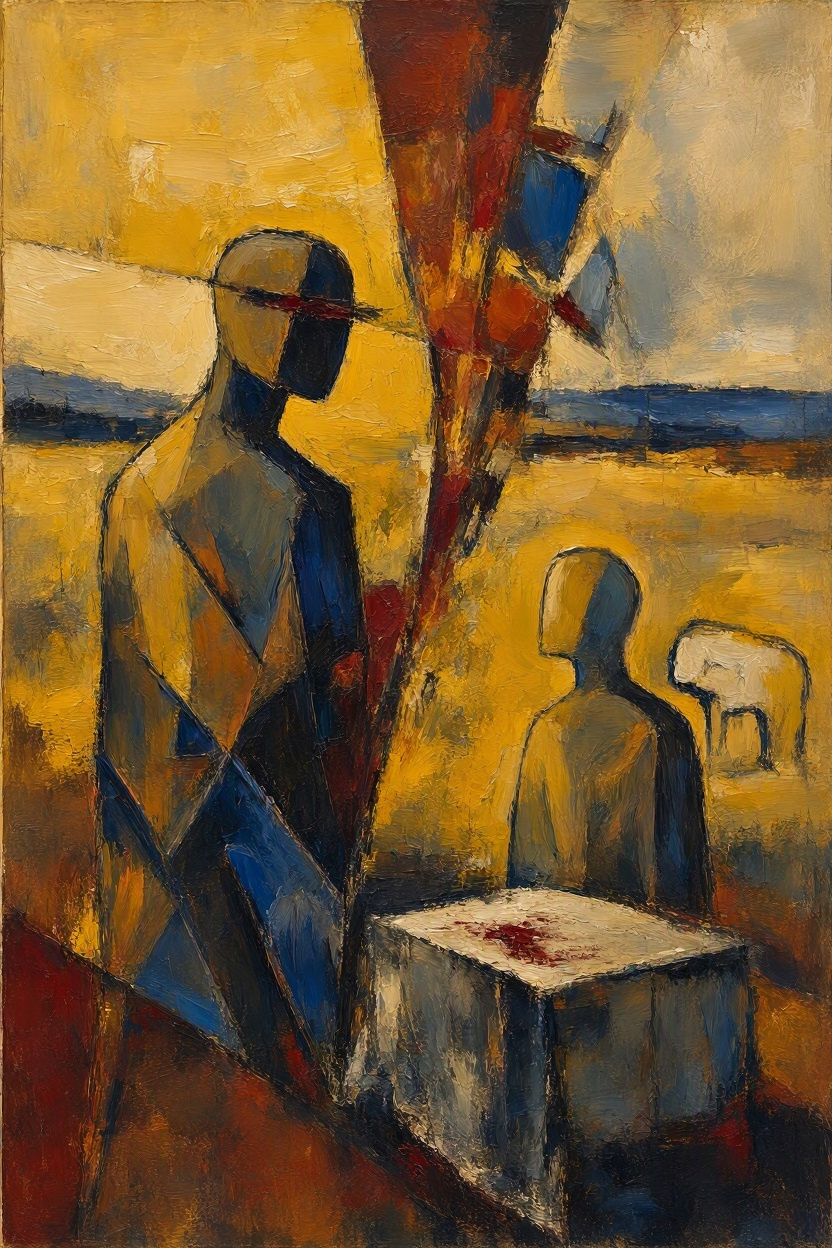
 This week we restart the Torah reading cycle with Beresheet. One of the most complex, mysterious, and intriguing passages in the parasha is the story of Cain and Abel. The entire account gets only 17 verses total. First, Cain has a bright idea to bring Hashem an offering—the first time we hear of such a concept explicitly in the Torah. Abel then copies his brother, and gets rewarded for it, while Hashem seemingly ignores Cain’s offering. This upsets Cain and he is “greatly distressed” (Genesis 4:5). Hashem asks Cain why he is so upset. “Surely, if you do right, there is uplift. But if you do not do right, sin couches at the door; its urge is toward you, yet you can be its master.” (v. 7)
The next thing we are told is that Cain is speaking to Abel, and suddenly “rises up” to kill him. God questions Cain, points out the blood of Abel calling out, and then curses Cain to be a wanderer upon the Earth. Cain’s response is that “my sin is too great to bear!” (v. 13) Cain worries that once he becomes a defenceless wanderer, anyone who finds him will kill him. God promises to give Cain a protective mark. Cain then goes to live in the land of Nod, gets married, has a son called Hanokh (“Enoch”, not to be confused with the other, more famous Enoch who never died), and builds a city that he names after his son (v. 17). That’s the whole narrative, and it brings up numerous big questions:
- Why and how did Cain kill Abel?
- When God asks Cain “where is your brother?”, Cain answers that he doesn’t know. How could Cain blatantly lie to God? Is he not aware of the basic fact that God is omniscient? Did he learn nothing from his parents (Adam and Eve) who tried to hide from God?
- On that note, Cain is clearly on a high prophetic level, able to communicate openly and directly with God. He seemingly invents the concept of offerings to Hashem, and later admits that his “sin is too great to bear”. This does not sound like an evil person. On the contrary, it sounds like someone who deeply wishes to serve God, and who is remorseful and repentant. Which is it? Who was Cain really?
- Cain worries that if he becomes a wanderer, “hidden from God’s face” (4:14) and without God’s protection, anyone who finds him will kill him. If there are no other humans besides Cain, Adam, and Eve at this point, who is he worried about? And who, exactly, did he end up marrying?
- Finally, despite being cursed to wander, we are told that Cain did not actually become a wanderer at all and, on the contrary, build the first human city! Why was his curse not realized? And why did he build a city? Why is a whole city necessary for a single family? And why did he specifically name his city Hanokh?
To answer the first question, the commentaries provide several answers. Many go with the simplest reading which implies that Cain killed Abel over the offerings. Abel stole Cain’s idea and then “one-upped” him. Cain was upset and struck his brother. Abel died. It is possible that Cain didn’t know that Abel would die, since he would not have been familiar with death. After all, Abel was the first person to die, and Cain was likely shocked and surprised by the outcome.
On the other hand, the Ramban (Rabbi Moshe ben Nachman, “Nahmanides”, 1194-1270, on Genesis 4:8) suggests that Cain’s murder was intentional. He sought to rule the world alone, so he got rid of his brother. Cain wanted only his own progeny to fill the planet, and the entire Earth to be his. The Midrash (Beresheet Rabbah 22:7) presents a similar narrative. The brothers had agreed that one of them would get all the land and the other would get all the goods. “This one said: ‘The land on which you are standing is mine.’ That one said: ‘What you are wearing is mine.’ That one said: ‘Take it off.’ This one said: ‘Fly.’ As a result: ‘Cain rose up against Abel his brother and killed him.’”
Another opinion in the same Midrash is that they were arguing over where the Holy Temple would eventually be built, each wanting it on his land. Yet another opinion presented is that they were fighting over who would get to marry “the first Eve” (ie. Lilith). This opinion is rejected because the first Eve had been destroyed, at which point the Midrash suggests the better-known opinion that Cain and Abel fought over a twin sister. Cain was born with a twin sister, and Abel was born with two twin sisters. Cain reasoned Abel’s second twin should be his wife, since he was older and the firstborn gets a double portion. Abel reasoned the extra twin should be his wife, since she was born alongside him. Presumably, incest was then allowed because there were no other people to mate with anyway (more on that below). Cain killed Abel to get the second twin. The Midrash then offers various opinions as to how Cain killed Abel: either with a stick, or a stone, or by slaughtering him—which he learned from Adam when he made the first sacrifice of a one-horned animal. (More on that in last year’s class on sacrifices here.)
Tosfot (in Da’at Zekenim on Genesis 4:8) places at least some of the blame on Abel. It says that Cain opened up to his brother about how disappointed he was following the offerings debacle. Instead of supporting him, Abel was joyous and heaped more shame on his brother. This is when Cain got upset and retaliated, fatally. The Arizal (Rabbi Itzchak Luria, 1534-1572) adds to this, saying that Abel’s soul had a total of 345 spiritual sparks, of which a whopping 308 were negative, and only 37 were positive (as discussed in detail in the recent class on the number 37). Apparently, there was a lot more bad than good within Abel that needed rectification (see Sha’ar haPesukim on Vayera).
Meanwhile, the Ben Ish Chai (Rabbi Yosef Chaim of Baghdad, 1835-1909, in Aderet Eliyahu on Genesis 4:8) writes that Cain was generally a good and loving sibling, and spoke to his brother softly, and always referred to him with endearing terms. He was tinged with a bit of jealousy, yes, and was embarrassed by the incident over the offerings, but had no intention to kill his brother. Rather, it was when “they went out in the field” that the yetzer hara got a hold of him. It was as if he was “possessed” and committed the crime in a state of madness.
Finally, the Zohar takes a particularly negative view of Cain. The Zohar (I, 37a) posits that Cain was actually not the son of Adam, but the son of the Serpent, who had copulated with Eve. It identifies the Serpent with the wicked angel Samael, and therefore puts Cain as one of the Bnei haElohim that mated with the daughters of man (Genesis 6:2). Cain’s entire lineage of hybrids was tainted with evil. He killed Abel because of this inherent evil—perhaps seeking to extinguish the lineage of Adam. The Zohar (III, 231a-b) goes so far as to say that the serpentine Cain killed Abel by “biting him like a snake”!
That said, when we go back to the actual Torah text and unravel it word-by-word, we might discover a totally different perspective on Cain.
Redeeming Cain
The Torah tells us that Eve named her first son Cain because kaniti ish et Hashem, “I have acquired a person with God.” (Genesis 4:1) This implies Cain was conceived in holiness, not in evil; with Hashem’s help, and not Samael. Indeed, the Talmud (Sanhedrin 38b) says that Cain and Abel were conceived before the Forbidden Fruit incident, so the Serpent was not yet in the picture. We then see that Cain seeks to serve and please Hashem, and brings him an offering. The term used is a minchah, meaning a vegan offering, typically of grain, or in this case, fruit. Cain does not slaughter any animals. He is not blood-thirsty or cruel. He does not violate the then-prohibition of meat consumption. He invents the concept of a peaceful minchah offering. This is a person with noble intentions. Abel copies him and tries to outdo his brother. It’s understandable that Cain gets upset.
God comes to speak to Cain, who is worthy to receive direct communication from Hashem. Cain seemingly speaks to God openly, “face to face”, reminiscent of how Moses later would. God does not chastise Cain or describe him as evil in any way. On the contrary, he says that Cain should not be upset, and that he has the potential to reach the greatest heights. God tells Cain that the evil inclination will tempt him, yes, but atah timshal bo, “you shall master it”. Hashem does not say that Cain might be able to master it, it’s implied from the phrasing that Cain will master his evil inclination.
We then see that Cain does succumb to the evil inclination when he kills Abel. Yet, as we see from the commentaries above, the conflict was not baseless, and Abel was not blameless. Cain immediately regrets what he did, and cries out that his “sin is too great to bear”. He resolves to be a better man, and to conquer his evil inclination as Hashem predicted. And we find that, truly, he does. We are not told that he harms any more people. On the contrary, he settles down with a family, and builds the first human city. He calls his first son, and his first city, Hanokh, literally “educate”. We might learn from this that Cain wants to educate mankind to be better, and not to succumb to evil as he once did. God’s curse for Cain is not realized—he does not become a poor wanderer, but a successful city builder. He is not murdered by anyone, and merits to live a long life.
The Torah doesn’t say exactly how long Cain lived. The Book of Jubilees (4:31) states that Cain died in the same year as Adam, who was 930 when he died. Based on the chronology in Jubilees (which suggests Cain was born in the second Jubilee), Cain would have been nearly 900 himself. Another ancient tradition, brought down in Philo’s Biblical Antiquities (sometimes called “Pseudo-Philo” by scholars) is that Cain died at 730 years old. Meanwhile, the Midrash (Beresheet Rabbah 22:12) has an opinion that Cain only died at the Great Flood, which was in 1656 AM according to rabbinic chronology, meaning that Cain lived some 1600 years! That would make him the longest-living person in Tanakh.
And who did Cain build his city for? Who did he want to “educate”? Who did he marry? The Torah says he went to live in the land of Nod, implying that it was an inhabited place. The Zohar (I, 9b) says he went to a specific place called Arka, which was inhabited by a different breed of humans. (Arka is one of the “seven lands”, or seven continents, explored previously here.) Remember that the Torah describes the creation of mankind twice, in Chapters 1 and 2 of Genesis. In Chapter 1, man is made on the Sixth Day, the same day as the animals. He is made in the image of God, yes, but there is no mention of a neshamah or civilization. It is only in Chapter 2 that a particular HaAdam is made, with a neshamah blown into him, placed in a special Garden to tend it and work it; given a purpose and a mission. This is civilized man, unlike the animalistic humans living outside of Eden that were created with the beasts on the Sixth Day. Therefore, we can logically reason that Cain went out to live among those uncivilized people (which would explain why he feared they would kill him!) and sought to educate them. He built a city for that purpose, and named it “educate”, a place for mankind to learn and get civilized. He found a wife among them, which makes a lot more sense than positing that he married his own twin (violating the Torah prohibition of incest, and opening up a host of genetic issues).
Amazingly, we find that it is in Cain’s lineage, not Seth’s, that major leaps in civilization occur. Cain’s descendant Yaval was the first of the animal herders (4:20), while his descendant Yuval was the first musician (4:21), and Tuval-Cain was the first metalworker (4:22). No such descriptions are given in the genealogy of Seth that follows in the next chapter. We only know by tradition that Seth’s descendant Enoch was great—the first scribe, philosopher, astronomer, and scientist—to whom is attributed the apocryphal Book of Enoch. And he is called Hanokh, just like Cain’s first son and city! This is surely no coincidence, and it is unlikely that a descendant of Seth would name his child after a descendant of Cain unless he was truly righteous. (There is one more person named Enoch in Tanakh, and I will say more in a separate forthcoming essay titled ‘The Three Enochs’, coming soon.)
Therefore, I believe Cain was not the embodiment of evil that he was later made out to be. I think Cain did realize God’s prophecy that he would master over evil, and ascend to great heights. And I think one can go even further: What if Cain didn’t actually kill Abel?
Revisiting Cain
Cain and Abel got into a conflict—that much we know. What happened after is not clear. When God comes to Cain asking about Abel’s whereabouts, Cain says he does not know where his brother is. “Am I my brother’s keeper?” God says that the blood of Abel is calling out of the ground. Cain breaks down and says his sin is too great to bear. After Cain is banished, his first response is that “whoever finds me will kill me”. God promises Cain that he will not be killed. This is strange, considering that the Torah’s own punishment for murder is execution. Why is Hashem protecting a murderer? And how is it that Cain suddenly breaks down in remorse if he had just murdered someone in cold blood? I believe we can read the passage differently, in a way that makes more sense. We must keep in mind the sources above that spoke of Cain as a good brother, as a grateful and sincere person, with positive intentions, and a desire to serve Hashem.
What if:
Cain and Abel got into a scuffle—not fatal, and maybe even not physical. Cain then abandoned his brother out “in the field”, alone and unprotected. Abel is discovered by those uncivilized humans (of Genesis 1), and he is killed by them. God comes to Cain and asks where Abel is. Cain does not lie to God; how could he? He genuinely does not know, because he abandoned his younger brother out in the fields. God reveals to Cain that Abel is dead, his blood calling out from the ground. Cain breaks down in anguish, and says his sin is too great to bear. God does not punish Cain by executing him—which would be the fitting punishment had Cain actually killed Abel—but only banishes him. Cain’s immediate response is that he will be found and killed. This now makes a lot more sense, ie. the same people that found and killed Abel will surely kill Cain too! So, God promises Cain protection. This only makes sense if Cain was not actually guilty of murder. And we find that the curse on Cain to be a banished wanderer is not realized at all. Cain repents, and becomes a city-dweller, and an educator for all mankind.
I believe this reading makes a lot more sense overall, and is truer to the plain text of the Torah. But it does have one glaring problem. Why does the Torah say explicitly that Cain “killed” Abel?
The truth is, this is a common manner of speech in the Torah. There are many examples where the Torah blames someone for doing something even though they did not actually do it. For instance, we read that Solomon apparently served idols:
Solomon followed Ashtoreth the goddess of the Sidonians, and Milcom the abomination of the Ammonites. Solomon did evil in the eyes of God and did not remain loyal to God like his father David. At that time, Solomon built a shrine for Chemosh the abomination of Moab on the hill near Jerusalem, and one for Molech the abomination of the Ammonites… (I Kings 11:5-7)
The wisest man of all time committed the worst acts of abomination and evil? The same great king who merited to build the first Holy Temple and was blessed by God to have everything? The prophet who wrote three of the Tanakh’s twenty-four holy books? Our Sages said “no way!” The Talmud (Shabbat 56b) makes clear that
Anyone who says King Solomon sinned is nothing other than mistaken, as it is stated: “And his heart was not perfect with YHWH his God, as was the heart of David, his father” (I Kings 11:4). By inference: Solomon’s heart was not equal to the heart of David, his father; however, he did not actually sin!
Solomon certainly did not literally serve idols (which would have resulted in capital punishment for him), but because he let it happen in his household and turned a blind eye to others doing it, the Torah reckons as if he himself did it. Earlier in the same page of Talmud, we read the same about David and Batsheva:
Anyone who says that David sinned is nothing other than mistaken, as it is stated: “And David succeeded in all his ways; and God was with him” (I Samuel 18:14). Is it possible that sin came to his hand and nevertheless the Divine Presence was with him?
The Tanakh makes it seem like David literally committed adultery, but the Sages point out that he technically did not, and that Batsheva was his true soulmate, designated since Creation (Sanhedrin 107a). The entire messianic lineage emerged from David and Batsheva, so it was obviously meant to happen! Many other examples are given in the above Talmud, including Reuben, Josiah, and the sons of Eli and Shmuel. Previously, we discussed the brothers of Joseph, who clearly didn’t sell him, but because they let it happen, the Torah makes it seem like they did.
So, I believe Cain could well be in the same category as David, Solomon, the brothers of Joseph, and all the other greats. Cain didn’t actually commit murder, but because he failed to protect his little brother and abandoned him, the Torah reckons it as if he did. He abandoned his sibling in the fields, and that was his huge mistake, a “sin too great to bear”. The lesson for us is crystal clear: brothers must take care of each other, and protect one another at all times. Brothers should never abandon each other, not even for a moment. “Do not stand by while your fellow’s blood is shed, do not hate your brother in your heart.” (Leviticus 19:16-17) Over and over, the Torah repeats the same message.
And this is true not only for our immediate siblings, but for the entire nation, since we are all brothers. We know that we need ahavat hinam, genuine brotherly love, to bring about the Final Redemption. And I believe this is alluded to in the Torah’s command to anoint a king. “You shall set a king over yourselves, one chosen by YHWH your God, from among your brothers [mikerev achikha] you shall set a king over yourselves…” (Deuteronomy 17:15) The wording is ambiguous; is Hashem choosing a king, or are we setting him over ourselves? I think the deeper meaning here is that when we internalize the Torah’s message of brotherly love, and truly love one another and stand up for each other like good brothers, then Hashem will certainly choose an anointed king for us, and Mashiach will arise from among our brothers.