
Tag Archives: Primordial Serpent

God of Gods, King of Kings

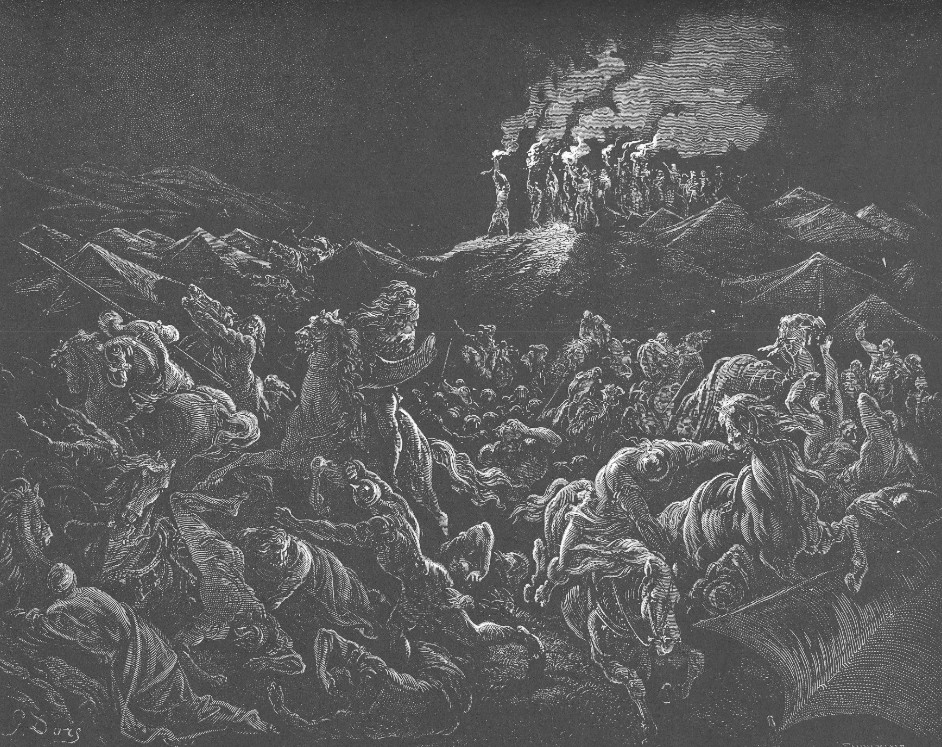
‘The Midianites Put to Flight’ by Gustav Doré

One of the difficult passages in this week’s double parasha, Matot-Massei, which closes the Book of Numbers, is where God seemingly commands a complete massacre of a neighbouring people, the Midianites. This is actually God’s final command to Moses, saying “Take revenge for the Israelites against the Midianites. Afterwards, you will be gathered to your people.” (Numbers 31:2) The next and final book of the Torah is Moses’ own account of his leadership, and was relayed over the last 37 days of his life.

The Israelites go on to slaughter every male Midianite (31:7), take the women and children captive (31:9), then burn down all the cities and take plunder (31:10-11). Still, the Israelites are chastised for letting the adult women live (31:15), as they were the very ones that tempted Israel into various sexual sins beforehand. Understandably, this is one of the most troubling passages in the whole Torah—how could a holy nation seem to behave in a manner more like the violent and bloodthirsty nations we condemn? Unfortunately, passages like this have also turned many away from the Torah, and generated numerous atheists. One such atheist is Richard Dawkins, who summarized it this way in his book, The God Delusion (ch. 2): Continue reading
Understanding Hair Covering for Women in Jewish Law

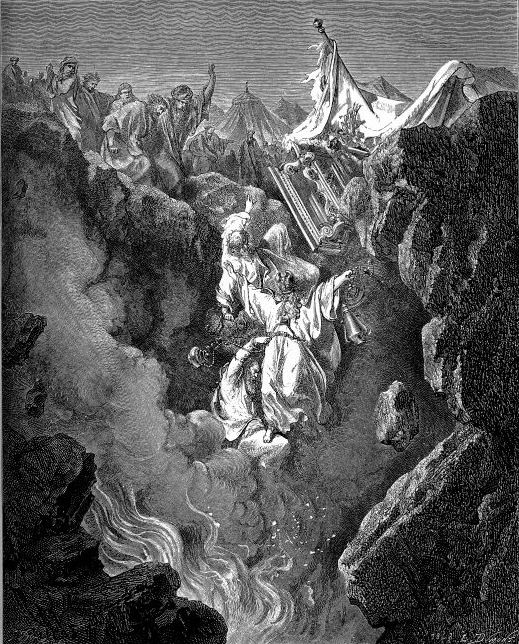
“Death of Korah, Dathan, and Abiram” by Gustave Doré

This week’s parasha, Korach, has a hidden theme: hair. In fact, the name of the villain himself, Korach (קרח), is spelled exactly the same way as kere’ach, “bald”. As we shall see below, Korach’s rebellion began when he saw himself bald-headed following his initiation ritual as a Levite. Hair comes up again in the famous story of one of Korach’s co-conspirators, a man named On ben Pelet. On is strangely mentioned right at the beginning of the parasha (Numbers 16:1), and never again. The Talmud (Sanhedrin 109b-110a) explains that he was saved thanks to his wife: She told her husband that he had nothing to gain from joining the rebellion; now he was subservient to Moses, and if the rebellion would be successful he would just become subservient to Korach!

On understood, but worried that he had already agreed to join the group. So, his clever wife got him drunk and sleepy, and On passed out in bed. Meanwhile, she went out to the entrance of their tent and “exposed her hair”. When Korach’s collaborators approached, the Talmud says they turned away due to the immodest sight of the woman. By the time On recovered from his drunken stupor, the whole episode was over, and he was spared. This story implies that Jewish women cover their hair, and for a woman to expose her hair publicly is immodest. Yet, nowhere in the Torah is there an explicit command for a Jew to cover their hair at all times (male or female). Hair-covering is not listed among the 613 mitzvot! If it isn’t a Torah mitzvah, where did it come from? Continue reading

The Spiritual Significance of 2025

What is the significance of the alignment of the last night of Chanukah with the first day of 2025? What does it have to do with the upcoming Chinese Year of the Snake? And how is it all connected to the new month of Tevet and the current Daf Yomi tractate Sanhedrin? Also: Why was the Zohar revealed to the world in the year 1290? Which verses in Tanakh prophetically allude to the year 2025? What is the significance of the letters on the dreidel? And what happened when Alexander the Great presided over a lawsuit against the Jews?

See also ‘The Dragon, the Snake & the Messiah’ and ‘Chinese Zodiac in Judaism’.