
This week’s double parasha, Nitzavim-Vayelekh, contains the famous verse “the concealed things are for Hashem, and the revealed things are for us and for our children, forever” (Deuteronomy 29:28). The “concealed things” are typically understood as referring to the concealed secrets embedded in the Torah, the deepest dimension of sod. The Torah is written in simple and plain language, in the style of narratives and stories, so that all people in all generations could understand it, even “children, forever”. For those who want to plunge deeper, however, there are profound secrets encoded within each word and letter. This field of study is commonly referred to as “Kabbalah”.
When we look at the various branches and styles of Kabbalah over the course of history, we can ten types altogether. This is fitting, since the core teaching of Kabbalah is the notion of Ten Sefirot, and we find countless things in Creation that parallel and reflect the Ten Sefirot. So, what are the ten types of Kabbalah, and how exactly do they parallel the Sefirot?
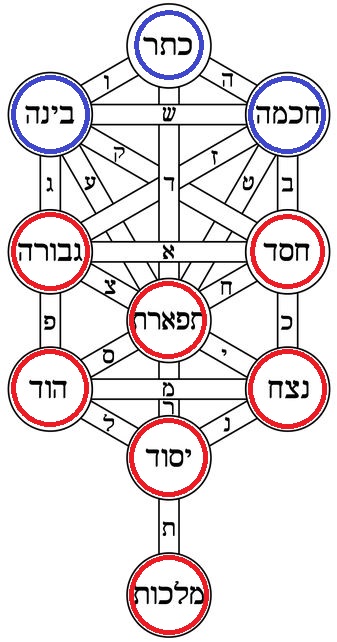
The Sefirot of Mochin above (in blue) and the Sefirot of the Middot below (in red) on the mystical “Tree of Life”.
The first three Sefirot are referred to as the Mochin, the “mental” or “intellectual” faculties. They are loftier and more transcendent, lying above the lower seven. First is Keter, literally the “crown”, referring to divine willpower. It is the highest and most sublime. Then comes Chokhmah, often translated as “wisdom”, but more like raw knowledge. Sitting opposite is Binah, “understanding”, going further past the raw information; involving synthesis, integration, and connection. Often, Keter is replaced with Da’at, literally “knowledge”, but described as more like “unification”. Whereas Keter is the initial will to do something, Da’at is the final manifestation of that will. Da’at is like the link between Chokhmah and Binah. These three are therefore often referred to by their acronym Chabad, standing for Chokhmah, Binah, and Da’at.
The Mochin neatly parallel the three original forms of Kabbalah: meditative, theoretical, and practical. Meditative Kabbalah, as the name suggests, deals with various meditative practices and rituals meant to uplift a person spiritually, elevating one’s soul ever-higher, perhaps even achieving an “out of body experience” or astral projection. Through Meditative Kabbalah, one is able to ascend to the highest realms and “touch” the divine. This corresponds to the loftiest and most sublime Keter. It is like linking one’s mind to the mind of God, so to speak.
Theoretical Kabbalah explores the nature of reality and the spiritual fabric of the cosmos. It is all about acquiring deeper knowledge of Creation—hence the parallel to Chokhmah. In fact, our Sages say that Creation was accomplished through Chokhmah, and Beresheet alludes to resheet chokhmah, “primordial wisdom” (as in Psalms 111:10, for instance). One of the most ancient mystical texts that we have—if not the most ancient—is Sefer Yetzirah, which begins by teaching that God created the cosmos through lamed-beit netivot chokhmah, “Thirty-Two Paths of Wisdom”. All of Creation emerges out of divine wisdom, and is a reflection of Chokhmah. The deeper study of Creation, therefore, parallels the Sefirah of Chokhmah.
Then there’s Practical Kabbalah, sometimes associated with “white magic” and the ability to generate a physical affect on the world. It is Sefer Yetzirah which is most-associated with this kind of power, and our Sages famously used it to create a “third-born calf” (Sanhedrin 67b), and even a whole human-like golem (Sanhedrin 65b). The core of Sefer Yetzirah is understanding the divine Hebrew alphabet and learning how to link and synthesize the letters to develop generative and creative powers. This synthesis is precisely the synthesis (and deeper “understanding”) of Binah. It is fitting that Binah is also called Ima, the “mother”, and is sometimes described as a generative womb.
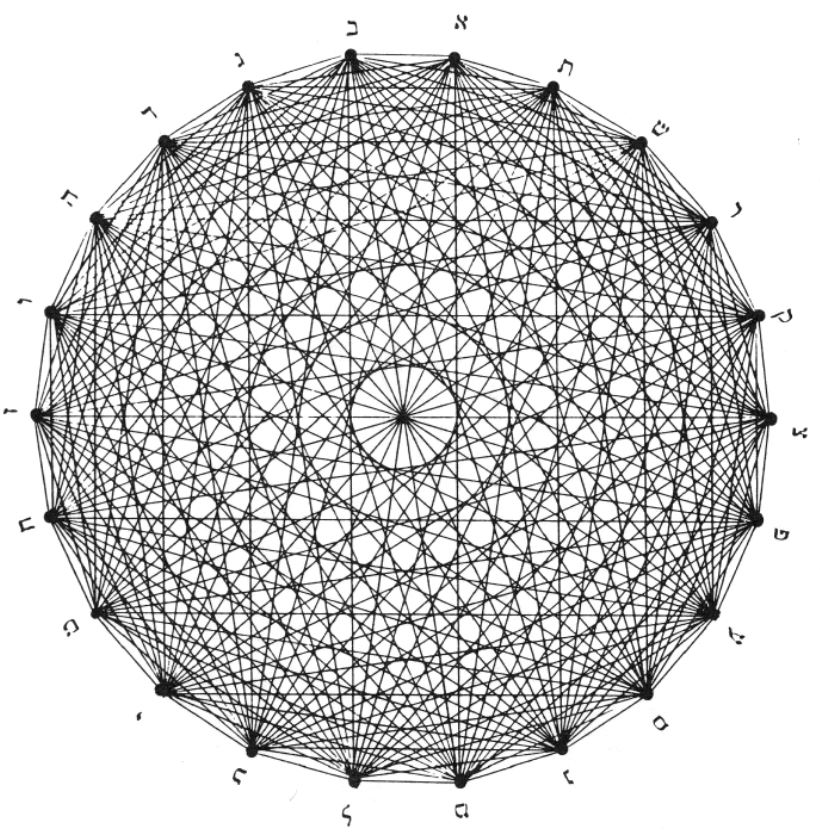
The Wheel of “231 Gates”, with lines connecting every combination of Hebrew letters. These are the “building blocks” of the cosmos.
The other equally ancient texts from around the same time period are the Heikhalot, describing various Heavenly journeys and “out of body experiences” of our Sages. This ties directly to Meditative Kabbalah and Keter. Finally, we have the various works of old mystical Midrash (in which one can include the Zohar, originally called Midrash d’Rabbi Shimon bar Yochai) which explore the nature of reality and the cosmos. These are the texts of Theoretical Kabbalah and deepest Chokhmah.
It was in 16th Century Tzfat that these ancient mystical texts were all integrated, unified, and systematized. It was first done by the Ramak (Rabbi Moshe Cordovero, 1522-1570), and then more fully by his successor, the Arizal (Rabbi Itzchak Luria, 1534-1572). More than any other, it was the Kabbalah of the Arizal (or “Lurianic Kabbalah”) that went on to completely revolutionize every aspect of Judaism, to this day. Lurianic Kabbalah, therefore, is a fitting parallel to Da’at, the place where the Mochin are unified and “systematized”. We say that out of that union in Da’at result the seven lower Sefirot, or Middot.

The Ten Sefirot
The first of the lower seven is Chessed, “kindness” and positivity, also known as Gedulah, “greatness” and “largesse”. Opposite lies Gevurah, “strength” and restraint, also known as Din, “judgement”. Balancing the previous two is Tiferet in the middle, meaning “beauty” or “harmony”, and representing compassion, mercy, and symmetry. I believe these represent the three major streams that emerged from Lurianic Kabbalah. One was the Kabbalah of the Ramchal (Rabbi Moshe Chaim Luzzatto, 1707-1746), which went further into the exploration of the cosmos and reality, unraveling the greatness (gedulah) of the Creator and His cosmos. It extends directly from the Chokhmah and Theoretical Kabbalah that lies above Chessed.
Around the same time emerged the Kabbalah of the Rashash (1720-1777), centred on meditations and kavanot, various intentions and mantras to have during prayer. This is the most difficult of the Kabbalistic systems, requiring tremendous amounts of time, concentration, effort, and practice. It very much fits with the restraint and self-discipline of Gevurah, not to mention the severity and difficulty of Din. Like Binah and Practical Kabbalah that lies directly above, it is quite challenging to actually put in practice, and few achieve success in this field.
In the middle is the Kabbalah of the Ba’al Shem Tov (Rabbi Israel ben Eliezer, c. 1698-1760), also known as “Hasidism”, which sought to infuse Kabbalah into everyday life. It, too, teaches various kavanot and meditative techniques like the Kabbalah of the Rashash, while also being intellectually stimulating and exploring the nature of reality like the Kabbalah of the Ramchal. (It is worth noting that some include with the Kabbalah of the Ramchal the similar Kabbalah of the Vilna Gaon.) Hasidism became a sort of “Jewish psychology”—and, in fact, did give rise to the modern field of psychology. It has been used extensively for mental, emotional, and spiritual healing. It lies beneath Keter because it can be seen as an extension of the original Meditative Kabbalah, and it lies beneath Da’at because it aims to make mysticism pragmatic and integrated into daily life. It is Tiferet because it is meant to bring about mental and emotional harmony, while serving as a source of healing. Tiferet is intrinsically linked to healing, and shares a root with the Hebrew word for healing, refuah. After all, healing is really just restoring balance to what is imbalanced and out of place. Of course, the Ba’al Shem Tov was himself a renowned folk healer!
The next three Sefirot are Netzach, Hod, and Yesod. Netzach is literally “victory” or “eternity”, and represents faith and persistence. At its core is direct connection to the one true Creator, referred to as Netzach Israel. On the other side is Hod, “majesty” or “splendour”, but also gratitude and grace. Netzach and Hod are intertwined and referred to as the “two legs” or “two thighs”. They are described as the roots of prophecy and divine inspiration. Between them lies Yesod, literally “foundation”, the place of intimacy, connection, and reproduction. What might these lower Sefirot represent in the realm of mystical teachings?
One of the interesting things we find in history is that a lot of the same mystical ideas found in Kabbalah are found in other religions. Secular Jews often find themselves drawn to these ideas in foreign religions, without realizing they have them in their own religion! Perhaps the most popular case of this is in Eastern philosophies, particularly Buddhism and Hinduism. These religions are also big on meditation, mantras, reincarnation, spiritual ecstasy and out of body experiences. Not surprisingly, they have attracted many Jews over the past century.
There is a notion in Kabbalah that just as the Jewish people went into exile, the Torah is “exiled” too and there are Torah ideas in “exile” among non-Jewish religions. Part of our work is in finding these ideas and showing their true source in the Torah. In this way, it is as if we are “Ingathering the Exiles” of Torah thought. For example, one can see major parallels between the Sefirot and Hindu Chakras, or the parah adumah and the Hindu holy cow, or the Hindu Brahman and Saraswati in Abraham and Sarah (wrote more about all of these, and more, here, as well as in the class on ‘Judaism vs. Hinduism’). It is often said that when Abraham sent his children to the East with “gifts” (Genesis 25:6), these were spiritual gifts and mystical teachings that the children carried across Asia, and eventually gave rise to religions like Hinduism. And this would explain why those authentic kernels of Kabbalah taught by Abraham (who is also commonly identified as the author or first expositor of Sefer Yetzirah) can be found in Indian mysticism and Eastern philosophies today. In Hebrew, “India” is Hodu, which I believe is a clear allusion to the Sefirah of Hod, where this type of mysticism is rooted.
On the opposite of Hod is Netzach. Of the non-Jewish religions, the religion that is most monotheistic (and superficially most similar to Judaism) is undoubtedly Islam. They are very much tied to Netzach, both in terms of its monotheistic core, and its domineering energy. Islam is an “Abrahamic” religion, claiming descent from Abraham (or “Ibrahim”, to them). It is an offshoot of Judaism, and borrowed many Jewish ideas and teachings. The Koran even quotes from the Talmud! (As I explored in the class on ‘Judaism vs. Islam’.) Islamic mysticism has tremendous depth, too, and the Sufi tradition has a great deal of overlap with Kabbalah. In fact, Rabbeinu Avraham (1186-1237, son of the Rambam) went so far as to say that the Muslim Sufi mystics preserved the mystical tradition of the Hebrew prophets! In his Kitab Kifayah al-Abidin, he wrote that “the ways of the ancient saints of Israel, which are not or but little practised among our contemporaries, have now become the practice of the Sufis of Islam, on account of the iniquities of Israel.” Rabbeinu Avraham admits that there are kernels of authentic Kabbalah dating back to our prophets within Islamic mysticism! He actually studied with the Sufis himself, as did other Egyptian rabbis, and scholars have traced those teachings eventually migrating to Tzfat, which then became the capital of Kabbalah in the 16th Century.
Between Netzach and Hod is Yesod where, I believe, lies the other major mystical religion that resembles Judaism (and that emerged directly from Judaism): Christianity. There are great overlaps between Christian mysticism and Jewish mysticism, too. In fact, the Zohar has been accused by its critics of drawing from Christian teachings (see ‘When & Why Was the Zohar Published’ in Garments of Light, Volume Three). Meanwhile, Hasidism has been compared to Christian mysticism as well, and emerged at the same time as a very similar movement in the Russian Orthodox Church (as I discussed in a recent class here). It is fitting to place those kernels of Kabbalah that “went into exile” in the Christian world within Yesod, under Tiferet where lies Hasidism. And it is all the more fitting to place it in Yesod because the founding figure of Christianity is thought to have been celibate, as are many of the priests of that religion to this day.
It must be repeated that all of this is not to say that Eastern, Christian, or Muslim mysticism is authentic Kabbalah, but only that kernels of authentic Kabbalah made their way to these religions, whether because of their links to Abraham, or because of their emergence out of Judaism, or because of the notion of “Torah in exile”, or because of “cross-pollination” of ideas over the course of history, as religious groups interacted with one another and rubbed off on each other. And it serves to explain why Jews are sometimes drawn to these other religions, because their neshamahs recognize something familiar and true in them. Hopefully, they are able to find their way back to Judaism and authentic Kabbalah (as is the case many times).
We are left with one final Sefirah at the very bottom, Malkhut, “kingdom”. It is described as the “empty vessel” at the base of the Sefirot, the receptacle that collects all the energy flowing from the Sefirot above. This is the Kabbalah of Mashiach, that collects all the types of mysticism above it and is able to make sense of them all and unify them all and pinpoint their primordial root in the Torah. In this way, through these teachings, all peoples of the world can see the wonder and majesty of Hashem, and come to His recognition and service. After all, the Final Redemption is a redemption for the whole world, as the prophets repeat countless times. And the Redemption will only be possible by revealing the inner dimensions of Torah to all nations. In our digital age, and in our world of free information and instant communication, we are absolutely ready for it.
A helpful diagram to summarize the above:
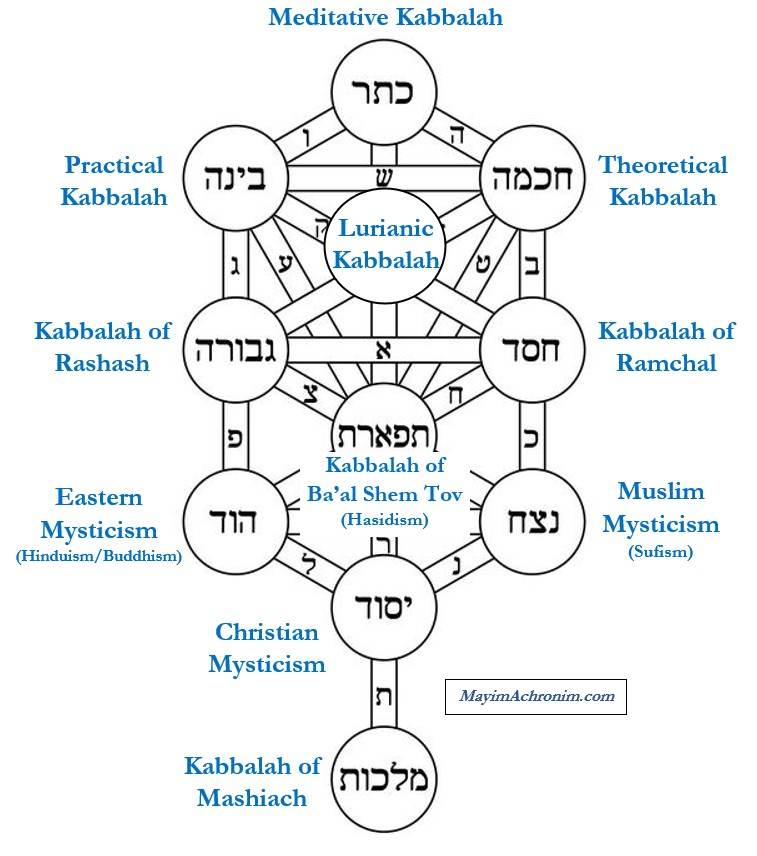
*Note that within “Eastern Mysticism” one can include other Eastern philosophies and schools of mysticism, including Jainism, Zoroastrianism, Shintoism, Taoism, Confucius, etc. Similarly, within “Muslim Mysticism” one can include those mystical religions similar to, or offshots of, Islam, such as Bahai or Druze.
Wishing everyone a ketiva v’chatima tova and a happy, healthy, sweet new year!
Rosh Hashanah Learning Resources:
The Puzzle of Rosh Hashanah (Video)
Secrets of Rosh Hashanah
The Origins & Meaning of Tashlich