Tag Archives: Biblical Hebrew

Demystifying Daniel’s Prophecies

In the Torah portion of Ha’azinu, we read about the importance of “remembering the days of the world” and “understanding the years of past generations” (Deuteronomy 32:7). It is absolutely vital for each person to have a solid grasp of history. It is only when one knows history that they will be able to properly understand the Scriptures. Reading the Tanakh without its historical context is futile, and will lead to false faith.

Case in point is the Book of Daniel, perhaps the most misunderstood and abused book of Tanakh. Christians often use it to “prove” that Jesus was the Messiah. The reality is that Daniel’s prophecies undoubtedly point to someone else as the “anointed one”, and have nothing at all to do with Jesus, or Christianity, or even the destruction of the Second Temple or the Roman Empire. Once a person understands the historical context of Daniel, everything becomes abundantly clear.

Daniel’s “Vision of the Four Beasts” by Gustave Doré

The critical part of Daniel to understand is the three central prophetic chapters, 7 to 9. Chapter 7 starts with the famous Vision of the Four Beasts. Daniel beholds four great creatures emerge from the sea. The first is a lion with eagle wings and human features (7:4). The second is a bear with three fangs (7:5). Then a leopard with four wings and four heads (7:6). Then the most terrible beast of all, different than the others, with iron teeth and ten horns (7:7). Another little horn emerges from the head of this beast, and it was like a human that spoke arrogantly (7:8). Continue reading →
Vav or Waw?

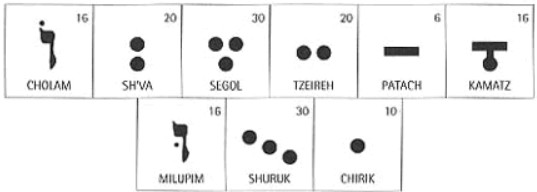
This article is a follow-up to the previous one about the correct pronunciation of God’s name (יהוה), YHWH. Recall that our Sages teach that the nekudot vowels on God’s name are shva, cholam, and kamatz, meaning that the right way to pronounce the name would be “Yehowah”. A number of people reached out arguing that the letter vav is pronounced with a “v” sound, and therefore the name is “Yehovah”. Some referred to the work of Dr. Nehemiah Gordon, who makes the case for the vav being “v” partly based on words in Ezekiel (more on that below), and partly based on a poem by Elazar haKalir (c. 6th century CE) where he rhymes levi (לוי) with navi (נביא). The implication is that Jews as far back as the 6th century were pronouncing the vav as a “v” sound. Gordon himself notes that great rabbis like the Ibn Ezra were puzzled by this rhyme, because it was common knowledge then that the vav is really a “w” sound. Indeed, we find that the vav was a waw for most of Israelite and Jewish history. Below are ten big reasons for why the vav is a waw. Continue reading →

The Letters of Creation (Video)

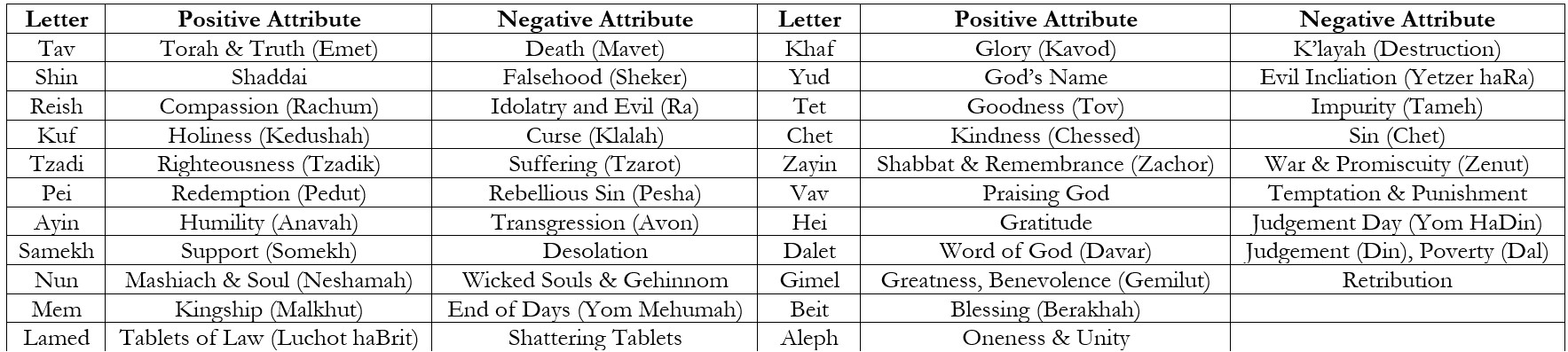
Why does the Hebrew alphabet begin with an Aleph? Why does the Torah begin with a letter Beit? What role did the divine Hebrew letters have in Creation? What is God’s “seal of truth”, and what is God’s “sceptre”? Why do we find pagan death cults in countries and cultures all over the world? And what is the missing “nun” verse in Psalm 145? Find out in this class as we unravel a fascinating ancient Midrash about the letters of the Hebrew alphabet presenting themselves before God at the start of Creation. Also: Did God really command Abraham to sacrifice his son, and did Abraham pass the test? What really happened with the Tree of Knowledge? And why does evil exist?

For a brief written summary, see here.

The summary chart at the end of the video: