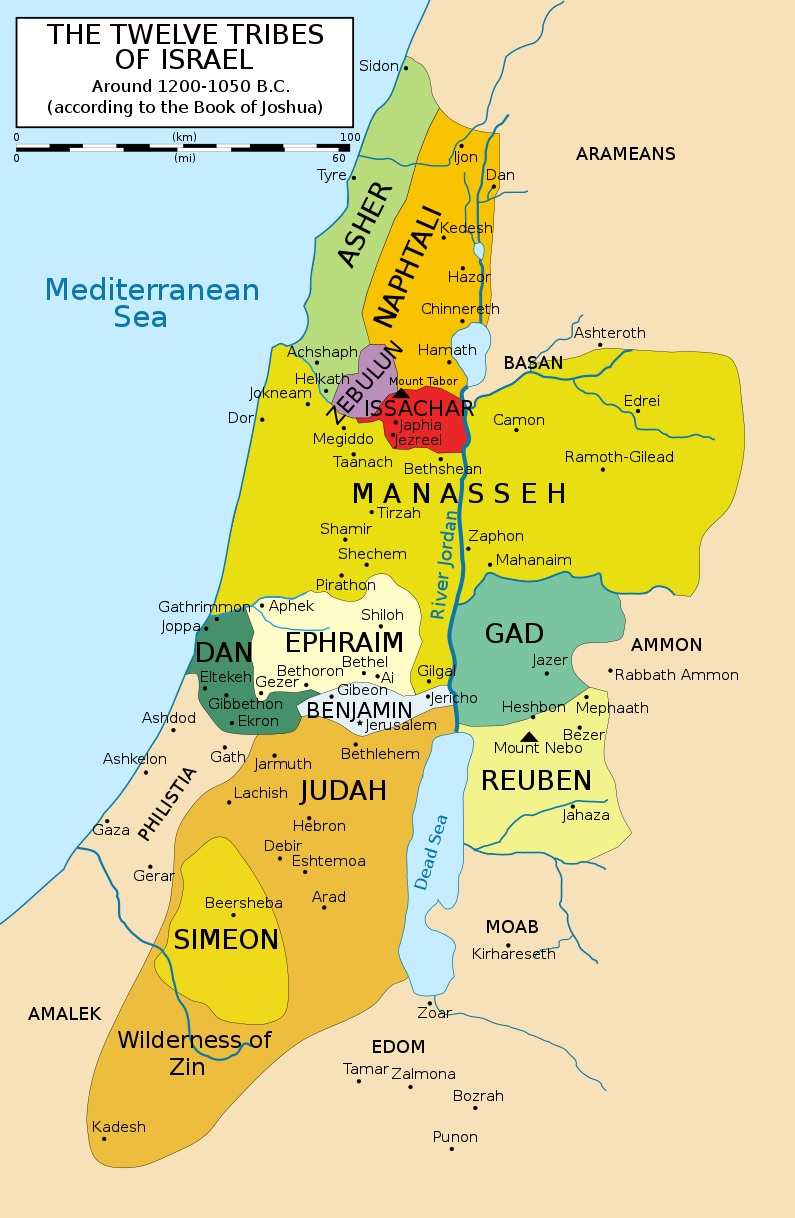
A rough outline of the ancient tribal boundaries of Israel
As we continue to celebrate Chanukah this week, it is worth exploring one of the most important numbers in Judaism, and one that is closely associated with Chanukah as well: 501. The focus of Chanukah is the miracle of the oil—where did that oil come from? When Jacob blessed his sons on his deathbed, he said of Asher that “his bread shall be oily [shmenah], and he shall yield royal delicacies.” (Genesis 49:20) Similarly, when Moses blessed the tribes before his passing, he said of Asher that he shall “dip his foot in oil [shemen]”. (Deuteronomy 33:24) Both blessings invoke special oil, and our Sages teach that the land of Asher produced the finest olive trees and the best olive oil. (See, for instance, Menachot 85b which says that Temple oil came from the Asherite town of Tekoa, and which describes the oil riches of the Asherite town of Gush Halav.) A later tradition explains that the Chanukah miracle of oil lasted precisely eight days because that’s how long it took to produce fresh oil from the northern territory of Asher and deliver it to Jerusalem. In other words, by day nine following the reconsecration of the Temple, a fresh batch of pure oil had arrived. And the oil came specifically from Asher (אשר), the numerical value of which is 501.
What is the deeper significance of the name “Asher”? When Leah named him, she based it on the fact that his arrival made her “fortunate”, the literal meaning of the name. But there is much more to it. When Moses first encountered Hashem at the Burning Bush, and asked how he should introduce God to the Israelites, the answer was Ehyeh Asher Ehyeh (Exodus 3:14). This is the most unique name of God, used just once in the entire Tanakh, in the context of the First Redemption and Exodus. Thus, this name became forever associated with Geulah, redemption and salvation. Rashi here cites the Sages explaining that Hashem meant “He will be (Ehyeh)” with Israel through the suffering in Egypt just as “He will be (Ehyeh)” with Israel throughout all future exiles and persecutions. In other words, Hashem is there with Israel at the First Redemption just as He will be at the Final Redemption.
The Arizal taught (in Sha’ar haMitzvot on Ekev) that one should meditate on the name Ehyeh Asher Ehyeh when washing mayim achronim, and the customary recital of the phrase “mayim acharonim chova” is to remind one of this, since chova (חובה) has a value of 21, equal to Ehyeh (אהיה)! This hastens to bring about the Final Redemption, when “knowledge of God shall fill the Earth as water covers the sea.” (Isaiah 11:9) This is the deeper meaning of the “final waters”, ie. the waters of the Final Redemption (as explored in depth in Secrets of the Last Waters). Now, this unique redemptive name of God has three parts to it, and is structured in such a way that one’s focus naturally shifts to the middle word Ehyeh Asher Ehyeh. It’s that same name Asher, with a value of 501. The Zohar has a profound teaching on this.
Why is it, the Zohar asks, that the Tanakh so many times prohibits the Israelites from worshipping Asherah trees? In ancient times, these trees were seen as fertility goddesses or symbolic of “mother earth” and worshipped by various cultures. We find tree worship not only in the ancient Middle East, but all over the world. Remnants of this are still found in practices like bedecking Christmas trees. The Zohar (I, 49a) notes the unmissable connection between Asherah and Asher. In fact, it points out that both of these names are found in one Torah verse!
We read in Deuteronomy 16:21 that “You shall not set up an Asherah of any kind of tree beside the altar of your God YHWH that [Asher] you may make (לֹא תִטַּע לְךָ אֲשֵׁרָה כָּל עֵץ אֵצֶל מִזְבַּח יְיָ אֱלֹהֶיךָ אֲשֶׁר תַּעֲשֶׂה לָּךְ). The word asher here seems to simply mean “that”, but can also be read as the actual name of God Asher, as if reading Hashem Eloheikha Asher. The Zohar explains that “Asher is her husband”, alluding to the Canaanite idolatry in ancient Israel, where Ba’al was worshipped alongside his divine consort Asherah. Similarly, the nearby Assyrians (Ashurim) worshipped their chief god Ashur, which is where the name of their people and empire came from.
The truth is that these terms actually originate in a holy place. Asher is indeed an appellation for Hashem, and Asherah was originally a term for the “feminine” manifestation of God in this world, ie. the Shekhinah! However, the idolaters adopted these terms and turned them into full-blown idols, associated with statues and trees, and tied to all kinds of immoral rituals. Such adaptation and corruption of holy terms and concepts that originate in the Torah happens in many instances and in many places. For example, we find that the Romans worshipped the metal-working god Vulcan, derived from the Torah’s Tuval-Cain, the first metalworker (Genesis 4:22). The Greeks worshiped a divine ancestor named Iapetus, who is really the Torah’s Yefet, forefather of the Greeks. The Canaanites worshiped a god named Adon, and the Egyptians Aten, and the Greeks Adonis—all, of course, emanating from a corruption of the true divine name Adonai. And its precisely with the prohibition of idolatry where we next find the number 501.
In the Ten Commandments, we are instructed not to make any temunah, idolatrous image. The Ba’al haTurim (Rabbi Yakov ben Asher, c. 1269-1343) points out that the gematria of temunah (תמונה) is 501, which is exactly equal to the term partzuf adam (פרצוף אדם), “the image of man”. In other words, we are forbidden from making idolatrous statues or images with human-like depictions of gods or God. (For lots more on understanding this Second Commandment, see here.) The depictions that we are allowed to make involve letters of the divine Hebrew alphabet, and the only kind of divine “image” we can meditate on is the letters making up various names of God. In fact, one of the oldest known Kabbalistic texts is the ancient Sefer haTemunah, which goes into tremendous depth about the divine forms of the Hebrew letters.
On a Kabbalistic level, the 501 of Partzuf Adam has tremendous meaning as well. Recall that in the Kabbalah of the Arizal, the Ten Sefirot are rectified and rearranged as five partzufim, “faces”. The highest of the partzufim corresponds to the highest and most sublime of the olamot, “worlds” or “dimensions”—that of Adam Kadmon. The initial primordial lights from which Creation took place emerged from Adam Kadmon. A little bit of that special divine light of Creation, the ohr haganuz, was concealed under God’s Throne and preserved for the righteous at the End of Days and in the Messianic Age (see Yalkut Shimoni II, 499). And all of this ties right back into Chanukah, which celebrates that divine light.
Chanukah is not explicitly mentioned in the Torah because, of course, the events of Chanukah happened many centuries after the Torah. Nonetheless, there are countless places in the Torah that secretly allude to Chanukah. One of these is parashat Tetzave, which begins with the command for Moses to light the menorah in the Mishkan, alluding to the future Chanukiah. The numerical value of Tetzave (תצוה) is also 501! The Ba’al haTurim further notes that 501 is the value of the term nashim tziva (נשים צוה), that God “commanded the women” to light Shabbat candles, which tap into the same divine light. The unique thing about parashat Tetzave is that it is the only parasha in which Moses is not explicitly mentioned (from the time that he is introduced in the Torah). The deeper reason for this is that Tetzave is not about the generation of the Exodus or the First Redemption, but rather about the Final Redemption; not about Moses, but secretly about Mashiach. Which brings us right back to 501, the number of the Final Redemption:
As we see in the world around us today, the final “exile” and persecution comes by way of the Ishmaelites. Whether it’s Hamas or Hezbollah, the Houthis or Iran, Qatar or the PA or the Muslim Brotherhood, or their many terrorist sympathizers around the world, it is the Ishmaelim who are hell-bent on destroying Israel and harming Jews wherever they might be. And so, the value of Ishmaelim (ישמעאלים) is also 501, the final barrier to the Final Redemption. But they will soon be neutralized, obliterated by another 501, as explained by Rav Shimshon of Ostropoli in his Pesach discourse called Ma’amar Sod Eztba Elokim. At the Passover seder, we are instructed to spill a drop of wine for each of the Ten Plagues, and then to spill additional drops as we recite the acronym of the plagues: datzach adash b’achav (דצ”ך עד”ש באח”ב). What is the point of this acronym?
Rav Shimshon explains that the total value of this phrase is 501, and it alludes to the secret angel that brought about the Ten Plagues. The angel is referred to by the term Taka Beresheet, or just Taka (תק״א), the numerical value of which is 501. Hashem used this angel to punish the Egyptians, “So that you may recount in the hearing of your child and of your children’s children that [asher] I made a mockery of the Egyptians and how I displayed My signs among them—in order that [asher] you may know that I am YHWH” (Exodus 10:2) The term Asher appears twice in this verse, alluding to the 501 of Taka that was used by God to make a mockery of the Egyptian oppressors, as well as to the redemptive name Ehyeh Asher Ehyeh.
So, too, in our days, the Ishmaelim of 501 will be neutralized by Taka of 501, stemming from that divine name of God Asher of 501, from the name of Redemption, Ehyeh Asher Ehyeh. We will soon be “saved from the flames”, just as Yehoshua the Kohen Gadol was in the Haftarah that we read on Shabbat Chanukah, that he was mutzal m’esh (מצל מאש), another term that equals 501. And as we say at the Rosh Hashanah table, we will no longer be a “tail”, but only a “head”, rosh (ראש), whose value is also 501. We will return to our Promised Land (אדמתנו), also 501, with the true Davidic Kingdom (המלכות), 501, restored for good. May we merit to see it very soon!
Chodesh Tov v’Chag Sameach!
For more on the number 501 and the connection to the divine light of Creation, Chanukah, and the Final Redemption, see the recent class on ‘Chanukah & the Final Redemption’:
*Another fascinating 501 that is tied to Redemption is that 501 is the sum value of Moshe (משה), 345, and Yosef (יוסף). Joseph was the one who brought the Children of Israel into Egypt, and Moses was the one who brought them out. Before his passing, Joseph relayed the “Redemption Code” pakod ifkod (פקד יפקד) which Moses activated when he returned to Egypt. And upon leaving Egypt, Moses made sure to take the bones of Joseph. His sarcophagus wondered with the Israelites throughout the Wilderness. In fact, the Sages say the Sea split in his merit! Moses and Joseph were thus the two driving forces of the first Redemption, and we know they will also play a key role in the Final Redemption, so it is quite fitting that the values of their names sum up to 501.