
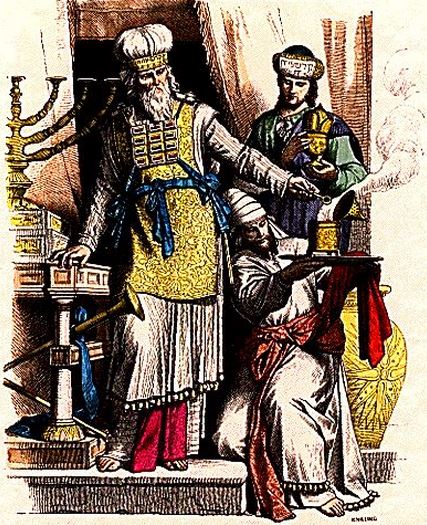
In this week’s parasha, Tzav, we find the interesting term hakohen hamashiach, the “anointed priest”, referring to the kohen gadol, “high priest”. This term appears a total of four times in the Torah; three times in last week’s parasha, and once at the beginning of this week’s parasha. These happen to be the only four instances of the term mashiach anywhere in the Chumash. Superficially, they do not refer to the Messiah, but rather to the high priest. The Chumash itself never explicitly speaks of hamelekh hamashiach, the anointed messianic king of Israel at the End of Days. However, it does allude to a messianic figure here in the parasha, because one of those future figures whose arrival we expect is the Kohen Tzedek, the “righteous priest” who will serve as the first kohen gadol in the rebuilt Jerusalem Temple.
At the start of the Second Temple era, the hope was that Zerubbabel would be Mashiach. The prophet Haggai (2:23) describes him as God’s “chosen one” while Zechariah (6:12) sees him as Tzemach, the “plant” that will sprout the Redemption. Recall that Zerubbabel was the Persian-appointed governor of Judea who led the first wave of Jews back to Israel following the end of the Babylonian Exile. He oversaw the rebuilding of the Temple. As the one overseeing the Ingathering of the Exiles and rebuilding of the Temple, and as the official leader of Judea, he was unsurprisingly recognized as the potential Mashiach of his generation. We read more about this in the Haftarah for Chanukah (Zechariah 2:14-4:7), where Zerubbabel is presented as a Messiah-like figure, while Yehoshua the Kohen Gadol would be the anointed high priest, hakohen hamashiach of the generation. Unfortunately, that generation did not merit the Final Redemption, and it didn’t come about. (Still, there is a prophetic work attributed to him called Sefer Zerubavel that describes what will happen at the End of Days, as explored in detail in a recent class here.)
Commenting on the above chapter in Zechariah where the prophet sees “four craftsmen”, the Sages ask “Who are these four craftsmen? Rav Hana bar Bizna said that Rabbi Shimon Hasida said: They are Mashiach ben David, Mashiach ben Yosef, Eliyahu, and the Righteous Priest [Kohen Tzedek].” (Sukkah 52b) The Midrash (Beresheet Rabbah 14:1), meanwhile, presents a different opinion:
There is a great debate with regards to how many messiahs there will be. Some say there will be seven, as it is said “then shall we raise against him seven shepherds…” (Micah 5:4) And some say there will be eight, as it is said, “and eight princes of men.” And it is neither of these, but actually four, as it is said, “And God showed me four craftsmen…” (Zechariah 2:3)
And David came to explain who these four craftsmen are [in Psalms 60:9 and 108:9, where God declares: “Gilead is mine, Menashe is mine; Ephraim also is the defence of my head; Judah is my sceptre”]: “Gilead is mine” refers to Elijah, who is from the land of Gilead; “Menashe is mine” refers to the Messiah who comes from the tribe of Menashe… “Ephraim is the defence of my head” refers to the Warrior Messiah who comes from Ephraim… “Judah is my sceptre” refers to the Great Redeemer, who is a descendant of David.
Instead of the kohen mashiach, here in the Midrash we have Mashiach ben Yosef seemingly split into two: a Mashiach ben Menashe and a Mashiach ben Ephraim! Moreover, one sometimes hears today of a “Mashiach ben Dan”. I have never come across this term in any of our texts. What I have seen is mention of a warrior figure who assists the “Warrior Messiah” (ie. Mashiach ben Ephraim), called Saryah ben Dan (see, for example, Zohar III, 194b). It seems like the notion of “Mashiach ben Dan” is based on Saryah ben Dan. This, in turn, likely has its origins in Samson, who came from the tribe of Dan, and was also recognized as the potential Mashiach of his generation. (Jacob famously foresaw this on his deathbed blessing, Genesis 49:16-18, where he concluded Dan’s blessing with “I await your salvation, Hashem!”)
Seven Names of Mashiach
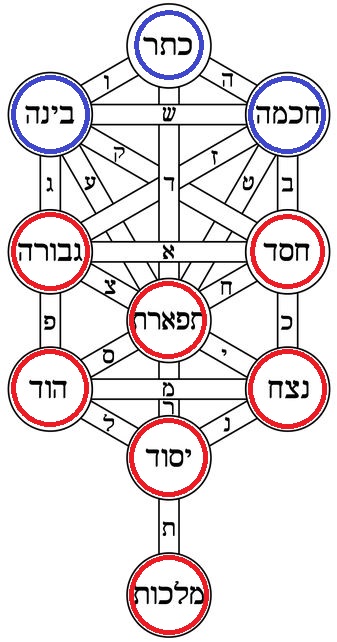
The higher Sefirot of Mochin (in blue) and the lower Sefirot of the Middot (in red).
Altogether, it appears that we have seven figures associated with Mashiach: Mashiach ben David, Mashiach ben Yosef, Mashiach ben Ephraim, Mashiach ben Menashe, Mashiach ben Dan, Eliyahu, and the Kohen Tzedek (HaKohen haMashiach). This would suggest that the first opinion in Midrash Rabbah above is best: seven messianic figures, based on the prophet Micah’s “Seven Shepherds”. And when we meditate upon these figures, we find a striking resemblance to the seven lower Sefirot.
We know that kohanim are rooted in Chessed, so the Kohen Tzedek parallels the first Sefirah. We know that Dan is connected to Din, and Saryah ben Dan is a warrior hero, so Mashiach ben Dan neatly parallels Gevurah. The brothers Menashe and Ephraim fit nicely with the “twin” Sefirot of Netzach and Hod. There is no doubt that Mashiach ben Yosef is rooted in Yesod, and Mashiach ben David in Malkhut. That leaves Eliyahu for Tiferet, the root Sefirah of Torah and Emet, just as Malachi (3:23-24) describes Eliyahu’s return to inspire Israel to come back to Hashem (as we will read this Shabbat in the Haftarah for Shabbat haGadol).
The big question is: are we really to expect seven distinct figures? The Tanakh seemingly only describes one Mashiach explicitly (see, for example, Isaiah 11 or Ezekiel 37). And then the Midrash comes in and states: “Rav Huna said: the Messiah is called by seven names and they are: Yinon, Tzidkenu, Tzemach, Menachem, David, Shiloh, Eliyahu.” (Midrash Mishlei, Buber ed., pg. 87) A parallel Midrash (Eichah Rabbah 1:51) points out that the gematria of “Tzemach” (צמח) and “Menachem” (מנחם) are identical (138) because they are actually one and the same. It gives another name instead: Nehira, the “illuminator”. In this Midrash, the seven names are Tzidkenu (or “Hashem Tzidkenu”, based on Jeremiah 23:6), Tzemach/Menachem, Shiloh, Chaninah, Yinon, Nehira, and David. In either case, the implication is that it’s not seven different messiahs, but one Mashiach with seven names—including “Eliyahu”! It is therefore possible that Eliyahu is not a distinct figure at all, but one and the same as Mashiach. As strange as this approach might sound, there may actually be support for it.
For example, the description in Isaiah 9:5 has Mashiach surprisingly called el gibbor, implying an angelic figure, as well as sar shalom, “prince of peace”, a title usually reserved for angels (like Metatron). And it fits well with Daniel’s description of “one like the son of man [k’var enash] coming down with the clouds of Heaven” (Daniel 7:13). Again, this is a description of an angelic being, like a human, coming down from Heaven, like Eliyahu who started off as a human, but never died and instead transfigured into an angel.
Meanwhile, we find sources connecting Eliyahu with Mashiach ben Yosef (see, for instace, Kol haTor, Ch. 2). Our Sages say that “Pinchas is Eliyahu”, and the numerical value of Pinchas (פינחס) is 208, equal to “Ben Yosef” (בן יוסף). The Talmud (Sotah 43a), meanwhile, says that Pinchas’ maternal lineage goes back to Yosef. Paternally, of course, he was a kohen. On that note, if we already have a “righteous priest” in Eliyahu, why do we also need a separate Kohen Tzedek? Can we not combine them into one figure? Then we have Vayikra Rabbah 1:1 telling us that Pinchas/Eliyahu was the angel that came to Samson’s Danite parents to herald his birth. We also know that Eliyahu is supposed to be the true prophet that identifies and anoints Mashiach ben David. Thus, Eliyahu is intertwined with every other messianic figure (all the more reason to parallel Eliyahu with Tiferet at the centre, which alone intertwines with all other Sefirot).
Seven, or One?
With all that said, can it really be that all seven messianic figures are just one figure? Why is it that at the end of the Pesach seder when we express our desire for the Final Redemption, we open the door for Eliyahu, but say nothing of Mashiach? Maybe Eliyahu is Mashiach! The Mishnah (Eduyot 8:7) debates the role of Eliyahu and ultimately concludes that he comes only to bring peace to the world. Is this not the same as the sar shalom, and is it not the role that we reserve for Mashiach ben David? Then there are those who hold that Mashiach ben David and Mashiach ben Yosef are one and the same person, possibly in two distinct phases. (This was explored in Part 3 of the Mashiach ben Yosef series. Interestingly, while the Talmud Bavli speaks of Mashiach ben Yosef, in Sukkah 52a, the parallel Talmud Yerushalmi, in Sukkah 23b, tells essentially the same story but refers to him as simply “Mashiach”, presumably ben David, not ben Yosef!)
The more difficult issue is combining the kohen tzedek, or hakohen hamashiach of this week’s parasha, with hamelekh hamashiach, the anointed king. If the anointed king has to be a direct descendant of King David, it seems he cannot simultaneously be a kohen, who is a direct descendant of Aaron from a totally different tribe (Levi). The standard understanding is that a kohen cannot be a king of Israel. In fact, that was one of the major issues with the Hasmonean dynasty established by the Maccabees following the Chanukah wars, since they were kohanim.
The first de facto Hasmonean king was Simon, brother of Judah Maccabee, and the only one to survive the wars with the Seleucids. However, he did not take the title “king” (melekh), instead electing to use the more neutral title nasi. He did serve as the kohen gadol. (In the past, I made the case that Simon Maccabee was the same as Shimon haTzadik in rabbinic literature.) It was his grandson Aristobulus who first took on the “king” title (basileus in Greek), and served as both kohen gadol and melekh, to great opposition from the rabbis of the time. He was succeeded by his brother Alexander Yannai, who infamously persecuted the rabbis and caused Shimon ben Shetach to flee to Egypt. So, it seems, the king and the priest cannot be one and the same figure. Presumably, there should be some kind of “separation of church and state”.
And yet, the Chumash itself never speaks of a messianic king, and the prophet Samuel chastised the people for wanting to have a king at all (before going on to anoint Saul). Meanwhile, the first person in the Torah referred to as a kohen was Melchizedek, the king of Shalem. He is described as both king and priest to El Elyon, God Almighty (Genesis 14:18). Rabbinic tradition identifies him with Shem, son of Noah; and his kingdom of Salem with Jerusalem (as explored in the class on Jerusalem here). In other words, the first king of Jerusalem was also the first priest in Jerusalem, and one could make the case that the same will happen at the End of Days, with priest and king in Jerusalem combined into one. That might explain why the only instances of mashiach in the Chumash are in reference to the kohen gadol!
One can draw further support for this from King David himself, who is described as wearing the ephod (I Chronicles 15:27), one of the special garments of the kohen gadol. He wore it specifically on the occasion of bringing the Ark of the Covenant into Jerusalem, perhaps in the hopes that this would usher in the Messianic Age. So, it might be possible for the king to be a kohen after all (maybe that’s how the Hasmoneans justified it!) This would also fit neatly with those, like Rambam, who held there will be no sacrifices in the Third Temple, implying the roles of kohanim will shift. It would also fit with those who held that the status of kohen will revert to all firstborn of Israel (and all those who wish to volunteer), not just those from the Tribe of Levi, as it was originally before the Golden Calf. Again, we have support for this in Tanakh, where David’s own sons apparently became kohanim voluntarily, as it says in II Samuel 8:18 that “David’s sons became priests” (וּבְנֵי דָוִד כֹּהֲנִים הָיוּ). Perhaps they believed that the Messianic Age was at hand and they could become priests voluntarily, despite not being patrilineal descendants of Aaron.
The Names & the Sefirot
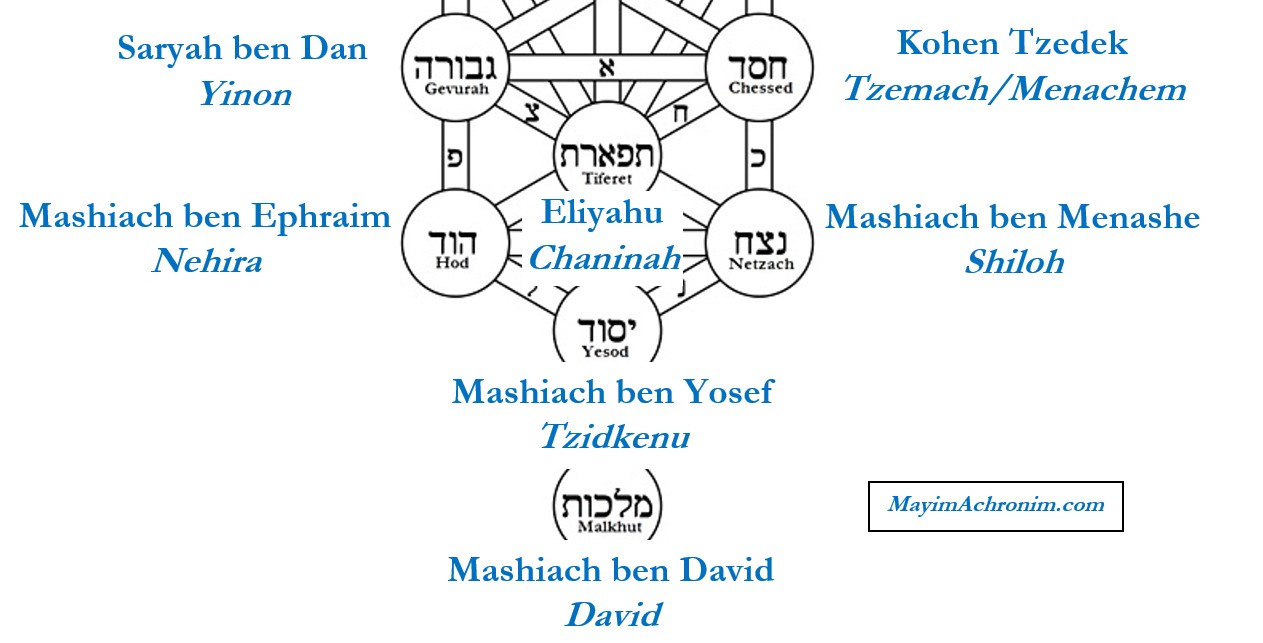
With all of this in mind, we can parallel the seven names in the Midrashim above to the seven Sefirot and seven figures, too:
We have already covered David (Malkhut) and Eliyahu (Tiferet). Tzemach is the flourishing plant, paralleling Chessed (note how in Tanakh, Tzemach is mentioned in the place that speaks of Yehoshua haKohen). Recall that Tzemach is the same as Menachem, the “comforting” that also comes from a place of Chessed. Shiloh (שילה) has the same numerical value as Moshe (משה), who is Netzach, paralleling Mashiach ben Menashe. “Menashe” (מנשה) is really just a “Moshe” (משה) with an added Nun for Netzach! Nehira the illuminator is Mashiach ben Ephraim, corresponding to Hod, the Sefirah of light. (Recall the Midrash about Oro shel Ephraim, the “Light of Ephraim”, in Yalkut Shimoni II, 499, which famously speaks of the final war at the End of Days between Persia and Arabia.) Tzidkenu is Yosef haTzadik in Yesod. That leaves Yinon for Gevurah (the name Yinon comes from Psalms 72:17, about the sun always shining for him).
The Midrash Rabbah above (like the Talmud in Sanhedrin 98b) also lists “Chaninah” as a name. This means “mercy”, drawn from Jeremiah 16:13 where God says He will initially show us “no mercy” (לא אתן לכם חנינה), but eventually He will. The next verse says that a day will come when we will no longer commemorate the First Redemption and the Exodus, but rather the much greater Final Redemption. Based on this, we can connect the name Chaninah once again to Eliyahu, for whom we open the door at the seder commemorating the Exodus, with a prayer that he will return for the Final Redemption. Moreover, we know that “mercy” or “compassion” is rooted in the Sefirah of Tiferet, further strengthening the connection to Eliyahu. To summarize:
Whether it will end up being one person or seven remains to be seen, with good evidence and verses supporting both positions. What we can clearly see is how the qualities of the Sefirot are found within Mashiach, whether one or seven. He is a paragon of love and kindness (Chessed), but also brings judgement and valour in battle (Gevurah). He is a model of balance and truthful living, an embodiment of mercy and Torah (Tiferet), with the prophetic spirit and light of Netzach and Hod. Finally, he has the righteousness and purity of Yesod, and the humility and leadership of Malkhut. We should all strive to embody these same qualities, so that each of us can play a role in ushering in the long-awaited Final Redemption.
Wishing Everyone a Chag Kasher v’Sameach!
Pesach Learning Resources:
Shabbat haGadol: the Great Sabbath (Video)
The Science of Chametz
Secrets of the Ten Plagues & the Passover Seder (Video)
A Brief History of Selling Chametz
Mysteries of Pesach (Video)
The Passover Seder and the Order of Creation
Kabbalah of Sefirat haOmer (Video)