In the midst of relaying the saga of Joseph, this week’s parasha takes a detour to explore what was happening with Yehudah at the same time. As is well-known, Yehudah married a Canaanite woman referred to as Bat Shua and had three sons. His eldest, Er, then married a woman named Tamar. After Er passed away young and childless due to his sins, Tamar had to marry his brother Onan to fulfil the law of yibum, or “levirate marriage”. The sinful second son also died shortly after, so Tamar had to marry the third, Shelah. However, Yehudah innocently believed that his two older sons may have died because of something wrong with Tamar, and wanted to avoid another levirate marriage to spare his remaining child.
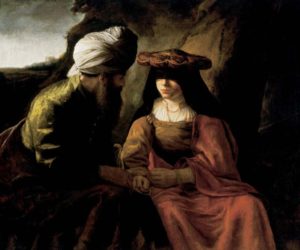
Rembrandt’s ‘Judah and Tamar’
Tamar decided to take matters into her own hands. She dressed up as a harlot and managed to seduce Yehudah himself. Tamar got pregnant from that union and gave birth to the twins Peretz and Zerach. From Peretz would eventually descend King David and, in turn, Mashiach. What Tamar had done out of desperation might be understandable on some level, but it does not change the fact that she did something completely immoral. In fact, Yehudah himself initially condemned her to death, before learning that he had been tricked by his own daughter-in-law. God always makes sure to mete out punishment measure-for-measure, and souls need a perfectly balanced rectification, or tikkun. Where did Tamar’s soul find her rectification?
 Recall that God originally made the cosmos entirely with Gevurah, or Din, with strict measure, strong judgement, and precise severity. This is why the account of Creation uses only Elohim as the name of God, for that is the name associated with Din (whereas the Tetragrammaton is typically associated with Chessed, unlimited kindness, and more specifically, with Rachamim, mercy and compassion). However, that universe was “too perfect” and too fragile, unable to contain God’s light. Of the ten “vessels” (the Sefirot) that held the universe together, the lower seven “shattered” and had to be reconstructed. The Arizal notes that they shattered into 288 major fragments. This is alluded to when the Torah says that the Spirit of God “hovered” over the primordial waters (Genesis 1:2). The word “hovered”, merachefet (מרחפת), is an anagram of met-rapach (מת רפ״ח), the fall or “death” of the 288 pieces (see Sha’ar HaPesukim on Beresheet).