Category Archives: Mashiach & End of Days

The Incredible History and Absurd Politics of Rachel’s Tomb

In this week’s parasha, Vayishlach, we read about Jacob’s return to the Holy Land after twenty years in Charan. After some time, Jacob and the family make a stop in Beit El, where Jacob first encountered God decades earlier. God appears to Jacob once more, and promises that “the land which I gave to Abraham and to Isaac, I will give to you and to your seed after you” (Genesis 35:12). God makes it clear that the Holy Land is designated solely for the descendants of Jacob—not the descendants of Esau, and not the descendants of Ishmael, or any other of Abraham’s concubine sons. It is the land of Israel, the new name that Jacob receives in this week’s parasha.

In fact, in this parasha we see mention of many Israelite sites, both ancient and modern, such as Hebron and Bethlehem. In our day, all of these are unfortunately within the political entity typically referred to as the “West Bank”. This title comes from the fact that the area is geographically on the west side of the Jordan River. Initially, the British Mandate for Palestine included both sides of the Jordan River, before the British gave the east to the Arabs to create the state of Jordan. This was the original “partition plan” for Palestine, with the eastern half meant to serve as the Arab state and the western half to become a Jewish one. Many have forgotten this important detail.
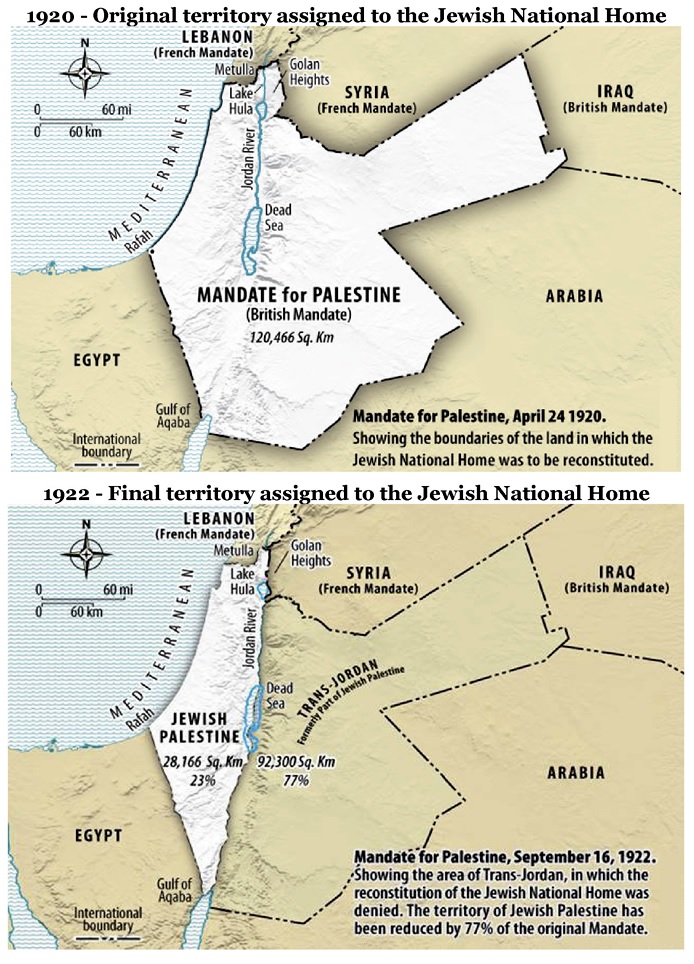
British Mandate for Palestine – Before and After (Credit: Eli E. Hertz)
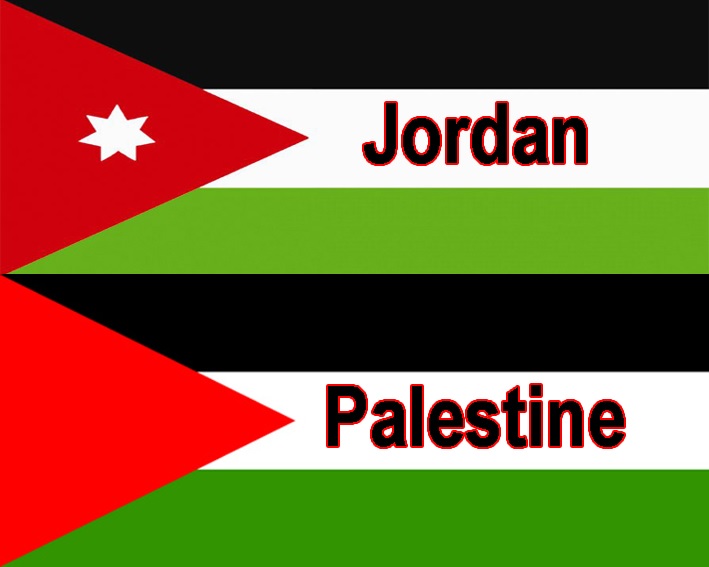
The current flags of the state of Jordan and the Palestinian movement. It is estimated that about half of Jordan’s current population of 9.5 million is Palestinian Arab.

Nonetheless, the unsuitable title of “West Bank” has stuck ever since. Some rightly avoid using the term in favour of the more appropriate “Judea and Samaria”. Truthfully, even this title is not entirely accurate, for the region is nothing less than the very heartland of Israel, the location of the vast majority of Biblical events, and the home of a plethora of Jewish holy sites. Among them is the tomb of Rachel, as we read in this week’s parasha (Genesis 35:16-20):

And they journeyed from Beit El, and there was still some distance to come to Ephrath, and Rachel gave birth, and her labor was difficult… So Rachel died, and she was buried on the road to Ephrath, which is Bethlehem. And Jacob erected a monument on her grave; that is the tombstone of Rachel until this day.

Throughout history, Rachel’s tomb was one of the most venerated sites in Judaism, and is often described as the Jewish people’s third-most holiest site (after the Temple Mount/Western Wall and Cave of the Patriarchs). As early as the 4th century CE the historian Eusebius already wrote of Rachel’s tomb being a holy site for Jews and Christians. Keep in mind that this is two centuries before anyone even whispered Islam. Not that it really matters, since Islam does not consider this a particularly special place. The Arab-Muslim historian and geographer of the 10th century, Al-Muqaddasi, doesn’t even mention Rachel’s tomb in his descriptions of Muslim-controlled Israel and its holy sites.
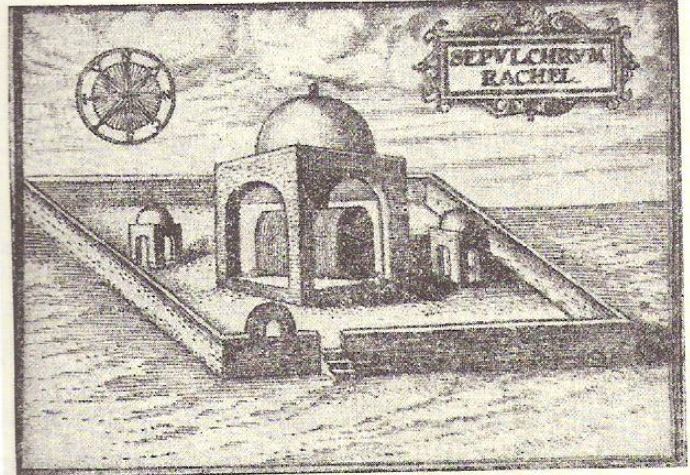
1585 Illustration of Rachel’s Tomb

Meanwhile, the Jewish traveler and historian Benjamin of Tudela (1130-1173) describes Rachel’s tomb in detail as being a domed structure resting upon four pillars, with Jewish pilgrims regularly visiting and inscribing their names on the surrounding eleven stones (representing the Tribes of Israel, less the tribe of Benjamin, as Rachel died giving birth to him). The earliest Muslim connection to the tomb is in 1421, when Zosimos mentions a small mosque at the site. (“Zosimos the Bearded” was a Russian Orthodox deacon famous for proposing the Moscow-Third Rome principle—which may be of great significance for calculating the time of Mashiach’s coming, as we’ve written in the past.)

The Ottomans originally transferred ownership of the site to the Jewish community (in 1615) but later reneged on the promise and even built walls to prevent Jews from going there, according to the British priest and anthropologist Richard Pococke (1704-1765). Pococke writes that the Ottomans used the area as a cemetery. Nonetheless, Jews could not be kept away from their millennia-old holy site, and continue to make pilgrimages. Christian writers G. Fleming and W.F. Geddes note in their 1824 report that “the inner wall of the building and the sides of the tomb are covered with Hebrew names, inscribed by Jews.”
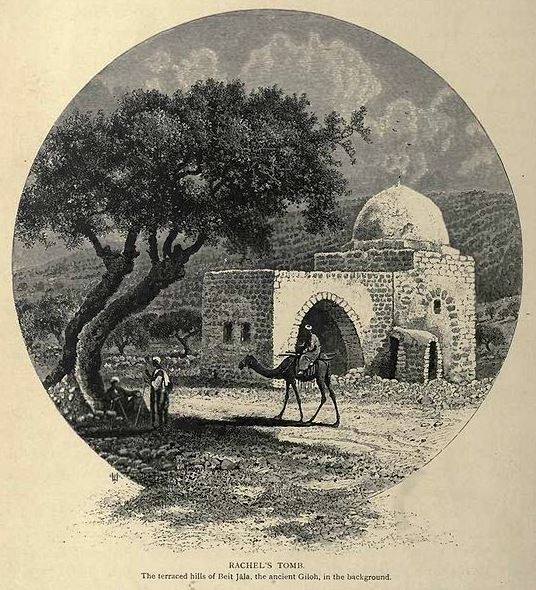
1880 Illustration of Rachel’s Tomb

Six years later, the Ottomans officially recognized Rachel’s tomb as a Jewish holy site again, and ten years later the site was purchased by famous Sephardic Jewish financier and philanthropist Moses Montefiore. Montefiore rebuilt the crumbling tomb, and even constructed a small adjacent mosque to appease the local Muslims. Around this time, British writer Elizabeth Anne Finn, who lived in Jerusalem while her husband was the consul there, wrote that Jerusalem’s Sephardic Jews never left the Old City unless to pray at Rachel’s tomb. Similarly, the Missionary Society of Saint Paul the Apostle wrote in 1868 that Rachel’s tomb

has always been held in respect by the Jews and Christians, and even now the former go there every Thursday, to pray and read the old, old history of this mother of their race. When leaving Bethlehem for the fourth and last time, after we had passed the tomb of Rachel, on our way to Jerusalem, Father Luigi and I met a hundred or more Jews on their weekly visit to the venerated spot.

Later, Jewish businessman Nathan Straus (of Macy’s fame) purchased even more land around the site that Montefiore had purchased. (Interestingly, Montefiore’s own tomb in England is a replica of Rachel’s tomb.)

Under the British Mandate, Jewish groups applied on multiple occasions for permission to repair the site, but were denied because of Muslim opposition. The Muslims themselves didn’t bother repairing it, of course. Conversely, many of them were (and still are) happy to attack the site whenever an opportunity presents itself:

Throughout the 1800s, the local e-Ta’amreh Arab clan had blackmailed the Jews to pay up 30 pounds a year or else they would destroy the tomb. In 1995, Arabs—led by a Palestinian Authority governor—attacked Rachel’s tomb and tried to burn it down. In 2000, they laid a 41-day siege on the site during the Second Intifada. In light of this, it made total sense when UNESCO declared in 2015 that Rachel’s tomb is a Muslim holy site that is “an integral part of Palestine”. The laughable resolution only confirms the senselessness and irrelevance of the United Nations.

Had they bothered to look at the historical record, they would have seen that Rachel’s tomb is, was, and always will be a Jewish holy site of immeasurable significance. Countless Jewish pilgrims have experienced miracles there, particularly for health and fertility. According to tradition, Rachel is the only matriarch to be buried outside of the Cave of the Patriarchs so that her spirit can weep and pray for her children in exile. Her prayers are successful, for we are in the midst of the exile’s final end, as prophesied by Jeremiah (31:14-16):

Thus said Hashem: “A voice is heard in Ramah, in lamentation and bitter weeping.” It is Rachel, weeping for her children. She refuses to be comforted for her children, because they are not. Thus said Hashem: “Refrain your voice from weeping, and your eyes from tears, for your work shall be rewarded,” said Hashem. “And they shall return from enemy lands. And there is hope for your future,” said Hashem. “And the children shall return to their borders…”


The above essay is adapted from Garments of Light, Volume Three.
Get the book here! 
Is the Lubavitcher Rebbe Mashiach?

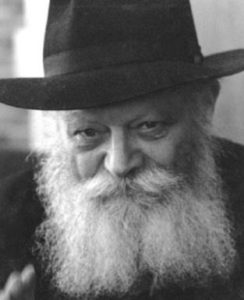
The Lubavitcher Rebbe (Photo Credit: Shlomo Vishinsky and Zev Markowitz/ chaiartgallery.com)

Today is the third of Tammuz, the yahrzeit of Rabbi Menachem Mendel Schneerson, better known as the Lubavitcher Rebbe. There is no doubt that the Rebbe was among the greatest sages of the last century (if not of all time). From the moment he took up the leadership of Chabad, the Rebbe began to make waves in the Jewish world, and quickly transformed Lubavitch into an international powerhouse. Today, Chabad finds itself in 81 countries, operating 3500 institutions.

The Rebbe himself inspired countless souls, both Jewish and non-Jewish. One of the latter was Congresswoman Shirley Chisholm (the first black woman in Congress). When Chisholm was first elected to the House of Representatives, she met fierce opposition and outright racism. Shortly after, she received a call from the Rebbe, who quelled her concerns and offered her advice on how to make the most of her situation. Chisholm went on to create programs that benefited millions of poor people, including the expansion of food stamps across the US. At her retirement breakfast, she said: “If poor babies have milk and poor children have food, it’s because this rabbi in Crown Heights had vision.”

With such vision, along with tremendous wisdom, righteousness, and charisma, it isn’t very surprising that a messianic movement would develop around the Rebbe. Despite the fact that he passed away in 1994, many within the Chabad movement continue to believe that he is Mashiach. Is there substance to this belief?

Mashiach Resurrected

One of the major arguments used by the so-called Mashichistim is a verse in the Talmud (Sanhedrin 98b) that states Mashiach can come from “among the living” or from “among the dead”. The Talmud states that if Mashiach is of the living, it would certainly be Rabbi Yehuda haNasi (who was also called, simply, Rebbi), the great compiler of the Mishnah; if of the dead, it would be the Biblical Daniel. Within Chabad, this passage is used to support the fact that despite the Rebbe’s passing, he may still return to be the messiah.

However, other texts state that Mashiach cannot be from the dead. For example, Midrash Rabbah (on Genesis 49:18) writes how Jacob saw a vision of Samson—who had the potential to be Mashiach—but when Jacob saw Samson’s death, he was saddened that Samson wouldn’t be the messiah and said, “I await Your salvation, Hashem!”

Some believe the Rebbe is not really dead (besides, if Mashiach is from “among the dead”, the Talmud already told us it would be Daniel!) but he is only “concealed”. Multiple Jewish sources state that Mashiach will come, then disappear for a certain amount of time, and then return again. For example, Midrash Rabbah (on Numbers 11:3), writes:

Just like the first redeemer, Moses, revealed himself to the Jews and then concealed himself… similarly, the final redeemer will reveal himself, then conceal himself… and then return and reveal himself again.

Thus, the Rebbe is said to only be “hidden”, and will imminently return. Of course, this isn’t very different from the Christian belief in Jesus’ eventual “second coming” (although it should be noted that Christians believe Jesus actually died, and was not simply “hidden”). Christians have been waiting eagerly for two millennia—much like some in Chabad have been waiting eagerly for over two decades.

In reality, when ancient Jewish sources speak of Mashiach’s concealment and return, they do not mean that Mashiach will disappear for millennia, or even decades. The Midrash cited above itself says that Moses was hidden from the Israelites for three months, and Mashiach would be hidden for only 45 days (though there are other opinions). And so, the potential for the Rebbe being Mashiach appears to have long expired.

The Rebbe on Being Mashiach

One of the things that the Rebbe was adamant about was studying and following the teachings of the Rambam. The Rambam makes it clear who Mashiach is: a Jewish leader who, among other things, successfully reunites the entire nation in Israel (ending the exile), defeats the nation’s enemies, and rebuilds the Temple in Jerusalem. Only one who has successfully accomplished these tasks can be titled “Mashiach”. The Rambam writes that if a person was on his way to fulfilling these, but died in the process, he is clearly not the messiah. The Rambam brings Shimon bar Kochva as an example. Although Bar Kochva was able to push the Romans out of Israel, reclaim the Temple Mount and start rebuilding the Temple, and was even proclaimed the messiah by Rabbi Akiva, he died and his messianic potential died with him.

Although the Rebbe did hint to himself possibly being the messiah in some of his talks (and his followers use those encoded statements as proof), he also said in one of his talks that one is only confirmed to be Mashiach when the Third Temple is built. Obviously, since the Rebbe did not build the Third Temple in his lifetime, he cannot be the messiah. If it turns out that the Rebbe does return somehow in the future, and accomplishes all the messianic tasks, then and only then can he be titled “Mashiach”. To do so now is premature and naïve, if not altogether wrong.

In fact, the Rebbe publicly made clear that he is not Mashiach. In his monumental biography of the Rebbe, Joseph Telushkin devotes a chapter to this question, and writes:

In 1965, Rabbi Avraham Parizh, an elder Chasid who had been with the movement from the time of the Fifth Rebbe, printed letters stating: “With great joy, we can inform you that King Messiah, for whom we have waited so many years, is already among us. He is the holy Lubavitcher Rebbe, Rabbi Menachem Mendel Schneerson, the King Messiah. His address is 770 Eastern Parkway, Brooklyn, New York. He does not need us to choose him since God has chosen him.” Rabbi Parizh printed up many of these letters and started handing them out in Israel. According to one account, Parizh also distributed these letters by dropping them out of a helicopter.

When the Rebbe learned of the letter, he instructed his secretariat to immediately dispatch a telegram to Parizh, dated June 24, 1965: “We were shocked by the letter [you wrote and handed out] and ask that you immediately cease distributing it. Gather and send to the secretariat all copies of the letter, every last one, and please confirm immediately that you have fulfilled this instruction.” Chasidim tell how Parizh spent several weeks scrounging around the streets of Tel Aviv looking for every such sheet he could find…

In 1991, Rabbi Aharon Dov Halprin, the editor of Chabad’s Israeli magazine, Kfar Chabad, wanted to print an article explaining why the Rebbe was worthy of being considered the presumed Messiah. When the Rebbe learned of this he responded sharply, “If you, God forbid, [plan to write] anything even remotely similar, it is preferable that you shut down the periodical completely.”

In an urgent audience to which the Rebbe summoned Chabad activist Rabbi Tuvia Peles, the Rebbe rebuked those who were making Messianic claims about him, saying, “They are taking a knife to my heart” and “they are tearing off parts of me.”

… Some months later, and shortly before the Rebbe’s stroke, the Alaska-based shliach, Rabbi Yosef Greenberg (author of Y’mei Bereishit), brought a letter to be given to the Rebbe in which he referred to him as “King Messiah”. Later that same day, Rabbi Groner told Greenberg that the Rebbe had looked at the letter, thrown it down in frustration, and then wrote on it, “Tell him that when the Moshiach comes, I will give him the letter.”

An even more definitive statement of the Rebbe on this same issue occurred at around the same time. An Israeli journalist, Sarah Davidowitz of the Kol Ha’ir newspaper, approached the Rebbe and said, “We appreciate you very much, we want to see you in Israel; you said soon you will be in Israel, so when will you come?” The Rebbe responded: “That depends on the Moshiach, not on me.” The journalist persisted, “You are the Moshiach!,” to which the Rebbe responded: “I am not”.

In light of this, to call the Rebbe “Mashiach” is highly inappropriate, and against his own wishes. More dangerously, it risks turning Chabad into a religion of its own. After all, Christianity developed in the very same way; in its first decades, it was nearly indistinguishable from Judaism, and was followed almost entirely by Jews. It took a couple of centuries before the divide between Judaism and Christianity was complete, and by that point, Jesus had become a God-like figure.

The same may very well happen with the Rebbe and Chabad in coming decades. Already, there are elements within Chabad who have taken to equating the Rebbe with some kind of god on Earth. Many in Chabad still write letters to the Rebbe, adorn their homes with countless images and elaborate paintings of him, and read out the Rebbe’s letters at important public events (while everyone is asked to rise in honour of the Rebbe’s “presence”, of course). It isn’t uncommon to see children saluting the Rebbe’s empty chair at 770, while worshippers ecstatically chant “long live our master, teacher, and rabbi, the king Mashiach” (see video here). If Chabad’s leaders do not rein in such activity soon, there is little doubt Lubavitch will morph into a religion of its own. And for the Rebbe—who worked so tirelessly to unite all Jews—that would be a most devastating legacy.


For a more detailed analysis of the Rebbe’s messianism, please see here

The Real Messiah: Debunking Christianity and Islam

At the end of last week’s article, we cited the Tanakh and a number of midrashim that speak of a “new covenant” or “new Torah” in the time to come, which is supposed to be brought by Mashiach. These sources may be quite shocking to read, especially when they speak of parts of the Torah we know and love essentially being annulled, and many of its laws no longer observed. These ideas might bring to mind Christianity and Islam, since the former believe in a “New Testament” that supplanted the “Old” one, while the latter see the Koran as a “Final Testament” that supplanted both the “New” and “Old”. As such, some have wondered: might Christians and Muslims actually have an argument?

No, they don’t.

Let’s start with Christianity: The first Christians were Jews who apparently followed a certain “rabbi” named Yehoshua, or Yeshu (or Jesus). We’ve already written in the past about the mythical origins of this Yehoshua, and how many details of his story were essentially plagiarized from the actual Biblical Yehoshua (Joshua). It isn’t too hard to imagine that the Jews who established Christianity were well-versed in the Tanakh, as well as various midrashic traditions. Of course, since they came to believe that Jesus was the messiah, they attributed to him what the Tanakh and other Jewish sources say about Mashiach, such as bringing a new covenant.

Yet, Jesus did not bring any new covenant at all. In fact, the New Testament itself records Jesus saying, “Do not think that I have come to abolish the Law or the Prophets; I have not come to abolish them but to fulfill them.” (Matthew 5:17) Jesus goes on to state that anyone who fails to keep even the tiniest of Jewish laws, or fails to be even stricter than the Pharisees (ie. Rabbinic Jews) will be “least in the kingdom of heaven.”

Keep in mind that the New Testament was not put together until at least a century after Jesus’ passing. The earliest gospel (Mark) was only composed some fifty years later. None of the gospel writers knew Jesus personally. In short, the New Testament has little to do with the historical Jesus and cannot be the new covenant of Mashiach.

More significantly, Jesus accomplished absolutely nothing that Mashiach is supposed to accomplish. He did not fulfil the ingathering of all the Jewish exiles, did not re-establish a Jewish kingdom in Israel, and did not bring peace to the world. Ironically, more people have been slaughtered in the name of Jesus than in the name of anything else. Not exactly what the Torah has in mind when it speaks of a messiah.

Islam is even easier to dispense with. Muhammad had no evident relationship to the Holy Land of Israel, the Jewish people, the Davidic dynasty, or any part of the Torah for that matter. Some scholars have argued that Islam should not even be considered an “Abrahamic” religion. The Koran itself describes Muhammad as an ummi, an “illiterate”. Muslims have traditionally interpreted this to mean that he was not literally illiterate, rather that he had no knowledge of previous holy books, particularly the Torah.

As for the Koran, like the New Testament it was not put together until long after Muhammad’s death. But that matters little, since the Koran doesn’t even claim to have been brought by a messiah. Muslims do not consider Muhammad a messiah! So, who was the messiah according to Islam? The Koran says that Jesus was! Muslims accept Jesus as al-Masih (Mashiach). In fact, Jesus is mentioned more than anyone else in the Koran (including Muhammad), a whopping 187 times! And as we’ve already seen, Jesus was certainly not the prophesized messiah.

The Rambam tells us how we can recognize the true messiah: a wise, righteous, and charismatic Jewish leader who brings the entire nation back to Israel, re-establishes there a holy kingdom at peace with its neighbours, and rebuilds the Temple in Jerusalem. Mashiach is the one who fulfills these tasks. Such a person may be worthy of transmitting a new covenant from God. Anyone else is only a pretender; either a false messiah or a failed one.

Chag sameach!