
Tag Archives: Ottoman Empire

Do Torah Verses Prophetically Allude to Historical Years?

This week we begin reading the fifth and final book of the Torah, Sefer Devarim. This book has a total of 955 verses, an important number in Judaism. It is said that there are 955 levels to the Heavens (see Ma’aseh Rokeach on Mishnah, Kinnim). This is based on a verse in Devarim where Moses says: “Behold, to Hashem, your God, belong the Heavens [hashamayim], and the Heaven of Heavens [shmei hashamayim], and the Earth and all that is on it!” (Deuteronomy 10:14) The numerical value of “Heavens” (השמים), when counting the full mem sofit, is 955. Meanwhile, the word “behold”, hen (הן), has a value of 55, to teach that the top 55 levels of Heaven are reserved solely for God. (Ma’aseh Rokeach says that the angel Metatron has access to 900 levels, but it is only Hashem beyond that.)
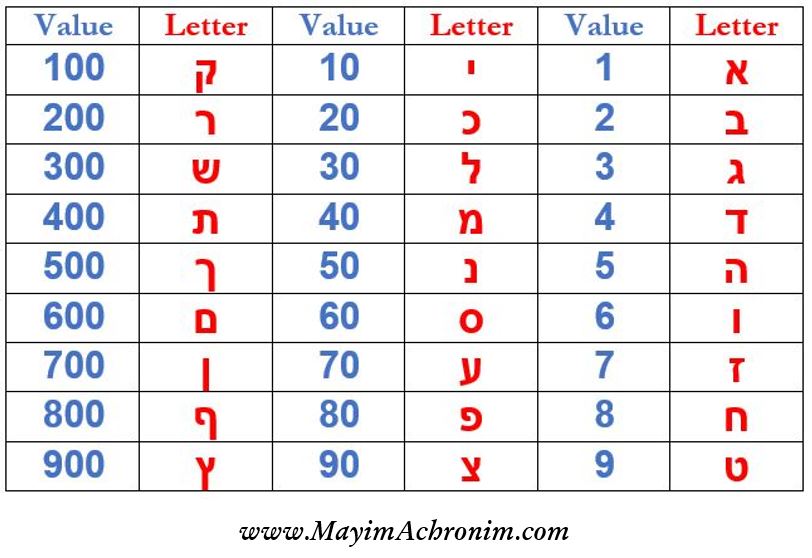
It is most fitting that Devarim has 955 verses, like the levels of Heaven. Indeed, the “Heavens” are a constant motif throughout the final book of the Torah, more so than in any other book. By my count, I found 39 instances of the word shamayim (and its variations) in Sefer Beresheet, 12 in Shemot, none in the next two, and 40 in Devarim. Included in the latter are some of the most critical and famed verses of the Torah, including lo b’shamayim hi, that the Torah “is not in Heaven” (Deuteronomy 30:12) and the Shema passage that we recite multiple times a day saying that God will “stop up the Heavens” if we do not fulfil his commandments (Deuteronomy 11:17), and that He will bless us greatly “like the Heavens” if we do (Deuteronomy 11:21). There’s also Hashem’s promise that He will ingather us back to the Holy Land from the “ends of the Heavens” (Deuteronomy 30:4), and Moses’ final divine song that starts Ha’azinu hashamayim (Deuteronomy 32:1).

Another interesting phenomenon that has been pointed out about Devarim is that its verses seem to allude to the historical years that they would correspond to. We are currently in the Jewish year 5786 AM (Anno Mundi, “year of the world”), and the Torah has a total of 5845 verses. (The Talmud says the Torah should have 5888 verses, and for a solution to that problem, see ‘The Torah’s Missing Verses’ in Garments of Light, Volume Two.) It’s not clear exactly where this concept comes from. Some bring it down in the name of the Vilna Gaon; I believe I first heard it years ago from Rabbi Benjamin Blech.

Before we get into it, it is important to mention that doing this kind of analysis requires lots and lots of counting and a good calculator, along with precision and persistence. I spent hours counting and recounting verses to make sure it’s all lined up correctly. Continue reading

Edom & the Return of the Pig

This week’s parasha, Shemini, describes the laws of kosher animals. The Torah specifically lists four exceptions of mammals that are not kosher: the gamal, camel; the shafan, commonly translated as “hyrax”; the arnevet, a “hare” of some sort; and the hazir, pig. The Midrash (Vayikra Rabbah 13:5) parallels these four animals to the four kingdoms that oppressed Israel:

“The camel,” this is Babylon, “because it brings up the cud” [Leviticus 11:4]—because it drew [another oppressive] kingdom after it. “And the hyrax,” this is Media, “because it brings up the cud”—as it drew a kingdom after it. “The hare,” this is Greece, “because it brings up the cud”—as it drew a kingdom after it. “And the pig,” this is Edom, “but it does not chew its cud”—because it does not draw a kingdom after it. Why is it called a pig [hazir]? It is because it will return [mahazeret] the crown to its owner. That is what is written: “Saviours will ascend Mount Zion to judge the mountain of Esau, and the kingdom will be God’s.” (Ovadiah 1:21)

The Midrash explains that three of the animals swallow their food but then regurgitate it, symbolic of the kingdoms that “swallowed” up Israel for a short period of time and then “regurgitated” it, to be followed by another oppressive kingdom. The pig, meanwhile, does not regurgitate its food, symbolic of Edom which swallowed up Israel and will maintain dominance until the End of Days, when it will actually play a key role in the restoration of Israel. (Recall that Edom refers to the people that emerged out of Esau—the elder twin of Jacob—called “Edom” both due to selling his birthright in exchange for a red stew, and because he was born red-haired, admoni.)

A closely related teaching of our Sages is that the hazir is thus called because Hashem will hahziro l’Israel, “return it to Israel” in the future (שעתיד הקב״ה להחזירו לישראל). There are several ways to understand this. Some go directly with the pshat and suggest that the pig will literally become kosher for consumption in future Mashiach times. There were those who argued that there will be a change in the nature of the pig, and it will become a ruminant species like the cow. Thus, it will have the two signs necessary for a kosher land animal and hence become kosher (see, for instance, the Ramad Valle’s Sefer haLikutim on Melechet haBirur). In the past, I’ve proposed that it could be referring to synthetic or lab-grown pork instead, which is now possible to produce (see ‘Pig Gelatin & Synthetic Pork: Kosher?’ in Volume Two of Garments of Light).

Another way to understand it is simply in reference to the above Midrash of the hazir being Edom. It’s not literally talking about pork becoming kosher (that’s really hard to imagine!) but rather that Hashem will “return” the hazir of Edom to Israel; ie. there will be a future reconciliation between the brothers Jacob and Esau. After all, Jacob promised Esau that he will come to live with him at Mt. Seir—but never did! (Genesis 33:14) Rashi comments “But when will he go? In the days of Mashiach, as it is said ‘And saviours shall go up on Mount Zion to judge the mount of Esau.’” A day will come in the future when Jacob and Esau will finally live in peace together. In fact, the Ba’al haTurim (Rabbi Yakov ben Asher, c. 1269-1343) points out that the gematria of “Esau” (עשו) is 376, equal to “peace” (שלום)!

The Edomite Pig

Why is Edom symbolized by a pig? Continue reading

The Blood Libels

In this week’s parasha, the Torah devotes an entire chapter (Leviticus 17) to the prohibition of consuming blood. God first forbids idolatrous and improper sacrifices before declaring that “if anyone of the house of Israel or of the strangers who reside among them partakes of any blood, I will set My face against the person who partakes of the blood; I will cut that person off from among kin.” (17:10) The Torah goes on to say that any land animal or bird that is slaughtered for food must have its blood entirely drained and buried under earth, before emphasizing again that “the soul of all flesh—its blood contains its soul. Therefore, I say to the Children of Israel: you shall not partake of the blood of any flesh, for the soul of all flesh is in its blood. Anyone who partakes of it shall be cut off.” (17:14)

Because of this, Jews throughout history have been exceedingly careful not to consume any blood whatsoever, even a tiny speck in a chicken egg. It is therefore tragically ironic that one of the most grotesque antisemitic accusations leveled against Jews for centuries is the “blood libel”—that Jews consume the blood of gentiles or use gentile blood to prepare matzot, or engage in some form of ritual murder. Where did this disgusting accusation come from, how did it evolve over the centuries, and how did it shape Jewish history? Continue reading