Red Sea or Reed Sea: Where is Mount Sinai?

This week’s parasha, Beshalach, recounts the Splitting of the Sea. It is common knowledge that this was the Red Sea, called yam suf in Hebrew. Yet, in recent decades scholars have tried to “debunk” that notion, preferring to associate yam suf with a smaller lake of some sort. They often start by pointing out that yam suf literally means “sea of reeds”. It is the Reed Sea, not the Red Sea. There are indeed several shallow, marshy lakes with reeds in that vicinity of Egypt, around the modern Suez Canal. The fact that the Torah speaks of the “Reed Sea” being near places like Pi-Hahirot, whose location is believed to be known, is used as further proof of yam suf not being the Red Sea.

Of course, this serves to diminish the great miracle of the Splitting of the Sea. It almost implies that the Israelites waded through a shallow lake, as opposed to crossing a vast expanse. The reality is that such a hypothesis does not at all fit with the descriptions we receive in the Torah. A careful look reveals what yam suf actually is, and further helps to locate an even bigger prize: Mount Sinai.  

A Sea or a Lake?

From the Torah’s description of the Splitting of the Sea, we learn that the waters stood as large walls to the left and right of the Israelites, and that the Egyptians later drowned in its depths (see, for instance, Exodus 14:28-29, 15:4, 8). This implies a deep sea, not a shallow, marshy lake.

Yam suf is mentioned well over twenty times in the Tanakh. When going through these verses and their context, one will find that it is a major geographical entity, not a small lake. For example, Numbers 14:25 says that the Amalekites and Canaanites live near yam suf, while Numbers 21:4 says the Edomites are near it, too. If it was a small lake somewhere in the Sinai Peninsula, or by the Suez Canal, this wouldn’t make much sense.
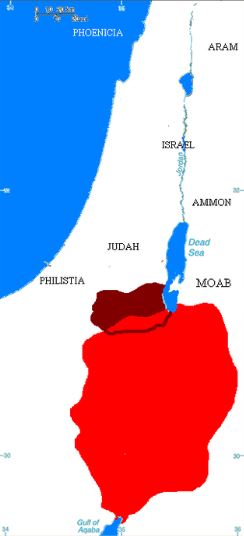
The Biblical lands of Edom, stretching down to the Red Sea (Credit: Briangotts)

In fact, the land of Edom is known to be in the area of what is today the Negev desert, roughly southern Israel and Jordan, going down to what is today Eilat. This is confirmed by I Kings 9:26, where we read that “King Solomon made a navy of ships in Etzion-Geber, which is beside Elot, on the shore of yam suf, in the land of Edom.” King Solomon built a navy-yard in a port near Elot (אֵלוֹת), undoubtedly related to today’s Eilat. And, like today’s Eilat, is in on the shore of yam suf, the Red Sea, in the land of Edom. This verse solves the entire puzzle. Scholars wonder why the sea became known as the Red Sea, when the answer might be right there in the Torah: to the Israelites, this was the sea by the land of Edom, which literally means “red”. It was the Edomite Sea, the “Red Sea”. And it is the selfsame body of water as yam suf.  

On that note, some have proposed that is isn’t yam suf, but yam sof, literally the sea “at the end”, since it is at the southernmost tip of Israel. Yet another idea is that it is yam sufa, “Storm Sea”, referring to the great wind storm that God sent to part the waters (Exodus 14:21). Whatever the case, there is little doubt that the Israelites did indeed cross what we know today as the Red Sea.

The bigger question is: where exactly did they cross?

Some believe that the Red Sea got its name from the red blooms of sea sawdust, Trichodesmium erythraeum (a type of cyanobacteria), that occasionally happen there.

Sinai or Saudi Arabia?
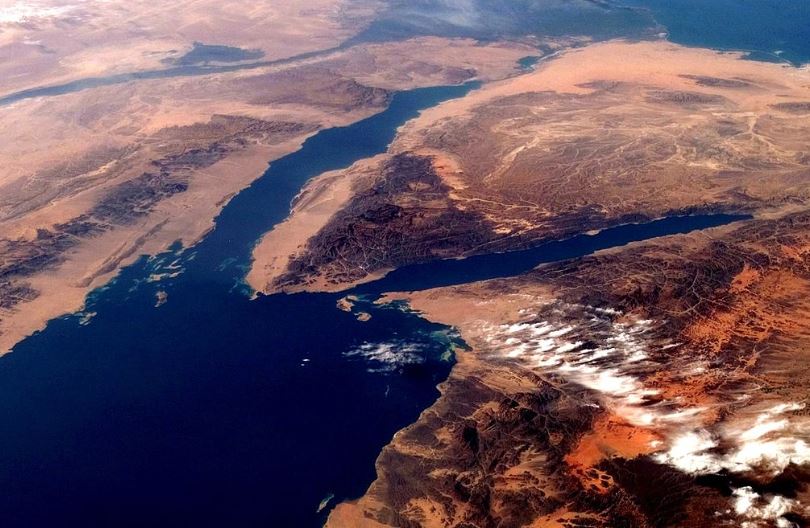
NASA Satellite Image of the Sinai Peninsula

It is commonly thought that Mount Sinai is somewhere in what is today called the Sinai Peninsula. In fact, back in the 6th century, Christians built a monastery on a mountain in the Peninsula which they believed to be Sinai. It still operates today as Saint Catherine’s Monastery, and is among the oldest Christian monasteries in the world. The only problem is that it isn’t anywhere near the real Mt. Sinai.

First off, the Torah introduces us to Mount Sinai when Moses is living far from Egypt in Midian. Recall that Moses had fled Egypt, and eventually ended up living among the Bedouins of Midian… This already confirms that Mount Sinai was probably not in today’s Sinai Peninsula, which would have still been under Egyptian control in those days. In fact, we know from historical and archaeological evidence that in those days, the Egyptians ruled at least as far as Canaan itself. Moses fled outside of Egypt’s domain, across the Red Sea, to what is today Saudi Arabia. This is the land traditionally associated with the Midianites. And the Torah tells us that Mt. Sinai is there (Exodus 3:1-2):

And Moses was shepherding the flock of Jethro, his father-in-law, the priest of Midian; and he led the flock to the farthest end of the wilderness, and came to the mountain of God, unto Horev. And the angel of God appeared unto him in a flame of fire out of the midst of a bush; and he looked, and, behold, the bush burned with fire, and the bush was not consumed…

The Torah famously tells us that Moses saw a burning bush during his first encounter on the “mountain of God”. In Hebrew, it is called a s’neh, which gives rise to the name Mount Sinai. This mountain is in the wilderness around Midian, in a land call Horev. Later on, the Israelites cross the Red Sea and journey towards this same mountain, where they receive the Ten Commandments. This implies that the Israelites crossed somewhere in the Gulf of Aqaba, ending up in what is today Saudi Arabia. This makes all the more sense since they can journey from there to the wilderness “on the other side of the Jordan”, where they spent forty years before crossing the Jordan River—from the East—into Israel.

Amazingly, there is a mountain in Saudi Arabia which is completely sealed off by the authorities, and off limits to any historians or archaeologists…


The above is an excerpt from Garments of Light, Volume Two. To continue reading, get the book here

Have the Torah’s Predictions Been Realized?

A major portion of the Tanakh deals with prophecies. While most of the words of the Prophets were already realized in their own days, or in subsequent decades, there are occasional places in Scripture where the Prophets speak of the distance future, or the “End of Days”. Similarly, other Jewish holy texts—including the Talmud, Midrash, and Zohar, among others—make predictions about the future. Have these predictions been realized in the many centuries that have passed since then? 

To find out, click here to check out our new ‘Prophecy’ page!

Chanukah & the Light of Creation

As we begin celebrating Chanukah, we are reminded that Jewish law forbids using the light of the Chanukah candles for mundane purposes. At first thought, this is strange since all other holiday candles which we light may be used for mundane purposes. One can have a candle-lit dinner with the Shabbat candles on the table, yet the same cannot be done with Chanukah candles. This is actually why we light an additional (“ninth”) candle called the shamash, whose job is to “protect” the light of the Chanukah candles so that we do not inadvertently make use of them. Why is it that the Chanukah lights must not be used? To answer this question, one must go all the way back, long before the Maccabees, to the very beginnings of the universe.

The Light of Creation

When we open the Torah we read that God’s first act of Creation within an empty universe was light. God said “Let there be light”, and so it was. A few paragraphs later, we read that on the fourth day God created various luminaries to “give light”, including the sun, moon, and stars. If the things that naturally give off light were only created on the fourth day, what was the light of the first day? The Sages (Chagigah 12a) grappled with this apparent contradiction:

But was the light created on the first day? …This is [to be explained] according to Rabbi Elazar, for Rabbi Elazar said: “The light which the Holy One, blessed be He, created on the first day, one could see thereby from one end of the universe to the other; but as soon as the Holy One, blessed be He, beheld the generation of the Flood and the generation of the Dispersion, and saw that their actions were corrupt, He arose and hid it from them…”

Now the Tannaim [differ on the point]: “The light which the Holy One, blessed be He, created on the first day one could see and look thereby from one end of the universe to the other,” this is the view of Rabbi Yakov. But the Sages say: It is identical with the luminaries; for they were created on the first day, but they were not “hung up” until the fourth day.

On the simple level, the Sages agreed that the light of the First and Fourth Days were really the same thing: while God created the luminaries on the First Day, He only set them in their specific locations and orbits on the Fourth Day. This is in line with another opinion that God really created everything in one instant, on the First Day, and on the subsequent “days” He simply put everything in its place. (For an explanation of this, see Pardes Rimonim 13:5.)

On a deeper level, as expounded by Rabbi Elazar and Rabbi Yakov, the light of the First Day was an entirely different entity. Unlike the familiar, physical light of the Fourth Day, the light of the First Day was a special, mystical light which contained the power for one to see across the universe, through all of time and space. According to the Zohar, this is the special radiance of Creation, from which all things were fashioned (see ‘The Big Bang and the Age of the Universe’ in Volume One of Garments of Light). This idea is already noted in the Midrash (Beresheet Rabbah 12:6) which adds that “the light with which God created the universe [was given] to Adam, and with it he stood and gazed from one end of the universe to the other.”

Adam and Eve were given this Divine Light as a gift. However, once they consumed the Forbidden Fruit, that light disappeared. In fact, the Kabbalists explain that initially Adam and Eve saw the world entirely through this Divine Light, and themselves glowed with this light. When they looked upon each other, they saw only each other’s light, which is why they were unashamed. After consuming the Fruit, that light disappeared, and when they looked upon each other they saw frail skin, and all of its lustful trappings. This is why they were suddenly ashamed and wanted to hide.

The Kabbalists explain that this is the mystical meaning of the interplay between the words for “light”, or (אור), and “skin”, ‘or (עור), words that sound the same and are written with just one substitution: The singular, holy aleph replaced with the ‘ayin, which literally means “eye” and represents this illusory physical world. Before the Fruit, Adam and Eve saw light; afterwards they saw only skin. (See Beresheet Rabbah 20:12, Zohar I, 22b, and Pardes Rimonim 13:3)

This is the deeper meaning behind God’s first word to Adam and Eve after their fall: “Ayeka?” The term literally means “Where are you?” referring to the fact that Adam and Eve were hiding because they were ashamed. Of course, God knew exactly where they were. So what did He mean by Ayeka?

Ayeka

The Sages explain that the original Divine Light, called Or HaGanuz, the “hidden light”, only shone for 36 hours. There are two opinions as to how one reaches this number. The first (as in Beresheet Rabbah cited above) is that the Light shone for the entire 24 hours of the first Shabbat, as well as the 12 hours preceding that Shabbat, from the moment that Adam and Eve were created on the sixth day. The light disappeared at Shabbat’s conclusion, which is one reason why we perform Havdallah at the end of Shabbat, symbolizing our hope for the restoration of that Light. Alternatively, the Light shone for the first three days of Creation, before those physical luminaries were created on the fourth day. Since each day had 12 hours of light and 12 hours of dark, that means each of the three days had 12 hours of this Divine Light, totalling up to 36.

In reality, both opinions are correct. The Divine Light initially shone for those first three days—36 hours—and was then concealed by the new physical luminaries. On the sixth day, when God created Adam and Eve, He entrusted them with that Light, and they possessed it for 36 hours until the conclusion of the first Sabbath, neatly mirroring those 36 hours of the first three days. When Adam and Eve consumed the Fruit, the Light disappeared from them, and was taken back up to Heaven, stored beneath God’s Throne (Yalkut Shimoni, Isaiah 499). This brings us back to Ayeka. The gematria of that word (איכה) happens to be 36. When God called out to Adam and Eve and said Ayeka, what He meant was not “where are you?” but “where is the Light?”

Restoring the Light

While the Or HaGanuz has been hidden for now, it reveals itself in this world through several channels. We find that same number 36 in a number of important places. Most notably, when we look at the actual number of texts in our Holy Scriptures, we find that there are 36: Genesis, Exodus, Leviticus, Numbers, Deuteronomy, Joshua, Judges, Samuel, Kings, Isaiah, Jeremiah, Ezekiel, Hoshea, Yoel, Amos, Ovadiah, Yonah, Micah, Nahum, Habakkuk, Tzephaniah, Haggai, Zechariah, Malachi, Psalms, Proverbs, Job, Song of Songs, Ruth, Lamentations, Ecclesiastes, Esther, Daniel, Ezra, Nehemiah, and Chronicles. While we generally group these texts into 24 “books” of the Tanakh for convenience, there are exactly 36 independent works. This reminds us that the Holy Scriptures contain within them the Divine Light, and through the study of these texts we can receive a glimpse of it.

Similarly, the Bnei Issachar (Rabbi Tzvi Elimelech Shapiro, c. 1783-1841) points out that there are 36 tractates to the Talmud. Study of Torah—whether Written (Tanakh) or Oral (Talmud)—serves to restore that Divine Light little by little. Naturally, this parallels the idea of the 36 Perfect Tzaddikim. The Sages state that in every generation there are exactly 36 perfectly righteous people alive, and the world only continues to exist in their merit (Sanhedrin 97b). They contain a spark of that Divine Light within them. And on the calendar, too, there is a month in which finding the Or HaGanuz is particularly auspicious. This is the month of Kislev which, the Bnei Issachar points out, is a contraction of kis (כס) and lev (לו), the former meaning “hidden” and the latter having the value of 36.

That brings us right back to Chanukah, which begins on the 25th of Kislev. We light one candle on the first day, two on the second, and so on. The total number of candles lit over the course of eight days just happens to be 36. The Chanukah lights are symbolic of that special holy light of Creation. One should not for a moment think that these are just mundane, physical lights. And this is the mystical reason for why Jewish law forbids using the Chanukah lights for any purpose. One should constantly meditate on the fact that the light of the Menorah represents the Or HaGanuz, the light of Creation, the holy light with which Adam and Eve “saw from one end of the universe to the other.”

Jewish law also requires one to place their Menorah in a widely visible spot. We must “publicize the miracle” as much as possible, hence the many public Menorah-lighting ceremonies that take place around the world, and the many electronic chanukiahs found outside synagogues, in shopping malls, and on the roofs of cars. We are not just commemorating the Chanukah miracle, but the Jewish mission to bring light into the world (as Isaiah 42:6 famously states).

From a mystical perspective, we light 36 candles to remind ourselves that our mission is to rectify the cosmos and reveal the primordial holy light of God. We remind ourselves that we should strive to return to being like the original Adam and Eve, who glowed with this light, and who looked past the deceptive skin to see the pure light within each other. When we learn to recognize each other’s inner glow, then we will merit a return to the luminous Garden of Eden.


The above is an excerpt from Garments of Light, Volume Two. Get the book here