
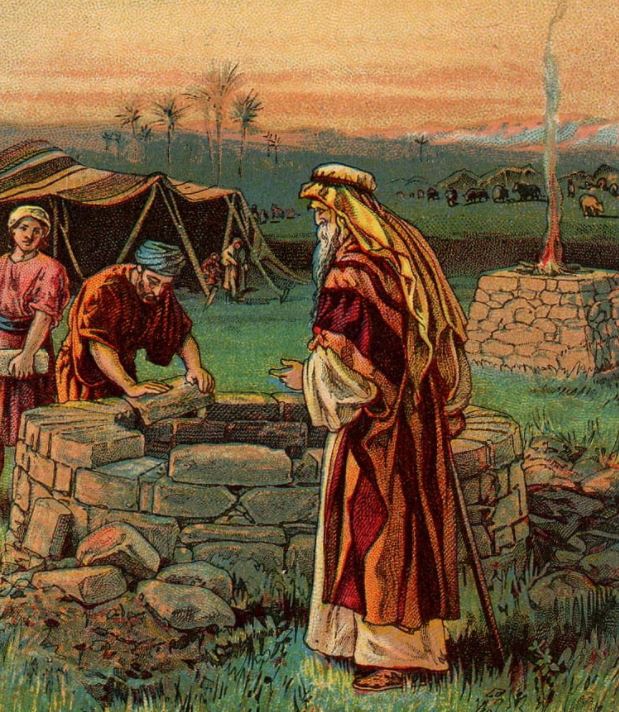
1906 illustration of Isaac, constructing a well.
This week’s parasha, Toldot, is the only one in the Torah that speaks at any length about Isaac. Abraham is introduced at the end of parashat Noach, is the protagonist of Lech Lecha and Vayera, and concludes his story in Chayei Sarah. Isaac, on the other hand, is only briefly discussed in Vayera, reappears only at the end of Chayei Sarah, and fairly quickly makes his exit in this week’s parasha (appearing just once more in Genesis 35, when he passes away). Thereafter, Jacob becomes the subject in the next few parashas. Of the three patriarchs, Isaac is least spoken of—by far.
What we are told of Isaac is that he was a diligent worker; digging wells, sowing seeds, and turning the barren lands of Israel into flourishing oases:
And Isaac sowed in that land, and found in the same year a hundred-fold; and God blessed him. And the man waxed great, and grew more and more until he became very great. And he had possessions of flocks, and possessions of herds, and a great household; and the Philistines envied him. Now all the wells which his father’s servants had dug in the days of Abraham his father, the Philistines had stopped them, and filled them with earth. And Avimelekh said unto Isaac: “Go from us; for you are much mightier than we!” … And Isaac dug again the wells of water… (Genesis 26:12-18)
Reading this passage, one can’t help but sense a certain familiarity with this narrative. A Jew comes to work a difficult land, and finds great prosperity. The Philistine becomes jealous, and seeks to expel the Jew from the land. Instead of trying to build up his own prosperity, the Philistine instead wastes time and effort trying to sabotage the Jew. When this doesn’t work, and the Philistine feels powerless, he continues to protest and shout at the Jew: “Go from us; for you are much mightier than we!” All along, the Jew quietly perseveres, and re-digs the wells. This is the story of Isaac and the Philistines; it is the story of modern Israel and the Palestinians.
In fact, of all the patriarchs and biblical figures, it is Isaac that is most associated with the land of Israel. He was the only patriarch never to leave the Holy Land, spending his entire 180-year lifespan there. The Torah says little of Isaac except for his diligent love and labour of the land. Of course, as we read at the start of the parasha, Isaac and Rebecca literally produced Israel—their son, that is. Every child is the product of three partners: father, mother, and God. Beautifully, the gematria of “Isaac” (יצחק), his wife “Rebecca” (רבקה), and God’s Name (יהוה) add up to 541, the value of “Israel” (ישראל). And just as it was the labour of Isaac and Rebecca that produced the boy Israel, it was their labour that first transformed the land of Israel.
Our Sages explain that the reason Isaac isn’t discussed very much in the Torah is because he actually did not complete his mission (see, for instance, Ba’al HaTurim on Deuteronomy 7:21). The Arizal further notes that the name “Isaac” (יצחק) is an anagram of קץ חי, meaning that his spirit will “live again at the End of Days” (Sha’ar HaPesukim, Lech Lecha). And this is precisely the spirit that guided and infused the Jewish pioneers who re-established modern Israel.
Like Isaac, these pioneers came to a completely barren land. It is worth recalling that when Mark Twain visited the Holy Land in 1869, he wrote:
A desolation is here that not even imagination can grace with the pomp of life and action… We never saw a human being on the whole route… There was hardly a tree or a shrub anywhere. Even the olive and the cactus, those fast friends of the worthless soil, had almost deserted the country… Of all the lands there are for dismal scenery, I think Palestine must be the prince… Can the curse of the Deity beautify a land? Palestine sits in sackcloth and ashes. Over it broods the spell of a curse that has withered its fields and fettered its energies. (The Innocents Abroad)
Similarly, when President Ulysses S. Grant visited in 1878 (becoming the first American president to do so), he described nothing but misery and poverty, concluding that the entire trip was “a very unpleasant one”. Who would ever think that less than a century later, Israel would be a prosperous, flourishing Middle Eastern powerhouse?
When we think of the re-establishment of Israel, we often think of those statesmen and warriors: Herzl and Weizmann, Ben-Gurion and Jabotinsky, Golda Meir, Moshe Dayan, and so on. But the real heroes were those simple Jews who made aliyah against all odds, sacrificing everything they had, working tirelessly to turn a desert into a sanctuary. Like Isaac long before them, they drained swamps and dug wells, sowed seeds and irrigated the land. And soon, like Isaac, they found me’ah she’arim, “hundred-fold” blessings.
Today’s Jerusalem neighbourhood of Mea Shearim was founded in 1874 by a group of religious Jews, at this very time during the week of parashat Toldot, where the name of the neighbourhoud comes from. We often forget that the first Jewish groups to make aliyah were deeply religious folks who yearned to return to the Holy Land, and to usher in the Final Redemption. Long before the Zionist movement, Rabbi Yehuda HaHasid Segal (c. 1660-1700) brought some 1500 Jews to Jerusalem in 1697. Eighty years later, Rabbi Menachem Mendel of Vitebsk (c. 1730-1788), one of the early Hasidic leaders, led a group of 300 Jews. In 1808, Rabbi Menachem Mendel of Shklov (c. 1750-1827), a disciple of the Vilna Gaon, fatefully brought another 150 Jews. This is not to mention the countless Sephardic Jews who settled in Israel in the 16th century following the Spanish Expulsion. (One of them, Don Joseph Nasi, nearly established a Jewish state then, and was granted the title “Lord of Tiberias” by the Ottomans!) These early returnees paved the way for future waves of larger aliyot.
Starting in 1882, those aliyot were primarily composed of thousands of secular Eastern European Jews. Truly, the word “secular” is inappropriate. While they had, for the most part, abandoned traditional Judaism and the old shtetl mindset, they fervently wished to return to their Biblical home, reclaim their Biblical language, work their God-given land, and reinvigorate the Jewish people. It was Rabbi Avraham Itzchak Kook (1865-1935) who best understood them.
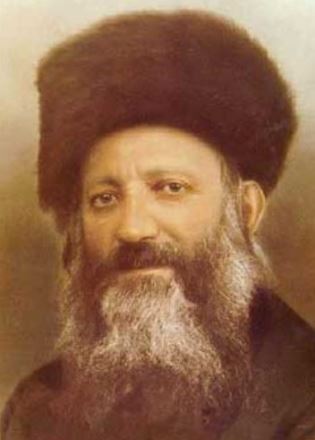
Rav Kook
Rav Kook never critiqued these pioneers, and recognized their old frustrations and resentments. He would say that they were not rebelling against the Torah, but against galut. They were tired of being weak, poor, and downtrodden; exiled and persecuted. He would say that, indeed, Jews had forgotten that they not only possessed a holy soul, but also a holy body. And he would point out that the work of these pioneers—draining swamps, digging wells, sowing seeds—was also holy work, and a fulfillment of the Torah. This is the work of Isaac, described in Jewish mysticism as the very embodiment of Gevurah, “strength”. Gevurah is associated with fire and passion, with self-sacrifice and perseverance, with working hard and overcoming challenges. This is a fitting description of Isaac and—political leanings aside—every one of those early Jewish pioneers. They were all, as Rav Kook described it, “a fiery spirit encased in powerful muscles.”
That these pioneers organized themselves into kibbutzim is no coincidence. In his Eros and the Jews, historian David Biale points out that the earliest origin of the word “kibbutz” is from the Tzfat Kabbalists of the 16th century! These kibbutzim referred to holy, mystical gatherings, with the ultimate aim of hastening the Redemption. Later on, Hasidim would adopt the term to refer to their own religious gatherings. Biale notes how Breslover Hasidim in particular would refer to their congregation as hakibbutz hakadosh. (See pgs. 118 and 270, with footnotes.)
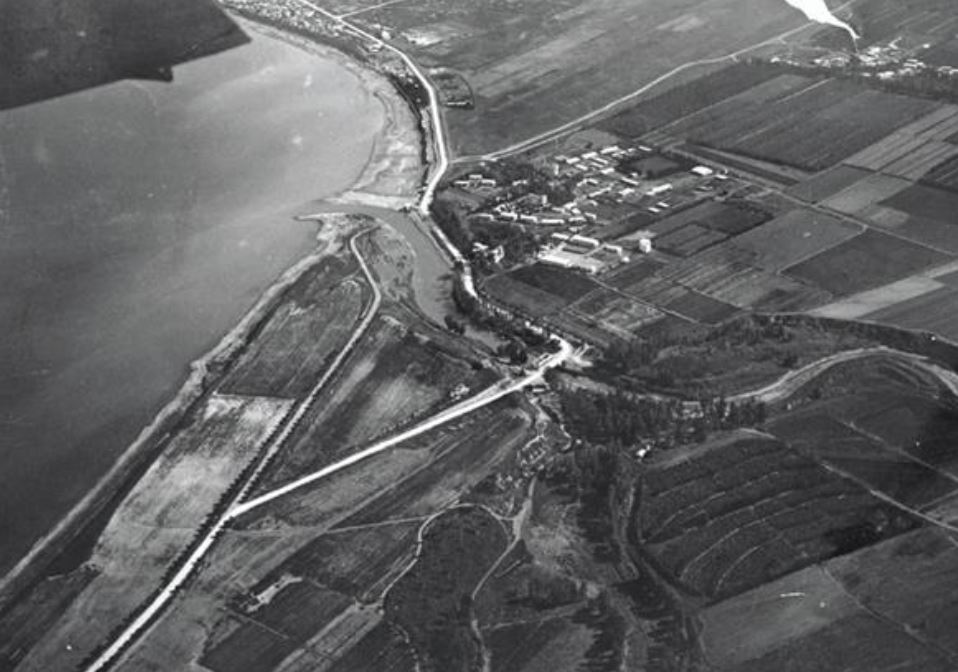
The farms of the first official kibbutz, Degania, in 1939
Certainly, the secular kibbutz could not be described as “religious”, but it definitely had a mysticism to it, and the very same goal of hastening the redemption of the Jewish people. More than anything else, it was the kibbutz that made modern Israel possible. It was the kibbutz, through unceasing collective labour and brotherly unity, that transformed a wasteland into a haven. To this day, Israel’s kibbutzim still produce 10% of its total industrial output (some $8 billion in wealth), and a whopping 40% of its agriculture! Needless to say, Hasidic Jews in Mea Shearim would have had little to eat without kibbutznikim in Degania.
These kibbutznikim still carry the spirit of Isaac, the very first hard-working agrarian, shepherd, hydrologist Jew who tirelessly worked the land of Israel to make it flourish with meah she’arim. And so, it may not be much of a stretch to point out that the gematria of “Isaac” (יצחק) is 208, exactly equivalent with “kibbutz” (קיבוץ). Our Sages explained that the Torah speaks so little of Isaac because his task was not finished. They prophesied that the spirit of Itzchak would return at the End of Days, ketz chai, to complete his work. How fortunate are we to see this prophesy realized right before our very eyes.
Shabbat Shalom
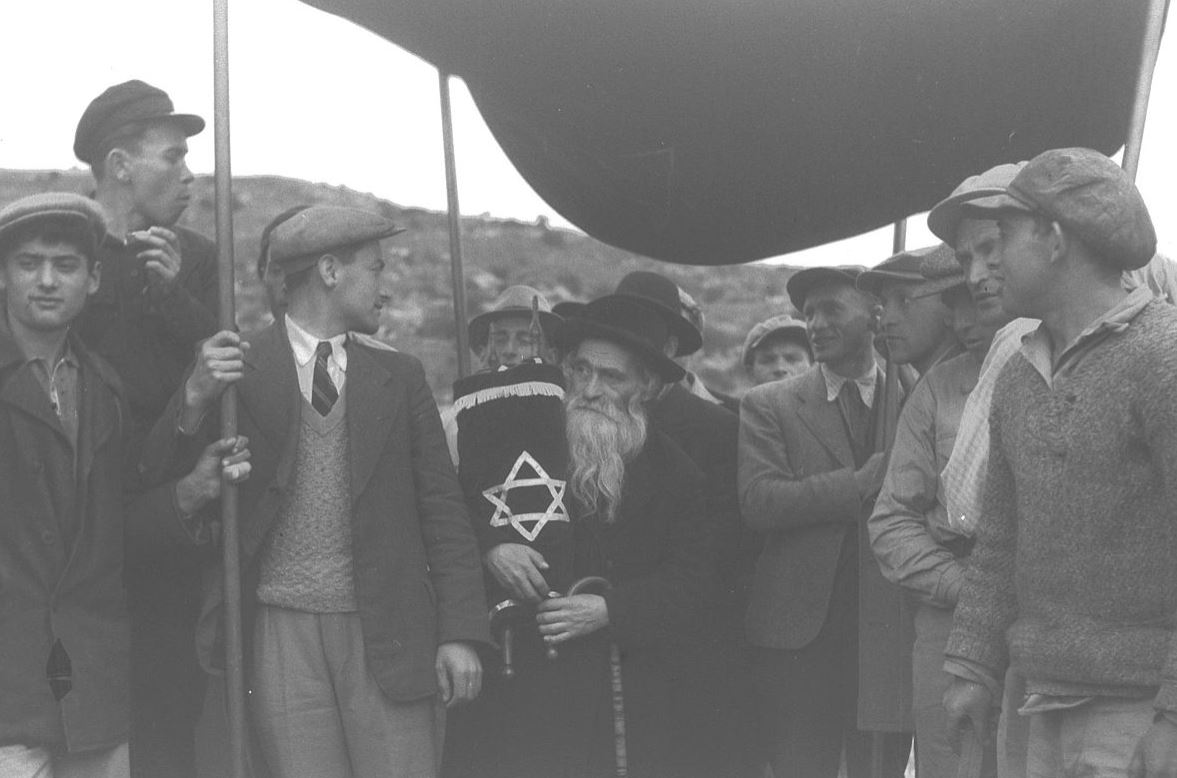
Rabbi Meir Yehezkel Holtzberg (1881-1956), bringing a Torah for the establishment of Kibbutz Hanita in 1938.