Tag Archives: Joseph

The Eighth Day of Pesach: Isaac, the Afikoman, and Mashiach ben Yosef

Of the three patriarchs, the holiday of Passover is most intimately tied to Isaac. According to tradition, Isaac was born on Passover. Commenting on Genesis 18:10, Rashi explains that the angels’ visit to Abraham and Sarah occurred on Passover, and the angels promised a son to be born – Isaac – exactly one year from that time. This important detail helps to solve a key chronological problem. Earlier, God had told Abraham that his offspring would be subjugated for 400 years. However, when one makes an accounting of the timeline, they will find that the Jews were only in Egypt for a total of 210 years! How could this be?

Commenting on that verse (Genesis 15:13), Rashi calculates how the Exodus occurred exactly 400 years from the birth of Isaac. Thus, God’s word was perfectly fulfilled, since Isaac was the very first of Abraham and Sarah’s offspring. Although Isaac was not subjugated in the sense that the Jews in Egypt were, nonetheless he was certainly troubled by the Canaanites and Philistines, as the Torah records, and was considered a “foreigner” in the Holy Land throughout his life, since God had not yet officially granted the land to the Jews, nor did Isaac settle it permanently.

Digging further, if Isaac was born on the first day of Passover, then his brit milah (circumcision) would have been on the eighth day of Passover. Though the eighth day is not celebrated in Israel, it is celebrated in the diaspora. According to Chassidic custom, as initiated by the Baal Shem Tov (the founder of Chassidism) the eighth day of Passover is associated with Mashiach. In fact, it is customary to hold a Seudat Mashiach, a “Mashiach Feast” on the final afternoon of the holiday, complete with matzahs and four cups of wine. Just as Passover celebrates the First Redemption (led by Moses), the last day of Passover is meant to represent the Final Redemption (led by Mashiach). And it is only commemorated in the diaspora since, after all, it is diaspora Jewry that needs the Final Redemption and the Ingathering of the Exiles more than anyone.

Finally, during the Pesach seder we have three matzahs to go along with the Pesach platter. It is taught that these three matzahs represent the three patriarchs: Abraham, Isaac, and Jacob. One of the fifteen steps in the seder is yachatz, where the middle of the three matzahs is broken in half. The larger half is covered and hidden as the afikoman, while the smaller half remains at the seder table. Thus, the matzah which we break is specifically the one associated with Isaac.

So then, what is the deeper connection between Mashiach and the Redemption, Passover and the Afikoman, and the forefather Isaac?

Who is Mashiach?

The Jewish mystics teach that there are actually two messiahs: Mashiach ben Yosef, and Mashiach ben David. This is derived from a number of texts and principles. One of these is the fact that the Tanakh has a clear pattern when it comes to major national events: first comes a descendant of the matriarch Rachel to usher it in, and then comes a descendant of the matriarch Leah to complete the mission. For example, Yosef (a son of Rachel) came to Egypt first to set the stage, and then came Yehuda (a son of Leah) to prepare the land for the actual arrival of the rest of the family (see Genesis 46:28). First, Joshua (of the tribe of Ephraim, and a descendant of Rachel) brought the Jews into the land of Israel following the Exodus, then Othniel (from the tribe of Yehuda) finished the job of conquering and settling the land. The first king of Israel was Saul (from the tribe of Benjamin, and a descendant of Rachel) and only then came King David (again of Yehuda). Thus, in every major event, we see clearly that first comes a descendant of Rachel to prepare the way and fight the battles, and only afterwards comes a descendant of Leah to finish the job.

In the same way, the Sages teach that first comes Mashiach ben Yosef (a descendant of Rachel), whose mission is to fight all the battles on behalf of Israel, and only after this comes Mashiach ben David (a descendant of Leah), who completes the messianic role. And who is Mashiach ben Yosef? Amazingly, the Sages say that this is none other than Isaac, reincarnated!

Of all the patriarchs and major Torah figures, Isaac is spoken of the least in Scripture. Hardly anything is said of him. It is explained that this is because Isaac has not completed his mission, and his story is not over. He has yet to fight many battles. The Sages permute his name – Itzchak (יצחק) – into the words Ketz Chai (קץ חי), literally that he “will live [again] at the End”. This is one reason why Itzchak (which means “will laugh”) is in the future tense. Isaac is Mashiach ben Yosef, who will come at the End to fight the final battles. Beautifully, the gematria of Itzchak (יצחק) is 208, equivalent to Ben Yosef (בן יוסף), also 208.

This brings us back to Passover and the afikoman. The middle matzah is broken in half. One half – the one associated with the patriarch Isaac – remains on the seder plate, together with the other matzahs that symbolize the other patriarchs. The other half – the larger one – is hidden away, only to be revealed at the very end. This is symbolic of Isaac’s final role as that of Mashiach, whose arrival is also concealed until the very ‘End of Days’. And on the eighth and final day of the Passover holiday – the day on which Isaac was circumcised and entered into the Covenant – we hold a ‘Mashiach Feast’ to celebrate the coming Final Redemption, may it arrive speedily and in our days.

Chag sameach!
Yosef and Yuya: Does Archaeological Evidence Prove the Biblical Narrative of Joseph?

In 1905, British Egyptologist James Quibell discovered a new tomb in the famed Valley of the Kings, where many of Egypt’s greatest mummified pharaohs were found. In this tomb were the bodies of two highly-preserved mummies, one male and one female: Yuya and Tjuyu. Scholars were astounded at the grand way in which Yuya was described: “the king’s lieutenant”, “master of the horse”, “superintendent of cattle”, and even, strangely, “father of the god”. Most amazingly, though, was the fact that Yuya was buried in the Valley of the Kings, despite never having been a pharaoh! Yuya was a unique and puzzling archaeological find. Who was he?

Father of the King

Parashat Miketz (Genesis 41:1-44:17) describes how Joseph rose to power in Egypt. It begins with Pharaoh’s bizarre string of nightmares, which none of his soothsayers were able to interpret. The royal cupbearer then informs Pharaoh that while he was in prison, a “Hebrew youth” was able to precisely interpret his dreams. Pharaoh summons the Hebrew youth – Joseph – who is indeed able to properly interpret Pharaoh’s dreams. The Sages tell us that Joseph’s interpretation was unique: it not only interpreted the dreams, but simultaneously offered the ideal solution for the problems that the dreams presented. Highly impressed, Pharaoh appointed Joseph as the prime minister of Egypt:

And Pharaoh said to his servants: “Can another man like this be found, in whom the spirit of God rests?” Then Pharaoh said to Joseph, “Since God has let you know all this, there is no one as understanding and wise as you. You shall be [head] over my house, and through your command all my people shall be nourished; only [with] the throne will I be greater than you… I have appointed you over the entire land of Egypt.” And Pharaoh removed his ring from his hand and placed it on Joseph’s hand, and he clothed him with garments of fine linen, and he placed the golden chain around his neck. And he had him ride in his secondary chariot, and they called out before him, “Avrekh!” appointing him over the entire land of Egypt. (Genesis 41:39-43)

Rashi explains that the term Avrekh is a contraction of av, “father”, and rikha, “king”, in other words, Joseph was called aba malka, “father of the king”, or “father of the pharaoh”.

We are then told how Joseph stockpiled food during the seven years of plenty, carefully mapping out a strategy to survive the coming years of famine. Not only did he plan for Egypt’s survival, but he ensured that Egypt would have enough to sell to all of the neighbouring nations and kingdoms that would also be affected by the great famine. Through this, he was able to make Egypt the wealthiest empire on the planet, turning what should have been seven years of hardship into seven years of immense prosperity.

No doubt, such a person would certainly be immortalized in Egypt’s history as one of its greatest leaders. In fact, the archaeological record appears to suggest that he may have been after all.

The Mystery of Yuya

Historians have uncovered a great deal of information about Yuya since the discovery of his tomb in 1905. He lived during the Eighteenth Dynasty of Egypt (1543-1292 BCE), and was an influential minister in the Pharaoh’s court. Strangely, his name is not of Egyptian origin, nor is his appearance. Many scholars believe he must have been a foreigner. He is described as being in charge of the horses and chariots, as well as the cattle. He is also titled “father of the god”, or more accurately, “father of the pharaoh” (since the pharaohs considered themselves gods). It isn’t difficult to see that Yuya is described in terms almost identical to the way that Joseph is described in the Torah.

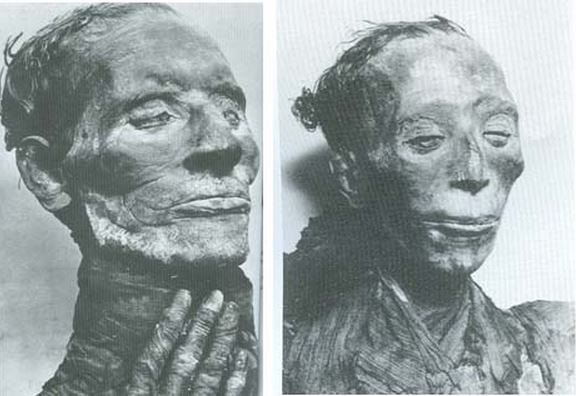
Egyptian journalist and author Ahmed Osman published a controversial book in 1987 about Yuya’s identification with Joseph, titled Stranger in the Valley of the Kings. He pointed out how Yuya’s mummy has Semitic features, evidence of a beard worn in the Hebrew style, and is the only mummy found to have its hands under its chin as opposed to across its chest. Moreover, the description of “father of the god/pharaoh” parallels Joseph’s description as Avrekh. Could the two really be the same person?

The mummies of Yuya and Tjuyu

The mummies of Yuya and Tjuyu

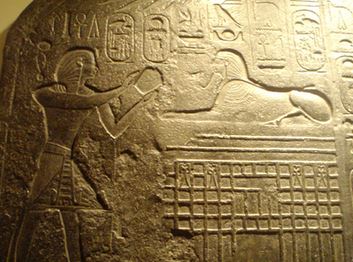
The historical record suggests that Yuya was the minister of the Pharaoh Thutmose IV, who reigned around 1400 BCE. This is not too far from the lifetime of Joseph. More amazingly, archaeologists have found a stele (an inscribed stone) commissioned by Thutmose IV that describes one of his dreams! Like Joseph’s pharaoh in the Torah, Yuya’s pharaoh Thutmose also derived great significance from his dreams.

It is further interesting to point out that Yuya was found entombed with his wife Tjuyu, who is known to have come from a royal family with priestly origins. Similarly, the Torah states that Joseph married the daughter of an Egyptian priest (Genesis 41:45).

And what of Yuya being a mummy? The Torah states: “And Joseph died at the age of one hundred and ten years, and they embalmed him and placed him in a sarcophagus in Egypt.” (Genesis 50:26) Joseph, too, was mummified!

The "Dream Stele" of Pharaoh Thutmose IV

The “Dream Stele” of Pharaoh Thutmose IV

Having said all that, the Torah also states that Joseph’s tomb was later taken out during the Exodus from Egypt (Exodus 13:19), and eventually brought to rest in Israel. This would make it very difficult for his mummy to be found in the Valley of the Kings. On top of this, historians have presented a number of other issues with the identification of Yuya with Joseph. So, perhaps Yuya is not Joseph after all.

Whatever the case may be, the amazing archaeological find of Yuya does give us proof that a foreigner could rise up through the highest ranks of Egyptian royalty, and even become “father to the pharaoh”. It gives us proof that the Torah’s account is quite accurate in its details, and in its terminology. And it certainly makes a compelling case for historical evidence of the Biblical narrative of Joseph.

The Origins of Monotheism

There are two more points that make the connection between Yuya and Joseph all the more fascinating. Historians see the root of the name “Yuya” as yw, which means “reed-leaf” in Ancient Egyptian. Meanwhile, Joseph’s name is יוסף, sharing a root with סוף, which also means “reeds” in Hebrew! The presence of “Ya”, a common appendage in Hebrew names to denote God’s name, makes it even more interesting.

Finally, the historical record shows that Yuya’s daughter married the pharaoh. They had a son, who became the pharaoh Akhenaten. Akhenaten was Yuya’s grandson. And he went down in history for doing one major thing for Egypt: destroying all of its idolatry to make the nation monotheistic. Unfortunately, his attempt to turn Egyptian society and religion monotheistic ultimately failed, and the kingdom reverted to its idolatry. But it wasn’t long after that the Jewish people left Egypt, beginning the spread of monotheism to the entire world.


The above is an excerpt from Garments of Light: 70 Illuminating Essays on the Weekly Torah Portion and Holidays. Click here to get the book!