In this week’s parasha, Tazria, we learn about the various laws of tzara’at, loosely translated as “leprosy”. The verse that begins the discussion starts by saying Adam ki ihyeh, “When a person has on the skin of the body a swelling, a rash, or a discolouration, and it develops into a scaly affliction on the skin…” (Leviticus 13:2) The phrasing is unique in that the statement strangely begins with the word adam. Grammatically, it would have been more appropriate and common for the Torah to say Ki ihyeh b’adam. Rav Yitzchak Ginsburgh cites an old tradition that there are three other such verses that use the word adam with strange grammar: Leviticus 1:2, Numbers 19:14, and Psalms 36:7. These four instances correspond to the four mystical olamot, dimensions or “universes” of Creation, called Asiyah, Yetzirah, Beriah, and Atzilut. In turn, they represent different stages in the development of every human being, literally an adam.
In addition to the four verses above, we can include the first verse in Chronicles, which is also unique in that it is made up of just three names, starting with “Adam”—here referring to the actual first civilized man Adam, and not adam generically. I believe this fifth instance alludes to the highest universe and ascension of man, that of Adam Kadmon. Recall that the five universes correspond to the five levels of soul, as well as to the five parts of God’s Ineffable Name (the four letters, plus the “crown” atop the letter yud), and the five books of the Torah.
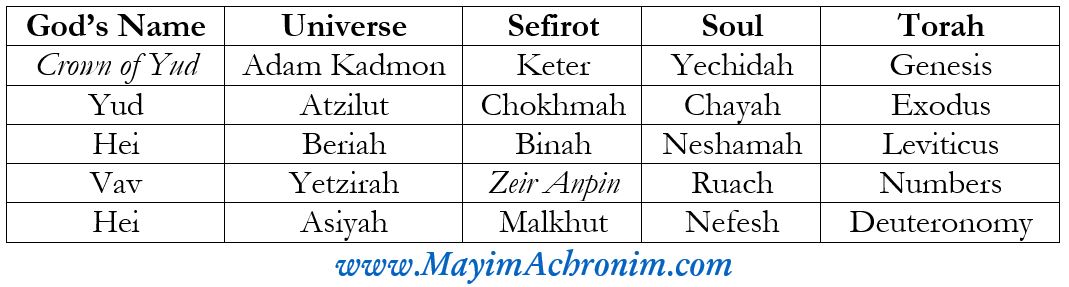
If we carefully go through the five special “Adam” verses, we can derive the key stages in the development of every human being. Stage one comes from Leviticus 1:2, where God declares: “When any of you presents [adam ki yakriv mikem] an offering of cattle to God…” This verse has been classically interpreted as a person offering up him or herself as an offering, adam mikem. In other words, any kind of significant growth or personal development requires self-sacrifice and hard work. If a person is not willing to give anything up, nor abandon any of their old ways, habits, and preconceived notions, there is little chance for successful spiritual elevation. Thus, step one is sacrifice.
Next is the verse in this week’s parasha about an adam being afflicted with leprosy. The result, of course, is that they are ostracized and separated from the community until their leprosy heals. (Interestingly, the word “ostracism” comes from the Greek ostracon, a potsherd upon which were engraved the names of undesirable people voted to be expelled.) This is actually the natural next step in the growth journey, because once a person abandons their old norms and starts to enter new areas of thought and practice, they will undoubtedly be criticized, attacked for their new-found “radicalism”, possibly branded as some kind of “reformer” or “heretic”, and ultimately “cut off” from their old community. They will be cast off as a “leper” of sorts, and valuable relationships will be lost. This stage is often experienced both by baalei teshuva who leave behind their secular lives, as well as religious people disenchanted with their particular sect, or synagogue, or denomination and looking to find new meaning. The second stage is quite a difficult process, and leads to the next step:
The third adam verse is Numbers 19:14, stating “When a person dies in a tent [adam ki yamut b’ohel]…” This is symbolic of the death of the old self. The person transitions to a new reality, a new hashkafa, renewed meaning in life, a fresh vigour and spirituality, and perhaps a new (and better) community. Only then is the person ready for the fourth adam verse: “man and beast [adam u’behemah] you save Hashem!” One has finally attained personal salvation, and communion with God. Such a person is a truly God-conscious, whole, and righteous individual.
There is just one more, sublime level after this, reserved for those who want to go even further, transcending the very bounds of time and space. This is the highest level of Adam Kadmon, corresponding to the loftiest yechidah soul. Fittingly, it corresponds to the opening Chronicles verse that has just three words: “Adam, Shet, Enosh.” If you read these not simply as names, but as an actual sentence, it literally means “man rules over mortality”! In other words, this person is immortalized and attains true eternity.
We can now add a new column to our previous table:
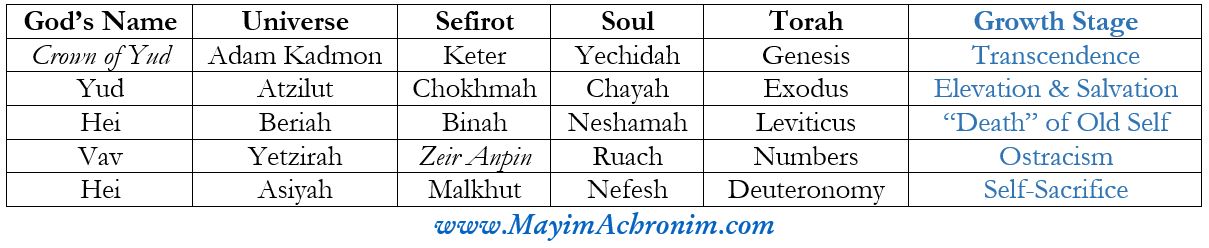
We can see how neatly the rows line up in the table. Ostracism is a fitting link for Bamidbar, when the Israelites were cast “into the Wilderness”. This is where a lot of the fundamental work needs to be done, hence its parallel to Yetzirah (“formation”), and the Middot (character traits) of Zeir Anpin. Similarly, Shemot is a fitting link to the “Salvation” or “Elevation” stage, a spiritual “exodus” to a new and higher plane, a personal Redemption. And “Transcendence” ties to Beresheet, as it is described as becoming one with Creation. At this highest stage, one has accessed and revealed their own inner “Mashiach”, because every adam has a spark of the first Adam, who gave over a portion of his soul to David and then, in turn, to Mashiach. Recall that “Adam” (אדם) is said to stand for “Adam-David-Mashiach”, and spans the entire course of history, from the first person to the “last”. And, the Arizal taught (Sha’ar haGilgulim, Ch. 11) that just about every human being has a spark of Adam, and a spiritual “portion” of the first human—and therefore also of the last.
In fact, we find the same five stages in the way our Sages described the events of Mashiach. The “sacrifice” stage (from Leviticus 1:2) is self-evident in Mashiach’s self-sacrifice on behalf of his nation. [Rav Ginsburgh points out that the word korbano (קרבנו), “his sacrifice” in the subsequent verse (Leviticus 1:3) has the same numerical value (358) as “Mashiach” (משיח)!] That Mashiach is ostracized like a leper is described by our Sages all over the place, and the Talmud even refers to him as “the Leper Scholar” (Sanhedrin 98b). The “death” of Mashiach ben Yosef, corresponding to stage three, is well-known (and will be explored more fully in an upcoming class). Then comes ushering in the Redemption for all of mankind (stage four), and finally bringing the world to a new, transcendent state where Heaven and Earth are united—corresponding to Adam Kadmon. This is the Mashiach journey, and this is the same journey for each of us, to ultimately bring out our very own inner mashiach.