Tag Archives: Mashiach

Did Bilaam Prophesize 9/11?

Parashat Balak describes how the Moabite king Balak hired the (non-Jewish) prophet Bilaam to curse the Israelites. Balak saw what the Israelites had done to neighbouring kingdoms, and feared that he would lose his own as well. He therefore sought to reverse their fortunes through a curse. The Sages state that Bilaam could sense the precise moment when – just once a day, for precisely 1/58,888th of an hour (or about 61 milliseconds) – God was in his “strictest” mode, and Bilaam could take advantage of this moment to kindle God’s wrath against His chosen people (Berakhot 7a).

The plan ultimately failed, of course, and instead of cursing the Israelites, Bilaam’s mouth uttered blessings and praises. Perhaps most interesting, Bilaam also spoke a series of prophecies about the End of Days. They begin like this:

I see it, but not now; I behold it, but it is not soon. A star has gone forth from Jacob, and a scepter will arise from Israel which will smite the Moabite princes and uproot the sons of Seth. Edom shall be inherited, and Seir will become the inheritance of its enemies, and Israel shall do valiantly. And out of Jacob shall one have dominion, and will destroy the remnant of the city… (Numbers 24:17-19)
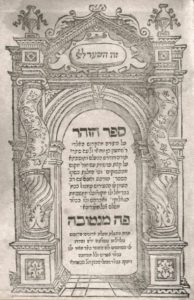
1558 Mantua Publication of the Zohar

1558 Mantua Publication of the Zohar

Bilaam describes a time in the very distant future, and the Sages agree that the “star of Jacob” refers to Mashiach. The Zohar (III, 212b) further elaborates on Bilaam’s prophecies, and describes what precisely is supposed to happen, and when that star of Jacob will be seen. Within this lengthy passage are a few verses that describe a scene quite familiar to the modern reader, and have therefore been used to suggest that the Zohar predicted the events of September 11, 2001:

… And [the star] will be seen on the sixth day, on the 25th day of the sixth month. It will be gathered on the seventh day, at the end of seventy days. On the first day it will be seen in a city of Rome. On that same day, three high structures of that city of Rome will fall and a great edifice will fall…

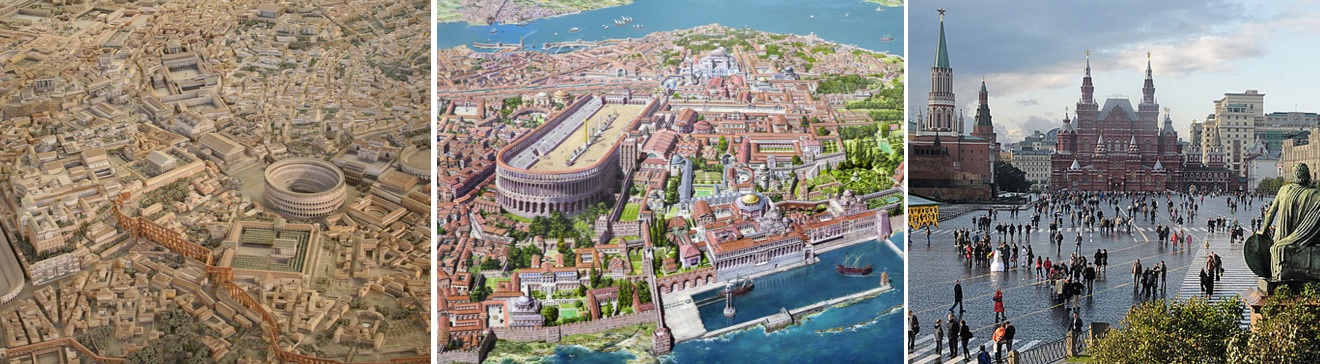
In traditional Jewish texts, Rome is typically referred to as Edom, and represents the entire Western (or European/Christian) world. The “city of Rome” represents whatever place is the centre of the Western world at a particular period of time. After the city of Rome itself had fallen in 476 CE, the “new Rome” was Constantinople. When this new Rome collapsed as well (and became present-day Istanbul), a “Third Rome” was said to arise. In the past, we have written about the identity of the Third Rome. Most scholars – at least in Jewish circles – agree on two possibilities: the Third Rome is either Moscow (as we have written about before), or New York.*
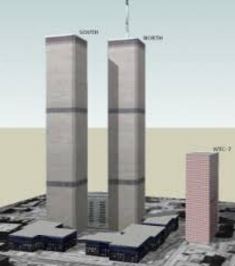
World Trade Centers: North, South, and 7

World Trade Centers North, South, and 7

If it is indeed New York, then the Zoharic passage above makes a lot of sense. A great edifice of three high structures will fall? Yes, on September 11, three of the iconic World Trade Center buildings collapsed (WTC1, WTC2, and WTC7). And the dates match quite closely, too. The Zohar says the 25th of the sixth month, ie. the 25th of the month of Elul. September 11, 2001 happened to be the 23rd of Elul!

Shortly after the 9/11 attacks, a number of articles circulated online (for example, here) suggesting that the Zohar predicted this tragedy, and added an additional detail of great interest: These articles claimed that Rabbi Eliyahu Kramer, better known as the Vilna Gaon – who lived in the 18th century – corrected the Zohar and wrote that the event will, in fact, take place on the 23rd of Elul. These articles claim that the Vilna Gaon’s correction is recorded in a mystical text called Sifra DiTzniuta.

Are these claims true, and did the Zohar really predict the September 11 attacks?

What Do The Prophecies Actually Say?

First of all, Sifra DiTzniuta was written and published long before the Vilna Gaon’s time, so suggesting that his correction of the Zohar was recorded there is already unlikely. The Vilna Gaon did write a commentary to the Sifra DiTzniuta. Having searched through both Sifra DiTzniuta and the Vilna Gaon’s commentary on it, I was unable to find any reference to the 23rd of Elul, or any correction of the Zohar’s prophecy. This doesn’t necessarily mean the claim is false, but it definitely looks like the source is incorrect.

Either way, we have to go back to the Zohar and read the entire passage, not only those few verses describing the fall of the buildings. It reads like this:

It is taught that in the future, the Holy One, blessed be He, will rebuild Jerusalem and reveal one firm star, glowing with seventy pillars of fire, and with seventy sparks flashing from it in the middle of the Firmament, and they will be reigned over by seventy other stars, and they will glow and burn for seventy days.

And [the star] will be seen on the sixth day, on the 25th day of the sixth month. It will be gathered on the seventh day, at the end of seventy days. On the first day it will be seen in a city of Rome. On that same day, three high structures of that city of Rome will fall and a great edifice will fall. The ruler of that city will die. Then the star will spread out to be seen in the rest of the world. In that time, great wars will stir all around the four corners of the world and no faith will be found among [its people].

In the middle of the world, when that star will shine in the middle of the Firmament, a great king will arise and rule the world, and his spirit will gain pride over all the kings, and he will awaken a war between both sides, and he will become strong against them.

On the day that the star will be hidden, the Holy Land will tremble forty-five miles around the place of the Holy Temple, revealing an underground cave. From this cave will come out a blazing fire to burn the world. And from this cave a great branch will grow out, and it will rule over the whole world, and to it will be given the kingdom. The Holy Beings will gather to it. Then Mashiach will be revealed to the entire world…

Clearly, there is a lot more going on! While Jerusalem has been rebuilt, we have yet to see the emergence of a star glowing with seventy pillars of fire, with seventy other stars glowing for seventy days. (These may be metaphors, of course, and may not be literally referring to celestial objects.) The Zohar says the edifice would fall at the end of seventy days (or at the beginning, depending on how one reads the passage). There was nothing particularly salient about the period of seventy days before or after 9/11. Moreover, “the ruler of that city” did not die on that day. The events of 9/11 did instigate “great wars” and it is true that we live in an increasingly faithless world. Ultimately, a “great king” to rule the entire world has not arisen (as far as we can tell), nor did the Holy Land tremble to reveal a cave from which Mashiach sprang forth.

Therefore, to suggest that this Zohar is speaking of the 9/11 attacks is perhaps a bit premature. While there are several parallels, the entire sequence of events has not occurred in the years since September 11, 2001. It appears that we have yet to witness the true fulfilment of Bilaam’s and the Zohar’s prophecies.

*While New York is the largest city in the United States, and by far its most important and famous, another candidate for the “Third Rome” is Washington, D.C. Washington has the plus of being a capitol city, the seat of “the ruler” as the Zohar says. It, too, was attacked on 9/11, and its major edifice – the Pentagon (the world’s largest office building) – damaged. Interestingly, long before Washington became America’s capital city, it was settled by a man who named it Rome!


The article above is adapted from Garments of Light – 70 Illuminating Essays on the Weekly Torah Portion and Holidays. Click here to get the book!
When is Mashiach Coming?

This week’s Torah portion is Metzora, loosely translated as “leper”. It begins by detailing the procedures for the purification of one who has been afflicted by leprosy. The Sages famously state (Arachin 15b) that the term metzora comes from “motzi shem ra”, slandering one’s fellow. Thus, a person would be afflicted with skin ailments if they were guilty of slander and evil speech. Since the slanderer is making their fellow look bad in the eyes of the public, they are appropriately punished by becoming visibly unsightly.

The connection between a metzora and a slanderer is seen in the case of Miriam, the sister of Moses. In chapter 12 of Numbers, we read how Miriam confronted Moses about his personal affairs in the presence of others. As a result of this public embarrassment, she was afflicted with leprosy, and became “white as snow” (v. 10).

Strangely, there is one more important figure that is said to be afflicted with leprosy, and for this person, the reasons appear inexplicable. The Talmud (Sanhedrin 98a) recounts the following:

Rabbi Yehoshua ben Levi met Elijah [the Prophet] by the entrance of Rabbi Shimon bar Yochai’s tomb… and asked him:
“When will the Messiah come?”
[Elijah responded:] “Go and ask him yourself.”
“Where is he?”
“At the entrance [of Rome].”
“And how will I recognize him?”
“He is sitting among the poor lepers, who are untying [their bandages] all at once, and retying them all at once, whereas he unties and reties each bandage separately, thinking, Should I be wanted, I must not be delayed.”

This fascinating passage suggests that Mashiach is sitting at the gates of Rome (according to numerous commentators, including the Vilna Gaon) among all the lepers expelled from the city. Unlike all the other lepers, Mashiach treats one bandage at a time, just in case he might be called to his mantle at any moment, and must always be ready. Indeed, the following page of the Talmud asks what Mashiach’s name might be, and after citing several possibilities, the rabbis conclude that he is known as the “Leper Scholar” (or “the Leper of Rebbi’s School”).

Why would Mashiach be a leper?

The Leper Scholar

The Lubavitcher Rebbe offers one interesting answer to the puzzle. He teaches (Likutei Sichot, Vol. 7, pg. 100) that Mashiach is essentially a perfect person on the inside; however, no human being is completely perfect – such a distinction is reserved only for God – and so, his minor spiritual imperfections appear only on his most outer garments – the skin. The Rebbe goes on to say that the leprosy appearing on his skin is actually a sign of Mashiach’s tremendous spiritual powers. Rabbi Eli Touger describes the Rebbe’s teaching like this: “…there are sublime spiritual influences which, because of the lack of appropriate vessels… can produce negative effects. For when powerful energy is released without being harnessed, it can cause injury. This is the reason for the [leprosy] with which Mashiach is afflicted.”

The Midrash writes that Mashiach’s most powerful weapon is his tongue, and he slays evil with his speech. In one passage (Pesikta Rabbati 37), Mashiach is said to be confronted with 140 wicked kingdoms, and God comforts him: “… do not be afraid, for all of them will perish by the breath of your lips.” This is based on the verse in Isaiah 11, where the Messiah is similarly described as destroying the wicked with his speech. The power of speech is perhaps the greatest of all – it is through speech that God created this entire universe (“And God said ‘Let there be light’…”) – one who knows the true powers of speech can create and destroy worlds!

The power of speech is precisely what the metzora abuses in slandering a fellow, and is thoroughly punished for it with leprosy. Meanwhile, Mashiach uses the same power to root out all evil. Yet, his power is so great that containing it in his feeble body inevitably manifests as a leprosy on his skin.

With this definition in mind, we may see the word metzora in a new light. The Sages say that metzora means motzi ra, literally one who brings out evil. While this can be taken to mean one who brings out evil words about others, it can also be read as one who removes evil from the world, which is Mashiach’s ultimate purpose.

When Will Mashiach Come?

The same pages of Talmud quoted above (Sanhedrin 98a-b) record that the students of Rabbi Yose ben Kisma asked him: “‘When will the Messiah come?’… So he answered them: ‘When this gate falls down, is rebuilt, falls again, and is again rebuilt, and then falls a third time, before it can be rebuilt the son of David will come.’” Rashi comments here that the “gate” which Rabbi Yose is referring to is none other than Rome (just as the Vilna Gaon commented above that Mashiach is sitting at the gates of Rome).

Rabbi Yose is saying that Rome will fall, and will be rebuilt two more times. When the Third Rome falls, one is assured that Mashiach’s arrival is imminent. Amazingly, historians often speak of “Three Romes”. The first Rome was the original Latin Rome. It collapsed in the 5th century CE, and was replaced by the Greek-speaking Constantinople (today’s Istanbul), the capital of the Eastern Roman Empire, later referred to as the Byzantine Empire. When Constantinople fell, the new, “Third Rome” was said to be Moscow. Moscow reached the peak of its global power with the Soviet Union, and collapsed just as dramatically less than 30 years ago.

Three Romes: Ancient Rome, Constantinople, and Moscow

Three Romes: Ancient Rome, Constantinople, and Moscow

Interestingly, Jewish literature commonly referred to Rome as Edom, literally the “red” empire. The Soviet Union, too, was known for its association with that colour; the Communists were commonly referred to as “the Reds”, the Soviet Army as the “Red Army”, with the focal point of their empire being Red Square in Moscow.

It is commonly taught that God created civilization as we know it to last 6000 years, followed by a seventh millennium of a peaceful, cosmic “Sabbath”, mimicking the seven days of Creation (see, for example, Sanhedrin 97a). Throughout the ages, various rabbis attempted to calculate the coming of Mashiach based on this principle. If the Final Era of mankind is the 7th millennium – the Sabbath – then the Messianic Era is the preparatory period that immediately precedes the Sabbath. How long should this period be? Well, how long do we spend preparing for Shabbat?

In Jewish law, one should stop working and start preparing for Shabbat six hours before its onset. If each millennium of human history corresponds to one day, then six hours corresponds to 250 years, which means that the official starting point of the Messianic Era was the year 5750 (since this is 250 years before the start of the 7th millennium). Indeed, 5750 is commonly cited as the beginning of the Ikveta d’Mshicha, the “Footsteps of Mashiach”.

Incredibly, Rosh Hashanah of 5750 was celebrated in September of 1989. The Berlin Wall – and the Soviet Union along with it – came crashing down less than two months after, that same November. The Third Rome had fallen right in line with the prophesized starting point of the “Footsteps of Mashiach”, just as the Talmud records in two brief pages of the tractate Sanhedrin (97a, 98b).

Needless to say, it appears that Mashiach’s arrival may very well be imminent.


The article above is adapted from Garments of Light – 70 Illuminating Essays on the Weekly Torah Portion and Holidays. Click here to get the book!
Yehoshua and the Origins of Christianity

This week’s Torah portion is Pinchas, named after the grandson of Aaron, who stemmed the tide of immorality that followed the Moabite and Midianite ploy to bring Israel to sin. For his efforts, God blessed Pinchas with an everlasting blessing of peace. In the past, we explored the nature of this blessing, and how it resulted in Pinchas’ apparent immortality, as well as his eventual rebirth as Elijah the Prophet. This week, we will explore another critical figure in the Torah: Yehoshua, better known as Joshua.

Midway through this week’s parasha we read how God commanded Moses to officially appoint Yehoshua as Moses’ successor. Yehoshua is described as a person within whom rests the spirit of God. Although there are a number of Torah figures who are described as possessing some sort of Divine Spirit, Yehoshua is one of only two who are described as having the spirit within them. In most cases throughout the Bible, the spirit of God is said to rest upon an individual (‘alav in Hebrew), or to have temporarily filled an individual (mal’e or timal’e in Hebrew). With regards to Yehoshua, it says that the spirit was within him. The only other person in the Torah who is described in such a way is Yehoshua’s direct forefather Yosef (Genesis 41:38).

An even more peculiar detail about Yehoshua is that he is called “Yehoshua bin Nun”. Every other person in the Bible is referred to by their name, as well as by their father’s name, with the designation ben – “son of” – in the middle. Yehoshua alone is called bin Nun instead of the regular ben Nun. Moreover, a person named Nun cannot be found anywhere in the Torah, and unlike most other Torah figures, Yehoshua’s genealogy is not given (although one is provided in the Book of I Chronicles, written many centuries after the Torah). Other than the fact that Yehoshua stems from the tribe of Ephraim, nothing else of his origins is divulged.

Out of a Fish

There happens to be an obscure Midrash that fills in some of the details about Yehoshua’s early life. There are a few variations of the story, with one particularly tragic version that seems to
mirror the Greek myth of Oedipus. According to this Midrash, Yehoshua was left by his parents, possibly placed in the Nile River like Moses was. Miraculously, a large fish swallowed him
up, and Yehoshua was later saved by fishermen. This is the meaning of bin nun, since nun means “fish” in Aramaic. Thus, Nun is not the name of his father at all, explaining why he is not
called ben Nun. Rather, bin Nun refers to his origins from the fish, with his true genealogy unknown.

In the controversial “Oedipus” version of the story, Yehoshua is saved by the Pharaoh’s fisherman, and thus grows up in the palace, becoming the court executioner. He tragically
ends up putting his own father to death, as was originally prophesized when Yehoshua was conceived (which is why his parents abandoned him to begin with). I prefer to think of it more in the style of Moses, where Yehoshua was placed in the Nile just as Moses was, to avoid the Pharaoh’s decree of slaughtering all the male-born. By also growing up in the palace, alongside Moses (though he would have been younger), the two would have been well-acquainted, and that might explain why Yehoshua is so close to Moses throughout the Torah narrative.

Whatever the case, Yehoshua grows up to be a holy man, the personal servant of Moses, one of just two righteous spies, and the leader that finally brought the people into the Holy Land. The Sages describe him as the moon to Moses’ sun, and the key link in the chain of Jewish Oral Tradition.

The Origins of Christianity

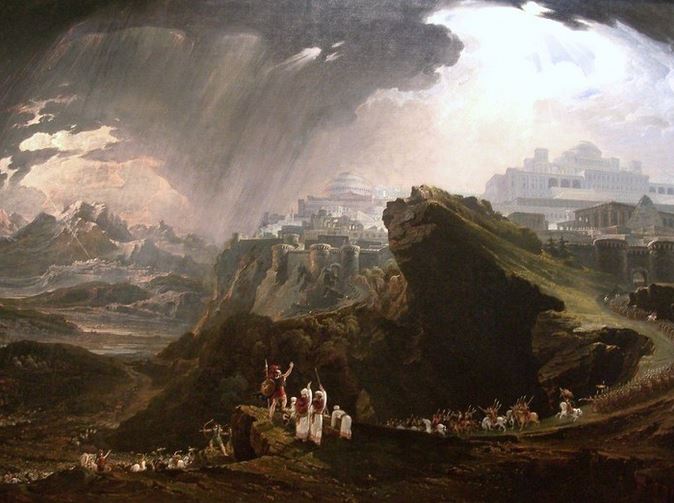
'Joshua Commanding the Sun to Stand Still upon Gibeon' by John Martin

‘Joshua Commanding the Sun to Stand Still upon Gibeon’ by John Martin

When looking at the life story of Yehoshua, it is hard to miss the connection to Christianity. Like Yehoshua, Jesus is a Jew said to have had a miraculous birth, spent time growing up in Egypt, and was described as having the spirit of God within him. Like Yehoshua, Jesus is symbolized by a fish, and is seen as a sort-of successor to Moses (as suggested by his supposed “Transfiguration”, where he ascends to be blessed by Moses and Elijah). In the same way that Yehoshua stems from Joseph, Jesus’ “earthly father” is said to be Joseph. Jesus is described as a miracle-worker, just as Yehoshua facilitated a number of miracles, such as making the sun and moon stand still at Gibeon, and stopping the flow of the Jordan River. Of course, Jesus’ original name as pronounced in his day was Yeshu, the Aramaic version of Yehoshua.

The similarities don’t end there. Strangely, the Torah makes no mention of Yehoshua’s wife or children (even the genealogy given in I Chronicles ends with Yehoshua himself). Jesus, too, failed to marry or have kids. The Talmud (Megillah 14b) suggests that Yehoshua did later marry Rachav, the harlot that assisted the Israelites in the conquest of the Holy Land. Rachav had repented and become a righteous woman. Similarly, Jesus had close encounters with Mary Magdalene, also described as a harlot, and also controversially rumoured to have possibly married Jesus!

It is important to remember that there is absolutely no evidence for the existence of Jesus outside of the New Testament. It is well-known that the New Testament was written long after Jesus would have lived, and is full of contradictions about the details of his life. Many have challenged the historicity of Jesus, with more and more scholars suggesting that he likely did not exist at all.

Considering all that, it isn’t hard to imagine how early Christians would have put together the mythology of Jesus based on previous Torah ideas and narratives: a miraculously-born baby with the spirit of God, whose very name means “salvation”; celibate and childless, a humble, Godly servant bringing others to repentance, and leading the Israelites to the Promised Land… This is the story of the Torah’s Yehoshua, and the story that was adapted to fit the mold of a new religion a couple of millennia ago.

The Jewish Sages did always view Yehoshua as a prototype of Mashiach. After all, he is the one that defeated the embodiment of evil known as Amalek, and the one that ended the exile of the Jews, returning the people to their land. So, it isn’t surprising that Christians used Yehoshua as a prototype for their own supposed Messiah. Ironically, though, not only did Jesus fail to defeat evil, and fail to bring an end to the exile, he was also indirectly responsible for inspiring the murder of countless people thanks to all the holy wars, inquisitions, and crusades fought in his name. Jesus’ own message may have been peace, but his followers used him incessantly for war and bloodshed. Two millennia have passed, and the world is still far from perfect. We continue to await the arrival of the true Messiah. May we all merit to see his coming soon.


The article above is adapted from Garments of Light – 70 Illuminating Essays on the Weekly Torah Portion and Holidays. Click here to get the book!