Tag Archives: Pharaoh

An Honest Look at the Film ‘Exodus: Gods and Kings’

This week we start a new book of the Torah, Shemot, known in English as ‘Exodus’. This volume is primarily concerned with the period of Israelite slavery in Egypt, and the subsequent salvation following the ten plagues and the Splitting of the Sea, climaxing with the revelation at Mt. Sinai, and the start of the transmission of the bulk of the Torah’s laws.

Coincidentally, not long ago was released Ridley Scott’s new film, Exodus: Gods and Kings, and I finally had a chance to see it this week. Though it appeared to show a little bit of promise at the start, the movie soon unravelled into a bizarre re-invention of the Biblical story. Of course, there is nothing wrong with some artistic liberties when adapting an ancient text for a modern film, nor is it too much of a problem to fill in some of the gaps in the Torah’s narrative. However, Exodus: Gods and Kings presented a completely twisted version that did not even slightly stick to the basic story of the Torah. It would take an entire tome to cover all the mistakes in the film, but perhaps we can offer just a few of the most blatant ones.

From the very beginning, we see that Moses seems to be completely unaware that he is not Egyptian. That’s quite odd: Semites and Egyptians had a totally different appearance. Take a look at this depiction of Semitic tribes, as discovered in the 12th dynasty tomb of Egyptian Khnumhotep II, official of the pharaoh Senusret II:

IbschaEgyptSemites

The Semites have a different skin tone, different hair styles, clothes, and so on. The filmmakers clearly knew this, as they show Moses bearded and sporting a nice hairdo, while all the other Egyptian royals are clean-shaven and bald. His eyes look different, and he wears clothes of a completely different style than all the others. How come? Didn’t he ever question why he doesn’t look anything like his “royal brethren”?

More importantly, the Torah clearly says that Moses was initially raised by his true birth mother, Yocheved (Exodus 2:7-9). Only after he was fully weaned did Yocheved present Moses to his new step-mother, the Pharaoh’s daughter (v. 10). It is totally inconceivable that Moses did not know he was a Hebrew! The Torah states that when Moses grew up, he “went out to his brothers and looked at their burdens” (2:11). He knew full-well that he was going out to his people.

At this point, when he saw an Egyptian taskmaster violently beating a Jew, he stepped in to save the victim, killing the Egyptian in the process. In the movie, this heroic act is replaced with an enraged Moses killing an Egyptian guard who was doing nothing terrible at all. The kind, compassionate Moses, described by the Torah as the humblest man that ever lived, is turned into a violent brute who kills indiscriminately. No wonder that Christian Bale, the actor who plays Moses, said of his character that he was “likely schizophrenic and was one of the most barbaric individuals that I ever read about in my life.” Makes sense if all he ever read about Moses was in the script for the film.

If Christian Bale did indeed read about Moses, perhaps he missed the whole part where Moses selflessly led his people for forty years in the wilderness. Where he literally sat from morning to evening to counsel the people and help them (Exodus 18:13). Or when he refused to abandon his people, even when God offered to make an entirely new nation out of Moses (Exodus 32:10). The many occasions where he convinced God to avert His just decrees and forgive the nation for their sins. The time where his sister Miriam transgressed severely against Moses, yet he did not hold even the tiniest of grudges or ill-will, and immediately prayed to God to heal Miriam and have mercy on her (Numbers 12:13). Or the simple fact that Moses led the revolution that brought monotheism (together with a higher sense of morality, starting with a set of Ten Commandments) to over two-thirds of the world’s population.

Worse than its depiction of Moses, though, was the film’s depiction of God: an irrational, pointlessly vengeful, literally childish figure. The film made it seem like the Ten Plagues were nothing more than God’s desire to kill as many people as possible. The reality, of course, was that the Ten Plagues were meant to be a measure-for-measure retribution for what the Egyptians had done; nothing more than cosmic karma. For example, just as the whole story begins with Pharaoh ordering the male-born to be drowned in the Nile, it ends with Pharaoh’s own male soldiers drowning in the Red Sea, measure for measure. Nor was God happy about any of this. The Talmud (Sanhedrin 39b) beautifully says that at the Splitting of the Sea, when the Egyptians drowned, the angels began to sing a joyous song, mimicking the Jews that were singing as well – but God immediately stopped them. He rebuked the angels, saying sadly: “My creations are drowning, and you are singing?”

When one studies the texts and commentaries, it becomes clear that each of the Plagues was specifically tailored towards the sins of the Egyptians, and was designed to bring the rightful justice that was due. Nowhere is this fact even hinted to in the movie. Most telling was after the plague of the firstborn, when Pharaoh confronts Moses demanding an answer as to why they suffered such a tragedy. The latter gives no logical reply, saying only that no Hebrews died. Perhaps the scriptwriter should have had something along the lines of: “Hey Pharaoh, did you forget all the countless babies that you slaughtered? Or the many warnings you were given that this was coming, and to stop your evil ways?” The scene almost makes Pharaoh seem like the victim, and Moses the villain. It appears that the main aim of the movie was to cast Moses (and God) in a bad light. It really seems like the filmmakers went out of their way to do this.

Moses is shown carelessly abandoning his family when he goes back to Egypt to save his people. His wife and son are angry, emotionally-scarred, losing their faith – and Moses does nothing about it. What was the point of making this shift from the Torah’s original version, which clearly states “Moses took his wife and sons, mounted them upon the donkey, and returned to the land of Egypt…” (Exodus 4:20)? He never abandoned his family, but took everyone with him!

It therefore appears quite evident that the purpose of Exodus: Gods and Kings was to turn one of the most beautiful and enduring stories into an ugly, twisted, and corrupt tale. The sheer number of mistakes is both inexcusable and inexplicable. One who wishes to experience a far truer (and more entertaining) version need only to open and read this week’s Torah portion.
Yosef and Yuya: Does Archaeological Evidence Prove the Biblical Narrative of Joseph?

In 1905, British Egyptologist James Quibell discovered a new tomb in the famed Valley of the Kings, where many of Egypt’s greatest mummified pharaohs were found. In this tomb were the bodies of two highly-preserved mummies, one male and one female: Yuya and Tjuyu. Scholars were astounded at the grand way in which Yuya was described: “the king’s lieutenant”, “master of the horse”, “superintendent of cattle”, and even, strangely, “father of the god”. Most amazingly, though, was the fact that Yuya was buried in the Valley of the Kings, despite never having been a pharaoh! Yuya was a unique and puzzling archaeological find. Who was he?

Father of the King

Parashat Miketz (Genesis 41:1-44:17) describes how Joseph rose to power in Egypt. It begins with Pharaoh’s bizarre string of nightmares, which none of his soothsayers were able to interpret. The royal cupbearer then informs Pharaoh that while he was in prison, a “Hebrew youth” was able to precisely interpret his dreams. Pharaoh summons the Hebrew youth – Joseph – who is indeed able to properly interpret Pharaoh’s dreams. The Sages tell us that Joseph’s interpretation was unique: it not only interpreted the dreams, but simultaneously offered the ideal solution for the problems that the dreams presented. Highly impressed, Pharaoh appointed Joseph as the prime minister of Egypt:

And Pharaoh said to his servants: “Can another man like this be found, in whom the spirit of God rests?” Then Pharaoh said to Joseph, “Since God has let you know all this, there is no one as understanding and wise as you. You shall be [head] over my house, and through your command all my people shall be nourished; only [with] the throne will I be greater than you… I have appointed you over the entire land of Egypt.” And Pharaoh removed his ring from his hand and placed it on Joseph’s hand, and he clothed him with garments of fine linen, and he placed the golden chain around his neck. And he had him ride in his secondary chariot, and they called out before him, “Avrekh!” appointing him over the entire land of Egypt. (Genesis 41:39-43)

Rashi explains that the term Avrekh is a contraction of av, “father”, and rikha, “king”, in other words, Joseph was called aba malka, “father of the king”, or “father of the pharaoh”.

We are then told how Joseph stockpiled food during the seven years of plenty, carefully mapping out a strategy to survive the coming years of famine. Not only did he plan for Egypt’s survival, but he ensured that Egypt would have enough to sell to all of the neighbouring nations and kingdoms that would also be affected by the great famine. Through this, he was able to make Egypt the wealthiest empire on the planet, turning what should have been seven years of hardship into seven years of immense prosperity.

No doubt, such a person would certainly be immortalized in Egypt’s history as one of its greatest leaders. In fact, the archaeological record appears to suggest that he may have been after all.

The Mystery of Yuya

Historians have uncovered a great deal of information about Yuya since the discovery of his tomb in 1905. He lived during the Eighteenth Dynasty of Egypt (1543-1292 BCE), and was an influential minister in the Pharaoh’s court. Strangely, his name is not of Egyptian origin, nor is his appearance. Many scholars believe he must have been a foreigner. He is described as being in charge of the horses and chariots, as well as the cattle. He is also titled “father of the god”, or more accurately, “father of the pharaoh” (since the pharaohs considered themselves gods). It isn’t difficult to see that Yuya is described in terms almost identical to the way that Joseph is described in the Torah.

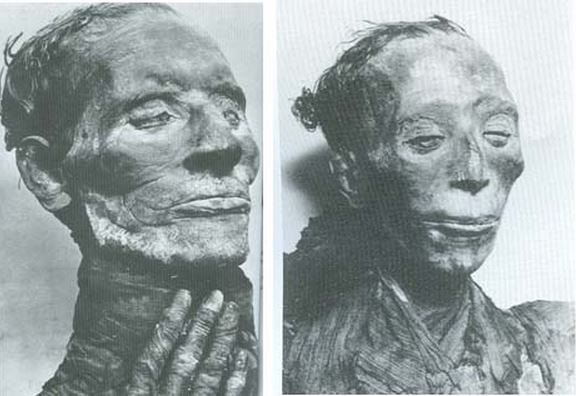
Egyptian journalist and author Ahmed Osman published a controversial book in 1987 about Yuya’s identification with Joseph, titled Stranger in the Valley of the Kings. He pointed out how Yuya’s mummy has Semitic features, evidence of a beard worn in the Hebrew style, and is the only mummy found to have its hands under its chin as opposed to across its chest. Moreover, the description of “father of the god/pharaoh” parallels Joseph’s description as Avrekh. Could the two really be the same person?

The mummies of Yuya and Tjuyu

The mummies of Yuya and Tjuyu

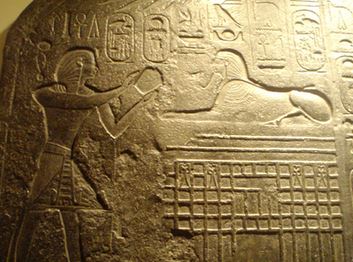
The historical record suggests that Yuya was the minister of the Pharaoh Thutmose IV, who reigned around 1400 BCE. This is not too far from the lifetime of Joseph. More amazingly, archaeologists have found a stele (an inscribed stone) commissioned by Thutmose IV that describes one of his dreams! Like Joseph’s pharaoh in the Torah, Yuya’s pharaoh Thutmose also derived great significance from his dreams.

It is further interesting to point out that Yuya was found entombed with his wife Tjuyu, who is known to have come from a royal family with priestly origins. Similarly, the Torah states that Joseph married the daughter of an Egyptian priest (Genesis 41:45).

And what of Yuya being a mummy? The Torah states: “And Joseph died at the age of one hundred and ten years, and they embalmed him and placed him in a sarcophagus in Egypt.” (Genesis 50:26) Joseph, too, was mummified!

The "Dream Stele" of Pharaoh Thutmose IV

The “Dream Stele” of Pharaoh Thutmose IV

Having said all that, the Torah also states that Joseph’s tomb was later taken out during the Exodus from Egypt (Exodus 13:19), and eventually brought to rest in Israel. This would make it very difficult for his mummy to be found in the Valley of the Kings. On top of this, historians have presented a number of other issues with the identification of Yuya with Joseph. So, perhaps Yuya is not Joseph after all.

Whatever the case may be, the amazing archaeological find of Yuya does give us proof that a foreigner could rise up through the highest ranks of Egyptian royalty, and even become “father to the pharaoh”. It gives us proof that the Torah’s account is quite accurate in its details, and in its terminology. And it certainly makes a compelling case for historical evidence of the Biblical narrative of Joseph.

The Origins of Monotheism

There are two more points that make the connection between Yuya and Joseph all the more fascinating. Historians see the root of the name “Yuya” as yw, which means “reed-leaf” in Ancient Egyptian. Meanwhile, Joseph’s name is יוסף, sharing a root with סוף, which also means “reeds” in Hebrew! The presence of “Ya”, a common appendage in Hebrew names to denote God’s name, makes it even more interesting.

Finally, the historical record shows that Yuya’s daughter married the pharaoh. They had a son, who became the pharaoh Akhenaten. Akhenaten was Yuya’s grandson. And he went down in history for doing one major thing for Egypt: destroying all of its idolatry to make the nation monotheistic. Unfortunately, his attempt to turn Egyptian society and religion monotheistic ultimately failed, and the kingdom reverted to its idolatry. But it wasn’t long after that the Jewish people left Egypt, beginning the spread of monotheism to the entire world.


The above is an excerpt from Garments of Light: 70 Illuminating Essays on the Weekly Torah Portion and Holidays. Click here to get the book!