Tag Archives: Pharaoh

Mashiach and the Mysterious 13th Zodiac Sign

When Jacob blesses his children before his passing, he begins by telling his sons that he wishes to reveal to them what will happen b’acharit hayamim, “in the End of Days”. Yet, the text we read does not appear to say anything about the End of Days! The Talmud (Pesachim 56a) states that the Shekhinah withdrew from Jacob at that moment so he was unable to reveal those secrets. If that’s the case, how was he able to properly bless his children?

The Talmud states that when the Shekhinah left him, Jacob worried one of his children was unworthy to hear those secrets. His sons then recited the Shema in unison and said, “just as there is only One in your heart, so is there in our heart only One.” Jacob was comforted to know they are all indeed righteous, and it seems the Shekhinah returned to him at this point, allowing him to bless his children in holiness. Nonetheless, Jacob reasoned that to reveal the secret of the End in explicit fashion would be unwise, so he encoded these mysteries within the blessings he recited. In fact, Jacob not only encrypted what will happen in the End, but summarized the breadth of Jewish history (see ‘How Jacob Prophesied All of Jewish History’ in Volume One of Garments of Light).

One place where Jacob appears to make an explicit reference to the End is in blessing Dan, when he says, “I hope for Your salvation, Hashem” (Genesis 49:18). Jacob says Dan will be the one to judge his people—alluding to the great Judgement Day—and wage the final battles like a “snake upon the road… who bites the horse’s heel so that its rider falls backwards”. Jacob is speaking of Mashiach. Although Mashiach is a descendent of David and from the tribe of Judah, the Midrash states that this is only through his father, while through his mother’s lineage Mashiach hails from the tribe of Dan.

Why does Jacob compare Mashiach to a snake?

Snakes of Divination

In cultures around the world, there is a peculiar connection between snakes and prophecy. In ancient Greece, for example, the Oracle went into a prophetic trance when supposedly breathing in the fumes (or spirit) of the dead python upon which the Temple in Delphi was built. According to myth, this great python (a word which has a Hebrew equivalent in the Tanakh, פתן) was slain by Apollo. The Temple was built upon its carcass. For this reason, the Greek prophetess was known as Pythia.

Similarly, the Romans had their sacred hill on the Vatican (later adopted as the centre of Christianity). The second-century Latin author Aulus Gellius explained that the root of the word Vatican is vates, Latin for “prophet”. Others explain that vatican refers more specifically to a “divining serpent”. Meanwhile, on the other side of the world the Aztecs had Quetzalcoatl and the Mayans had Kukulkan, the “feathered serpent” god of wisdom and learning. And such mystical dragons appear just about everywhere else, from Scandinavia to China.

Incredibly, the Torah makes the same connection, where Joseph is described as a diviner who uses a special goblet to nachesh inachesh (Genesis 44:5). This term for divination is identical to nachash, “snake”. In Modern Hebrew, too, the term for guessing or predicting is lenachesh. Why is the snake associated with otherworldly wisdom and prophecy?

Primordial Serpent

Back in the Garden of Eden, it was the Nachash, “Serpent”, who encouraged Eve to consume of the Forbidden Fruit. This was the fruit of the Tree of Knowledge. The Serpent is the one who unlocked the minds of Adam and Eve to higher wisdom so that they could “be like God”. Jewish tradition maintains that Adam and Eve were eventually supposed to eat of the Tree of Knowledge (for otherwise why would God put it there to begin with?) but they simply rushed to do so when they were not yet ready. They transgressed God’s command, and knew not what to do with all of this tremendous information, resulting in the shameful descent of man into sin. The one who instigated it all was the Nachash.

It appears that ever since then, the snake has been a symbol of forbidden wisdom. Such divination and mysticism can be quite dangerous, and most are unable to either grasp or properly use this knowledge. The Talmud cautions as much in its famous story of the four sages who entered “Pardes” (Chagigah 14b). Pardes is an acronym for the depths of Jewish wisdom, from the simple (pshat) and sub-textual (remez) to the metaphorical (drash) and esoteric (sod). The result of entering the mystical dimensions was that Ben Azzai died, Ben Zoma detached from this world, and Elisha ben Avuya became a heretic. Only Rabbi Akiva was able to “enter in peace and depart in peace.” It is important to remember that Rabbi Akiva was the teacher of Rabbi Shimon bar Yochai, the originator of the Zohar. (Still, the Zohar, like most mystical texts, does not speak explicitly of esoteric matters, but cloaks them in layers of garments and complex language which only the most astute can unravel.)

Long before, Joseph was a master of this wisdom, surprising even the Pharaoh and his best mystics, who proclaimed: “Can there be such a man in whom the spirit of God rests?” (Genesis 41:38). Joseph, of course, is a prototype of Mashiach. The sages state that Mashiach is a great prophet and sage in his own right, but can he really surpass the unparalleled prophecy of Moses or the wisdom of Solomon? The Alter Rebbe (Rabbi Schneur Zalman of Liadi, 1745-1812) solved the issue thus:

After the resurrection all will rise… the Patriarchs and Matriarchs, Moses and Aaron, all the righteous ones and the prophets, tens of thousands beyond number. Is it possible that Mashiach will teach them the same Torah that is revealed to us today? …Will all who knew the whole Torah be required to learn new laws from Mashiach? We must therefore say that Mashiach will instruct them in the “good of discernment and knowledge of the secrets of the esoteric teachings of Torah” that the “eyes will not have seen”—Moses and the Patriarchs not having been privileged to that knowledge, for only to Mashiach will it be revealed as it is written of him [Isaiah 52:13] “and he shall be very high.” (Likkutei Torah, Tzav)

Mashiach is the greatest of mystics, the holder of “forbidden” knowledge which will soon no longer be forbidden. The time will come when, as God originally intended, man will eat from the Tree of Knowledge and be “like God”. That first requires a return of mankind to the Garden of Eden, which is the very task of Mashiach. Beautifully, the gematria of Mashiach (משיח)—the one who brings us back into Eden—is 358, the same as Nachash (נחש)—the one who forced us out to begin with. And so, as Jacob foresaw, the snake symbolizes Mashiach himself.

While Mashiach is likened to a serpent, he must also defeat the Primordial Serpent which embodies all evil. Indeed, the Sages speak of two serpents (based on Isaiah 27:1): the “straight” serpent (nachash bariach) and the “twisted” serpent (nachash ‘akalaton). Mashiach is the straight serpent that devours the twisted one. This was all alluded to in Moses’ staff-turned-serpent consuming the Pharaoh’s staff-turned-serpent. In fact, another serpent staff, the nachash nechoshet, is later used by Moses to heal the nation. This healing staff found its way into Greek myth as well, where it was wielded by the healer god Asclepius, and eventually into the modern internationally-recognized medical symbol.

And that brings us back to the End of Days.

The 13th Zodiac

In recent years, there have been whispers of a necessity to change the current 12-sign horoscope to include a 13th zodiac sign. This was featured in the media on a number of occasions, with flashy headlines suggesting that some people’s astrological sign may now have changed. It is based on the fact that there is a “precession of the equinoxes”: Earth’s axis changes very slowly over time, meaning that the constellations which are visible in the night sky change, too.

The astrological signs are based on the 12 major constellations (out of 88 constellations total) that align with the sun and “rule” for about a month’s time every year (each making up 30º of the total 360º). The argument is that due to the precession of the equinoxes, a 13th sign has crept in which we can no longer ignore. The majority of astrologers have rejected this argument, mainly because astrology isn’t really based on the stars but fixed to the vernal equinox. While some in the East (namely Hindus) use “sidereal astrology”, which is based on shifting star positions, the system used in the West (“tropical astrology”) has 12 signs roughly corresponding to the 12 months.

The same is true in traditional Jewish thought, where each sign corresponds to a month on the Hebrew calendar, as well as to one of the twelve tribes of Israel. Having said that, including a 13th month for the Jewish system is not a problem at all. In fact, it is actually a solution, since the Jewish calendar has a 13th month in a leap year. The extra month has an astrological sign, too! Similarly, although we always speak of twelve tribes of Israel, there are really thirteen since, as we read in this week’s parasha, Jacob made Joseph count as two separate tribes: Ephraim and Menashe.

Whatever the case, whether the horoscope requires modification or not is irrelevant to Judaism, which denies any astrological effect on Israel (see ‘Should Jews Believe in Astrology’ in Volume One of Garments of Light). Besides, unlike astrologers, astronomers both ancient and modern have always been aware of this thirteenth constellation. To the ancient Babylonians it was the snake-like Nirah, while to the ancient Greeks it was known as Ophiuchus, the “serpent-bearer”. This constellation is in the shape of a man firmly grasping a twisted snake (the interlinked constellation Serpens). This is, of course, the very symbol of Mashiach, that serpentine saviour who defeats the primordial snake and all of its evil. After being an astrological footnote for a very long time, Ophiuchus has entered the spotlight, as if the cosmos itself is reminding us of Mashiach’s impending arrival.
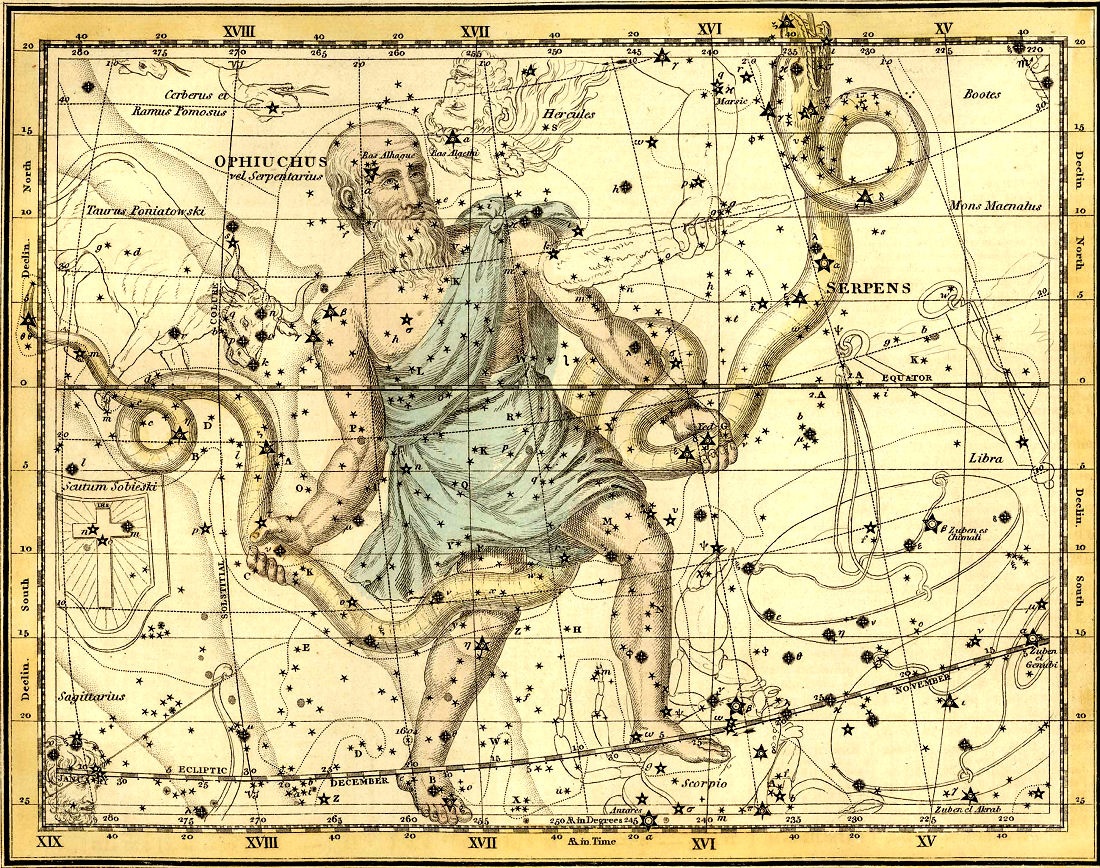
The constellation Ophiuchus (or Serpentarius) grasping the constellation Serpens, from Alexander Jamieson’s Celestial Atlas of 1822. It is interesting to note that Mashiach must be a direct descendant of King David, whose own father Yishai (Jesse) was also called Nachash! (See Talmud, Shabbat 55b.)


The above is an excerpt from Garments of Light, Volume Two. Get the book here! 
Did the Jews Build the Pyramids?

The second book of the Torah, Shemot, begins by recounting the Israelite bondage in Egypt, and the Exodus that followed. One often overlooked question is: when did all of this actually happen? The Torah itself never gives any years or specific dates for its events. The accepted Jewish tradition is that the Exodus took place in the Hebrew year 2448, which corresponds to roughly 1312 BCE. What might archaeology and the historical record reveal?

City of Ramses

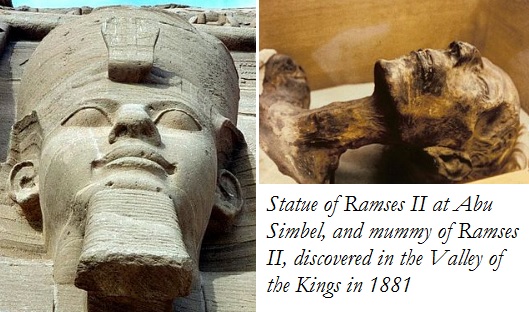
The Torah tells us that one of the major cities that the Israelites built was Ramses (Exodus 1:11). The historical record shows that this city was, not surprisingly, built by the pharaoh Ramses II (the Great). However, his reign spanned 1279-1213 BCE, too late for the Jewish dating of the Exodus. Perhaps it was Ramses’ grandfather, Ramses I – the founder of Egypt’s famous 19th dynasty – that began building a new capital city to be named after him. Ramses I reigned 1292-1290 BCE; still too late to coincide with Jewish tradition.

The Torah never identifies the names of any pharaohs it mentions. It describes at least three different ones: the pharaoh that dealt with Abraham, and the one that appointed Joseph many decades later, as well as the “new pharaoh” that forgot about Joseph’s contributions (Exodus 1:8). The pharaoh at the time of the Exodus was likely a different pharaoh altogether, too. The description we have of Ramses II actually parallels the Torah’s Exodus pharaoh quite well.

Ramses II was Egypt’s longest-reigning monarch (66 years!) and had over 100 children. He vastly expanded Egypt’s wealth, and stretched its territory and influence as far as the lands of Canaan and Syria. We see that he was a prolific builder, commissioning – among many other projects – a massive temple complex known as the Ramesseum, which still stood over 1000 years later when it marvelled the Greek historian Diodorus. His city of Ramses (or Pi-Ramses) was located in northeastern Egypt, in the land of Goshen, precisely where the Torah says the Israelites dwelled.

The Hyksos

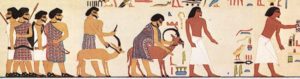
Images of Semites in Egypt, discovered in a Twelvth Dynasty tomb, dated to c. 1900 BCE

The historical record shows that a few centuries before Ramses, a mysterious Semitic tribe migrated to Egypt en masse and ended up taking over the kingdom. They were called heqa khaseshet, “foreign rulers”, which gave rise to the term “Hyksos”. Eventually, the Egyptians fought back and regained control from the foreigners. Most were expelled, many were killed, and it is likely that some were enslaved.

The ancient Jewish historian Josephus wrote that “Hyksos” comes from hekw shasu, “shepherd kings”. Of course, the Torah describes in detail how the Hebrews came down to Egypt and made sure everyone knew they were shepherds, a trade frowned upon in Egypt. Josephus cites historical sources suggesting that 480,000 Hyksos were ultimately expelled, and he concludes that these were the ancient Israelites!

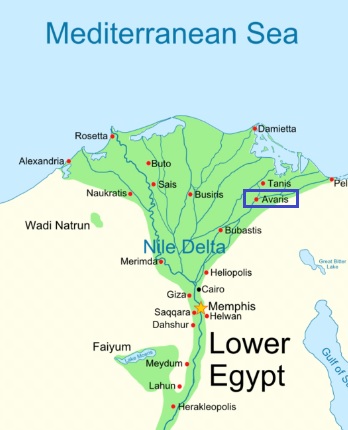
The city of Ramses was discovered 30 kilometres south of Tanis, which is right by Avaris!

It is interesting to point out that the Hyksos’s capital city was also in the northeastern region of Goshen. The city was named Avaris, or Hawara. These sound quite similar to the way the Egyptians refer to the Hebrews in the Torah: ivri.

Historians date the Hyksos period from 1638 to 1530 BCE, totalling just about 110 years. Amazingly, the Zohar (I, 212a-b) states that the Israelites ruled over Egypt for 110 years, then spent the remaining 290 years of their time in Egypt as slaves. This would mean that the Exodus happened 290 years after the end of the Hyksos period. Doing the math, 290 years after 1530 BCE takes us to 1240 BCE – right in the heart of the reign of Ramses II!

Solar Eclipse

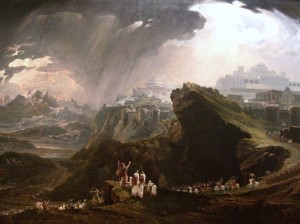
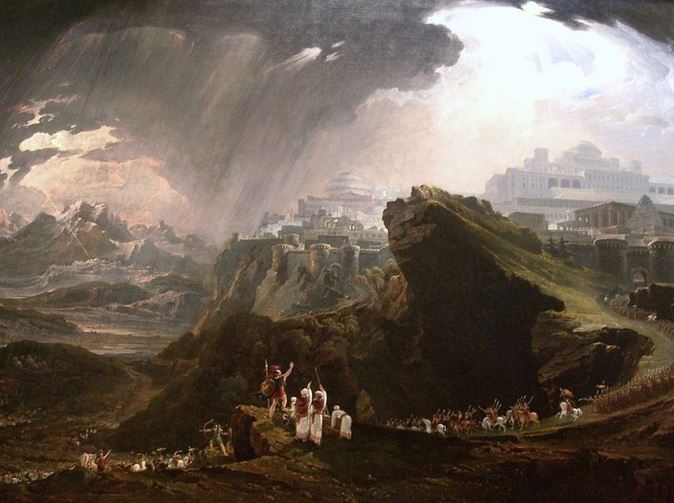
‘Joshua Commanding the Sun to Stand Still upon Gibeon’ by John Martin

All of the above suggests that the Exodus happened closer to the middle of the 13th century BCE. Recently, Israeli scientists discovered what may have been Joshua’s famous “stopping of the Sun” at the Battle of Gibeon (as described in the Book of Joshua, chapter 10). Interpreting this event as a solar eclipse, scientists at Ben Gurion University used NASA data to find any solar eclipses that may have been seen in the area between 1500 and 1000 BCE. They found exactly one, which took place on October 30, 1207 BCE.

This is incredible because the Battle of Gibeon would have happened roughly 40 years after the Exodus (since the Israelites spent 40 years in the Wilderness before Joshua led them to the Promised Land). If the Exodus took place around 1240 BCE, as we suggested above, then the dating of Joshua’s battle and the solar eclipse is right on target!

Reconciliation

The major issue now is that 1240 BCE seems to contradict the traditional Jewish dating of 1312 BCE. The truth is that Ancient Egyptian chronology is notoriously inaccurate. Scholars admit that discrepancies do exist, and are off by anywhere from 30 to 300 years. The discrepancy in our case is only about 70 years, well within the margins of errors.

Compared to the many foggy lists that scholars use to put together Egyptian chronology, the Torah’s chronology is fairly consistent and straight-forward. The years are added up based on peoples’ lifespans and the ages at which they had children, which are explicitly recorded. Historians might therefore want to take another look at Jewish chronology (as brought down in Seder Olam) if they wish to resolve some of their own conflicts.

And did the Jews build the pyramids? They may have built some pyramids (although by that time, pyramids had gone out of style). However, the famous Great Pyramid of Giza was completed by the middle of the third millennium BCE, long before any Israelites were on the scene.


The above article is adapted from Garments of Light: 70 Illuminating Essays on the Weekly Torah Portion and Holidays. Click here to get the book! 

Yehoshua and the Origins of Christianity

This week’s Torah portion is Pinchas, named after the grandson of Aaron, who stemmed the tide of immorality that followed the Moabite and Midianite ploy to bring Israel to sin. For his efforts, God blessed Pinchas with an everlasting blessing of peace. In the past, we explored the nature of this blessing, and how it resulted in Pinchas’ apparent immortality, as well as his eventual rebirth as Elijah the Prophet. This week, we will explore another critical figure in the Torah: Yehoshua, better known as Joshua.

Midway through this week’s parasha we read how God commanded Moses to officially appoint Yehoshua as Moses’ successor. Yehoshua is described as a person within whom rests the spirit of God. Although there are a number of Torah figures who are described as possessing some sort of Divine Spirit, Yehoshua is one of only two who are described as having the spirit within them. In most cases throughout the Bible, the spirit of God is said to rest upon an individual (‘alav in Hebrew), or to have temporarily filled an individual (mal’e or timal’e in Hebrew). With regards to Yehoshua, it says that the spirit was within him. The only other person in the Torah who is described in such a way is Yehoshua’s direct forefather Yosef (Genesis 41:38).

An even more peculiar detail about Yehoshua is that he is called “Yehoshua bin Nun”. Every other person in the Bible is referred to by their name, as well as by their father’s name, with the designation ben – “son of” – in the middle. Yehoshua alone is called bin Nun instead of the regular ben Nun. Moreover, a person named Nun cannot be found anywhere in the Torah, and unlike most other Torah figures, Yehoshua’s genealogy is not given (although one is provided in the Book of I Chronicles, written many centuries after the Torah). Other than the fact that Yehoshua stems from the tribe of Ephraim, nothing else of his origins is divulged.

Out of a Fish

There happens to be an obscure Midrash that fills in some of the details about Yehoshua’s early life. There are a few variations of the story, with one particularly tragic version that seems to
mirror the Greek myth of Oedipus. According to this Midrash, Yehoshua was left by his parents, possibly placed in the Nile River like Moses was. Miraculously, a large fish swallowed him
up, and Yehoshua was later saved by fishermen. This is the meaning of bin nun, since nun means “fish” in Aramaic. Thus, Nun is not the name of his father at all, explaining why he is not
called ben Nun. Rather, bin Nun refers to his origins from the fish, with his true genealogy unknown.

In the controversial “Oedipus” version of the story, Yehoshua is saved by the Pharaoh’s fisherman, and thus grows up in the palace, becoming the court executioner. He tragically
ends up putting his own father to death, as was originally prophesized when Yehoshua was conceived (which is why his parents abandoned him to begin with). I prefer to think of it more in the style of Moses, where Yehoshua was placed in the Nile just as Moses was, to avoid the Pharaoh’s decree of slaughtering all the male-born. By also growing up in the palace, alongside Moses (though he would have been younger), the two would have been well-acquainted, and that might explain why Yehoshua is so close to Moses throughout the Torah narrative.

Whatever the case, Yehoshua grows up to be a holy man, the personal servant of Moses, one of just two righteous spies, and the leader that finally brought the people into the Holy Land. The Sages describe him as the moon to Moses’ sun, and the key link in the chain of Jewish Oral Tradition.

The Origins of Christianity

'Joshua Commanding the Sun to Stand Still upon Gibeon' by John Martin

‘Joshua Commanding the Sun to Stand Still upon Gibeon’ by John Martin

When looking at the life story of Yehoshua, it is hard to miss the connection to Christianity. Like Yehoshua, Jesus is a Jew said to have had a miraculous birth, spent time growing up in Egypt, and was described as having the spirit of God within him. Like Yehoshua, Jesus is symbolized by a fish, and is seen as a sort-of successor to Moses (as suggested by his supposed “Transfiguration”, where he ascends to be blessed by Moses and Elijah). In the same way that Yehoshua stems from Joseph, Jesus’ “earthly father” is said to be Joseph. Jesus is described as a miracle-worker, just as Yehoshua facilitated a number of miracles, such as making the sun and moon stand still at Gibeon, and stopping the flow of the Jordan River. Of course, Jesus’ original name as pronounced in his day was Yeshu, the Aramaic version of Yehoshua.

The similarities don’t end there. Strangely, the Torah makes no mention of Yehoshua’s wife or children (even the genealogy given in I Chronicles ends with Yehoshua himself). Jesus, too, failed to marry or have kids. The Talmud (Megillah 14b) suggests that Yehoshua did later marry Rachav, the harlot that assisted the Israelites in the conquest of the Holy Land. Rachav had repented and become a righteous woman. Similarly, Jesus had close encounters with Mary Magdalene, also described as a harlot, and also controversially rumoured to have possibly married Jesus!

It is important to remember that there is absolutely no evidence for the existence of Jesus outside of the New Testament. It is well-known that the New Testament was written long after Jesus would have lived, and is full of contradictions about the details of his life. Many have challenged the historicity of Jesus, with more and more scholars suggesting that he likely did not exist at all.

Considering all that, it isn’t hard to imagine how early Christians would have put together the mythology of Jesus based on previous Torah ideas and narratives: a miraculously-born baby with the spirit of God, whose very name means “salvation”; celibate and childless, a humble, Godly servant bringing others to repentance, and leading the Israelites to the Promised Land… This is the story of the Torah’s Yehoshua, and the story that was adapted to fit the mold of a new religion a couple of millennia ago.

The Jewish Sages did always view Yehoshua as a prototype of Mashiach. After all, he is the one that defeated the embodiment of evil known as Amalek, and the one that ended the exile of the Jews, returning the people to their land. So, it isn’t surprising that Christians used Yehoshua as a prototype for their own supposed Messiah. Ironically, though, not only did Jesus fail to defeat evil, and fail to bring an end to the exile, he was also indirectly responsible for inspiring the murder of countless people thanks to all the holy wars, inquisitions, and crusades fought in his name. Jesus’ own message may have been peace, but his followers used him incessantly for war and bloodshed. Two millennia have passed, and the world is still far from perfect. We continue to await the arrival of the true Messiah. May we all merit to see his coming soon.


The article above is adapted from Garments of Light – 70 Illuminating Essays on the Weekly Torah Portion and Holidays. Click here to get the book!