
Tag Archives: Talmud

The Kabbalah of Shavuot

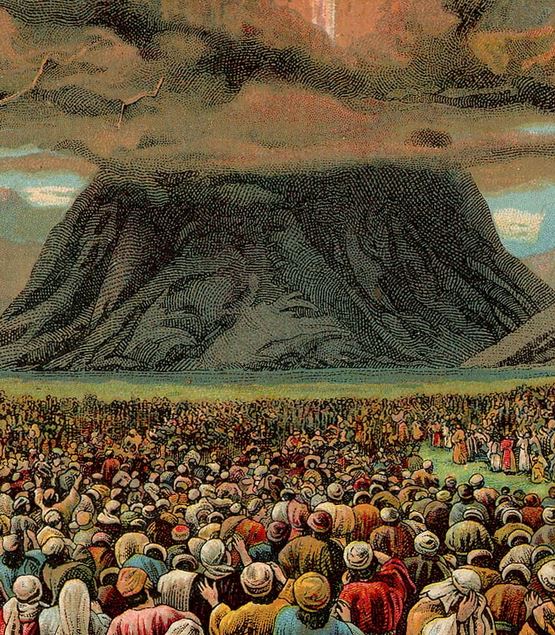
With Shavuot coming tomorrow night, let us delve into some of its deeper cosmic mysteries, as relayed in a most profound passage in the Zohar (III, 97b-98b, together with Ra’aya Mehemna). It begins by describing Shavuot night as a “wedding” between Hashem and His people. It is well-known that Mount Sinai served as the “chuppah”, the Torah as the “ketubah”, Hashem as the groom, and Israel as the bride. As explored in depth previously, in ancient times an Israelite bride was adorned with 24 different ornaments, and the corresponding “ornaments” of the Jewish people are the 24 books of Tanakh.

The Zohar says that there are those who, on Shavuot, learn the Oral Torah at night and the Written Torah during the day. But it also says that, just as a bride is excited the whole night before her wedding and doesn’t sleep, and prepares for her wedding with her 24 adornments, so too the Jewish people should stay up all night and not sleep, and “adorn” ourselves with the 24 books of Tanakh. This is why the Arizal laid out his tikkun text for Torah study on the night of Shavuot to be entirely from Tanakh, the Written Torah, and not the Oral Torah. The Arizal says that together with the Tanakh, one should study mystical commentaries on it. (This was the impetus behind my tikkun for Shavuot, to lay out the correct sections of study from Tanakh, and provide a concise and fitting mystical commentary on each section.) Why Tanakh and its encoded secrets should be the sole focus on Shavuot needs further elucidation. Continue reading
Rambam, In His Own Words

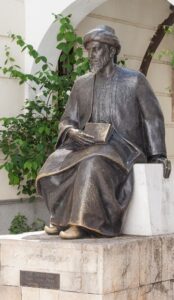
Rambam Monument in Cordoba, Spain

This Friday, the 20th of Tevet, is the yahrzeit of Rabbi Moshe ben Maimon (1138-1204), better known as the “Rambam”, or “Maimonides”. Rambam is one of the most fascinating figures in Jewish history, and also one of the most mysterious, multi-faceted, and complex. His impact on the course of Judaism cannot be overstated. Eight hundred years later, scholars, historians, and rabbis continue to debate his true views, positions, and beliefs. Rabbi Dr. Leon Stitskin (1911-1978), philosophy professor at Yeshiva University, described the Rambam as one who “reveals the truth by stating it, and hides it by contradicting it.” (Letters of Maimonides, pg. 18) More recently, Rabbi Dr. Aaron Adler (in his Al Kanfei Nesharim) noted a whopping 749 places where the Rambam’s early work, his Commentary on the Mishnah, appears to contradict his later works! And when it comes to the Rambam’s Moreh Nevukhim, the “Guide for the Perplexed”, some rabbis were so uncomfortable with it they denied that the Rambam ever wrote it! Who exactly was the Rambam, and what did he truly believe and teach?

Physician & Philosopher

Rambam was born in Cordoba, Spain to Rabbi Maimon, a student of Rabbi Yosef ibn Migash, who was a student of the famous Rif, Rabbi Isaac Alfasi (1013-1103). When he was around 10 years old, the extremist Almohads conquered Cordoba and forced all non-Muslims to convert, die, or flee. The Rambam’s family fled to North Africa. Settling in Morocco, the Rambam became a rabbi, but also studied at the University of Fez to become a physician. Meanwhile, he was deeply immersed in Greek philosophy, and came to embrace the school of Aristotle above the others. He is well-known for his work in integrating Aristotelian philosophy with Torah and Judaism. This set the stage for others around the world to do the same, most notably Thomas Aquinas (1225-1274), a Catholic theologian and saint who integrated Aristotle with Catholicism, and cited Maimonides in his works. The Rambam believed that Aristotle was the greatest Gentile of all time, and wrote in his letter to Shmuel ibn Tibbon: Continue reading

Mysteries & Secrets of Tefillin

At the end of this week’s parasha, Ekev, we read one of four passages in the Torah that speak of the great mitzvah of tefillin. In the list of 613, tefillin is actually two separate mitzvot—one for the head, and one for the arm. Some even say that tefillin counts as eight mitzvot, since we should multiply by four for the four times the Torah speaks of it! (Menachot 44a) Today, the mitzvah of tefillin is one of the best-known practices in all of Judaism, thanks in large part to the Lubavitcher Rebbe’s tefillin campaign starting in 1967, in the days leading up to the miraculous Six-Day War. We find many Jews who are otherwise secular or unaffiliated still laying tefillin every day. Following October 7, demand for tefillin was so high that there were reportedly shortages. Yet, tefillin binding hasn’t always been so widespread and well-known.

The Talmud (Berakhot 47a) suggests that one thing distinguishing Torah scholars (talmidei chakhamim) from the general public (am ha’aretz) is that the latter do not don tefillin. Even in responsa literature from the times of the Geonim (roughly 500-1000 CE), we find Jews asking if tefillin should be worn by all Jewish men, or if it was specifically reserved for great rabbis and Torah scholars. More puzzling still, we find that no other prophet besides Moses speaks of them, and there is no explicit mention of tefillin anywhere in the rest of Tanakh. Nor is there any historical or archaeological evidence of tefillin prior to about two millennia ago. Tefillin may just be the most mysterious Torah mitzvah we have. Where did it really come from, and what secrets does it contain? Continue reading