Tag Archives: Rabbi Oshaia

Why Physical Labour is a Spiritual Necessity

In this week’s Torah portion, Ekev, Moses tells the Israelites that if they follow God’s commandments, He will “give the rain of your land in its season, the former rain and the latter rain, and you shall gather in your corn, and your wine, and your oil.” The Talmud (Berakhot 35b) asks:

“And you shall gather in your corn.” What is to be learned from these words? Since it says, “This book of the law shall not depart out of your mouth,” I might think that this injunction is to be taken literally. Therefore it says, “And you shall gather in your corn”, which implies that you are to combine the study of them with a worldly occupation.

Although elsewhere the Torah states that one should always be meditating upon the Torah, here we are told that we should be working the fields. The Sages learn from this the importance of combining Torah study with some form of employment. This sentiment is expressed throughout rabbinic literature. Pirkei Avot (2:2) famously states:

Rabban Gamliel, the son of Rabbi Yehudah HaNasi, would say: Beautiful is the study of Torah with the way of the world, for the toil of them both causes sin to be forgotten. And all Torah study that is not accompanied by work will eventually be negated and lead to sin.

Rabban Gamliel goes so far as to say one who only learns Torah and does not combine it with labour will have their Torah learning nullified, and will be lead to sin. The Rambam (Hilkhot Talmud Torah 3:10) takes an even more hard-line approach:

Anyone who takes upon himself to study Torah without doing work, and derive his livelihood from charity, desecrates [God’s] Name, dishonours the Torah, extinguishes the light of faith, brings evil upon himself, and forfeits his life in the World to Come, for it is forbidden to derive benefit from the words of Torah in this world.

Our Sages declared: “Whoever benefits from the words of Torah forfeits his life in the world” … Also, they commanded and declared: “Love work and despise rabbinic positions,” and “All Torah study that is not accompanied by work will eventually be negated and lead to sin.” Ultimately, such a person will steal from others.

Rabbi Moshe ben Maimon, the Rambam (1135-1204)

In another place (Hilkhot Matnot Ani’yim 10:18), the Rambam further elaborates:

Even a dignified Sage who becomes poor should work in a profession, even a degrading profession, rather than seek public assistance. It is better to skin the hides of dead animals than to tell the people, “I am a Sage” or “I am a priest, support me.”

… Our greatest Sages were wood-choppers, porters of beams, water-drawers for gardens, blacksmiths, and charcoal-makers. They did not ask anything from the public and refused to accept anything that was given to them.

The Sages that the Rambam is referring to include the great Hillel, who famously worked as a wood-chopper, though just enough to support his family and pay the entrance fee to the Torah study hall (Yoma 35b), and Rabbi Yehoshua ben Chananiah who was a blacksmith and charcoal-maker (Berakhot 28a). Meanwhile, Rav Papa and Rav Chisda were beer brewers, and Rav Chanina and Rav Oshaia were cobblers (Pesachim 113a-b). The Rambam was himself a physician.

Of course, today we need rabbis who devote themselves full-time to the needs of the community, and to serve as teachers, judges, counsellors, and so on. Such leaders certainly deserve a good salary for their work. However, those adults that simply learn Torah most of the day, subsisting off of the community while giving little in return, are engaging in a tremendous transgression.

Humans are meant to be productive. From the very beginning, God made man His partner in creation, to complete what He started – asher bara Elohim la’asot. God explicitly instructed Adam to work the Garden and tend to it (Genesis 2:15). Physical work is part of man’s spiritual rectification. Amazingly, the Talmud (Nedarim 49b) records how Rabbi Yehuda would carry a huge pitcher of water over his shoulder on his way to the beit midrash, and Rabbi Shimon would similarly carry a heavy basket, both saying “great is labour, for it honours its worker”. Women are not exempt from this, and the Talmud famously states that a husband who forbids his wife from doing any work should better divorce her, since “idleness leads to promiscuity” and “idiocy” (Ketubot 59b).

The Rambam once again summarizes it best (Hilkhot Talmud Torah 3:11):

It is a great thing for a person to derive his livelihood from his own efforts. This attribute was possessed by the pious of the early generations. In this manner, one will merit all honour and benefit in this world and in the World to Come, as it is said: “If you eat the toil of your hands, you will be happy and it will be good for you.” [Psalms 128:2] You will be happy in this world, and it will be good for you in the World to Come, which is entirely good.


The above is an excerpt from Garments of Light, Volume Two. Get the book here

Sefer Yetzirah and the 32 Paths of Creation

The first chapter of the Torah famously describes God’s creation of the universe. Although the text is quite brief, our Sages had much to say about the events of Creation. This is an especially important topic in Kabbalah, traditionally divided into two main headings: Ma’ase Beresheet, “the Work (or Narrative) of Creation”, and Ma’ase Merkavah, “the Work (or Narrative) of the Chariot”. The former explores the genesis and nature of the universe, along with a host of metaphysical concepts, while the latter is primarily focused on various aspects of God, and the mechanism of prophecy.

One of the most ancient Kabbalistic texts is Sefer Yetzirah, the “Book of Formation”. This book outlines in more detail how God created the universe. Since the Torah tells us that God created the world by speaking it into existence (“God said, ‘Let there be light…’”), it is taught that the building blocks of the universe are the very letters of the Hebrew alphabet. Everything that exists was fashioned out of unique combinations of these special letters.

Along with the 22 letters were the Ten Sefirot, divine energies that imbue everything within Creation. These Sefirot are sometimes said to parallel the 10 base numerical digits, from 0 to 9 (the word sefirah also means “counting”). Just as modern physicists might argue that the entire universe can be reduced to mathematical equations, Sefer Yetzirah reduces all of Creation down to these foundational numbers and letters. And so, Sefer Yetzirah begins by stating that God created the universe through lamed-beit netivot, thirty-two paths.

The Power of Sefer Yetzirah

Sefer Yetzirah is first explicitly mentioned over 1500 years ago in the Talmud (Sanhedrin 65b), where Rabbi Chanina and Rabbi Oshaia studied it together on Friday afternoons. Using the secrets described in the text, the two rabbis apparently learned how to create ex nihilo, like God. Each Friday, they would team up to create a calf out of thin air—and eat it!

It is said that the patriarch Abraham was capable of the same feat. In the well-known narrative of the three angels visiting Abraham, we read how Abraham “took butter and milk, and the calf which he had made, and set it before them…” (Genesis 18:8). Many have asked: how is it possible that the forefather of the Jewish people gave his guests a mixture of dairy and meat products? The simplest answer is that, of course, Abraham preceded the giving of the Torah and at that time there was still no prohibition on consuming dairy and meat together. However, Jewish tradition maintains that although the forefathers lived before the giving of the Torah, they still fulfilled its precepts through an oral tradition, and from the prophecies they received directly from God. So, how did Abraham put both dairy and meat before his guests?

The Malbim (Rabbi Meir Leibush ben Yechiel Michel Wisser, 1809-1879) comments on the verse by citing earlier mystical teachings that say Abraham knew the secrets of Sefer Yetzirah and fashioned the calf from scratch! This is why the verse clearly says “…and the calf which he had made [asher asah]”. Since Abraham made the calf, it was only a hunk of flesh with no divine soul (which only God can infuse), and was therefore pareve, neither dairy nor meat. In fact, many believe that Abraham was actually the author of Sefer Yetzirah. Others maintain that it was written by Rabbi Akiva, based on teachings that were initially revealed by Abraham.

A Brief Overview of the 32 Paths

Where exactly are the 32 Paths of Creation derived from? A careful analysis of the Genesis text shows that God (Elohim) is mentioned 32 times in the account of creation. Each of these 32 parallels the 32 paths. There are ten cases where the Torah says vayomer Elohim, “And God said…” in the first chapter. These 10 correspond to the Ten Sefirot. The remaining 22 mentions of God correspond to the 22 letters in the following way:

Sefer Yetzirah breaks down the Hebrew alphabet into three groups: the “mothers” (ima’ot), the “doubles” (kefulot), and the “elementals” (peshutot). There are three mother letters: Aleph (א), Mem (מ), and Shin (ש). These are the “mothers” because each is associated with one of the three primordial elements of Creation: Aleph is the root of air (avirאויר), Mem is the root of water (mayimמים), and Shin is the root of fire (esh, אש). These three correspond to the three times that the Torah says “God made” (Genesis 1:7, 16, and 25).

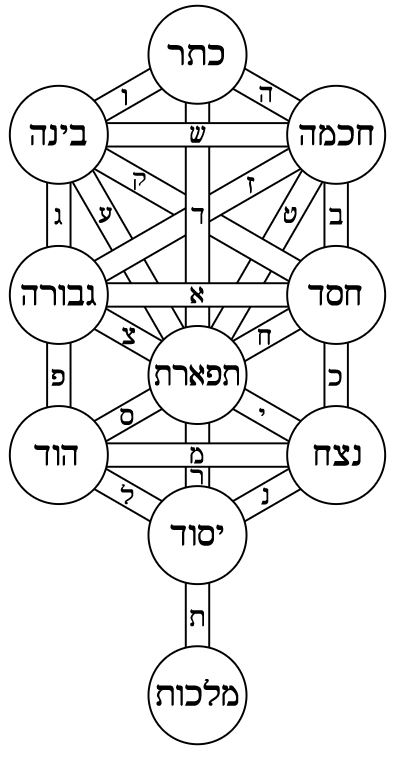
The “Tree of Life” depicting the Ten Sefirot, intertwined by the 22 Letters of the Hebrew Alphabet. Together, they make up the 32 Paths of Wisdom.

There are then 7 “doubled” letters, those that have two sounds in Hebrew:  Beit (ב), Gimel (ג), Dalet (ד), Khaf (כ), Pei (פ), Reish (ר), and Tav (ת). The double sounds of beit and veit, khaf and haf, pei and phei are well-known to us today, while the other four are a little more mysterious (see below on parashat Noach, ‘Shabbat or Shabbos: What’s the Correct Pronunciation?’)  The seven kefulot correspond to the seven times that the Torah says “God saw” (Genesis 1:4, 10, 12, 18, 21, 25, 31). The remaining 12 letters, the peshutot, correspond to the remaining 12 times that God is mentioned.

To summarize, the 32 paths derive from the 32 times that God is mentioned in Genesis, and further broken down into their groupings of 10, 3, 7, and 12 based on the specific type of verb used in relation to God.

Finally, all of these are embedded in the most famous of Kabbalistic diagrams, the Etz Chaim, “Tree of Life”. The 10 circles on the diagram correspond to the Ten Sefirot. The Sefirot are interconnected by 22 lines, corresponding to the 22 letters. There are three horizontal lines, corresponding to the three mother letters; seven vertical lines, corresponding to the seven doubled letters; and twelve diagonal lines, corresponding to the twelve elemental letters. This simple diagram amazingly captures a great deal of information, and is a key tool in Kabbalah—as well as the first step towards creating your very own calf!


The above is an excerpt from Garments of Light, Volume Two. Get the book here