Tag Archives: State of Israel

Tisha B’Av: The Untold Story of Napoleon and the Jews

Tisha b’Av is the saddest day on the Jewish calendar. This holiday commemorates many historical tragedies, most significantly the destruction of both Holy Temples in Jerusalem. One of the most common stories heard on Tisha b’Av is about Napoleon walking by a Paris synagogue on this day, hearing the lamentations and loud weeping of the Jews. In the story, he asks what the Jews are crying about, and after being told about the destruction of the Temple nearly two millennia ago, apparently remarks something along the lines of: “A nation that cries and fasts for 2,000 years for their land and Temple will surely be rewarded with their Temple.”

Hearing this story immediately sets off some alarms. Firstly, Napoleon was no ignoramus, and was certainly well aware of the destruction of the Temple (after all, the Temple is featured in the “New Testament” and plays an important role in Christian history as well). More notably, Napoleon was a military man his entire life; his biography is the very definition of a tough guy. This man lived by the sword—it is highly unlikely that he would praise people for sitting and crying about something.

In fact, the myth of Napoleon and Tisha b’Av has been debunked multiple times. One of the earliest known sources of the legend is a Yiddish article from 1912, later included in the 1924 American Jewish Yearbook, and similarly appearing in a 1942 book called Napoleon in Jewish Folklore. Here, we are given a far more logical version of the story: After hearing the weeping of the Jews in a synagogue in Vilnius, Napoleon points to his sword and says, “This is how to redeem Palestine.”

Napoleon and the Jews

An 1806 depiction of Napoleon emancipating the Jews

Napoleon would actually play a tremendous role in Jewish history, and might even be credited with starting the process of “redeeming Palestine”. It was Napoleon that ushered in the “emancipation” of Jews in Europe. Wherever he conquered, he would free the Jews from the ghettos, and give them equal rights. In France, he went so far as to declare Judaism one of the state’s official religions in 1807. Napoleon also famously sought (and failed) to re-establish the Sanhedrin.

These actions brought upon him the ire of many of his contemporaries, especially Czar Alexander of Russia, who branded Napoleon the “Anti-Christ” for liberating the despised Jews. Moscow’s religious authority at the time proclaimed:

In order to destroy the foundations of the Churches of Christendom, the Emperor of the French has invited into his capital all the Judaic synagogues and he furthermore intends to found a new Hebrew Sanhedrin—the same council that the Christian Bible states condemned to death (by crucifixion) the revered figure, Jesus of Nazareth.

Rabbi Schneur Zalman of Liadi, the “Alter Rebbe” (1745-1812)

Of course, most Jews were ecstatic, and relished their newly acquired liberties. It became common for Jews to name their children “Napoleon”, or adopt the last name “Schöntheil”, the German translation of “Bonaparte”. Yet, not all Jews were happy about this development. The Alter Rebbe—founder of Chabad, who lived during the times of Napoleon—wrote the following in one of his letters:

If Bonaparte will be victorious, Jewish wealth will increase, and the prestige of the Jewish people will be raised; but their hearts will disintegrate and be distanced from their Father in Heaven. But if Alexander will be victorious, although Israel’s poverty will increase and their prestige will be lowered, their hearts will be joined, bound and unified with their Father in Heaven…

The Alter Rebbe thus fled from the approaching French forces, inspired his followers to do the same, and even supported the Russian military. He was right about Bonaparte. Napoleon had no interest whatsoever in seeing the Jews flourish as Jews, or practice their religion proudly. His intentions were clear: the complete assimilation of the Jews into European society. It was Napoleon that first permitted Jews to serve in the military, openly stating that “Once part of their youth will take its place in our armies, they will cease to have Jewish interests and sentiments; their interests and sentiments will be French.”

As it turned out, opening the doors for Jews to serve in the French military would lead to the proliferation of the Zionist movement, and the establishment of the State of Israel.

France and Israel
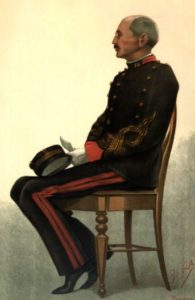
1899 Guth painting of Alfred Dreyfus for Vanity Fair

In 1894, Theodor Herzl was a young journalist working in Paris. He was covering the infamous “Dreyfus affair”, where a Jewish captain in the French military, Alfred Dreyfus, was wrongly accused of treason. During this time, Herzl witnessed the extreme anti-Semitism of the French firsthand. He realized that no matter how much the Jews assimilate, they would still never be accepted into European society, and reasoned that the Jews must have their own free state. Thus, it was a Jewish soldier in the French military—what Napoleon so dearly wanted—which catapulted the Zionist movement.

Interestingly, Napoleon himself seemed to have supported the notion of a Jewish state in Israel. In 1799, before he was emperor, and while besieging the city of Acre in Israel, Napoleon issued a proclamation inviting “all the Jews of Asia and Africa to gather under his flag in order to re-establish the ancient Jerusalem. He has already given arms to a great number, and their battalions threaten Aleppo.” Ultimately, the British defeated Napoleon’s forces, and the plan never materialized.

Nonetheless, Napoleon’s role in igniting the flames of Zionism cannot be overlooked. Zionism was primarily a secular movement, its most fervent supporters being assimilated European Jews who, like Herzl, were frustrated that they were still hated and unwanted in European society. This secularism was a direct result of Napoleon’s campaigns. Without his spearheading of the Jewish “emancipation”, it is doubtful that there would have ever been a Zionist movement to begin with.

And although there is much to criticize about Zionism, these mostly secular European Jews succeeded in re-establishing a free Jewish state in the Holy Land after two very long millennia. Yes, the Israeli government is unfortunately secular, and Mashiach has not yet come, and there is a great deal of work to do to restore a proper Jewish kingdom as God intended. However, the State of Israel allowed for the majority of Jews to return to their homeland, escape persecution, live openly as Jews, fulfil mitzvot only possible in the Holy Land, and travel freely to Jerusalem. Israel is undoubtedly paving the way for the Final Redemption, which is why many great rabbis of recent times have described it as reshit tzmichat geulatenu, the first steps of the redemption.

It is therefore fitting that the gematria of “France” (צרפת), where the whole process began, is 770, a number very much associated with redemption as it is equivalent to בית משיח, the “House of Mashiach”. Ironically, this number is most special for Chabad—the same Chabad that so resisted Napoleon and the French! (And at the same time, adopted the tune of Napoleon’s military band as their own niggun, still known as “Napoleon’s March” and traditionally sung on Yom Kippur!)

Most beautifully, it appears to have all been predicted long ago by the Biblical prophet Ovadia, who prophesied (v. 17-21):

And Mount Zion shall be a refuge, and it shall be holy; and the house of Jacob shall possess their heritage… And they shall possess the Negev, the mount of Esau, and the Lowland, with the [land of the] Philistines; and they shall possess the field of Ephraim, and the field of Samaria; and Benjamin with Gilead. And the great exile of the children of Israel, that are wandering as far as צרפת [France], and the exile of Jerusalem that is in Sepharad, shall possess the cities of the Negev. And saviours shall come upon Mount Zion to judge the mount of Esau; and the kingdom shall be God’s.


The article above is an excerpt from Garments of Light: 70 Illuminating Essays on the Weekly Torah Portion and Holidays. Click here to get the book! 
1909: End of the “Jewish Curse” and Fulfilment of Prophecy

Towards the end of this week’s parasha, Ki Tavo, we read a long list of horrifying curses with which God threatens the Jewish people if they stray from the path of righteousness. What’s more shocking than reading this terrible list is realizing that the Jewish people have experienced just about every one of these curses in our long history: oppression, destruction, injustice, fear, poverty, starvation, exile, genocide, desperation, forced conversion, captivity, expulsion, and utter annihilation. The Torah says that these travails will be so extensive that the Jewish people “will become an astonishment, an example, a byword among all the peoples to whom Hashem will lead you.” (Deut. 28:37) Israel will become the very epitome of curses and suffering. Indeed, history has confirmed this unfortunate prophecy.

Thankfully, the prophecies don’t end there. The haftarah for this parasha is a passage from the prophet Isaiah. Isaiah prophesies the very opposite, and says that a time will come when all of these curses will be reversed into blessings. Whereas Moses says God “will scatter you among all the nations, from one end of the earth to the other,” (28:64), Isaiah says that “all have gathered, they have come to you; your sons shall come from afar, and your daughters shall be raised…” (60:4). While Moses warns that “your skies above you will be copper, and the earth below you iron” (28:23), Isaiah says that “Instead of the copper I will bring gold, and instead of the iron I will bring silver.” (60:17) God confirms that He has put us through many trials in the past, and while this was long in duration, it was nonetheless only temporary, for “in My wrath I struck you, and in My grace I have had mercy on you.” (60:10)

Amazingly, we are living the fulfilment of Isaiah’s prophecies. The Jewish people have returned en masse to the Promised Land, have made the barren deserts bloom once more, and have miraculously defended their borders time and again. In the span of just several decades, the State of Israel has transformed into an agricultural, technological, and military powerhouse – despite very few natural resources, a small landmass, and a tiny population. As Isaiah predicted “…the abundance of the west shall be turned over to you, the wealth of the nations will come to you.” (60:5) Now, all that remains to be seen is the last part of Isaiah’s promises:

Violence shall no longer be heard in your land, neither robbery nor destruction within your borders, and you shall call your walls “salvation”, and your gates “praise”… And your people, all of them righteous, shall inherit the land forever, a scion of My planting, the work of My hands in which I will glory. The smallest shall become a thousand and the least a mighty nation; I am Hashem, in its time I will hasten it. (60:18, 21-22)

Israel will finally have true peace, with the world no longer questioning the indigenous Jewish people’s legitimacy to inhabit their Holy Land. The very last verse of this prophecy then says that when that time finally comes, God will “hasten” its arrival. This is quite the perplexing statement, and one that has kept rabbis and scholars thinking for millennia. The problem is as follows: If something is being hastened, then it is obviously coming before its time, and if it is coming on time, then it hasn’t been hastened!

Another way of looking at it is that one makes haste when they are already late. Few would disagree that this final redemption is long overdue. Since it is so late in coming, God will make haste to bring it about. An even simpler explanation is that when the time comes, God will hasten the series of events to bring about that happy ending. Recent history has shown that this is exactly what has happened.

In the late 1800s, the thought of an independent Jewish state in the Holy Land was still a very distant dream. The “first aliyah” began in 1882, and though as many as 35,000 Jews migrated to Israel by 1903, some scholars estimate that up to 90% of them left Israel soon after because of unfavourable conditions.

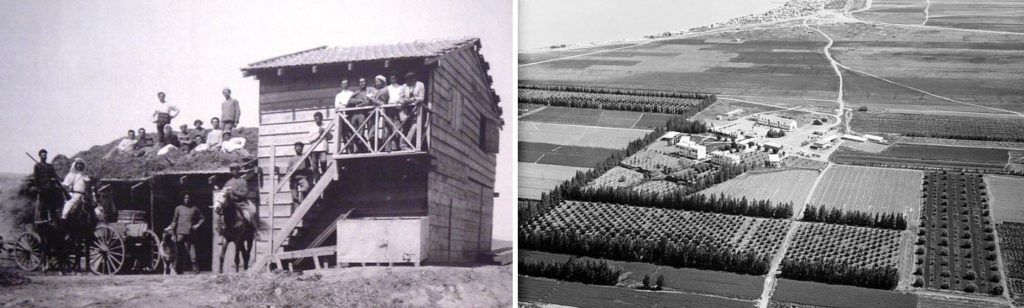
Then came 1909. In that year, a group of ten men and two women established a unique collective near the Galilee which would become the first kibbutz. The model of the kibbutz proved successful, and expanded from twelve people in 1909 to four thousand people living in thirty kibbutzim across the country by 1929. The kibbutz became one of the most significant factors in the rebirth of Israel, playing a key role in defending the land, driving agricultural innovation, and inspiring the “Israeli dream”.

Degania Alef, the first kibbutz, in 1910 (Left), and in 1931 (Right)

Degania Alef, the first kibbutz, in 1910 (Left), and in 1931 (Right)

Around the same time in 1909, a group of 66 families parceled out a plot of land outside of Jaffa (which was previously purchased by a wealthy Dutch Jew named Jacobus Kann). By 1922, this little settlement had become the bustling city of Tel-Aviv, with a population hitting 34,000 just a few years later. It would only take two more decades for the declaration of independence to be proclaimed from that city, and two more to liberate all of Jerusalem.

66 Families Parcel Out Tel-Aviv in 1909 (Left), the city in 1922 (Middle), and Tel-Aviv today (Right)

66 Families Parcel Out Tel-Aviv in 1909 (Left); the city in 1922 (Centre); and Tel-Aviv today (Right)

Events have certainly progressed very quickly, and a glance at today’s geopolitical situation shows that they continue to rapidly accelerate. The spark for it all appears to have been lit in 1909 by those two seminal events – the first kibbutz and the first city – which propelled the rebirth of Israel and the fulfilment of Biblical prophecy. What’s most interesting is that this special number – 1909 – is precisely the gematria (numerical value) of that final cryptic verse of Isaiah: “The smallest shall become a thousand and the least a mighty nation; I am Hashem, in its time I will hasten it.”


The above is adapted from Garments of Light: 70 Illuminating Essays on the Weekly Torah Portion and Holidays. Click here to get the book! 
Yom Ha’Atzmaut: Uniting the Secular and the Religious

The 5th of Iyar is Yom Ha’Atzmaut, Israel’s Independence Day. It was on this day in 1948 that David Ben-Gurion proclaimed the establishment of the State of Israel. Immediately, the armies of three neighbouring Arab states—Egypt, Jordan, and Syria—declared war and invaded. Iraq and Saudi Arabia sent in additional forces. Lebanon assisted them, too. Yemen, Pakistan, and Sudan sent even more fighters. On top of that, there were fighters of the Holy War Army, essentially a local Arab militia composed of over 1,300 troops, as well as the Arab Liberation Army, with over 6,000 troops from various Arab states. Despite being completely surrounded, outnumbered, and outgunned, the nascent State of Israel miraculously destroyed its enemies in just under ten months.

The miracles did not stop there. In 1967, Egypt, Syria, Jordan, and Iraq amassed 550,000 troops to “drive Israel into the sea.” With less than half of those numbers, Israel launched a pre-emptive strike that decimated the Arab forces in six days. Jerusalem was reclaimed, allowing Jews to visit their most holy sites for the first time in centuries. The miracles continued through the Yom Kippur War of 1973, and even through the 1991 Gulf War (which Israel did not directly take part in), and continue to this day. Ben-Gurion’s famous words are fitting: “In Israel, in order to be a realist, you must believe in miracles.”

Despite the fact that Jews once more have an independent state that is strong and prosperous (for the first time since the Maccabees defeated the Greeks and established the Hasmonean kingdom over 2000 years ago) there have been some, particularly in the Ultra-Orthodox Jewish world, that have opposed the State. This opposition comes in various degrees, from those that simply don’t support the secular government; to those that refuse to participate in state programs, military or national service, and the like; to those that completely side with anti-Israel groups bent on annihilating the State. Although, of course, the State of Israel is far from perfect, and its secularization often takes reprehensible forms, opposing the State makes little sense, particularly in light of what Jewish holy texts tell us.

Meanwhile, the ultra-secular elements in Israel, who strive to expunge Judaism, make even less sense, considering that the only claim Jews have to the land is tied to the Torah—the fact that God gave us this land, and we are its indigenous people, inhabiting it since Biblical times. Without the Tanakh, what claim does a secular person have to live in Israel? Moreover, many secular Israelis are blinding themselves to the miracle that is Israel, failing to see God’s hand in every step of its history.

By properly exploring Israel’s miraculous existence, perhaps the gap between the secular and the religious may be bridged. The former can come to see the validity and truth of God and His Torah, while the latter can come to see the State of Israel as a fulfilment of Biblical prophecy.

Prophecy Fulfilled

A look through history makes it clear: if it were not for God’s incredible miracles, the State of Israel would have never gotten off its feet, nor would it have survived to this day. God promises us in the Torah that “five of you shall chase a hundred, and a hundred of you shall chase ten thousand; and your enemies shall fall before you by the sword.” (Leviticus 26:8) This is precisely what has happened in every single war that Israel has participated in. In 1948, Israel tragically suffered 6,000 casualties, while the Arabs suffered over 20,000. In 1967, Israel suffered as many as 983, but the Arabs over 24,000. In 1973, Israel was surprise-attacked on Yom Kippur, completely unprepared for battle, faced with an invasion that had over one million troops from literally all over the world, including nearly 4,000 from Cuba! In comparison, Israel had 400,000 at best, reservists included. The highest estimates place 2,800 Israeli casualties, compared to 20,000 for the attackers.

In one well-known incident from this war, 150 Syrian tanks went up against just 7 remaining Israeli tanks left with no ammo in the “Valley of Tears” of the Golan Heights. Just as Israeli commander Avigdor Ben-Gal prepared to send a message saying his forces could no longer hold on, the Syrians suddenly retreated in a panic. All in all, Israel lost around 60 tanks in the Valley of Tears; the Syrians lost over 500. To this day, military analysts are puzzled by the Syrian withdrawal. Many theories have been proposed, including that the Syrians thought it must be an ambush, or even that higher up in the government Israel had threatened Syria with a nuclear strike. One Syrian soldier would later reveal what may have been the real reason: they thought they had been swarmed by an army of angels!

It isn’t just in military victories that God has clearly blessed the State. In under 70 years, Israel has flourished and is among the most developed and prosperous countries in the world. Isaiah prophesized:

The wilderness and the parched land shall be glad; and the desert shall rejoice, and blossom as the rose. It shall blossom abundantly, and rejoice… they shall see the glory of Hashem, the excellency of our God. (Isaiah 35:1-2)

Indeed, Israel and its once-parched lands have blossomed abundantly. Israel is now self-sufficient in its food production (meaning no one will starve if Israel stops all imports of food) and exports over $1.3 billion in food every year.

Israel famously exports a great deal of innovation and technology, too, and is a global leader in science. Its high-tech sector, nicknamed “Silicon Wadi”, is second only to Silicon Valley. Despite its short existence, Israel ranks 12th in per capita Nobel Prizes—higher than Canada and the US, Germany, France, and the entire European Union for that matter. There are nearly 400 million Muslim Arabs across 22 countries, and altogether they account for just 7 Nobel Prizes (of which two were “peace” prizes for terrorist-sponsors Anwar Sadat and Yasser Arafat!) while some 6 million Jews in Israel alone have won 12 Nobel Prizes. There is no doubt that Israel, with God’s blessing, has lived up to the Biblical ideal of being a “light unto the nations.” (Isaiah 42:6)

History makes it clear that the establishment and survival of the State of Israel is nothing short of a divine miracle, and would not happen were it not for God’s support and supervision. Before Moses passed away, he sang his final song to the people, and told them: “Remember the days of old, understand the years of past generations.” (Deuteronomy 32:7) Consider the historical facts: does history not make it so plainly obvious? “How could one chase away a thousand… if not for Hashem who delivers them up?” (Deuteronomy 32:30) Is it logical that 7 tanks can scare off 150? That a million invaders can be subdued by mere thousands? That a nation so soon back from the brink can rebuild such a prosperous state in a barren desert so quickly? And that it was all prophesied long ago, as Ezekiel foresaw that “in the End of Years” the Jews people shall return to their land, coming back from “the sword, gathered from among many peoples, [returning] upon the mountains of Israel, which have been a continual waste…” (Ezekiel 38:8) Is it not obvious that God is pulling the strings?

Uniting in Righteousness

Finally, the Torah also tells us a well-known principle: the land of Israel is holy, and “vomits out” anyone who does not deserve to live there. In light of this, the great Moroccan sage Rabbi Avraham Azulai (c. 1570-1643) wrote in his Chessed L’Avraham (Ma’ayan 3, Nahar 12):

And you should know, every person who lives in the Land of Israel is considered a tzadik, including those who do not appear to be tzadikim. For if he was not righteous, the land would expel him, as it says “a land that vomits out its inhabitants.” (Leviticus 18:25) Since the land did not vomit him out, he is certainly righteous, even though he appears to be wicked.

Thus, as a general rule, all Israelis—secular and religious—are deemed righteous in their own way, and for any one side to label the other as “wicked” is incorrect. We mustn’t forget that the Holy Temple was destroyed because of sinat hinam, baseless hatred and incessant infighting. Instead of opposing one another, we should all strive to support one another, to understand each other, and make Israel—the one homeland that we all have—the best that it can be. Then we will be able to realize the prophecy of Isaiah:

I will set your stones in fair colours, and lay your foundations with sapphires. And I will make your pinnacles of rubies, and your gates of carbuncles, and all your border of precious stones. And all your children shall be disciples of God, and great shall be the peace of your children… (Isaiah 54:11-13)


The above is an excerpt from Garments of Light, Volume Two. Get the book here