
Tag Archives: Talmid Chakham

Korach and Daniel: What’s the Connection?

This week’s parasha (in the diaspora) is Korach. In a traditional Chumash, at the end of each parasha there is a “Masoretic note” that provides a mnemonic to remember how many verses are in the parasha. This mnemonic is not random, and has a deep significance of its own. The mnemonic for parashat Korach, which has 95 verses, is “Daniel” (דניאל), which has a numerical value of 95. What hidden connection were the Masoretes concealing in this note? What does Korach have to do with Daniel?
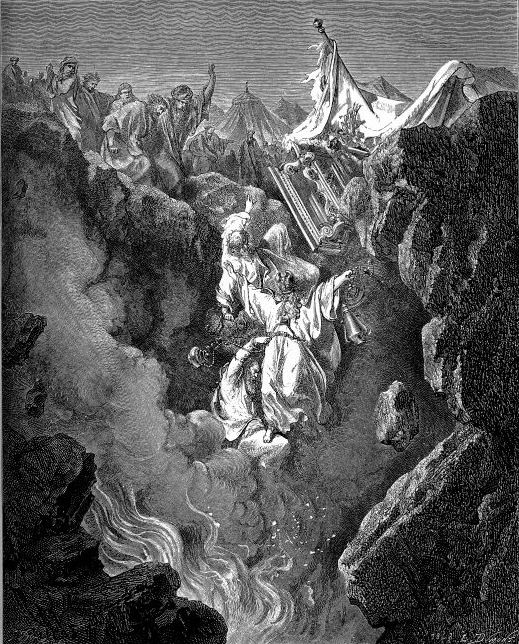
“Death of Korah, Dathan, and Abiram” by Gustave Doré

At the heart of Korach’s rebellion was the argument that “all of Israel is holy” (Numbers 16:3). He accused Moses of nepotism and elitism, saying that Moses and his family took over the top positions and placed themselves above the commoners. Rashi comments (on 16:6) that Moses actually agreed with Korach to some extent, and said he also wished that everyone could be on the same spiritual plane. This is why he told Korach and his followers to take their own incense pans and attempt to make an offering like a High Priest. Moses’ defence was that, of course, he was only fulfilling God’s will.

In the absolute sense, Korach’s argument was not wrong, it was just not l’shem shamayim (as our Sages state in Avot 5:17). He was not rebelling for Heaven’s sake, or to truly elevate the people, but for his own glory and ulterior motives. This is why he failed. Truthfully, though, God did intend for all of Israel to be on the same plane—eventually. The Wilderness generation was not yet ready for it, but in time God would lead Israel towards oneness and equality. And when did this happen? Precisely in the time of Daniel!

After the First Temple was destroyed, Israel was exiled to the melting pot that was Babylon. Outside the Holy Land and without a Temple, the kohen had no role, and being a priest became mostly irrelevant. Instead, Babylon saw the rise of the chakham, the Jewish sage. The educated scholars knew how to adapt and what to do, and how to lead the community in exile. Of course, being a chakham was not based on birthright or genealogy, it was entirely based on merit and scholarship. Anyone could be a chakham!

Meanwhile, in a few short generations, the old Israelite tribal affiliations were forgotten. In Babylon, everyone became a Yehudi, simply a Judahite or “Jew”. We read in Megillat Esther that Mordechai was a Benjaminite, yet he is first called an Ish Yehudi before the text mentions that he is an Ish Yemini. His primary identity was that he was a Jew, not a Benjaminite! Mordechai knew his Benjaminite lineage because he was one of the elders and original exiles, but the younger generations that followed quickly forgot their detailed backgrounds. In short, everyone became a Jew (even the priestly Levites!) and everyone now had the potential to be a great chakham and leader, like Mordechai himself.

Mordechai’s contemporary was Daniel, another great sage who made sure to keep Jewish law despite serving the Babylonian government (as we read in the first chapter of the Book of Daniel), and worked tirelessly to ensure Judaism would not be forgotten in exile. In fact, Daniel plays a hidden role in the Megillah, as our Sages identified him with the character called Hatakh (Esther 4:5), palace attendant of Queen Esther (Megillah 15a). Hatakh is the hidden hero in the story, delivering the secret communications between Esther and Mordechai, and helping her confront Haman. There is a beautiful gematria here, too, because Haman (המן) is 95, as is Daniel (דניאל), suggesting numerically that Daniel “neutralized” Haman.

So, it was in the era of Daniel that Korach’s case for an equal Israel was realized. This is the deeper meaning for why parashat Korach has exactly 95 verses, and this is why the Masoretic note reminds us about Daniel at the end of Korach’s parasha.

Shabbat Shalom!

Why Physical Labour is a Spiritual Necessity

In this week’s Torah portion, Ekev, Moses tells the Israelites that if they follow God’s commandments, He will “give the rain of your land in its season, the former rain and the latter rain, and you shall gather in your corn, and your wine, and your oil.” The Talmud (Berakhot 35b) asks:

“And you shall gather in your corn.” What is to be learned from these words? Since it says, “This book of the law shall not depart out of your mouth,” I might think that this injunction is to be taken literally. Therefore it says, “And you shall gather in your corn”, which implies that you are to combine the study of them with a worldly occupation.

Although elsewhere the Torah states that one should always be meditating upon the Torah, here we are told that we should be working the fields. The Sages learn from this the importance of combining Torah study with some form of employment. This sentiment is expressed throughout rabbinic literature. Pirkei Avot (2:2) famously states:

Rabban Gamliel, the son of Rabbi Yehudah HaNasi, would say: Beautiful is the study of Torah with the way of the world, for the toil of them both causes sin to be forgotten. And all Torah study that is not accompanied by work will eventually be negated and lead to sin.

Rabban Gamliel goes so far as to say one who only learns Torah and does not combine it with labour will have their Torah learning nullified, and will be lead to sin. The Rambam (Hilkhot Talmud Torah 3:10) takes an even more hard-line approach:

Anyone who takes upon himself to study Torah without doing work, and derive his livelihood from charity, desecrates [God’s] Name, dishonours the Torah, extinguishes the light of faith, brings evil upon himself, and forfeits his life in the World to Come, for it is forbidden to derive benefit from the words of Torah in this world.

Our Sages declared: “Whoever benefits from the words of Torah forfeits his life in the world” … Also, they commanded and declared: “Love work and despise rabbinic positions,” and “All Torah study that is not accompanied by work will eventually be negated and lead to sin.” Ultimately, such a person will steal from others.

Rabbi Moshe ben Maimon, the Rambam (1135-1204)

In another place (Hilkhot Matnot Ani’yim 10:18), the Rambam further elaborates:

Even a dignified Sage who becomes poor should work in a profession, even a degrading profession, rather than seek public assistance. It is better to skin the hides of dead animals than to tell the people, “I am a Sage” or “I am a priest, support me.”

… Our greatest Sages were wood-choppers, porters of beams, water-drawers for gardens, blacksmiths, and charcoal-makers. They did not ask anything from the public and refused to accept anything that was given to them.

The Sages that the Rambam is referring to include the great Hillel, who famously worked as a wood-chopper, though just enough to support his family and pay the entrance fee to the Torah study hall (Yoma 35b), and Rabbi Yehoshua ben Chananiah who was a blacksmith and charcoal-maker (Berakhot 28a). Meanwhile, Rav Papa and Rav Chisda were beer brewers, and Rav Chanina and Rav Oshaia were cobblers (Pesachim 113a-b). The Rambam was himself a physician.

Of course, today we need rabbis who devote themselves full-time to the needs of the community, and to serve as teachers, judges, counsellors, and so on. Such leaders certainly deserve a good salary for their work. However, those adults that simply learn Torah most of the day, subsisting off of the community while giving little in return, are engaging in a tremendous transgression.

Humans are meant to be productive. From the very beginning, God made man His partner in creation, to complete what He started – asher bara Elohim la’asot. God explicitly instructed Adam to work the Garden and tend to it (Genesis 2:15). Physical work is part of man’s spiritual rectification. Amazingly, the Talmud (Nedarim 49b) records how Rabbi Yehuda would carry a huge pitcher of water over his shoulder on his way to the beit midrash, and Rabbi Shimon would similarly carry a heavy basket, both saying “great is labour, for it honours its worker”. Women are not exempt from this, and the Talmud famously states that a husband who forbids his wife from doing any work should better divorce her, since “idleness leads to promiscuity” and “idiocy” (Ketubot 59b).

The Rambam once again summarizes it best (Hilkhot Talmud Torah 3:11):

It is a great thing for a person to derive his livelihood from his own efforts. This attribute was possessed by the pious of the early generations. In this manner, one will merit all honour and benefit in this world and in the World to Come, as it is said: “If you eat the toil of your hands, you will be happy and it will be good for you.” [Psalms 128:2] You will be happy in this world, and it will be good for you in the World to Come, which is entirely good.


The above is an excerpt from Garments of Light, Volume Two. Get the book here