In this week’s parasha, Mishpatim, we read about a large set of laws that Moses received on Mt. Sinai following the Ten Commandments. While there, God tells Moses (Exodus 23:20-21):
Behold, I am sending an angel before you to guard you on the way and to bring you to the place that I have prepared. Beware of him and obey him; do not defy him, for he will not forgive your transgression, for My Name is within him.
God sends an angel to guide the Israelites through the Wilderness to the Promised Land. This is a very special angel, for God says that He has placed His Name within the angel. The Torah does not identify the name of this angel, but the Talmud does (Sanhedrin 38b):
A certain heretic said to Rav Idit: “It is written: ‘And to Moses He said: Come up to God.’ [Exodus 24:1] The heretic raised a question: It should have stated: ‘Come up to Me.’” Rav Idit said to him: “This is Metatron, whose name is like that of his Master [God], as it is written: ‘…for My Name is within him.’”
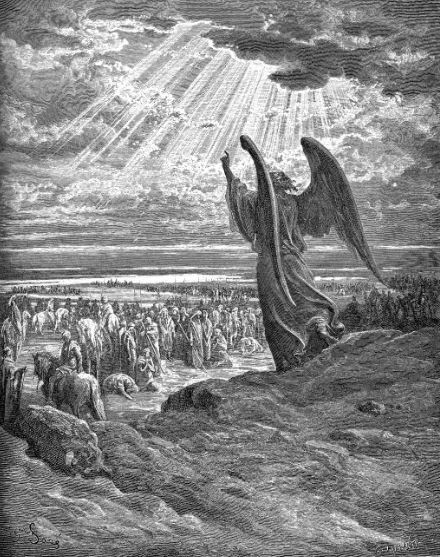
‘Angel Appearing to Joshua’ by Gustave Doré. According to the Book of Zerubavel, this was Metatron, the same angel that led the Israelites through the Wilderness.
A heretic challenges Rav Idit by saying that God should have spoken to Moses in the first person, saying “come up to Me”, not “come up to God”. Rav Idit replied that the speaker was the angel Metatron, who was sent by God to be His representative, and has God’s Name within him, as the Torah clearly states.
How do we find God’s Name within the name “Metatron”? The Kabbalists pointed out that the gematria of Metatron (מטטרון) is 314, equal to the Name of God Shaddai (שדי). However, this is only on the surface level. In reality, God’s absolute Name is the Tetragrammaton, and we do not find these four letters (Yud, Hei, Vav, Hei) in Metatron.
Of course, we must remember that the names of angels were generally adapted from non-Jewish sources, as the Talmud affirms (Yerushalmi, Rosh Hashanah 6a). How could this be? The true names of the angels had to be concealed so that people would be unable to summon them. Metatron, therefore, is not the angel’s real name. This is pretty evident in itself because anyone who first hears the term “Metatron” would never guess it is a Hebrew word. It sounds foreign, perhaps Aramaic, or more likely Greek. Indeed, some scholars have suggested that “Metatron” comes from the Greek meta and thronos, meaning “near” or “after the throne”, ie. that Metatron is the angel that sits nearest to the Throne of God, or the one that has authority right after the Throne of God. This brings us to the second place in the Talmud where Metatron is mentioned, in one of the most perplexing and intriguing Talmudic passages.
Sitting in Heaven
The Talmud relates the famous story of the “Four Who Entered Pardes” (Chagigah 14b-15a):
The Sages taught: Four entered “the orchard” [pardes], and they are: Ben Azzai, and Ben Zoma, Acher, and Rabbi Akiva… Ben Azzai glimpsed and died, and with regard to him the verse states: “Precious in the eyes of the Lord is the death of His pious ones” [Psalms 116:15]. Ben Zoma glimpsed and was harmed, and with regard to him the verse states: “Have you found honey? Eat as much as is sufficient for you, lest you become full from it and vomit it” [Proverbs 25:16]. Acher cut the saplings. Rabbi Akiva came out safely.
…“Acher cut the saplings” [meaning, he became a heretic]. With regard to him, the verse states: “Do not let your mouth bring your flesh into guilt” [Ecclesiastes 5:5]. What was it [that led him to heresy?] He saw the angel Metatron, who was granted permission to sit and write the merits of Israel [some versions add: for one hour a day]. He said: “It is taught that in the world above there is no sitting, no competition, no turning one’s back to Him, no lethargy. Heaven forbid—there are two authorities!”
They removed Metatron from his place in Heaven and smote him with sixty lashes of fire, so that others would not make the mistake that Acher did…
In this esoteric narrative, four great mystics of the highest order are able to ascend to the Heavens. Ben Azzai died immediately, Ben Zoma lost his mind, and Elisha ben Avuya became a heretic, for which he was referred to as Acher, “the other”. Only Rabbi Akiva exited in peace. (For a deeper analysis of this enigmatic passage, see Secrets of the Last Waters.)
The Talmud relates what it was that turned Elisha ben Avuya into a heretic. He saw Metatron sitting in the Heavens, when it was taught to him that none but God sits in Heaven. He concluded that perhaps there is more than one god, and this led him to abandon the Torah. (We must remember that this was nearly two millennia ago, in a time when most of the world was still polytheistic.) Back in Heaven, Metatron was severely punished for not standing up when the Sages entered, causing Acher’s apostasy.
This narrative seems to support the Greek origins of the name Metatron. He was the angel that was permitted to sit in Heaven—like none other but God Himself—as if on a lesser throne, a throne next to God’s, meta-tron. So, what was his real name?
Becoming an Angel
The renowned scholar of Kabbalah, Gershom Scholem, researched the origins of the angel and presented his findings in an essay, “Metatron”. He found that in the most ancient texts which mention the figure (such as the Apocalypse of Abraham) he is called Yeho-El (יהואל). This is precisely what we’d expect, for angel names generally have the suffix El, and Metatron is the one who carries God’s Name, the Tetragrammaton. His real name, then, is simply the Name of God with the angelic El appended to it. In some texts, he is even referred to as the “Lesser God” (יהוה קטן). Not surprisingly, these texts didn’t make it (for the most part) to the official corpus of Rabbinic literature. They did find their way into Gnostic and Mandean texts. (On that note, it should be mentioned that Christians revere Metatron, too, as do Muslims, who refer to him as Mitatrush.)
Scholem also presents alternative possibilities to the name Metatron. It may be rooted in matara, “keeper of the watch”, or metator, “a guide” (after all, Exodus says God designated him to guide the Israelites in the Wilderness). In some ancient texts, Metatron is an angel that preceded Creation and assisted God in bringing about the physical universe. Again, this is a dangerous idea that may lead to a belief in dualism or heresy, and is a problem for a monotheistic Judaism. Instead, Jewish texts generally present the origins of Metatron in a different way.

Cover for the popular 2011 video game ‘El Shaddai – Ascension of the Metatron’, released for PlayStation 3 and Xbox 360. Gamers play as Enoch in defending the world, and are supported by angels like Michael, Gabriel, Uriel, and Raphael. The game developers clearly did their research!
The Zohar draws from the apocryphal Book of Enoch in teaching that “Enoch is Metatron” (see, for example, Zohar III, 189a). Recall that Enoch was a descendant of Adam (seven generations down) of whom the Torah states “And all the days of Enoch were three hundred sixty and five years. And Enoch walked with God, and he was not; for God took him.” (Genesis 5:23-24) Thus, Enoch never died, but was taken up to Heaven by God, where he was transformed into the angel Metatron. He is the angel that “walks with God”. The one that God sent to Earth to lead the Israelites. This is a fitting role for Metatron, for he was once a man of the Earth, too.
In Jewish tradition, there are two men who became angels, and two angels who descended into this world and became like men. The latter are Shemhazai and Azazel, while the former are Enoch and Elijah. Perhaps we can say that Enoch and Elijah filled the missing spaces of Shemhazai and Azazel. Enoch became the angel referred to as Metatron, while Elijah became the angel referred to as Sandalfon. Interestingly, if Metatron’s real name is Yeho-El, then we find that the names of the two angel-men share the same letters: יהואל and אליהו. In fact, the names are just reversed, and mean the same thing!
It should be mentioned that there were those in the past who rejected the notion that Enoch became an angel. For example, Onkelos translates Genesis 5:24 to say that Enoch was “no more” because God killed Enoch! This would fit with the alternate view that Metatron has nothing to do with Enoch and was already an angel before Creation. In more recent centuries, some Kabbalists even believed there must be two Metatrons, each with a slight variation of the name (מטטרון and מיטטרון). It is also possible that the two became one: an angel called Metatron existed before Creation, and when Enoch went up to God his soul was fused with that angel.
The notion of a fusion of different souls is supported by the teachings of the Arizal (Rabbi Isaac Luria, 1534-1572). In one place, he describes how Enoch took the highest and purest soul of Adam, called zihara ila’ah, and fused together with it in becoming Metatron (Sha’ar HaPesukim on Beresheet). Elsewhere, the Arizal writes that any person who refines themselves to the highest degree, and fulfils all of their rectifications, is called a malakh, “angel” (Sha’ar HaGilgulim, ch. 39). The Arizal says this was the case with Elijah, for example, among others.
Scribing and Teaching
What is the angelic role of Metatron? We saw above from the Talmud that Metatron is the Heavenly Scribe, writing down the merits of Israel. Gershom Scholem argues that he is one and the same as the Sar HaOlam, the “prince of the world” mentioned in Rabbinic literature, appointed to watch over our Earth. The Talmud (Yevamot 16b) says that he is the subject of the verse: “I have been young, and now am old; yet I have not seen the righteous forsaken, nor his seed begging bread.” (Psalms 37:25) This makes sense, for Metatron began his life as the earthly Enoch; born a baby, grew to adulthood, and was then transformed into an angel with everlasting life.
The Arizal agrees, teaching that Metatron is the “prince of the seventy nations”, the angel above all the lesser angels appointed to watch over each of the seventy root nations on Earth (Sha’ar HaGilgulim, ch. 31). In the same place, the Arizal confirms that Metatron is Enoch, who never died. He also reveals that he was the angel that came to Joseph and taught him all seventy languages in one night so that Joseph could present himself before Pharaoh.
In his commentary on Sefer Yetzirah, the Ravad (Rabbi Avraham ben David, c. 1125-1198) says that Metatron was the angel that taught Moses. The Talmud (Avodah Zarah 3b) states that Metatron teaches Torah to little schoolchildren. Not much else is known of him.
In the past, various critics of Judaism have used the notion of Metatron to suggest that Jews have strayed from monotheism. This is a false claim. From its first pages, the Torah speaks of angels that serve as God’s emissaries and assistants. Metatron is just another angel, albeit one imbued with more powers than others.
This brings us back to the first Talmudic passage cited above (Sanhedrin 38b), which continues with the heretic questioning Rav Idit: “If so, we should worship [Metatron] as we worship God!” Rav Idit replied: “It is written: ‘Do not defy [tammer] him,’ meaning ‘Do not replace Me [temireni] with him.’” In a classic play on words, Rav Idit explains that when God said not to rebel against His appointed angel, He also meant not to start worshipping him in place of God.
We mustn’t forget that there is only one God whom we pray to and turn to. The Jewish people have no intercessors or intermediaries. We are Israel (ישראל), or yashar-El (ישר-אל), “direct to God”. And Rav Idit concludes in the Talmudic passage that the ancient Israelites ultimately rejected Metatron as their guide, and requested that God Himself lead them, as it is written (Exodus 33:15): “If Your Presence go not with me, raise us not up from here.”
The above essay is adapted from Garments of Light, Volume Three.
Get the book here!