
This week’s parasha, Shemini, describes the laws of kosher animals. The Torah specifically lists four exceptions of mammals that are not kosher: the gamal, camel; the shafan, commonly translated as “hyrax”; the arnevet, a “hare” of some sort; and the hazir, pig. The Midrash (Vayikra Rabbah 13:5) parallels these four animals to the four kingdoms that oppressed Israel:
“The camel,” this is Babylon, “because it brings up the cud” [Leviticus 11:4]—because it drew [another oppressive] kingdom after it. “And the hyrax,” this is Media, “because it brings up the cud”—as it drew a kingdom after it. “The hare,” this is Greece, “because it brings up the cud”—as it drew a kingdom after it. “And the pig,” this is Edom, “but it does not chew its cud”—because it does not draw a kingdom after it. Why is it called a pig [hazir]? It is because it will return [mahazeret] the crown to its owner. That is what is written: “Saviours will ascend Mount Zion to judge the mountain of Esau, and the kingdom will be God’s.” (Ovadiah 1:21)
The Midrash explains that three of the animals swallow their food but then regurgitate it, symbolic of the kingdoms that “swallowed” up Israel for a short period of time and then “regurgitated” it, to be followed by another oppressive kingdom. The pig, meanwhile, does not regurgitate its food, symbolic of Edom which swallowed up Israel and will maintain dominance until the End of Days, when it will actually play a key role in the restoration of Israel. (Recall that Edom refers to the people that emerged out of Esau—the elder twin of Jacob—called “Edom” both due to selling his birthright in exchange for a red stew, and because he was born red-haired, admoni.)
A closely related teaching of our Sages is that the hazir is thus called because Hashem will hahziro l’Israel, “return it to Israel” in the future (שעתיד הקב״ה להחזירו לישראל). There are several ways to understand this. Some go directly with the pshat and suggest that the pig will literally become kosher for consumption in future Mashiach times. There were those who argued that there will be a change in the nature of the pig, and it will become a ruminant species like the cow. Thus, it will have the two signs necessary for a kosher land animal and hence become kosher (see, for instance, the Ramad Valle’s Sefer haLikutim on Melechet haBirur). In the past, I’ve proposed that it could be referring to synthetic or lab-grown pork instead, which is now possible to produce (see ‘Pig Gelatin & Synthetic Pork: Kosher?’ in Volume Two of Garments of Light).
Another way to understand it is simply in reference to the above Midrash of the hazir being Edom. It’s not literally talking about pork becoming kosher (that’s really hard to imagine!) but rather that Hashem will “return” the hazir of Edom to Israel; ie. there will be a future reconciliation between the brothers Jacob and Esau. After all, Jacob promised Esau that he will come to live with him at Mt. Seir—but never did! (Genesis 33:14) Rashi comments “But when will he go? In the days of Mashiach, as it is said ‘And saviours shall go up on Mount Zion to judge the mount of Esau.’” A day will come in the future when Jacob and Esau will finally live in peace together. In fact, the Ba’al haTurim (Rabbi Yakov ben Asher, c. 1269-1343) points out that the gematria of “Esau” (עשו) is 376, equal to “peace” (שלום)!
The Edomite Pig
Why is Edom symbolized by a pig? One is because, as our Sages taught, the pig looks kosher on the outside with its split hooves, but is really not kosher on the inside. The same is true for the religion of Edom, which presents itself outwardly as being “kosher” when it really isn’t. Yes, it’s based on the same God and the same Scriptures, reveres many of the same Prophets, and has similar prayers—but all directed towards an unkosher theology. The religion of Edom also did away with most of the mitzvot, including the consumption of pork!
Pork had always been a major part of the European diet. The same cannot be said of the religion of Ishmael, which adopted the prohibition on consuming pork. Historically, pork consumption was not popular in the Middle East, and there were times that it was prohibited even in ancient Egypt and Mesopotamia. One reason is because raising pigs for meat requires a lot of water, which tends to be scarce in the Middle East. Europe, with its many large rivers and lakes, never had this problem. So, the pig was symbolic of Europe, and of Christianity, and therefore symbolic of Edom and the Western world.
But a reconciliation between Edom and Israel—Esau and Jacob—was predicted to come about, despite the rough history. And not only a reconciliation, but that Edom would actually play an active role in restoring Israel at the End of Days. Indeed, we have seen this prophetic Midrash realized in our times. After all, it was Great Britain that wrested the Holy Land from the Muslim Ottomans and resolved to create a Jewish state. A few decades later, the State of Israel was proclaimed upon the exit of British troops on May 14, 1948.
We might also extend it to what’s happening today, with the United States being Israel’s biggest ally and supporter, and fighting alongside Israel against Iran and its proxies. The US is certainly playing a major role in helping “restore the crown to its owner”. The more fundamental question here is: why do we identify Western powers like Great Britain and the United States with Edom to begin with? The common answer is that the Sages identified Edom with the Roman Empire, which then became Christian and gave rise to Christian Europe, so all nations and empires that emerged from Christian Europe have been referred to as part of the realm of “Edom”. But why did the Sages identify the Roman Empire as Edom in the first place? In the series of videos on Understanding Edom, I proposed five different ways of tying the Roman Empire and Christian Europe to the Biblical Edom. Below is a brief summary.
Isaac’s Blessings & Esau’s Genealogy
The first connection between Esau and Christian Europe can be found within Isaac’s blessing in Genesis 27. After Jacob took his father’s blessing, Esau arrives and is totally distraught to learn that what should have been his blessing went to his brother. Isaac realizes that the person he gave the blessing to was truly the one who deserved it, insisting that gam barukh ihyeh, “and he shall remain blessed” (v. 33). But Esau doesn’t give up, and begs his father for at least something. So Isaac does give him a blessing, saying “See, your abode shall enjoy the fat of the earth and the dew of heaven above. Yet by your sword you shall live, and you shall serve your brother; but when you grow restive, you shall break his yoke from your neck.” (v. 39)
One can see the Jewish-Christian relationship encapsulated in this verse. Christian Europe grew powerful and wealthy, but “lived by the sword” throughout history, dominating the planet and launching essentially all of mankind’s bloodiest and deadliest conflicts. At the same time, European kingdoms often became indebted to Jewish banks, and would then “break the yoke” and launch a pogrom or expulsion to make the debts go away. Both the 1290 English Expulsion and the 1492 Spanish Expulsion had more to do with wiping away debts to Jewish banks than the religious and social aspects. (In the 1290 case, King Edward didn’t just delete the debts to the Jews, he redirected them to be owed to him instead!)
Thus, in Isaac’s blessings to Jacob and Esau our rabbis saw a model of the Jewish-Christian rollercoaster relationship, and hence the identification of Esau’s Edom with Christian Europe. But where did the association with the Roman Empire specifically come from? This takes us to the second derivation:
This one is found in the long genealogy of Esau given in Genesis 36. The final verse says that Esau’s descendants included “The chief Magdiel, and the chief Iram. Those are the clans of Edom—that is, of Esau, father of the Edomites—by their settlements in the land which they hold.” (Genesis 36:43) Rashi comments here that Magdiel is the true founder of Rome. In his Em laMikra, Rabbi Eliyahu Benamozegh (1823-1900) wonders:
Rashi says that Magdiel is Rome, and thus it was customary among the poets to nickname Rome “Magdiel”. And all my days I was puzzled by this and in my heart I wondered if perhaps the name Iram was switched with Magdiel, for it is more accurate to say that Iram is Rome, for this is what it’s called!
It makes a lot more sense that Iram founded Rome and named it after himself. Iram even sounds like Ir Rom, meaning “City of Rome”. This may be further supported by a careful reading of the Midrash (Pirkei d’Rabbi Eliezer 38:7), which explains:
And Esau took all that his father had left, and he gave to Jacob the land of Israel, and the Cave of Machpelah, and they wrote a perpetual deed between them. Jacob said to Esau: “Go from the land of my possession, from the land of Canaan.” Esau took his wives, and his sons, and his daughters, and all that he had, [as it is said, “And Esau took his wives… and all his possessions which he had gathered in the land of Canaan] and went into a land away from his brother Jacob.” (Genesis 36:6) And as a reward, because he removed all his belongings on account of Jacob his brother, [God] gave him one hundred countries from Seir unto Magdiel, as it is said, “Chief Magdiel, Chief Iram” (Genesis 36:43), which is Rome.
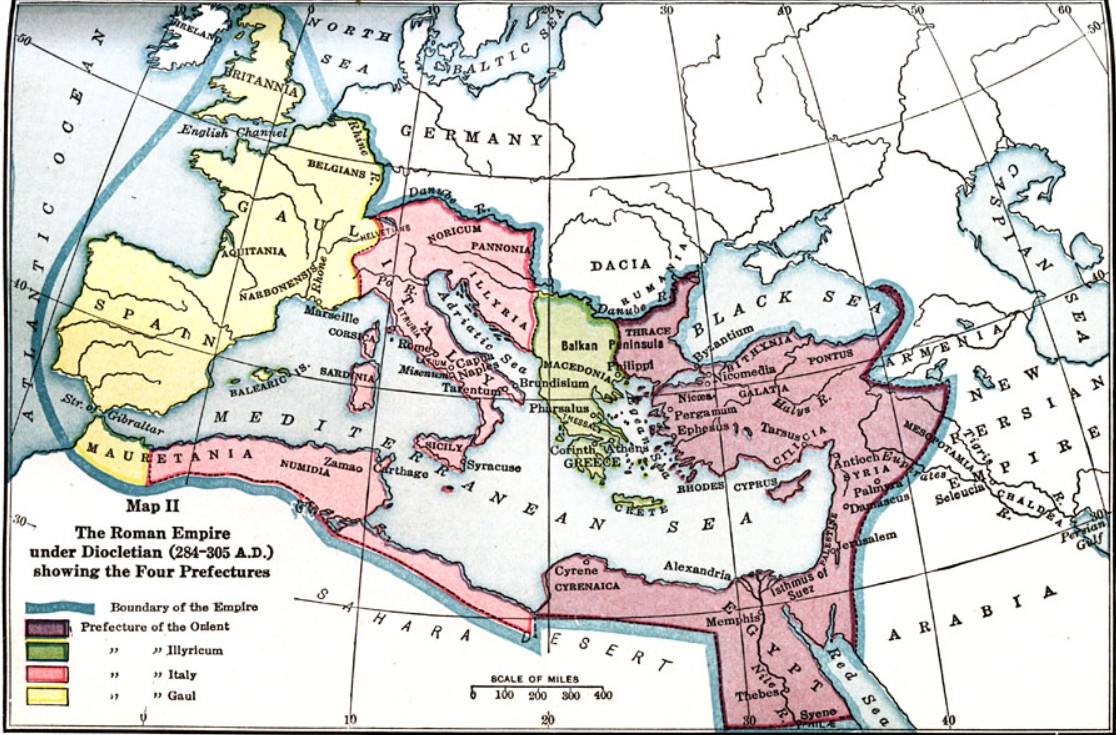
So Rome was founded by Esau’s descendant Magdiel or Iram, or both (like Remus and Romulus?) This provides a direct link between Esau and Rome, not just spiritual or symbolic, but genealogical and ancestral. According to this Midrash, Esau agreed to give up any claim to the Holy Land, and moved far away so that there would be no disputes over it. In exchange, Hashem blessed him to eventually become a mighty empire, spanning one hundred regions. Amazingly, at the time of Emperor Diocletian (r. 284-305), the Roman Empire had approximately one hundred provinces!
Zepho & Herod
Another key figure mentioned earlier in Genesis 36 is Esau’s grandson Tzfo, commonly transliterated as “Zepho”. He was the son of Eliphaz, son of Esau (v. 11). The midrashic work Sefer haYashar (on parashat Vayechi and Shemot) gives a long and detailed account of Zepho’s life. It starts by telling us that after Jacob was brought back to the Holy Land for burial, a war broke out between his sons and the sons of Esau. “And Joseph overpowered all the people of Esau’s sons, and he captured Zepho, the son of Eliphaz, with fifty of his men, and he bound them with iron chains, and he surrendered them into the hands of his servants to bring them down into Egypt.”
Eventually, Zepho escaped Egypt and went to a neighbouring African kingdom where he befriended a king named Angias. Zepho rose up the ranks to become the top general of the kingdom. Soon, he plotted revenge against the sons of Israel in Egypt, but King Angias refused to go to war with them. Zepho ended up leaving and heading to the island of Kittim, ie. the future Roman province Citium, today’s Cyprus. The Cypriotes elected the mighty Zepho as their king, and he went on to launch successful military campaigns to conquer all the neighbouring islands, all the way to Sicily and then mainland Italy. Sefer haYashar concludes by saying that Zepho ruled Cyprus and Italy for some fifty years. This gives us yet another potential genealogical and ancestral connection between Rome and Esau.
The fourth connection centres on a different king: Herod. I have already covered this in depth previously in ‘How Esau Became Rome’. To summarize, King Herod (r. 37-4 BCE) was the despised Roman client king of Judea, appointed by the Roman senate to rule over the Jewish people even though he was not a native Judean. The people hated his oppressive regime, and he slaughtered many Jews and rabbis (as attested to both in rabbinic tradition and in the historical works of Josephus). Herod became a symbol of the dreaded Roman oppressor. Herod’s background? He was an Idumean, and “Idumea” was the Roman name for Edom! I believe this is when the Rome-Edom connection was first clearly established, due to the oppressive and Esau-like Roman-Idumean king of Judea, Herod. And the fifth and final connection is closely related, going back to the same time period.
One of the terrible things that Herod is accused of is referred to by Christians as the “Massacre of the Innocents”. Although there is no historical evidence that this ever happened, Christians believe (based on a story in the Book of Matthew) that Herod sought to kill all the male babies born in Bethlehem because he feared the birth of the messianic king that would dethrone him. Jesus was supposedly that baby, and had to be concealed and miraculously saved. It sounds very much like the story of baby Moses, of course, from which it was appropriated. Whatever the case, Jesus goes on to become the central figure of Christianity, which became the religion of Rome, and then Europe. Jesus’ actual name was Yeshua, ישוע, and I’ve suggested in the past that this name has the exact same letters as Esau, עשו, just with an added yud. It’s almost like Esau is trying to take that holy yud back and reclaim his birthright! This may serve as yet another, more esoteric connection between Esau and Christian Europe.
Today, the long-prophesied reconciliation between Jacob and Esau is well underway, as we see happening all around us. Although we also witness elements within Edom (and Israel) that want to stop this from happening, it will inevitably be realized, and hopefully we see its fruitful conclusion very soon.
Wishing everyone a wonderful conclusion to Pesach, chag sameach!
Sefirat haOmer Learning Resources:
Kabbalah of the Omer (Video)
The Spiritual Significance of Sefirat haOmer
Mourning and Music in the Omer
A New Perspective on Rabbi Akiva, Rachel, and the 24,000
The Kabbalah of Yom Ha’Atzmaut