What is the true origin and purpose of the Talmud? How do we properly understand some of its seemingly bizarre statements? Find out as we explore the most misunderstood ancient religious text in the world.
See also:

What is the true origin and purpose of the Talmud? How do we properly understand some of its seemingly bizarre statements? Find out as we explore the most misunderstood ancient religious text in the world.
See also:
This Monday evening is Lag b’Omer, the 33rd day in the Omer count and traditionally commemorated as the yahrzeit of the 2nd-century CE sage and mystic Rabbi Shimon bar Yochai. Aside from being one of the most-cited voices in the Mishnah and Talmud, Rabbi Shimon (“Rashbi”) is even more famous for being the protagonist of the Zohar, the “textbook” of Jewish mysticism. Although he himself did not write it, the Zohar is based on his life and teachings, and is drawn from a collection of manuscripts initially produced by his disciples.
The timing of Lag b’Omer is even more significant because it is also the date when the “plague” upon the students of Rabbi Akiva ceased. After the deaths of some 24,000, only five of his students survived to rebuild Judaism—Rashbi being one of them. We must remember that Rabbi Akiva himself was jailed during this time, and eventually executed. It is during Rabbi Akiva’s time imprisoned that the Talmud (Pesachim 112a) relates an incredible story of when his student Rashbi came for a visit:
Rabbi Shimon approached his teacher behind bars and said lamdeni Torah, “teach me Torah!” Rabbi Akiva refused, since the Romans had banned Torah study—that was the reason Rabbi Akiva was imprisoned in the first place—and he did not want to get Rashbi in trouble, too. Incredibly, Rashbi responded by threatening Rabbi Akiva: “If you will not teach me, I will tell Yochai my father, and he will deliver you to the government!” This is puzzling, since Rabbi Akiva was already in jail at this point, so it seems like Rashbi was threatening to have Rabbi Akiva executed! We learn from this (among other places) that Rashbi’s father Yochai was a wealthy and influential figure in the Roman government, and could make such an order. This actually helps to explain why Rashbi later had to go into hiding from the Romans and spent over a dozen years in a cave, simply for criticizing the Roman regime. Certainly, many simple Jews (and gentiles) at the time would have criticized the Roman authorities without having to fear for their lives. Rashbi probably needed to go into hiding for what he said because his father was involved with the Roman government. He was well-connected and potentially a political threat to the authorities.
Rabbi Akiva told Rashbi: “My son, more than the calf wishes to suck, the cow wants to suckle!” In other words, Rabbi Akiva really did want to teach Torah, of course, even more than Rashbi wanted to learn, but he did not want to put his student in danger. Rashbi countered by arguing: “But who is the one in danger? The calf!” It is the baby that is in a fragile state, and needs the mother more than the mother needs the child. Rashbi was saying he needed Torah like a calf needs milk, otherwise he is (spiritually) in trouble anyway. Rabbi Akiva relented and relayed five final teachings, though they were terse and cryptic.
The first, appropriately, was “If you wish to hang yourself, do so on a big tree.” Since what Rashbi was asking of Rabbi Akiva potentially carried a death sentence, Rabbi Akiva gave him a teaching directly related to that. The simple meaning is that if Rashbi is going to be executed al kiddush Hashem, as a martyr sanctifying God’s Name, he should do so on a “big tree”, meaning to make it public so that the Kiddush Hashem is that much greater and inspires others to strengthen their resolve. Of course, Rabbi Akiva himself would soon be executed in such a way, with a huge Kiddush Hashem of his own.
[It should be noted that Rashi (not Rashbi) interpreted this first teaching metaphorically to mean that if you cite a Torah teaching, do so by citing it in the name of a great earlier sage, the “big tree”. The Ben Ish Chai, meanwhile, comments mystically that the “big tree”, ilan gadol, is the mystical Tree of Life, the ilan hakadosh, of the Sefirot. More specifically, ilan (אילן) has a value of 91, which is a clear allusion to the special Octagrammaton, explained here.]

The Octagrammaton, the eight-letter Name of God that fuses Hashem with Adonai
Rabbi Akiva’s second teaching was: “When you teach your son, teach him from a corrected scroll.” This teaching was also highly prescient, since Rashbi would soon have to go into hiding with his son, Rabbi Elazar. The two spent all of their time in the cave learning. From elsewhere in the Talmud (Ketubot 19b) we learn that a “corrected scroll”, sefer mugah, is any scroll or book of Tanakh that has been carefully proofread to make sure there are no errors. If an error is found, one has up to thirty days to correct it. Based on this, the Talmud explains the meaning of Rabbi Akiva’s second teaching is that a child should be taught properly from the beginning, because if they learn something erroneous in childhood, it will be hard to correct later.
The third teaching of Rabbi Akiva was: “Do not cook in your fellow’s pot.” The Talmud explains that this means a person should preferably not marry a divorcee whose husband is still alive, for she will likely still be thinking of her first love (whether positively or negatively). The Talmud cites a parallel teaching that when two divorced people marry each other, there are “four minds in their bed”. Each one brings the baggage of their previous relationship!
We’ll skip ahead to the fifth teaching as it is related to the third one: Rabbi Akiva teaches that a man should get married (and stay married!) and this is a mitzvah v’guf tahor, both a great mitzvah in itself, and also makes a man’s body pure, since he will not be drawn to sexual sins (having a wife to take care of those urges), and will have children to keep him busy and make him more responsible. It’s no coincidence that Rabbi Akiva saves this for his final teaching, since he himself was lucky to marry the right woman, who encouraged and supported him, and whom he later credited for all of his Torah learning and success.
These two short teachings on marriage actually carry a great deal of hidden mystical meaning (as, for instance, the Ben Ish Chai comments and explains in his Ben Yehoyada). Rashbi would go on to teach the fundamentals of Jewish mysticism in the Zohar, where marital intimacy is the central theme and metaphor that runs throughout the text. In fact, much of Kabbalah in general is based on the dynamics of a marriage as a metaphor for greater cosmic spiritual realities.
Finally, the fourth teaching of Rabbi Akiva is regarding a case where a person rents out a field to their fellow, who will work the land. Instead of taking monetary payment, the renter takes a portion of the produce of the field. This is both a mitzvah to help your fellow, who gets land to work and does not have to pay rent (just a portion of his yields), and is good for the renter’s own wellbeing, since he will eat fresh fruits and be healthy. Thus, it is a mitzvah v’guf gadol—both a big mitzvah and gives one a great, healthy body. Like the other teachings, this one was relevant to Rashbi since, as we’ve seen, Rashbi came from a powerful and wealthy family. He had the means to rent out fields to less privileged people.
As an important aside, there is a famous Talmudic debate between Rashbi and Rabbi Ishmael regarding whether a man should spend all of his time learning Torah, or get a job and make his own living, while also making time to learn Torah (Berakhot 35b). Rabbi Ishmael argued that, although the Tanakh tells us to meditate upon the Torah day and night, and that “it should not depart from your mouth” (Joshua 1:8), we also recite every day in the Shema that “you shall gather in your grain…” (Deuteronomy 11:14), meaning a person needs to work, too! Rashbi countered that if a person works, they will not have enough time to study Torah, as they will always be busy with something; plowing, sowing, harvesting, threshing, and so on. Rashbi argued that if a person fulfils God’s will, then God will bless them with riches, allowing them to outsource the work to others. He therefore concluded that ideally a person should learn all day, and leave the physical work for others. Of course, it was easy for Rashbi to say this since he came from a super-wealthy family, and was able to hire people to do that work!
Ultimately, the debate in the Talmud is settled by Abaye who said: “Many have acted in accordance with Rabbi Ishmael and were successful [in their Torah study. And many] have acted in accordance with Rabbi Shimon ben Yochai and were not successful!” Oftentimes, it is those who balance Torah with labour that become the greatest scholars, while those who are full-time learners fail to achieve Torah greatness. Note as well that Abaye specifically referred to Rashbi as, not just “Rabbi Shimon” (as he did Rabbi Ishmael, without a patronym), but “Rabbi Shimon ben Yochai”, emphasizing that he was the son of the wealthy Yochai, and most people are not so privileged like him.
Today, Rashbi’s position is still taken as support for certain kollels and for those who “make Torah-learning their profession”. However, it is important to clarify here that Rashbi never supported learning Torah at someone else’s expense. Rashbi was very wealthy himself, and could afford to hire others to do his work, while he learned all day. He certainly would not have supported the idea of making a living through learning Torah, for the Talmud clearly states in many places (including several times in Pirkei Avot 1:13, 2:2, 4:5) that this is unacceptable. The Torah should not be used as a “shovel to dig with”, to derive personal or material benefit. And when Rashbi had to go into hiding and did not have his father’s wealth and estate to support him, he lived meagrely on nothing but carobs and water. In either case, he never relied on the funds of others to make a living.
Going back to Rabbi Akiva, it appears that this encounter with Rashbi was his last, and he was soon executed. His final five teachings were concise, but deeply meaningful, especially for Rashbi himself. Rashbi would go on to be one of the five who rebuilt Judaism. His own final discourse, the Idra Zuta, contained deeply profound teachings as well. For an exploration of the last passage in the Idra Zuta, see the following short class:
Happy Lag b’Omer!
Today we celebrate Yom Ha’Atzmaut, the modern State of Israel’s Independence Day, which immediately follows Yom HaZikaron, when we commemorate those who have given their lives for Israel. Each one of those lost is an indescribable tragedy. Though Israel has won the majority of its wars, the price has been devastatingly high. We know that what happens in this material world is often just a reflection of higher realities occurring in the spiritual worlds. With that in mind, what can we all do spiritually to affect the worlds above, in order to strengthen Israel militarily here below? The Torah gives us four major tools that a Jew can do that will go a long way in boosting Israel’s might and, God willing, reducing casualties in war.
The first of these tools comes from this week’s parasha, Acharei Mot, which spends many lines describing the Yom Kippur service. Commenting on one of the verses here (Leviticus 16:12), the Ba’al HaTurim (Rabbi Yakov ben Asher, 1269-1340) points out that “in the merit of the Yom Kippur service, [the Israelites] would win wars.” Although we do not have a Temple today to fulfill all of the services, nonetheless our heartfelt prayers and repentance on Yom Kippur affect a change in the Heavens that result in Israel becoming militarily stronger and victorious in war.
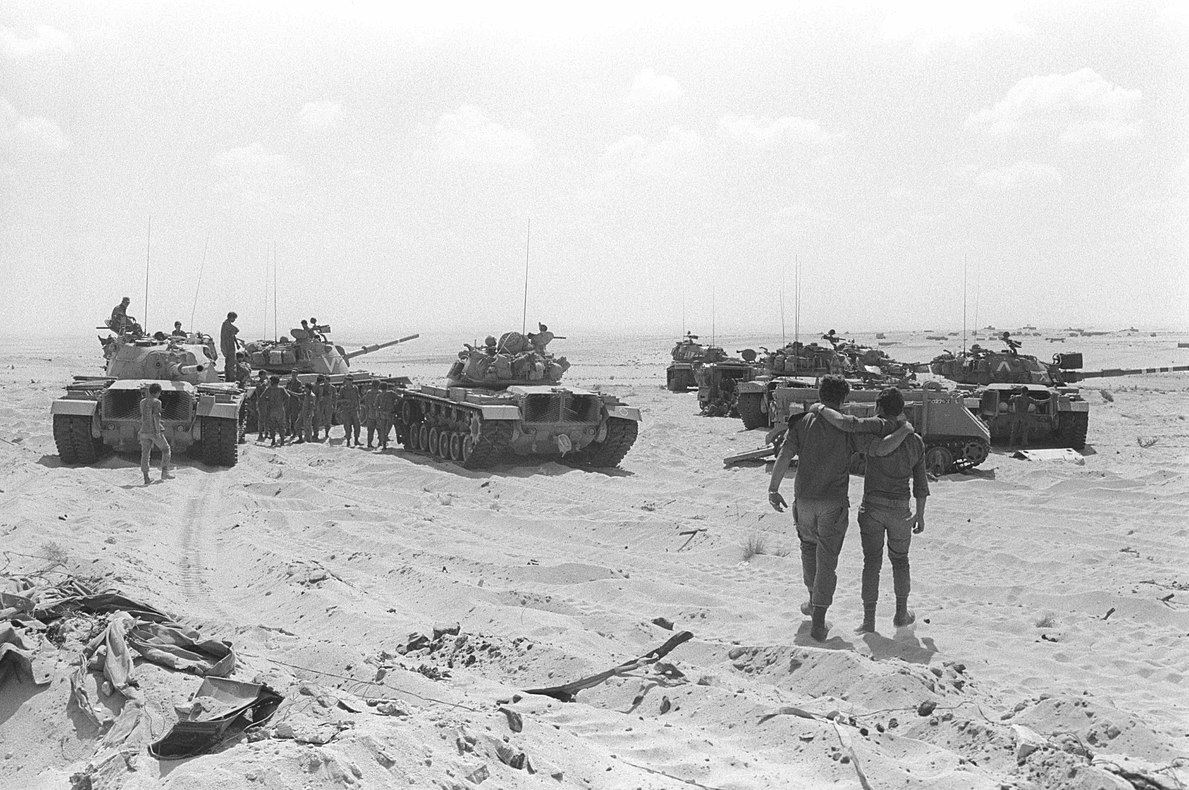
We see a perfect demonstration of this in the 1973 Yom Kippur War, when Israel was surprise-attacked by its Arab neighbours, totally unprepared and with most of its soldiers in the synagogues. The war initially went very badly, and military analysts even predicted the impending demise of Israel. Yet, things turned around quickly, and just two weeks later the war ended with a resounding victory for Israel. Henceforth, the Arabs never tried another invasion, and Egypt—the leading power in the Arab world—gave up any goals of destroying Israel, instead pursuing peace. The Arab armies thought that by attacking Israel on Yom Kippur they had a big advantage. The reality was the exact opposite! In the merit of Yom Kippur, Israel won the war and permanently altered the geopolitical landscape in the Middle East.
Six years earlier, before the similarly miraculous Six-Day War, the Lubavitcher Rebbe instituted another campaign to strengthen Israel militarily: encouraging the donning of tefillin. Ever since, Chabadnikim around the world go to street corners, supermarkets, bus stops and other public places to encourage Jewish men to wrap. Various reasons have been given for why the Rebbe chose tefillin specifically as a way to strengthen Israel. The main one is based on a passage in the Talmud (Rosh Hashanah 17a). Here, the Sages discuss an End of Days prophecy in Zechariah which states a third of the population will be purified “by fire”. The Sages say these are the rebellious people who sinned with their bodies. The Talmud further defines that when it comes to the gentiles, the ones who sinned with their bodies are those who engaged in sexual sins. When it comes to Jews, however, it refers to those who never put tefillin on their bodies!
Based on this, the Rebbe saw that there is tremendous merit in donning tefillin, and puts a Jew into a wholly different spiritual category once he has done so, even just once. Moreover, since the verse in Zechariah is talking about an End of Days prophecy about the final apocalyptic war before Mashiach’s arrival, the Rebbe saw further significance to our day and age, hence the message that we should increase the observance of tefillin. Indeed, the tefillin campaign was a huge success, as was Israel’s subsequent Six-Day War, with huge implications for the coming of Mashiach, since this is when Jerusalem and the Jewish heartland of Judea and Samaria were reclaimed and liberated.
I believe there is another proof for the tefillin-military might connection: In Berakhot 57a, we read that a person who dreams of himself in tefillin should expect greatness. This is based on Deuteronomy 28:10 which reads: “And all the peoples of the earth shall see that the name of God is called upon you; and they shall be afraid of you.” The Sages ask: what does it mean to have the “name of God” upon you? It means putting on tefillin, since this is when God’s Name is literally wrapped upon a person’s body! And, when the gentiles see a Jew in tefillin, it inspires a sense of awe and fear among them. So, just as Deuteronomy promises, when the Jewish nation carefully and diligently dons tefillin, it will inspire fear in our enemies.
Another segulah for reducing Israel’s casualties on the frontlines and beyond is the mitzvah of charity. This one is well-known and needs little elaboration, since the Tanakh emphatically states that tzedakah tatzil mimavet, “charity saves from death” (Proverbs 10:2). As explained in detail elsewhere (see ‘How Charity Can Save Your Life’ in Garments of Light, Volume One), providing a financial contribution to a worthy cause affects a change in the Heavens that can tear up a decree hanging over a person’s soul. This is because the money one earns is tied directly to the exertion they put in to earn that money, since a person invests their time, energy, and soul into their work. The Torah tells us that giving even a half-shekel serves as kofer nefesh, an atonement for the soul (Exodus 30:12). There is a beautiful mathematical proof to this in that the words shekel (שקל) and nefesh (נפש) have the same numerical value (430)!
Finally, the Torah states that if we are worthy, “Five of you shall chase away a hundred, and a hundred of you shall chase away ten thousand; your enemies shall fall before you by the sword.” (Leviticus 26:8) A classic question here is regarding the ratios: five chasing away a hundred is a ratio of 1 to 20, but a hundred chasing away ten thousand is a ratio of 1 to 100! What we can learn from this is that the more Jews are united and fighting together, the stronger we become. That strength does not just grow linearly, but exponentially! The message is that we must all be united. Instead of sinat hinam, baseless hatred and enmity, we must have ahavat hinam, baseless love and unity. This is our greatest source of strength.
Putting it all together, we have four key tools to increase Israel’s military and physical might: Yom Kippur, tefillin, tzedakah, and ahava. Amazingly, if we take the initials* of these terms (י כ ת צ א), they spell out כי תצא, as in כִּֽי־תֵצֵ֥א לַמִּלְחָמָ֖ה עַל־אֹיְבֶ֑יךָ וּנְתָנ֞וֹ יְהֹוָ֧ה אֱלֹהֶ֛יךָ בְּיָדֶ֖ךָ, “When you go out to war against your enemies and God will deliver them into your hand…” (Deuteronomy 21:10) There is no better proof than this that if we increase our observance of these crucial mitzvot as a nation, we will undoubtedly be invincible, and God will deliver all of our enemies into our hands.
Yom Ha’Atzmaut Sameach!
*If we take only the first initials of the four mitzvot above (without the kaf of kippur), we have יתצ״א, which carries a value of 501. This is a very significant number, too. At the Pesach seder, we group the Ten Plagues by their initials and recite דצ״ך עד״ש באח״ב. The great kabbalist Rav Shimshon of Ostropoli (d. 1648) taught that the value of this phrase is 501, equivalent to an angel named תק״א that facilitated the plagues and punished the enemies of Israel (see his Ma’amar Sod Eztba Elokim). Additionally, this is reminiscent of the “Angel of God” that struck down the Assyrian camp of 185,000 soldiers to protect Jerusalem in the time of King Hezekiah (II Kings 19:35).
From the Archives: The Kabbalah of Yom Ha’Atzmaut