Category Archives: Kabbalah & Mysticism

Leviathan & the Seven Serpents

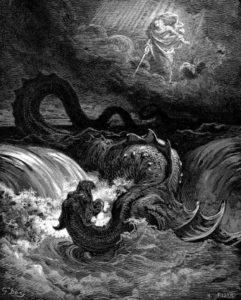
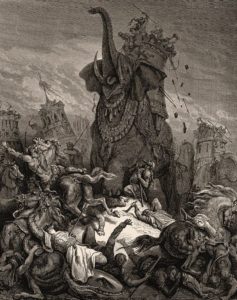
‘Destruction of Leviathan’ by Gustav Doré

In this week’s parasha, Va’era, we read about Moses’ first confrontation with Pharaoh and the famous battle of their serpentine staffs. Interestingly, in last week’s parasha when Moses’ staff first turned into a serpent (Exodus 4:3), the word used was nachash, while this time it says tanin (7:9-10)! The former term certainly means a “snake”, but the latter is more general and can be any serpent, reptile, or even crocodile. Mystical texts see this as an allusion to the greatest of the taninim, created by God on the Fifth Day of Creation, the great sea dragon called Leviathan. The Zohar (II, 27b) comments here that the Leviathan was red like a rose, with iron-like scales, wing-like fins, a powerfully-thrashing tail, and fire coming out of its mouth. It has long migrations in the deep seas lasting seventy years.

Commenting on the words hataninim hagedolim, “the great sea monsters”, in Genesis 1:21, Rashi says that God originally created a pair of Leviathans, but they were so terrible that He slew the female so that the couple wouldn’t reproduce. God then “salted” its flesh and preserved it for the righteous in the World to Come, who are said to enjoy it at the “Feast of Leviathan” in the End of Days. Rashi is quoting the Talmud here (Bava Batra 74b-75a), which adds that God will make a sukkah for the tzadikim from the skin of the Leviathan. The leftover skin will be draped over “the walls of Jerusalem” and will shine and glow to wow the entire world. Perhaps that means the Kotel will have a miraculous new look in the near future, which is quite fitting since it will no longer be a “wailing” wall.

We read here in the Talmud that God castrated the male Leviathan, too, and provides a Scriptural source for it all in Isaiah 27:1, that “He will slay the Serpent that is in the sea…” The Sages ask: why did God slay the female and not the male? One answer is that the female could have still laid eggs without the male. Indeed, we know scientifically that there is a phenomenon called parthenogenesis where female fish are able to reproduce even without fertilization by a male. The Talmud then gives another answer based on Psalms 104:26, which says “There is Leviathan, whom You have formed to sport with.” God created the Leviathan just to “sport with”, and it wouldn’t be appropriate to sport with a female Leviathan, so he left the male only. (It seems gender segregation in sports is not a new issue!)

There is a way to interpret all of this metaphorically, too, and the Talmud goes on to say that the Jordan River flows into the “mouth of Leviathan”, while the ancient Seder Rabbah d’Beresheet says the entire planet “rests” on one of the fins of Leviathan. Even the Zohar has an interesting interpretation of the taninim gedolim of Creation, saying they are actually referring to the “Seventy Princes”, the Heavenly angels overseeing the seventy nations of the world. Leviathan is chief among them. From other sources, we learn that the chief of all the Seventy Princes is the angel Metatron (ie. Enoch), so we find here a link between the great Metatron and Leviathan. (This is further appropriate because the earliest known reference to a “Feast of Leviathan” is actually the apocryphal Book of Enoch!)

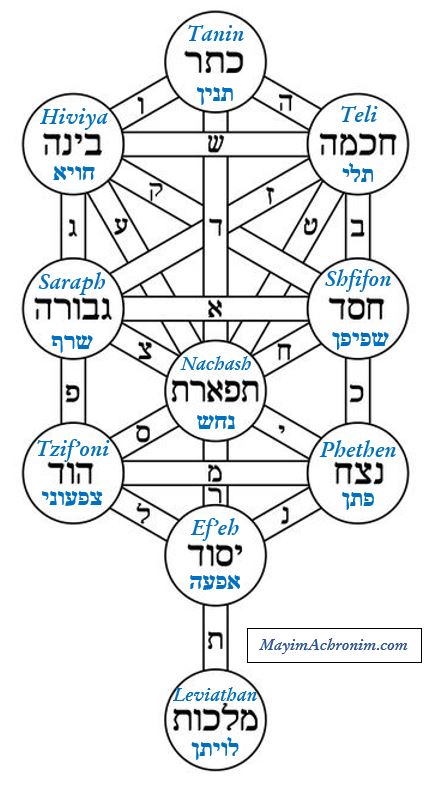
Mystical texts say the spirit of Metatron is found within Mashiach (see, for instance, Kol haTor), and Mashiach is destined to slay the remaining Leviathan at the End of Days, ushering in the final Kingdom of God on Earth. This, too, might be a metaphor for Mashiach subduing all seventy nations and unifying them under one God, as we read in Zechariah 14:9 that “Hashem shall be king over the entire Earth; on that day Hashem will be one and His name will be one.” In fact, the numerical value of “Leviathan” (לויתן) is 496, equal to Malkhut (מלכות), “Kingdom”. Leviathan thus corresponds to the last of the Sefirot. (We explored in the past how the changing astronomical constellations in the sky above us are shifting now to reveal this very process.) Intriguingly, we find six other terms for serpents throughout the Tanakh, and they neatly parallel the six other “lower” Sefirot from Chessed to Yesod.

The Seven (Eight?) Serpents

The most common term for a serpent is, of course, nachash. This snake corresponds to the central Sefirah of Tiferet. Tiferet is the spiritual root of all Israel, and of Mashiach in particular. This is another reason why the values of nachash (נחש) and “Mashiach” (משיח) are equal, both being 358. When Jacob blessed his son Dan, he saw a vision of Mashiach and said “I await Your salvation, Hashem!” (Genesis 49:18) Before that, Jacob fittingly described Mashiach (while seemingly speaking of Dan) as a nachash ‘alei derekh, a “snake upon the road”.

He then used another serpentine term, saying that Mashiach should also be a shfifon ‘alei orach, typically translated as a “viper upon the path”. The Maharal (Rabbi Yehuda Loew of Prague, c. 1512-1609) in Gur Aryeh connects this mysterious term with several roots, including the humbling shofef, as well as neshef, meaning an “exhale” or a “relaxation” or even a happy gathering of some sort. The shfifon (שפיפן) has positive energy, and corresponds to the loving Sefirah of Chessed. Jacob was possibly alluding to Mashiach’s role to bring all of Israel together and reconnect them spiritually through various “paths”.

On the opposite side of the Sefirotic tree we have the fiery and judging Gevurah. This corresponds to the Torah’s saraph (שרף), a “burning” venomous snake that God used to punish the people in the Wilderness for their rebelliousness (Numbers 21). To heal the people, Moses then made a nachash nechoshet, a copper serpentine rod. Now we can understand why it had to be specifically a nachash because, as we saw above, that one corresponds to Tiferet, which is said to be the source of healing and shares a root with refuah!  Mashiach, too, is said to carry a serpentine staff. In fact, the Midrash and Zohar state that a woman called “Heftzibah” will bring it to him, finding it somewhere in Tiberias where Eliyahu hid it. She is also known as Mevaseret Tzion, the “Herald of Zion”, as per Isaiah 40:9 (see Sefer Zerubbabel and Zohar III, 173b).

Next, we have the “twin” Sefirot of Netzach and Hod, corresponding to the legs. They are always referred to as being the source of prophecy. In Psalm 91 we read “You will tread on lion cubs and phethen…” The phethen (פתן) is none other than the python. It is worth noting that in ancient Greece, the python was associated with prophecy, and their prophetic Oracle at Delphi was called Pythia. In the famous messianic prophecy of Isaiah, we read of another serpent paralleling the python: “A babe shall play over the hole of a phethen, and an infant pass its hand over the den of a tzif’oni.” (11:8) The word used for a “den” here is me’urat, which can be read as m’orat, ie. “from the light [or fire] of the tzif’oni”. The Malbim (Rabbi Meir Leibush Wisser, 1809-1879) reads it this way, saying the “fiery” poison of the tzif’oni (צפעוני) will no longer harm a child in the Messianic Age. This gives us a clue that the tzif’oni corresponds to Hod, lying beneath the fiery Sefirah of Gevurah, and tempering its judgement. More significantly, we can learn from this Isaiah verse that in the Messianic Age, even a child will be able to connect to Netzach and Hod and attain the light of prophecy.
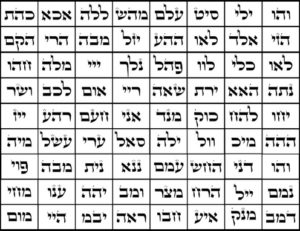
The 72 Names of God (For the origin of these Names, see here.)

Finally, the last word for a serpent in Tanakh is ef’eh (אפעה), as we read in the Book of Job that “He sucks the head of a viper; the tongue of the ef’eh kills him.” (20:16) This one parallels the Sefirah of Yesod, the domain of sexual purity. In fact, the Kabbalists teach that of the 72 Names of God, the one that links to Yesod and through which one can atone for sexual sins is חב״ו. In the Amidah, there is a kavanah to insert during the kibbutz galuyot blessing to purify one of wasted seed and other sexual issues and it quotes a well-known phrase chayil bala’a vayakienu, mibitno yorishenu El, “The riches that he swallowed he vomits; God empties it out of his innards.” The letters of the first three words (חַיִל בָּלַע וַיְקִאֶנּוּ מִבִּטְנוֹ יֹרִשֶׁנּוּ אֵל) spell חב״ו. And where does this powerful verse come from? The preceding one in Job! (20:15) Thus, we have a clear Scriptural link between the ef’eh and Yesod.
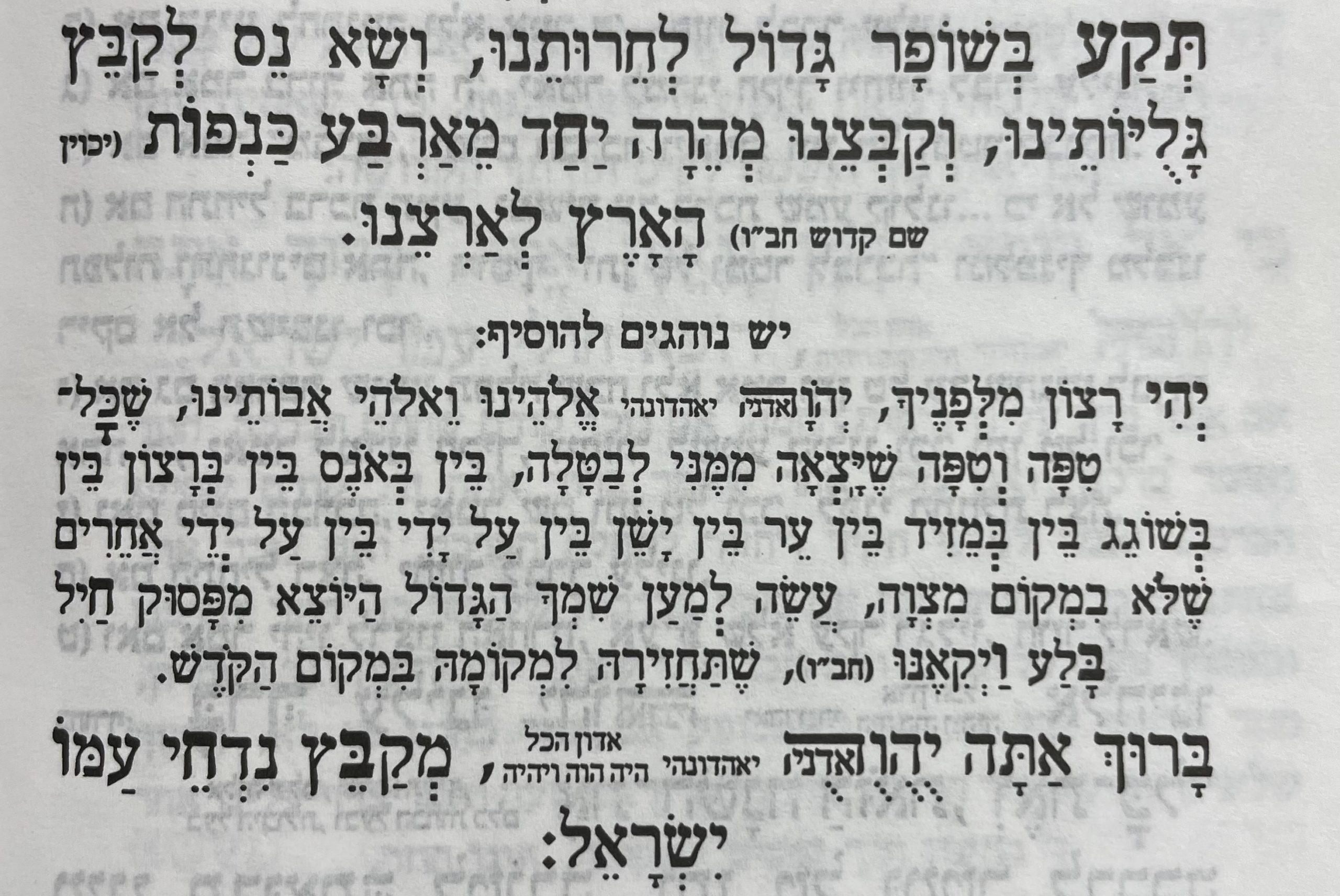
Text of the blessing, with kavanah, both highlighting the חב״ו name.

And what of the Mochin, the upper three Sefirot? Perhaps we can link them to serpentine terms outside of Scripture. For instance, there’s the Teli (תלי) of Sefer Yetzirah (6:1-2), typically understood as the dragon constellation Draco. Recall that Sefer Yetzirah is an exposition of the Lamed-Bet Netivot Chokhmah, 32 Paths of Wisdom, so the Teli is directly linked to the Sefirah of Chokhmah. Then there’s the Talmud’s Aramaic hiviya (חויא), the root of which is said to come from Eve (חוה), and her encounter with the Snake. This would parallel the “motherly” Sefirah of Binah (also called Ima). And Keter on top, the origin of all the others, would be the generic term Tanin (תנין) with which we started, referring to any of the serpents below and often used interchangeably with them, as in this week’s parasha. Altogether, we have the following array of links between mystical Sefirot and mystical serpents:
Rabbi Akiva and the Maccabees

On Chanukah we commemorate the victory of the Maccabees over the Seleucid Greek oppressors. The leader of the revolt was an elder kohen named Matityahu ben Yochanan. The second chapter of the Book of Maccabees describes how the revolt broke out: the Greek officers came to Modi’in requesting a sacrifice be made in honour of the wicked king. As Matityahu was the most illustrious elder in the city, he was approached specifically and told that he would be rewarded greatly if he brought the offering. Matityahu replied:

I and my sons and my kindred will keep to the covenant of our ancestors. Heaven forbid that we should forsake the law and the commandments! We will not obey the words of the king by departing from our religion in the slightest degree. (2:20-22)

Another Jew then came up to offer the sacrifices, and Matityahu “sprang forward and killed him upon the altar. At the same time, he also killed the messenger of the king who was forcing them to sacrifice, and he tore down the altar.” (v. 24-25) The Book of Maccabees compares Matityahu to Pinchas, who had struck down the wicked Zimri back in the generation of Moses.

We are then told that Matityahu “and his sons fled to the mountains, leaving behind in the city all their possessions.” (v. 28) They launched a full-scale revolt against the Seleucids, and “Then they were joined by a group of Hasidim, mighty warriors of Israel, all of them devoted to the law.” (v. 42) Originally, the warriors were not called “Maccabees”—that was only the nickname of Yehuda—but rather Hasidim, the “pious ones”. History’s first Hasidim were mighty warriors!

Matityahu himself passed away soon after and, following an impassioned final speech, left Yehuda in charge of the military, while placing Shimon in charge of making decisions (v. 65-66). Shimon would go on to be the only son to survive, and became the leader of Israel when peace was achieved. Though he did not take the title of “king”, he established the Hasmonean dynasty. (We previously explored his true identity here.)

In the Second Book of Maccabees (8:22-23), we learn how Yehuda divided up his forces:

He appointed his brothers also, Shimon and Yosef [Yochanan] and Yonatan, each to command a division, putting fifteen hundred men under each. Besides, he appointed Elazar to read aloud from the Holy Book, and gave the watchword, “God’s help!” Then, leading the first division himself, [Yehuda] joined battle against Nicanor.

‘Death of Eleazar’ by Gustav Doré

It’s amazing to read that Yehuda made sure to leave his brother Elazar with a group of people to learn Torah and pray. Later, Elazar himself would join the fray, and tragically died by being trampled under a war elephant, in an attempt to strike down a Greek general. Strangely, in the passage above one of the brothers is called “Yosef”, when we know that he is actually called “Yochanan”. Is this a simple error? Did Yochanan have two names or is, perhaps, the text alluding to a mystical secret about the spiritual nature of the five sons of Matityahu? I believe the latter is a very real possibility, for we find the story of Matityahu and his five sons seemingly repeated in a different group of people, some three hundred years later.

Rabbi Akiva’s Rebellion

In the 2nd century CE, the Seleucids were long gone and the oppressor of the Jewish people was the Roman Empire. The Jerusalem Temple had been destroyed back in 70 CE, and now in 132 CE, a warrior called Shimon bar Kochva rallied the Jews again to fight off the Romans. He succeeded at first, managed to expel the Romans, minted new coins, and even cleared the Temple Mount to get ready for the Third Temple. Rabbi Akiva was convinced Shimon bar Kochva was the real deal, and declared him the presumptive messiah. He gave full backing for the rebellion. As we know, it didn’t end well. Rabbi Akiva was executed by the Romans, and lost 24,000 students in the conflict (as explained here).

Before his death, Rabbi Akiva managed to find five new students: Rabbi Meir, Rabbi Yehuda bar Ilai, Rabbi Yose ben Halafta, Rabbi Shimon bar Yochai, and Rabbi Elazar ben Shammua. (That said, we have evidence that Rabbi Meir and Rabbi Shimon had been his students for some years prior already.) Rabbi Akiva did not have a chance to actually ordain them, so it was Rabbi Yehuda ben Bava that later did, and paid the ultimate price:

He went and sat between two great mountains, between two large cities; between the Sabbath boundaries of the cities of Usha and Shefaram, and there ordained five sages: Rabbi Meir, Rabbi Yehudah, Rabbi Shimon, Rabbi Yose, and Rabbi Elazar ben Shammua…

As soon as their enemies discovered them, Rabbi Yehudah ben Bava urged them: “My children, flee!” They said to him: “What will become of you, Rabbi?” He replied: “I will lie down before them like a stone which none can overturn.” It was said that the enemy did not stir from the spot until they had driven three hundred iron spears into his body, making it like a sieve… (Sanhedrin 14a)

Thanks to Rabbi Yehuda ben Bava’s martyrdom, the five new rabbis escaped with their lives. They went on to revive Judaism in the years following the Bar Kochva Revolt (Yevamot 62b). Of the five, one in particular stood out: Rabbi Shimon bar Yochai. He was the one that revealed the mystical teachings of Judaism, and gave over what would become the Zohar. These revolutionary teachings saved Judaism and kept the flame burning through centuries of persecution and exile.

Reading the account of the Maccabees and the account of Rabbi Akiva’s students, one can’t but help see the striking parallels. Each revolt begins with a daring elder sage supporting an uprising against a powerful empire. Each describes Torah-observant, pious Jewish warriors hiding in caves and mountains and fighting guerrilla-style. In the case of the former, the Temple is purified and rededicated; in the case of the latter the Temple Mount is cleared and previous Roman plans to build an idolatrous shrine to Jupiter are halted. Five sons of Matityahu lead the war against the Greeks and save Judaism from extinction. Five students of Rabbi Akiva survive the war, lead the post-rebellion recovery, and save Judaism from extinction. The two sets of five have much in common, too:

Shimon the Maccabee goes on to set the foundations for a prosperous new Jewish kingdom, and for a proliferation of Torah learning. Shimon bar Yochai goes on to help produce the Mishnah, set the foundations for Kabbalah and the proliferation of the deepest dimensions of Torah. The initial leader of the Maccabees (and the greatest warrior overall) was Yehuda, while the initial leader of the students of Rabbi Akiva was Yehuda bar Ilai, who is actually the most-oft cited sage in the whole Mishnah! In both cases there is a Rabbi Elazar to “read aloud from the Holy Book” and call in God’s Name. Rabbi Akiva had a student named Yose, and it seems there is no such parallel among the Maccabees, until we remember that strange verse in II Maccabees cited above that calls Yochanan “Yosef”. I believe this is a cryptic allusion that Yochanan should be equated to Rabbi Akiva’s Yose (short for “Yosef”).

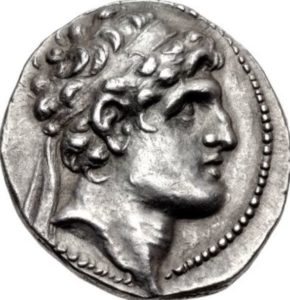
Coins depicting King Alexander I Balas

Finally, according to many opinions the illustrious Rabbi Meir actually had a different name, and meir was only a nickname because he was such a holy “illuminator”. The illustrious Yonatan was chosen from the brothers to serve as kohen gadol once the Temple was reclaimed, and held the post for some two decades as the conflict with the Greeks raged on. As kohen gadol, he henceforth stayed away from battle and focused on diplomacy. We know that Rabbi Meir, too, was not a big fan of Bar Kochva’s Revolt, and seems to have maintained good relations with the Romans. In fact, the Talmud tells us he once put on the garments of a Roman officer and went to free his sister-in-law from captivity (Avodah Zarah 18a). Meanwhile, we know that Yonatan was the first to ally with the Greeks, supporting up-and-comer Alexander Balas for the Seleucid throne, after which a grateful Balas invited Yonatan to his wedding and dressed him in royal Greek garments.

So, how do we make sense of the striking similarities between Matityahu and his five sons and Rabbi Akiva and his five students? Could it simply be history repeating itself? Or is it something more profound, perhaps a set of reincarnations for the purposes of tikkun? The major fault of the Maccabees was that, while they ensured the physical survival of the Jewish people, they did not do enough to preserve long-term spiritual success. Very quickly after them, their Hasmonean descendants became Hellenized, took on Greek names, and even persecuted rabbis. It is said that this is one reason why Hasmonean history—along with the Books of Maccabees—was suppressed by the Sages. (Chanukah is the only holiday without a Talmudic tractate devoted to it!)

With this in mind, one might suggest that God gave Matityahu and his five sons another chance, and the second time around they came to ensure the survival of the Jewish faith, the transmission of the Mishnah—most of which is relayed in the name of these six figures—as well as the transmission of major parts of Talmud, Midrash, and Kabbalah. In the second go, their military victory was not as successful, but the spiritual and moral victory was far greater, ensuring the long-term survival of the Jewish people.

Chag sameach!

The Light of Creation (Video)

In recent decades, science has discovered and confirmed what the ancient Jewish mystics knew about the origins of our universe. In this fascinating class, we dive into the secret of Creation and of God declaring “Let there be light!” Join us as we uncover some of the most profound mysteries of the cosmos, and see what it all has to do with the light of Chanukah, and the forthcoming Messianic Age.

See also ‘Chanukah & the Light of Creation’ here.
Link to Rabbi Ginsburgh’s Periodic Table here.