
Tag Archives: Brahman

God of Gods, King of Kings

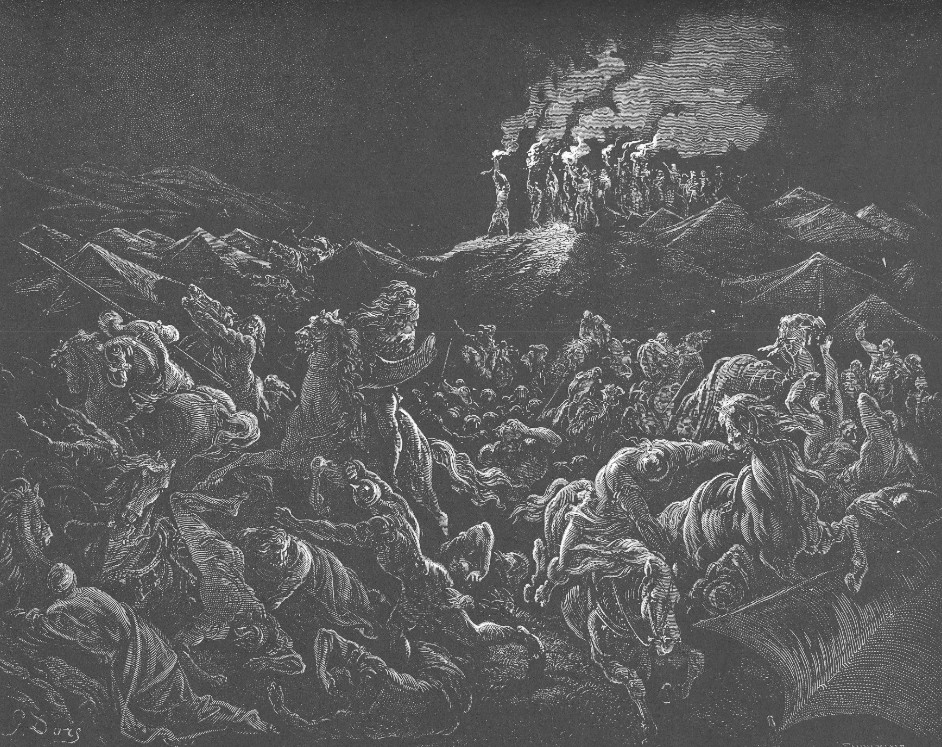
‘The Midianites Put to Flight’ by Gustav Doré

One of the difficult passages in this week’s double parasha, Matot-Massei, which closes the Book of Numbers, is where God seemingly commands a complete massacre of a neighbouring people, the Midianites. This is actually God’s final command to Moses, saying “Take revenge for the Israelites against the Midianites. Afterwards, you will be gathered to your people.” (Numbers 31:2) The next and final book of the Torah is Moses’ own account of his leadership, and was relayed over the last 37 days of his life.

The Israelites go on to slaughter every male Midianite (31:7), take the women and children captive (31:9), then burn down all the cities and take plunder (31:10-11). Still, the Israelites are chastised for letting the adult women live (31:15), as they were the very ones that tempted Israel into various sexual sins beforehand. Understandably, this is one of the most troubling passages in the whole Torah—how could a holy nation seem to behave in a manner more like the violent and bloodthirsty nations we condemn? Unfortunately, passages like this have also turned many away from the Torah, and generated numerous atheists. One such atheist is Richard Dawkins, who summarized it this way in his book, The God Delusion (ch. 2): Continue reading

Judaism vs. Hinduism

Are Hindus spiritual descendants of the Biblical Abraham? Find out in this class where we explore the many things that Judaism and Hinduism have in common, how our histories have been intertwined for millennia, and why India and Israel are natural allies on the global stage. Also discussed: Are there Lost Tribes of Israel in India? How does Judaism view reincarnation? What are the mystical 72 Names of God? And who was the Talmud’s mysterious Rabbi Yehuda the Hindu?

For more, see ‘Holy Cow: Parallels Between Judaism and Hinduism’.

For more on the Third Eye in Judaism, please see here.

For the incredible life of Mirra Alfassa, see here, and for an amazing Jewish story with Swami Vijayananda, here.

Holy Cow: Parallels between Judaism and Hinduism

This week’s parasha, Chukat, begins with a description of the “Red Cow”, parah adumah, alone capable of removing the spiritual impurity of death. Some have described the Red Cow as Judaism’s “holy cow”, and have even compared it to the veneration of cows in Hinduism. The parallel is quite inappropriate, since the Red Cow in Judaism was not at all worshipped or honoured in any way, and it was slaughtered and burned to ashes—something that a Hindu would find reprehensible. Cow slaughter (and beef consumption) is prohibited in Hinduism. At least, this is the case today. In ancient times, Hindus actually did eat beef, and cow sacrifices were an important part of Hindu ritual, just as there are many bovine sacrifices in the Torah. In fact, there are an astounding number of parallels between Hinduism and Judaism.

Continue reading