Tag Archives: Creation

Why Physical Labour is a Spiritual Necessity

In this week’s Torah portion, Ekev, Moses tells the Israelites that if they follow God’s commandments, He will “give the rain of your land in its season, the former rain and the latter rain, and you shall gather in your corn, and your wine, and your oil.” The Talmud (Berakhot 35b) asks:

“And you shall gather in your corn.” What is to be learned from these words? Since it says, “This book of the law shall not depart out of your mouth,” I might think that this injunction is to be taken literally. Therefore it says, “And you shall gather in your corn”, which implies that you are to combine the study of them with a worldly occupation.

Although elsewhere the Torah states that one should always be meditating upon the Torah, here we are told that we should be working the fields. The Sages learn from this the importance of combining Torah study with some form of employment. This sentiment is expressed throughout rabbinic literature. Pirkei Avot (2:2) famously states:

Rabban Gamliel, the son of Rabbi Yehudah HaNasi, would say: Beautiful is the study of Torah with the way of the world, for the toil of them both causes sin to be forgotten. And all Torah study that is not accompanied by work will eventually be negated and lead to sin.

Rabban Gamliel goes so far as to say one who only learns Torah and does not combine it with labour will have their Torah learning nullified, and will be lead to sin. The Rambam (Hilkhot Talmud Torah 3:10) takes an even more hard-line approach:

Anyone who takes upon himself to study Torah without doing work, and derive his livelihood from charity, desecrates [God’s] Name, dishonours the Torah, extinguishes the light of faith, brings evil upon himself, and forfeits his life in the World to Come, for it is forbidden to derive benefit from the words of Torah in this world.

Our Sages declared: “Whoever benefits from the words of Torah forfeits his life in the world” … Also, they commanded and declared: “Love work and despise rabbinic positions,” and “All Torah study that is not accompanied by work will eventually be negated and lead to sin.” Ultimately, such a person will steal from others.

Rabbi Moshe ben Maimon, the Rambam (1135-1204)

In another place (Hilkhot Matnot Ani’yim 10:18), the Rambam further elaborates:

Even a dignified Sage who becomes poor should work in a profession, even a degrading profession, rather than seek public assistance. It is better to skin the hides of dead animals than to tell the people, “I am a Sage” or “I am a priest, support me.”

… Our greatest Sages were wood-choppers, porters of beams, water-drawers for gardens, blacksmiths, and charcoal-makers. They did not ask anything from the public and refused to accept anything that was given to them.

The Sages that the Rambam is referring to include the great Hillel, who famously worked as a wood-chopper, though just enough to support his family and pay the entrance fee to the Torah study hall (Yoma 35b), and Rabbi Yehoshua ben Chananiah who was a blacksmith and charcoal-maker (Berakhot 28a). Meanwhile, Rav Papa and Rav Chisda were beer brewers, and Rav Chanina and Rav Oshaia were cobblers (Pesachim 113a-b). The Rambam was himself a physician.

Of course, today we need rabbis who devote themselves full-time to the needs of the community, and to serve as teachers, judges, counsellors, and so on. Such leaders certainly deserve a good salary for their work. However, those adults that simply learn Torah most of the day, subsisting off of the community while giving little in return, are engaging in a tremendous transgression.

Humans are meant to be productive. From the very beginning, God made man His partner in creation, to complete what He started – asher bara Elohim la’asot. God explicitly instructed Adam to work the Garden and tend to it (Genesis 2:15). Physical work is part of man’s spiritual rectification. Amazingly, the Talmud (Nedarim 49b) records how Rabbi Yehuda would carry a huge pitcher of water over his shoulder on his way to the beit midrash, and Rabbi Shimon would similarly carry a heavy basket, both saying “great is labour, for it honours its worker”. Women are not exempt from this, and the Talmud famously states that a husband who forbids his wife from doing any work should better divorce her, since “idleness leads to promiscuity” and “idiocy” (Ketubot 59b).

The Rambam once again summarizes it best (Hilkhot Talmud Torah 3:11):

It is a great thing for a person to derive his livelihood from his own efforts. This attribute was possessed by the pious of the early generations. In this manner, one will merit all honour and benefit in this world and in the World to Come, as it is said: “If you eat the toil of your hands, you will be happy and it will be good for you.” [Psalms 128:2] You will be happy in this world, and it will be good for you in the World to Come, which is entirely good.


The above is an excerpt from Garments of Light, Volume Two. Get the book here

When is Mashiach Coming?

This week’s Torah portion is Metzora, loosely translated as “leper”. It begins by detailing the procedures for the purification of one who has been afflicted by leprosy. The Sages famously state (Arachin 15b) that the term metzora comes from “motzi shem ra”, slandering one’s fellow. Thus, a person would be afflicted with skin ailments if they were guilty of slander and evil speech. Since the slanderer is making their fellow look bad in the eyes of the public, they are appropriately punished by becoming visibly unsightly.

The connection between a metzora and a slanderer is seen in the case of Miriam, the sister of Moses. In chapter 12 of Numbers, we read how Miriam confronted Moses about his personal affairs in the presence of others. As a result of this public embarrassment, she was afflicted with leprosy, and became “white as snow” (v. 10).

Strangely, there is one more important figure that is said to be afflicted with leprosy, and for this person, the reasons appear inexplicable. The Talmud (Sanhedrin 98a) recounts the following:

Rabbi Yehoshua ben Levi met Elijah [the Prophet] by the entrance of Rabbi Shimon bar Yochai’s tomb… and asked him:
“When will the Messiah come?”
[Elijah responded:] “Go and ask him yourself.”
“Where is he?”
“At the entrance [of Rome].”
“And how will I recognize him?”
“He is sitting among the poor lepers, who are untying [their bandages] all at once, and retying them all at once, whereas he unties and reties each bandage separately, thinking, Should I be wanted, I must not be delayed.”

This fascinating passage suggests that Mashiach is sitting at the gates of Rome (according to numerous commentators, including the Vilna Gaon) among all the lepers expelled from the city. Unlike all the other lepers, Mashiach treats one bandage at a time, just in case he might be called to his mantle at any moment, and must always be ready. Indeed, the following page of the Talmud asks what Mashiach’s name might be, and after citing several possibilities, the rabbis conclude that he is known as the “Leper Scholar” (or “the Leper of Rebbi’s School”).

Why would Mashiach be a leper?

The Leper Scholar

The Lubavitcher Rebbe offers one interesting answer to the puzzle. He teaches (Likutei Sichot, Vol. 7, pg. 100) that Mashiach is essentially a perfect person on the inside; however, no human being is completely perfect – such a distinction is reserved only for God – and so, his minor spiritual imperfections appear only on his most outer garments – the skin. The Rebbe goes on to say that the leprosy appearing on his skin is actually a sign of Mashiach’s tremendous spiritual powers. Rabbi Eli Touger describes the Rebbe’s teaching like this: “…there are sublime spiritual influences which, because of the lack of appropriate vessels… can produce negative effects. For when powerful energy is released without being harnessed, it can cause injury. This is the reason for the [leprosy] with which Mashiach is afflicted.”

The Midrash writes that Mashiach’s most powerful weapon is his tongue, and he slays evil with his speech. In one passage (Pesikta Rabbati 37), Mashiach is said to be confronted with 140 wicked kingdoms, and God comforts him: “… do not be afraid, for all of them will perish by the breath of your lips.” This is based on the verse in Isaiah 11, where the Messiah is similarly described as destroying the wicked with his speech. The power of speech is perhaps the greatest of all – it is through speech that God created this entire universe (“And God said ‘Let there be light’…”) – one who knows the true powers of speech can create and destroy worlds!

The power of speech is precisely what the metzora abuses in slandering a fellow, and is thoroughly punished for it with leprosy. Meanwhile, Mashiach uses the same power to root out all evil. Yet, his power is so great that containing it in his feeble body inevitably manifests as a leprosy on his skin.

With this definition in mind, we may see the word metzora in a new light. The Sages say that metzora means motzi ra, literally one who brings out evil. While this can be taken to mean one who brings out evil words about others, it can also be read as one who removes evil from the world, which is Mashiach’s ultimate purpose.

When Will Mashiach Come?

The same pages of Talmud quoted above (Sanhedrin 98a-b) record that the students of Rabbi Yose ben Kisma asked him: “‘When will the Messiah come?’… So he answered them: ‘When this gate falls down, is rebuilt, falls again, and is again rebuilt, and then falls a third time, before it can be rebuilt the son of David will come.’” Rashi comments here that the “gate” which Rabbi Yose is referring to is none other than Rome (just as the Vilna Gaon commented above that Mashiach is sitting at the gates of Rome).

Rabbi Yose is saying that Rome will fall, and will be rebuilt two more times. When the Third Rome falls, one is assured that Mashiach’s arrival is imminent. Amazingly, historians often speak of “Three Romes”. The first Rome was the original Latin Rome. It collapsed in the 5th century CE, and was replaced by the Greek-speaking Constantinople (today’s Istanbul), the capital of the Eastern Roman Empire, later referred to as the Byzantine Empire. When Constantinople fell, the new, “Third Rome” was said to be Moscow. Moscow reached the peak of its global power with the Soviet Union, and collapsed just as dramatically less than 30 years ago.

Three Romes: Ancient Rome, Constantinople, and Moscow

Three Romes: Ancient Rome, Constantinople, and Moscow

Interestingly, Jewish literature commonly referred to Rome as Edom, literally the “red” empire. The Soviet Union, too, was known for its association with that colour; the Communists were commonly referred to as “the Reds”, the Soviet Army as the “Red Army”, with the focal point of their empire being Red Square in Moscow.

It is commonly taught that God created civilization as we know it to last 6000 years, followed by a seventh millennium of a peaceful, cosmic “Sabbath”, mimicking the seven days of Creation (see, for example, Sanhedrin 97a). Throughout the ages, various rabbis attempted to calculate the coming of Mashiach based on this principle. If the Final Era of mankind is the 7th millennium – the Sabbath – then the Messianic Era is the preparatory period that immediately precedes the Sabbath. How long should this period be? Well, how long do we spend preparing for Shabbat?

In Jewish law, one should stop working and start preparing for Shabbat six hours before its onset. If each millennium of human history corresponds to one day, then six hours corresponds to 250 years, which means that the official starting point of the Messianic Era was the year 5750 (since this is 250 years before the start of the 7th millennium). Indeed, 5750 is commonly cited as the beginning of the Ikveta d’Mshicha, the “Footsteps of Mashiach”.

Incredibly, Rosh Hashanah of 5750 was celebrated in September of 1989. The Berlin Wall – and the Soviet Union along with it – came crashing down less than two months after, that same November. The Third Rome had fallen right in line with the prophesized starting point of the “Footsteps of Mashiach”, just as the Talmud records in two brief pages of the tractate Sanhedrin (97a, 98b).

Needless to say, it appears that Mashiach’s arrival may very well be imminent.


The article above is adapted from Garments of Light – 70 Illuminating Essays on the Weekly Torah Portion and Holidays. Click here to get the book!

Are There Really Just Four Non-Kosher Animals With One Sign?

This week’s parasha is Shemini, “eighth”, referring to the eighth day of the Mishkan’s inauguration ceremony. On this day, the sons of Aaron, Nadav and Avihu, brought an unsanctioned incense offering, and perished because of it. The Torah goes on to describe various sacrificial and priestly laws before going into the rules for kosher food.

When it comes to land animals, those that have split hooves and chew cud are kosher. Animals that do not have both signs are not kosher. The Torah then goes on to give four examples of animals that have one of the signs, but not the other: the camel chews cud, but does not have a completely split hoof; the pig has a split hoof, but does not chew cud; and the shafan and arnevet (unknown species often described as rabbits, hyraxes, or badgers), who chew cud but do not have split hooves.

The Torah uses these as examples of non-kosher animals that were present in Israel and surrounding regions in those days; animals that were familiar to the Israelites. The Torah does not state anywhere that these must be the only four non-kosher animals in the entire world that possess one sign, and not the other. Yet, somehow it became popular for Torah lecturers, particularly in the world of kiruv (Jewish outreach), to suggest that thousands of years ago, the Torah predicted there are only four such animals in the whole world, and to this day, no other animals have been found that only offer one sign. While ancient Jewish literature has plenty of amazing foresight into scientific matters – which may be used to show people its deep wisdom and divinity – this particular argument is highly flawed. The truth is, there are other animals that have one of the two signs, and not the other. Let’s take a look at a few examples.

Hippos & Llamas

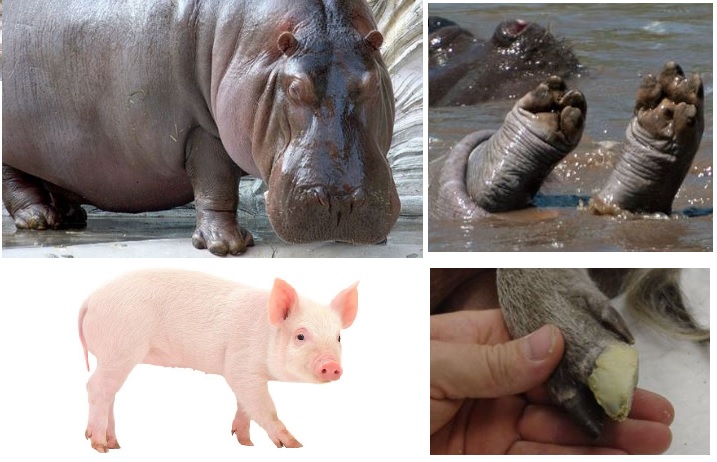
A famous problem was the case of the hippopotamus. A hippo has the same foot structure as a pig, and like a pig, does not chew its cud. (While it is herbivorous, eating mostly grass and aquatic plants, hippos have been noted to even eat meat on occasion.) A hippopotamus is thus a perfect example of another animal that has split hooves but does not strictly chew cud.

Hippo and Pig Hooves

Hippo and Pig Hooves

Despite this, people will still go out of their way to insist that the Torah’s four animals must be the only four. Some even suggest that the hippopotamus must really just be another type of pig! Of course, hippos are no more pigs than they are cows, or any other animal. In fact, today scientists know that hippos are most closely related to whales (and DNA analysis confirms this).

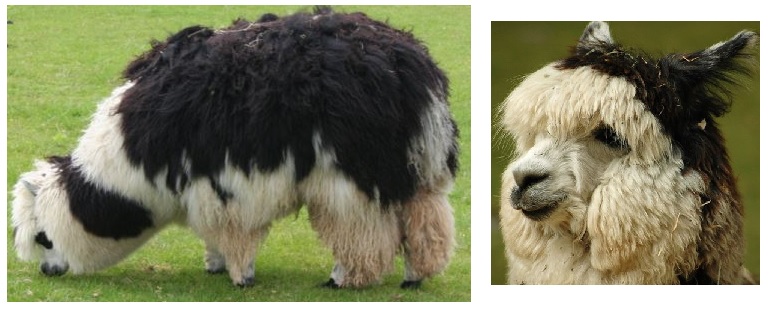
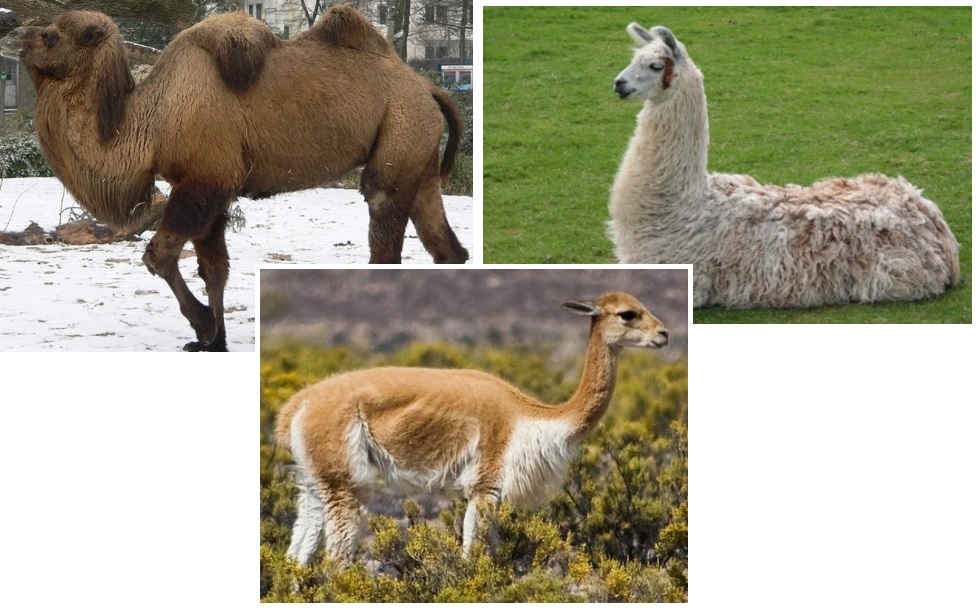
On the other side of the spectrum are the animals that chew cud but do not have fully-split hooves. The llama and alpaca are good examples. Once again, there are those that will insist these must be just another type of camel – even though they have wool, and no humps, are commonly used for their meat, and were once thought to be closer to sheep.

Huacaya Alpaca

Huacaya Alpaca

Some might argue that since camels and llamas are officially grouped by scientists in the same family of ‘camelids’, they can be thought of as being basically the same. In reality, a zoological ‘family’ could be a vast group with very different species. For example, donkeys and horses are in the same family, yet no one in Biblical times (or today) would consider them “the same”. In fact, a donkey has a totally different status in Judaism than a horse, and a firstborn donkey is required to be redeemed in Jewish law. No rabbi would permit a horse to be redeemed in place of a donkey!

Camelids: Bactrian Camel, Llama, and Vicuana

Camelids: Bactrian Camel, Llama, and the deer-looking Vicuna

Truth in Kiruv

At the end of the day, the debate over the four animals listed in the Torah matters very little. The Torah does not claim these are the only four animals, so there is no need to make that conclusion. The problem is when people do make that conclusion, then use it as a proof to convince others of the divinity of Judaism. Those victims might be convinced initially, then go on to do their own research and discover that the “proof” was actually false, which may then serve to push them away from Judaism altogether.

Besides, there are many more solid arguments from ancient Jewish literature that can be used instead. Here are a couple of much better ones:

בְּשַׁעְתָּא דִּסְתִימָא דְכָל סְתִימִין בָּעָא לְאִתְגַּלְּיָא, עֲבַד בְּרֵישָׁא נְקוּדָה חֲדָא, וְדָא סָלֵיק לְמֶהֱוֵי מַחֲשָׁבָה. צַיֵּיר בָּהּ כָּל צִיּוּרִין חָקַק בָּהּ כָּל גְּלִיפִין… וְרָזָא דָא, בְּרֵאשִׁית בָּרָא אֱלֹהִים. זֹהַר, דְּמִנֵּיהּ כָּלְהוֹ מַאֲמָרוֹת אִתְבְּרִיאוּ בְּרָזָא דְאִתְפַּשְׁטוּתָא דִנְקוּדָה דְּזֹהַר סְתִים דָּא

זוהר חלק א (בראשית) דף ב/א, טו/א

“When God began to create, He first made a singular point, with which he then formed all formations, and carved out all things… And the secret of ‘In the beginning, God created…’ [Genesis 1:1] is radiance [zohar], from which all Utterances were created, in the secret of the expansion of the point of radiance.”

The Zohar, a mystical commentary on the Torah first published in the 13th century (based on much older teachings) describes that creation began from a singular point of radiation that expanded to give rise to all things. This is precisely what science tells us today with the Singularity that spawned the Big Bang, and the cosmic expansion and cooling that followed, giving rise to all matter. (See ‘Torah on the Big Bang and the Age of the Universe’ here for more.)

The Zohar also tells us:

דהא כל ישובא מתגלגלא בעגולא ככדור, אלין לתתא, ואלין לעילא, וכל אינון בריין משניין בחזוויהו משנויא דאוירא, כפום כל אתר ואתר

זוהר חלק ג (ויקרא) דף י/א

“… The entire planet is rotating in a circle like a ball. There are people below, and people above, all different in appearance due to the different atmospheres of each land.”

At least seven centuries ago, the Zohar already taught that the Earth is spherical, and more significantly, that it is rotating (which scientists only confirmed in the 19th century – see Foucault’s 1852 pendulum experiment). The Zohar also states that despite the Earth’s spherical nature, people live above and below, without falling off the planet, and that people living in different lands have different features because of different environmental conditions, hinting at biological adaptation.

Credit: Dailygalaxy.com

Credit: Dailygalaxy.com