Tag Archives: Lubavitcher Rebbe

A Brief History of Red Heifers

This week’s double parasha (in the diaspora), Chukat-Balak, begins with a description of the purifying parah adumah, the “red heifer”. The Mishnah devotes an entire tractate, Parah, to explore the subject. It gives a short history of all the red cows that had been prepared up until that point (3:5). The first was, of course, prepared by Moses in the Wilderness. According to the Mishnah, this one jar of ashes lasted nearly a millennium, throughout the period of Judges and the entire First Temple era! (Only a pinch of red heifer ashes was needed to make a large amount of purifying liquid.)

The second red heifer was prepared by Ezra at the conclusion of the Babylonian Exile and the return of the Jews to the Holy Land. After that, there were seven more to span the Second Temple era. Shimon haTzadik, the last of the Great Assembly, prepared the third and fourth red cows. (For more on the identity of Shimon haTzadik, see ‘Who Was the First Rabbi in History?’) Recall that the Great Assembly, Knesset HaGedolah, was a council of 120 prophets and sages that helped to re-establish Judea following the Babylonian Exile. They are credited with canonizing the Tanakh, and putting together the first formal prayer texts of Judaism.

The fifth and sixth red cows were prepared by the kohen gadol Yochanan. He is an intriguing figure who, according to the Talmud, served as high priest for a whopping 80 years! (Berakhot 29a) Nonetheless, the Talmud uses him as proof for the teaching: “Do not be sure of yourself until you die!” This is because, despite serving as high priest for 80 years, Yochanan ultimately became a Tzduki, a Sadducee that denied the Oral Torah and rabbinic tradition.

The exact identity of Yochanan is subject to debate. According to Seder haDorot, he is the father of Matityahu, who was of course the leader of the Hasmonean revolt against the Seleucid Greeks and father of the Maccabees. When we say “Matityahu ben Yochanan” in our prayers, we are referring to this Yochanan. The Rambam, however, held that Yochanan Kohen Gadol was the son of Matityahu, who was probably named after his grandfather Yochanan. We know that one of the five sons of Matityahu was indeed named Yochanan. A third possibility, more in line with historical sources like Josephus, and with the Book of Maccabees, is that he was the son of Shimon, son of Matityahu. So, Yochanan Kohen Gadol is the same person as John Hyrcanus. (“John” and “Yochanan” are the same name.)

Coins minted by John Hyrcanus at the end of the second century BCE, with the Hebrew inscription: “Yohanan the High Priest, Council [or Leader] of Jews” (יהוחנן כהן גדול חבר היהודים)

The latter opinion makes the most sense. It explains why Yochanan would have to prepare a red heifer after the recapture and repurification of the Temple, which had previously been defiled by the Greeks. It also explains his unusually long tenure, because he would have served during the Hasmonean dynasty, which lasted about 100 years altogether. Moreover, we know that there was great conflict between the Pharisees and Sadducees precisely during the Hasmonean period, with King Alexander Yannai at one point persecuting and expelling the Pharisees, including the likes of his brother-in-law Shimon ben Shatach and contemporaries like Yehoshua ben Perachia. So, the Yochanan Kohen Gadol of the Talmud is most likely the High Priest John Hyrcanus of historical sources. And, because he served so long, he merited to prepare two red heifers.

See the video above to learn more about the fascinating era of Pharisees and Sadducees 

The next three red heifers were prepared by mysterious figures: Elyeho’enai ben HaKof, Hanamel the Egyptian, and Ishmael ben Piavi. The latter two seem to have been mentioned by Josephus. Hanamel is called Ananelus by Josephus, and he was appointed high priest by King Herod. He was replaced by a Yehoshua ben Piavi, which may be the same person as the Mishnah’s Ishmael ben Piavi. So, the last two red heifers were prepared in the time of King Herod (who reigned roughly between 37 and 4 BCE). This takes us pretty much to the end of the Second Temple era.

That leaves just one more, tenth, red heifer to the be prepared by Mashiach for the Third Temple. Although the Mishnah above doesn’t say that, the Rambam (Rabbi Moshe ben Maimon, 1138-1204) does in his Mishneh Torah, writing that “the tenth will be brought by the king Mashiach; may he speedily be revealed—amen, may it be God’s will!” (Sefer Taharah, Hilkhot Parah Adumah 3:4) The Lubavitcher Rebbe pointed out that the Rambam does not add a prayer for the coming of Mashiach anywhere else in the Mishneh Torah, not even in the Laws of Kings where he actually relays the halakhot of Mashiach! So, there is a particularly strong connection between the red heifer and Mashiach. It may be because Mashiach himself is thought to have a ruddy complexion, like King David his progenitor, or because some hold Mashiach will come from Edom, the “red” Western world, as per Isaiah 63:1 and other sources.

Another possibility is that the presence of a perfectly kosher red heifer in Israel would be an especially auspicious sign of Mashiach’s impending arrival. In recent years, a number of such red heifers have indeed been spotted. Jerusalem’s Temple Institute is always on the lookout for the ideal parah adumah, and has even sought to breed their own. Last year, five perfectly good red heifers were delivered to the Temple Institute from a farmer in Texas. So, we have the red heifers already. Now, all we need is Mashiach.

Shabbat Shalom!
Spiritual Tools for Israel’s Military Might

Today we celebrate Yom Ha’Atzmaut, the modern State of Israel’s Independence Day, which immediately follows Yom HaZikaron, when we commemorate those who have given their lives for Israel. Each one of those lost is an indescribable tragedy. Though Israel has won the majority of its wars, the price has been devastatingly high. We know that what happens in this material world is often just a reflection of higher realities occurring in the spiritual worlds. With that in mind, what can we all do spiritually to affect the worlds above, in order to strengthen Israel militarily here below? The Torah gives us four major tools that a Jew can do that will go a long way in boosting Israel’s might and, God willing, reducing casualties in war.

The first of these tools comes from this week’s parasha, Acharei Mot, which spends many lines describing the Yom Kippur service. Commenting on one of the verses here (Leviticus 16:12), the Ba’al HaTurim (Rabbi Yakov ben Asher, 1269-1340) points out that “in the merit of the Yom Kippur service, [the Israelites] would win wars.” Although we do not have a Temple today to fulfill all of the services, nonetheless our heartfelt prayers and repentance on Yom Kippur affect a change in the Heavens that result in Israel becoming militarily stronger and victorious in war.

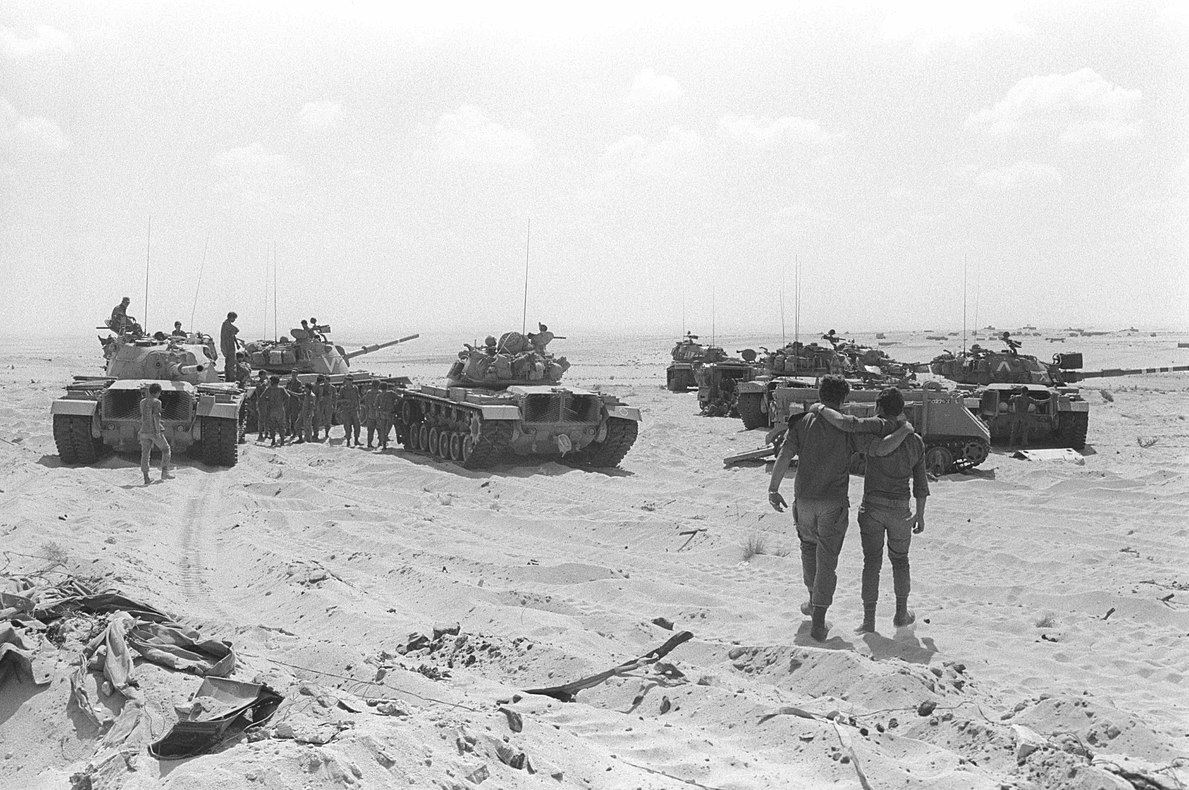
We see a perfect demonstration of this in the 1973 Yom Kippur War, when Israel was surprise-attacked by its Arab neighbours, totally unprepared and with most of its soldiers in the synagogues. The war initially went very badly, and military analysts even predicted the impending demise of Israel. Yet, things turned around quickly, and just two weeks later the war ended with a resounding victory for Israel. Henceforth, the Arabs never tried another invasion, and Egypt—the leading power in the Arab world—gave up any goals of destroying Israel, instead pursuing peace. The Arab armies thought that by attacking Israel on Yom Kippur they had a big advantage. The reality was the exact opposite! In the merit of Yom Kippur, Israel won the war and permanently altered the geopolitical landscape in the Middle East.

Six years earlier, before the similarly miraculous Six-Day War, the Lubavitcher Rebbe instituted another campaign to strengthen Israel militarily: encouraging the donning of tefillin. Ever since, Chabadnikim around the world go to street corners, supermarkets, bus stops and other public places to encourage Jewish men to wrap. Various reasons have been given for why the Rebbe chose tefillin specifically as a way to strengthen Israel. The main one is based on a passage in the Talmud (Rosh Hashanah 17a). Here, the Sages discuss an End of Days prophecy in Zechariah which states a third of the population will be purified “by fire”. The Sages say these are the rebellious people who sinned with their bodies. The Talmud further defines that when it comes to the gentiles, the ones who sinned with their bodies are those who engaged in sexual sins. When it comes to Jews, however, it refers to those who never put tefillin on their bodies!

Based on this, the Rebbe saw that there is tremendous merit in donning tefillin, and puts a Jew into a wholly different spiritual category once he has done so, even just once. Moreover, since the verse in Zechariah is talking about an End of Days prophecy about the final apocalyptic war before Mashiach’s arrival, the Rebbe saw further significance to our day and age, hence the message that we should increase the observance of tefillin. Indeed, the tefillin campaign was a huge success, as was Israel’s subsequent Six-Day War, with huge implications for the coming of Mashiach, since this is when Jerusalem and the Jewish heartland of Judea and Samaria were reclaimed and liberated.

I believe there is another proof for the tefillin-military might connection: In Berakhot 57a, we read that a person who dreams of himself in tefillin should expect greatness. This is based on Deuteronomy 28:10 which reads: “And all the peoples of the earth shall see that the name of God is called upon you; and they shall be afraid of you.” The Sages ask: what does it mean to have the “name of God” upon you? It means putting on tefillin, since this is when God’s Name is literally wrapped upon a person’s body! And, when the gentiles see a Jew in tefillin, it inspires a sense of awe and fear among them. So, just as Deuteronomy promises, when the Jewish nation carefully and diligently dons tefillin, it will inspire fear in our enemies.

Another segulah for reducing Israel’s casualties on the frontlines and beyond is the mitzvah of charity. This one is well-known and needs little elaboration, since the Tanakh emphatically states that tzedakah tatzil mimavet, “charity saves from death” (Proverbs 10:2). As explained in detail elsewhere (see ‘How Charity Can Save Your Life’ in Garments of Light, Volume One), providing a financial contribution to a worthy cause affects a change in the Heavens that can tear up a decree hanging over a person’s soul. This is because the money one earns is tied directly to the exertion they put in to earn that money, since a person invests their time, energy, and soul into their work. The Torah tells us that giving even a half-shekel serves as kofer nefesh, an atonement for the soul (Exodus 30:12). There is a beautiful mathematical proof to this in that the words shekel (שקל) and nefesh (נפש) have the same numerical value (430)!

Finally, the Torah states that if we are worthy, “Five of you shall chase away a hundred, and a hundred of you shall chase away ten thousand; your enemies shall fall before you by the sword.” (Leviticus 26:8) A classic question here is regarding the ratios: five chasing away a hundred is a ratio of 1 to 20, but a hundred chasing away ten thousand is a ratio of 1 to 100! What we can learn from this is that the more Jews are united and fighting together, the stronger we become. That strength does not just grow linearly, but exponentially! The message is that we must all be united. Instead of sinat hinam, baseless hatred and enmity, we must have ahavat hinam, baseless love and unity. This is our greatest source of strength.

Putting it all together, we have four key tools to increase Israel’s military and physical might: Yom Kippur, tefillin, tzedakah, and ahava. Amazingly, if we take the initials* of these terms (י כ ת צ א), they spell out כי תצא, as in כִּֽי־תֵצֵ֥א לַמִּלְחָמָ֖ה עַל־אֹיְבֶ֑יךָ וּנְתָנ֞וֹ יְהֹוָ֧ה אֱלֹהֶ֛יךָ בְּיָדֶ֖ךָ, “When you go out to war against your enemies and God will deliver them into your hand…” (Deuteronomy 21:10) There is no better proof than this that if we increase our observance of these crucial mitzvot as a nation, we will undoubtedly be invincible, and God will deliver all of our enemies into our hands.

Yom Ha’Atzmaut Sameach!


*If we take only the first initials of the four mitzvot above (without the kaf of kippur), we have יתצ״א, which carries a value of 501. This is a very significant number, too. At the Pesach seder, we group the Ten Plagues by their initials and recite דצ״ך עד״ש באח״ב. The great kabbalist Rav Shimshon of Ostropoli (d. 1648) taught that the value of this phrase is 501, equivalent to an angel named תק״א that facilitated the plagues and punished the enemies of Israel (see his Ma’amar Sod Eztba Elokim). Additionally, this is reminiscent of the “Angel of God” that struck down the Assyrian camp of 185,000 soldiers to protect Jerusalem in the time of King Hezekiah (II Kings 19:35).


From the Archives: The Kabbalah of Yom Ha’Atzmaut

Is There a Jewish Way to Dress?

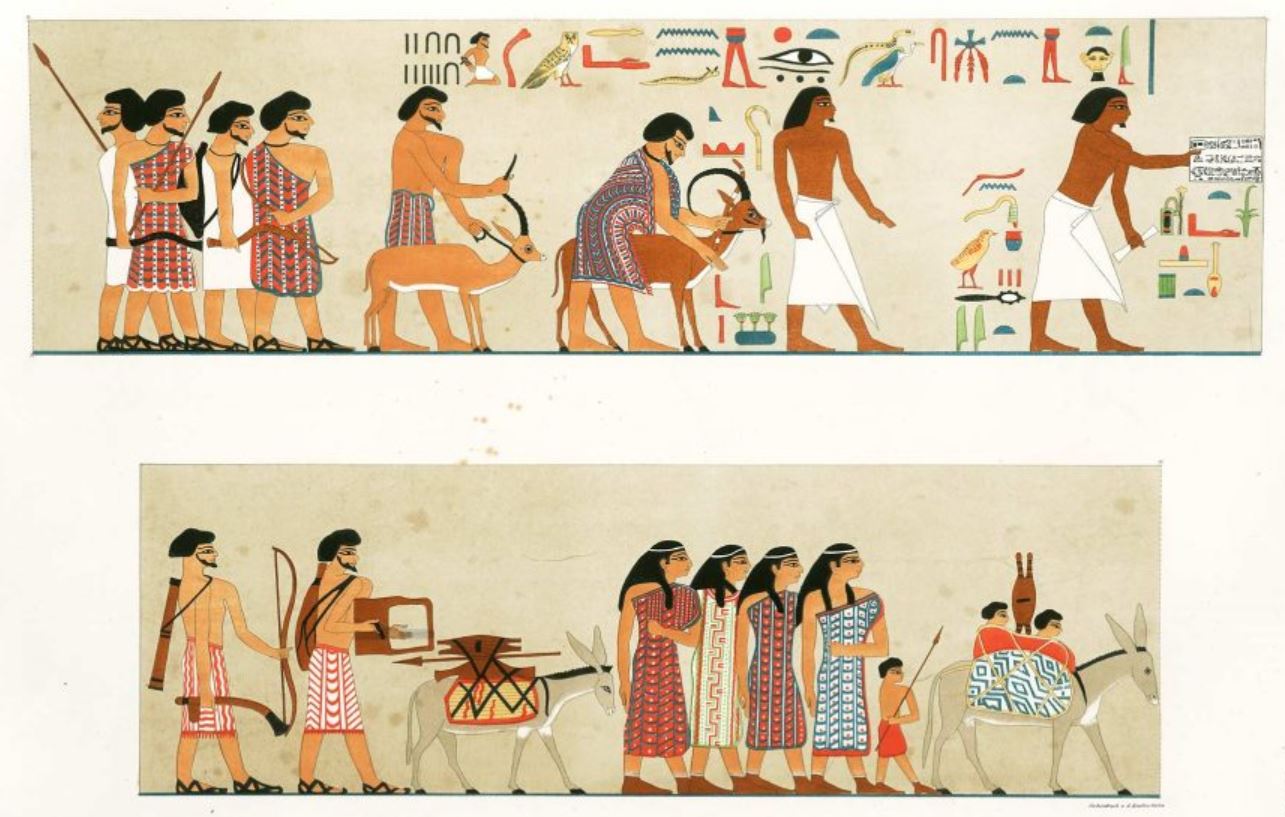
In this week’s parasha, Bo, the Israelites are finally freed from their subjugation in Egypt. We read that in their haste to leave, they bound up their unleavened dough in their garments (Exodus 12:34). Intriguingly, the very next verse says that the Israelites took from the Egyptians “silver items, gold items, and garments”. This is significant in light of the famous Midrash that the Israelites merited to be saved because they preserved three things throughout their long enslavement: their cuisine, their language, and their clothing (see Pesikta Zutrata on Ki Tavo, 46a).* In other words, the Israelites preserved their unique Hebrew foods (included in which is observing the mitzvah of not consuming the gid hanashe, which began with Jacob), their divine Hebrew language, and also their unique mode of dress. What was this dress, and how was it different from the garments of the Egyptians?

Egyptian tomb paintings at the Beni Hassan archaeological site depicting Semites migrating to Egypt.

Continue reading