Tag Archives: Mt. Sinai

What Are the Jewish People “Chosen” For?

This week’s very powerful Torah portion is Va’etchanan. In it, Moses continues his farewell speech to the nation before his death. Among other important points, he recaps the Ten Commandments, and proclaims the text of the Shema. Included in this speech are a number of significant prophecies and statements.

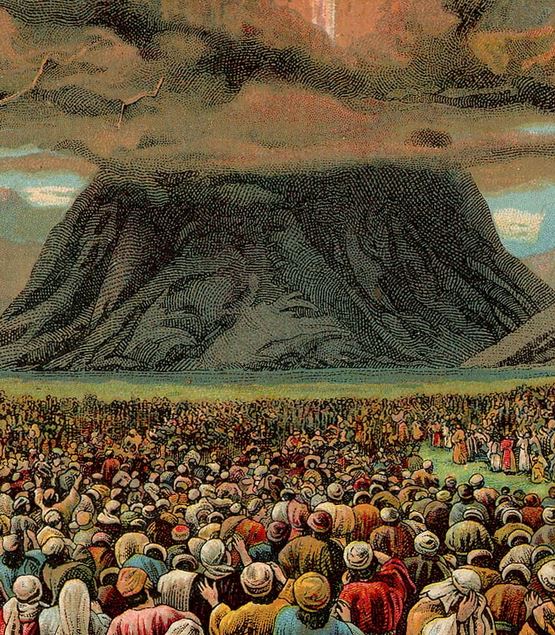
Moses reminds the people that what they witnessed at Mt. Sinai was a totally unique, once-in-history event, where God brought forth a divine revelation to the entire nation, with every single individual experiencing a prophetic vision. Moses tells us to always remember that this has never happened elsewhere in history (Deuteronomy 4:32-34). Although modern Biblical critics will immediately point out that there is no proof that such a national revelation ever took place, Moses tells us that no other people has ever even claimed such a thing! To this day, there is no nation or religion that claims to have started with a national revelation. Strangely, only the Jewish people make such a claim.

National Revelation at Sinai (Providence Lithograph Company, 1907)

A 1907 Illustration of the National Revelation at Sinai

(Although some point out that the Aztecs seem to have a similar story of their god guiding them through a Wilderness to their very own promised land in Mexico, most modern scholars agree that this myth is very recent, adopted from the Jewish story in the Torah. The Aztecs picked it up from Christian missionaries and made it their own.)

Another prophecy in this week’s portion is that the Jewish people will be scattered around the world, and will always remain small in number (4:27). Three thousand years later, the prophecy still holds true, with just 0.2% of the world’s population being Jewish. That’s quite amazing, as it defies normal growth patterns. There are roughly two billion Christians in the world, and their religion emerged over a thousand years after Judaism. The number of Muslims is also steadily nearing two billion, and they came around even later, roughly 1400 years ago. Hindus, Buddhists, Sikhs, and virtually all other major religions outnumber the Jews. Even the Bahai faith, which started just 160 years ago is quickly catching up, and will soon outnumber Judaism, too.

Moses suggests that it is precisely because we are small in number that God chose us (7:7). Perhaps this can be explained with simple economics of supply and demand. The more of something that there is, the less value it is perceived to have. (Note the word perceived; all human life is of course equal.) The sworn enemies of the Jews seem to agree: Hamas thought it was totally fair to demand 1000 Palestinians to be freed in exchange for one Jew – Gilad Shalit!

The big question is: why did God “choose” us?

The Chosen People

To understand why God chose the Jewish people, and what exactly we are chosen for, one must look back to the beginning of the whole story. Originally, there were no Jews and no Torah. There were only Adam and Eve, in a perfect world, living with God’s revealed presence. The problem of this “perfect” world was that Adam and Eve were essentially unable to truly enjoy it. Having never experienced anything “bad”, they had no concept of what is “good” either. Life was just bland.

In the middle of Eden, God placed the Tree of Knowledge of Good and Evil. By consuming of its fruit, Adam and Eve would be introduced to these new concepts. They would now have to experience hardship and confront evil, but measure for measure, they would now also be able to enjoy goodness and pleasure. After all, it is only because we have had negative experiences that we can truly understand, appreciate, and strive for the positive ones.

Adam and Eve had a choice. They chose the Tree of Knowledge. With that, their perfect world was over. However, this was only temporary. God’s intention was for mankind to live in a world of goodness, not one of suffering. Yet, in order to make the most of the Garden of Eden, mankind first had to experience evil, overcome it, and transcend it. Ever since Adam and Eve were banished from the Garden, their mission has been to remove evil from their midst, restore goodness, and finally return to that Garden.

Adam and Eve were unable to do this, and neither were their children, or grandchildren. As humans multiplied, they only become more and more sinful, pushing themselves further away from Godliness and goodness. After ten generations, God hit the “restart” button to try again with Noah. Noah ultimately failed as well, and once more each passing generation only fell further into immorality. It took another ten generations before things started to change.

Abraham’s Revolution

Abraham was the first person to properly recognize what the universe was all about. He understood that the current state of the world was wrong. Life was never meant to be this way. Abraham thus made it his life’s mission to repair the world. He travelled across the Middle East and spread monotheism, righteousness, and Godliness wherever he went. Abraham embodied all of the traits necessary to restore the world to a state of Eden. And so, it wasn’t so much that God chose Abraham, but rather, that Abraham chose God.

To complete the task of repairing the world would require more than just one man. This huge mission would require a nation. Thankfully, Abraham’s son Isaac continued in his father’s path, as did Jacob the grandson, and his own twelve sons. From these twelve sons an entire nation was born – a nation whose mission would be to restore the world to the Garden of Eden.

History shows that the Jewish people have indeed done so. The Jews’ moral contributions to the world have been vast, and described in books like Ken Spiro’s WorldPerfect – The Jewish Impact on Civilization and Thomas Cahill’s The Gifts of the Jews, among others. The Jews’ contributions to science, medicine, and technology may be even greater. Some of the most important minds behind breakthroughs like the personal computer and the internet, the cellphone and lasersvaccines and automobiles were Jews, as were some of the greatest figures in biology, chemistry, mathematics, and physics. It is also important not to forget the immeasurable spiritual contributions of the Jews to the world.

Of course, Jews are not perfect. The Torah itself attests to this many times, even in this week’s parasha that admonishes the nation on multiple occasions. At the end of the day, the name of our nation is Israel, which literally translates as “struggles with God.” Our history has been a difficult one, full of struggles and challenges. It is clear, though, that we are nearing the end of this period, and we will soon see the restoration of the Garden of Eden, as God originally intended.


The article above is adapted from Garments of Light – 70 Illuminating Essays on the Weekly Torah Portion and Holidays. Click here to get the book!

An Honest Look at the Film ‘Exodus: Gods and Kings’

This week we start a new book of the Torah, Shemot, known in English as ‘Exodus’. This volume is primarily concerned with the period of Israelite slavery in Egypt, and the subsequent salvation following the ten plagues and the Splitting of the Sea, climaxing with the revelation at Mt. Sinai, and the start of the transmission of the bulk of the Torah’s laws.

Coincidentally, not long ago was released Ridley Scott’s new film, Exodus: Gods and Kings, and I finally had a chance to see it this week. Though it appeared to show a little bit of promise at the start, the movie soon unravelled into a bizarre re-invention of the Biblical story. Of course, there is nothing wrong with some artistic liberties when adapting an ancient text for a modern film, nor is it too much of a problem to fill in some of the gaps in the Torah’s narrative. However, Exodus: Gods and Kings presented a completely twisted version that did not even slightly stick to the basic story of the Torah. It would take an entire tome to cover all the mistakes in the film, but perhaps we can offer just a few of the most blatant ones.

From the very beginning, we see that Moses seems to be completely unaware that he is not Egyptian. That’s quite odd: Semites and Egyptians had a totally different appearance. Take a look at this depiction of Semitic tribes, as discovered in the 12th dynasty tomb of Egyptian Khnumhotep II, official of the pharaoh Senusret II:

IbschaEgyptSemites

The Semites have a different skin tone, different hair styles, clothes, and so on. The filmmakers clearly knew this, as they show Moses bearded and sporting a nice hairdo, while all the other Egyptian royals are clean-shaven and bald. His eyes look different, and he wears clothes of a completely different style than all the others. How come? Didn’t he ever question why he doesn’t look anything like his “royal brethren”?

More importantly, the Torah clearly says that Moses was initially raised by his true birth mother, Yocheved (Exodus 2:7-9). Only after he was fully weaned did Yocheved present Moses to his new step-mother, the Pharaoh’s daughter (v. 10). It is totally inconceivable that Moses did not know he was a Hebrew! The Torah states that when Moses grew up, he “went out to his brothers and looked at their burdens” (2:11). He knew full-well that he was going out to his people.

At this point, when he saw an Egyptian taskmaster violently beating a Jew, he stepped in to save the victim, killing the Egyptian in the process. In the movie, this heroic act is replaced with an enraged Moses killing an Egyptian guard who was doing nothing terrible at all. The kind, compassionate Moses, described by the Torah as the humblest man that ever lived, is turned into a violent brute who kills indiscriminately. No wonder that Christian Bale, the actor who plays Moses, said of his character that he was “likely schizophrenic and was one of the most barbaric individuals that I ever read about in my life.” Makes sense if all he ever read about Moses was in the script for the film.

If Christian Bale did indeed read about Moses, perhaps he missed the whole part where Moses selflessly led his people for forty years in the wilderness. Where he literally sat from morning to evening to counsel the people and help them (Exodus 18:13). Or when he refused to abandon his people, even when God offered to make an entirely new nation out of Moses (Exodus 32:10). The many occasions where he convinced God to avert His just decrees and forgive the nation for their sins. The time where his sister Miriam transgressed severely against Moses, yet he did not hold even the tiniest of grudges or ill-will, and immediately prayed to God to heal Miriam and have mercy on her (Numbers 12:13). Or the simple fact that Moses led the revolution that brought monotheism (together with a higher sense of morality, starting with a set of Ten Commandments) to over two-thirds of the world’s population.

Worse than its depiction of Moses, though, was the film’s depiction of God: an irrational, pointlessly vengeful, literally childish figure. The film made it seem like the Ten Plagues were nothing more than God’s desire to kill as many people as possible. The reality, of course, was that the Ten Plagues were meant to be a measure-for-measure retribution for what the Egyptians had done; nothing more than cosmic karma. For example, just as the whole story begins with Pharaoh ordering the male-born to be drowned in the Nile, it ends with Pharaoh’s own male soldiers drowning in the Red Sea, measure for measure. Nor was God happy about any of this. The Talmud (Sanhedrin 39b) beautifully says that at the Splitting of the Sea, when the Egyptians drowned, the angels began to sing a joyous song, mimicking the Jews that were singing as well – but God immediately stopped them. He rebuked the angels, saying sadly: “My creations are drowning, and you are singing?”

When one studies the texts and commentaries, it becomes clear that each of the Plagues was specifically tailored towards the sins of the Egyptians, and was designed to bring the rightful justice that was due. Nowhere is this fact even hinted to in the movie. Most telling was after the plague of the firstborn, when Pharaoh confronts Moses demanding an answer as to why they suffered such a tragedy. The latter gives no logical reply, saying only that no Hebrews died. Perhaps the scriptwriter should have had something along the lines of: “Hey Pharaoh, did you forget all the countless babies that you slaughtered? Or the many warnings you were given that this was coming, and to stop your evil ways?” The scene almost makes Pharaoh seem like the victim, and Moses the villain. It appears that the main aim of the movie was to cast Moses (and God) in a bad light. It really seems like the filmmakers went out of their way to do this.

Moses is shown carelessly abandoning his family when he goes back to Egypt to save his people. His wife and son are angry, emotionally-scarred, losing their faith – and Moses does nothing about it. What was the point of making this shift from the Torah’s original version, which clearly states “Moses took his wife and sons, mounted them upon the donkey, and returned to the land of Egypt…” (Exodus 4:20)? He never abandoned his family, but took everyone with him!

It therefore appears quite evident that the purpose of Exodus: Gods and Kings was to turn one of the most beautiful and enduring stories into an ugly, twisted, and corrupt tale. The sheer number of mistakes is both inexcusable and inexplicable. One who wishes to experience a far truer (and more entertaining) version need only to open and read this week’s Torah portion.