
Tag Archives: New Testament

Should Jews Celebrate New Year’s?

On December 31st, much of the world’s population stays up past midnight to commemorate the start of the new calendar year. This event is considered to be the most widely-celebrated public holiday in the world. Yet every year, many Jews wonder if they should be participating in these celebrations. Some answer with a quick no, since January 1st is associated with the circumcision of Jesus (as it is the 8th day following Christmas, December 25th). Others may say yes, since, among other reasons, we all use the Gregorian calendar, and January 1st is simply a secular holiday, having lost any past religious affiliations. As is often the case, the truth lies somewhere in the middle.

Back to the Roman Calendar
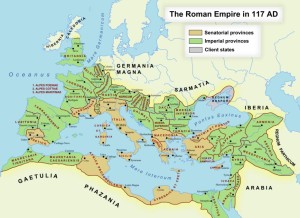
Roman Empire (Credit: Ancient History Encyclopedia)

Roman Empire (Credit: Ancient History Encyclopedia)

Today’s Gregorian calendar is based on the older Julian calendar, introduced by Julius Caesar. Historical records show that by the time of Julius Caesar, the Romans celebrated their new year on January 1st. In fact, “January” is named after the Roman god Janus, the deity of beginnings and ends, doors and gateways. Janus is always depicted as a double-headed god, with one head looking back into the past, and the other gazing into the future.

January 1st was also the start of the consular year in Rome, when the two highest-ranking elected officials, the consuls, took up their office for a single year term. From this information, we see that January 1st was already celebrated as a new year long before the time of Jesus.

Was Jesus Circumcised on the 1st of January?

Today, some Christian denominations still commemorate January 1st as the “Feast of the Circumcision”. The math is simple: if Christmas is the holiday of Jesus’ birth, then like all Jews he would have been circumcised on the eight day following his birth – January 1st. The question is: was Jesus actually born on the 25th of December?

Of course, many are aware of the fact that Jesus was certainly not born on the 25th of December. The New Testament does not mention the date of his birth at all, and suggests it was sometime in the summer, since it mentions people going to take a census (always done in the summer months), and that the shepherds were out watching their flocks (which they probably wouldn’t do in the cold winter nights of December). Early Christian leaders gave various dates to the birth of Jesus, ranging from March 28th to November 18th. Today, scholars believe it was likely the end of September.

Ironically, early Christian leaders actually mocked those who celebrated birthdays of any kind, especially that of Jesus, and considered it a pagan ritual. Alas, this is where Christmas actually comes from. Originally, December 25th was around the time of the pagan Roman holiday of Saturnalia. Later, it was also instituted as a holiday in honour of the birth of Sol Invictus, the solar deity. This comes from an ancient tradition to celebrate the “birth of the sun”, since the days start getting longer around this time of the year, hence the “solar rebirth”. To make Christianity more palatable to pagans, Christian leaders eventually switched “birth of the sun” to “birth of the Son”, ie. Jesus. And so, Jesus was not born on the 25th of December, and certainly wasn’t circumcised on the 1st of January.

(That is, of course, if Jesus had existed at all. More and more scholars are agreeing that Jesus probably never existed to begin with. Click here to read more about this.)

Celebrating the New Year on the 1st of January

Most European countries actually adopted January 1st as the start of a new year quite recently. The British Empire celebrated the New Year on March 25th until 1752! Similarly, many calendars continue to celebrate a new year sometime in the spring, including the Iranian, Assyrian, and several Indian calendars. Others have New Year’s days at other times, most famously the Chinese New Year in late January/early February. Nonetheless, most of these places, including China, also commemorate January 1st as the start of an international new year. Today, January 1st is definitely devoid of any real religious significance, and is perhaps the one truly global celebration. Having said that, it may still be tied to a historical bitterness for the Jewish people.

Sylvester’s Day

In several European countries, New Year’s Eve is called “Sylvester” or “St. Sylvester’s Day”. In Israel, too, December 31st is called “Sylvester”. This is the day of the passing of Pope Sylvester I, later canonized as a saint. Essentially nothing is known of this pope, though various legends arose over the centuries. Historical records suggest that it was during his reign that the Roman Emperor Constantine proclaimed the Edict of Milan which, among other things, stripped Jews of various rights and forbade them from living in Jerusalem.

Yet, Sylvester has nothing to do with New Year’s Eve itself; it is simply a coincidence of dates. Besides, many churches mark Sylvester’s Day on January 2nd, not December 31st. Either way, few people commemorate Sylvester’s Day at all, and most people have never even heard of it. (If Sylvester really was so bad for the Jews, maybe we should celebrate the day of his death!)

New Year’s in the Talmud

Amazingly, the Talmud (Avodah Zarah 8a) actually discusses New Year’s, calling it by its Roman name, Kalenda, or Kalends. The Mishnah here begins by listing it among the holidays of idol worshippers. However, it then goes on to explain that Kalenda originates in the Torah!

The Rabbis explain that following the consumption of the Forbidden Fruit, Adam soon noticed that the days were gradually getting shorter. (Since he was created on Rosh Hashanah – in the autumn – and consumed the Fruit that very same day.) Adam mistakenly thought that the days must be getting shorter because of his sin, and the world was descending into eternal darkness. He started to fast in repentance, and after eight days of fasting, the winter solstice came, and Adam noticed that the days were once again getting longer. In celebration, Adam established an eight-day feast (to balance out his eight-day fast). The following year, Adam commemorated both the winter solstice (around December 25th) and the day that marked the end of his eight-day feast (January 1st). The Talmudic sages conclude: “However, [Adam] established them for the sake of Heaven, but the [heathens] appropriated them for the sake of idolatry.”

So perhaps, if we have the sake of Heaven in mind, we may just be able to celebrate New Year’s in some way after all.
Yehoshua and the Origins of Christianity

This week’s Torah portion is Pinchas, named after the grandson of Aaron, who stemmed the tide of immorality that followed the Moabite and Midianite ploy to bring Israel to sin. For his efforts, God blessed Pinchas with an everlasting blessing of peace. In the past, we explored the nature of this blessing, and how it resulted in Pinchas’ apparent immortality, as well as his eventual rebirth as Elijah the Prophet. This week, we will explore another critical figure in the Torah: Yehoshua, better known as Joshua.

Midway through this week’s parasha we read how God commanded Moses to officially appoint Yehoshua as Moses’ successor. Yehoshua is described as a person within whom rests the spirit of God. Although there are a number of Torah figures who are described as possessing some sort of Divine Spirit, Yehoshua is one of only two who are described as having the spirit within them. In most cases throughout the Bible, the spirit of God is said to rest upon an individual (‘alav in Hebrew), or to have temporarily filled an individual (mal’e or timal’e in Hebrew). With regards to Yehoshua, it says that the spirit was within him. The only other person in the Torah who is described in such a way is Yehoshua’s direct forefather Yosef (Genesis 41:38).

An even more peculiar detail about Yehoshua is that he is called “Yehoshua bin Nun”. Every other person in the Bible is referred to by their name, as well as by their father’s name, with the designation ben – “son of” – in the middle. Yehoshua alone is called bin Nun instead of the regular ben Nun. Moreover, a person named Nun cannot be found anywhere in the Torah, and unlike most other Torah figures, Yehoshua’s genealogy is not given (although one is provided in the Book of I Chronicles, written many centuries after the Torah). Other than the fact that Yehoshua stems from the tribe of Ephraim, nothing else of his origins is divulged.

Out of a Fish

There happens to be an obscure Midrash that fills in some of the details about Yehoshua’s early life. There are a few variations of the story, with one particularly tragic version that seems to
mirror the Greek myth of Oedipus. According to this Midrash, Yehoshua was left by his parents, possibly placed in the Nile River like Moses was. Miraculously, a large fish swallowed him
up, and Yehoshua was later saved by fishermen. This is the meaning of bin nun, since nun means “fish” in Aramaic. Thus, Nun is not the name of his father at all, explaining why he is not
called ben Nun. Rather, bin Nun refers to his origins from the fish, with his true genealogy unknown.

In the controversial “Oedipus” version of the story, Yehoshua is saved by the Pharaoh’s fisherman, and thus grows up in the palace, becoming the court executioner. He tragically
ends up putting his own father to death, as was originally prophesized when Yehoshua was conceived (which is why his parents abandoned him to begin with). I prefer to think of it more in the style of Moses, where Yehoshua was placed in the Nile just as Moses was, to avoid the Pharaoh’s decree of slaughtering all the male-born. By also growing up in the palace, alongside Moses (though he would have been younger), the two would have been well-acquainted, and that might explain why Yehoshua is so close to Moses throughout the Torah narrative.

Whatever the case, Yehoshua grows up to be a holy man, the personal servant of Moses, one of just two righteous spies, and the leader that finally brought the people into the Holy Land. The Sages describe him as the moon to Moses’ sun, and the key link in the chain of Jewish Oral Tradition.

The Origins of Christianity

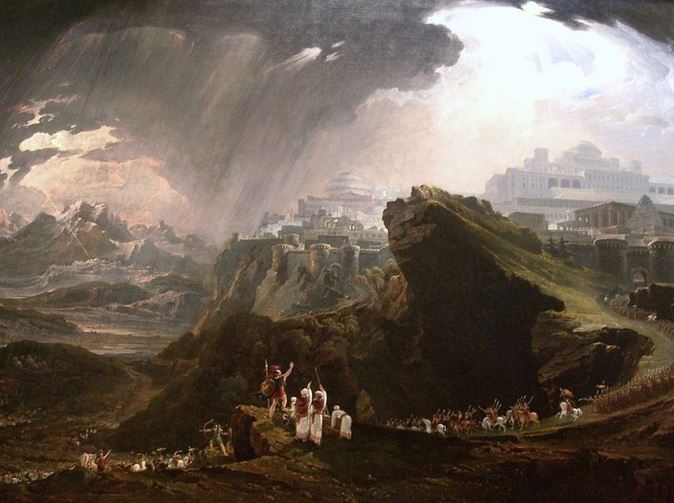
'Joshua Commanding the Sun to Stand Still upon Gibeon' by John Martin

‘Joshua Commanding the Sun to Stand Still upon Gibeon’ by John Martin

When looking at the life story of Yehoshua, it is hard to miss the connection to Christianity. Like Yehoshua, Jesus is a Jew said to have had a miraculous birth, spent time growing up in Egypt, and was described as having the spirit of God within him. Like Yehoshua, Jesus is symbolized by a fish, and is seen as a sort-of successor to Moses (as suggested by his supposed “Transfiguration”, where he ascends to be blessed by Moses and Elijah). In the same way that Yehoshua stems from Joseph, Jesus’ “earthly father” is said to be Joseph. Jesus is described as a miracle-worker, just as Yehoshua facilitated a number of miracles, such as making the sun and moon stand still at Gibeon, and stopping the flow of the Jordan River. Of course, Jesus’ original name as pronounced in his day was Yeshu, the Aramaic version of Yehoshua.

The similarities don’t end there. Strangely, the Torah makes no mention of Yehoshua’s wife or children (even the genealogy given in I Chronicles ends with Yehoshua himself). Jesus, too, failed to marry or have kids. The Talmud (Megillah 14b) suggests that Yehoshua did later marry Rachav, the harlot that assisted the Israelites in the conquest of the Holy Land. Rachav had repented and become a righteous woman. Similarly, Jesus had close encounters with Mary Magdalene, also described as a harlot, and also controversially rumoured to have possibly married Jesus!

It is important to remember that there is absolutely no evidence for the existence of Jesus outside of the New Testament. It is well-known that the New Testament was written long after Jesus would have lived, and is full of contradictions about the details of his life. Many have challenged the historicity of Jesus, with more and more scholars suggesting that he likely did not exist at all.

Considering all that, it isn’t hard to imagine how early Christians would have put together the mythology of Jesus based on previous Torah ideas and narratives: a miraculously-born baby with the spirit of God, whose very name means “salvation”; celibate and childless, a humble, Godly servant bringing others to repentance, and leading the Israelites to the Promised Land… This is the story of the Torah’s Yehoshua, and the story that was adapted to fit the mold of a new religion a couple of millennia ago.

The Jewish Sages did always view Yehoshua as a prototype of Mashiach. After all, he is the one that defeated the embodiment of evil known as Amalek, and the one that ended the exile of the Jews, returning the people to their land. So, it isn’t surprising that Christians used Yehoshua as a prototype for their own supposed Messiah. Ironically, though, not only did Jesus fail to defeat evil, and fail to bring an end to the exile, he was also indirectly responsible for inspiring the murder of countless people thanks to all the holy wars, inquisitions, and crusades fought in his name. Jesus’ own message may have been peace, but his followers used him incessantly for war and bloodshed. Two millennia have passed, and the world is still far from perfect. We continue to await the arrival of the true Messiah. May we all merit to see his coming soon.


The article above is adapted from Garments of Light – 70 Illuminating Essays on the Weekly Torah Portion and Holidays. Click here to get the book!