Tag Archives: Rabbi Akiva

Sefer Yetzirah and the 32 Paths of Creation

The first chapter of the Torah famously describes God’s creation of the universe. Although the text is quite brief, our Sages had much to say about the events of Creation. This is an especially important topic in Kabbalah, traditionally divided into two main headings: Ma’ase Beresheet, “the Work (or Narrative) of Creation”, and Ma’ase Merkavah, “the Work (or Narrative) of the Chariot”. The former explores the genesis and nature of the universe, along with a host of metaphysical concepts, while the latter is primarily focused on various aspects of God, and the mechanism of prophecy.

One of the most ancient Kabbalistic texts is Sefer Yetzirah, the “Book of Formation”. This book outlines in more detail how God created the universe. Since the Torah tells us that God created the world by speaking it into existence (“God said, ‘Let there be light…’”), it is taught that the building blocks of the universe are the very letters of the Hebrew alphabet. Everything that exists was fashioned out of unique combinations of these special letters.

Along with the 22 letters were the Ten Sefirot, divine energies that imbue everything within Creation. These Sefirot are sometimes said to parallel the 10 base numerical digits, from 0 to 9 (the word sefirah also means “counting”). Just as modern physicists might argue that the entire universe can be reduced to mathematical equations, Sefer Yetzirah reduces all of Creation down to these foundational numbers and letters. And so, Sefer Yetzirah begins by stating that God created the universe through lamed-beit netivot, thirty-two paths.

The Power of Sefer Yetzirah

Sefer Yetzirah is first explicitly mentioned over 1500 years ago in the Talmud (Sanhedrin 65b), where Rabbi Chanina and Rabbi Oshaia studied it together on Friday afternoons. Using the secrets described in the text, the two rabbis apparently learned how to create ex nihilo, like God. Each Friday, they would team up to create a calf out of thin air—and eat it!

It is said that the patriarch Abraham was capable of the same feat. In the well-known narrative of the three angels visiting Abraham, we read how Abraham “took butter and milk, and the calf which he had made, and set it before them…” (Genesis 18:8). Many have asked: how is it possible that the forefather of the Jewish people gave his guests a mixture of dairy and meat products? The simplest answer is that, of course, Abraham preceded the giving of the Torah and at that time there was still no prohibition on consuming dairy and meat together. However, Jewish tradition maintains that although the forefathers lived before the giving of the Torah, they still fulfilled its precepts through an oral tradition, and from the prophecies they received directly from God. So, how did Abraham put both dairy and meat before his guests?

The Malbim (Rabbi Meir Leibush ben Yechiel Michel Wisser, 1809-1879) comments on the verse by citing earlier mystical teachings that say Abraham knew the secrets of Sefer Yetzirah and fashioned the calf from scratch! This is why the verse clearly says “…and the calf which he had made [asher asah]”. Since Abraham made the calf, it was only a hunk of flesh with no divine soul (which only God can infuse), and was therefore pareve, neither dairy nor meat. In fact, many believe that Abraham was actually the author of Sefer Yetzirah. Others maintain that it was written by Rabbi Akiva, based on teachings that were initially revealed by Abraham.

A Brief Overview of the 32 Paths

Where exactly are the 32 Paths of Creation derived from? A careful analysis of the Genesis text shows that God (Elohim) is mentioned 32 times in the account of creation. Each of these 32 parallels the 32 paths. There are ten cases where the Torah says vayomer Elohim, “And God said…” in the first chapter. These 10 correspond to the Ten Sefirot. The remaining 22 mentions of God correspond to the 22 letters in the following way:

Sefer Yetzirah breaks down the Hebrew alphabet into three groups: the “mothers” (ima’ot), the “doubles” (kefulot), and the “elementals” (peshutot). There are three mother letters: Aleph (א), Mem (מ), and Shin (ש). These are the “mothers” because each is associated with one of the three primordial elements of Creation: Aleph is the root of air (avirאויר), Mem is the root of water (mayimמים), and Shin is the root of fire (esh, אש). These three correspond to the three times that the Torah says “God made” (Genesis 1:7, 16, and 25).
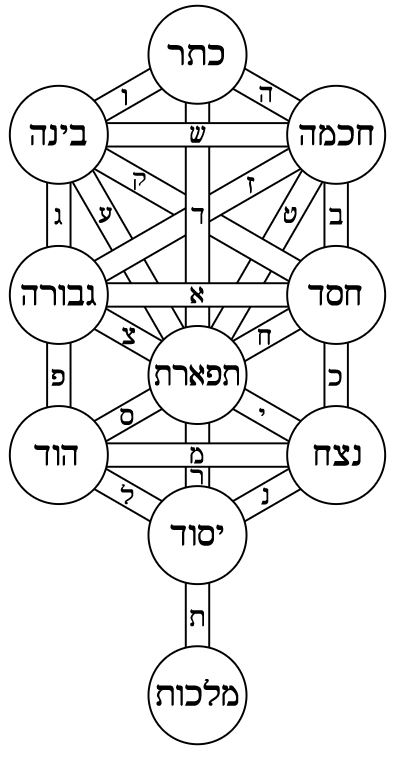
The “Tree of Life” depicting the Ten Sefirot, intertwined by the 22 Letters of the Hebrew Alphabet. Together, they make up the 32 Paths of Wisdom.

There are then 7 “doubled” letters, those that have two sounds in Hebrew:  Beit (ב), Gimel (ג), Dalet (ד), Khaf (כ), Pei (פ), Reish (ר), and Tav (ת). The double sounds of beit and veit, khaf and haf, pei and phei are well-known to us today, while the other four are a little more mysterious (see below on parashat Noach, ‘Shabbat or Shabbos: What’s the Correct Pronunciation?’)  The seven kefulot correspond to the seven times that the Torah says “God saw” (Genesis 1:4, 10, 12, 18, 21, 25, 31). The remaining 12 letters, the peshutot, correspond to the remaining 12 times that God is mentioned.

To summarize, the 32 paths derive from the 32 times that God is mentioned in Genesis, and further broken down into their groupings of 10, 3, 7, and 12 based on the specific type of verb used in relation to God.

Finally, all of these are embedded in the most famous of Kabbalistic diagrams, the Etz Chaim, “Tree of Life”. The 10 circles on the diagram correspond to the Ten Sefirot. The Sefirot are interconnected by 22 lines, corresponding to the 22 letters. There are three horizontal lines, corresponding to the three mother letters; seven vertical lines, corresponding to the seven doubled letters; and twelve diagonal lines, corresponding to the twelve elemental letters. This simple diagram amazingly captures a great deal of information, and is a key tool in Kabbalah—as well as the first step towards creating your very own calf!


The above is an excerpt from Garments of Light, Volume Two. Get the book here

The Hidden History of Lag B’Omer

This week’s Torah reading is Emor, which begins with a continuation of various priestly and Temple-related laws. The parasha then lists all of the Biblical holidays, starting with the weekly Sabbath, then Passover, Shavuot, Rosh HaShanah, Yom Kippur, Sukkot, and Shemini Atzeret. The holidays of Chanukah and Purim are Rabbinically-instituted, having occurred long after the events of the Torah were complete (although it is important to note that the Torah does allude to those future events, too).

It is here in this week’s parasha that we are also commanded to count the 50 days between Passover and Shavuot, the period known as Sefirat HaOmer (the meaning of which we have explored in the past; see ‘The Spiritual Significance of Sefirat HaOmer‘). There are a number of important dates that fall during the Sefirat HaOmer period. Perhaps the most well-known of these is Lag B’Omer, which literally means “the 33rd day of the Omer” (Lag, ל”ג is the Hebrew designation for the number 33). This festive holiday is marked with lighting bonfires, playing with bows and arrows, and taking a break from the usual mourning customs of the Omer period.Bonfire

The basic story of Lag B’Omer is that during the first 32 days of the Omer period nearly two thousand years ago, a plague decimated Rabbi Akiva’s 24,000 students. All of his students died, hence the mourning customs still observed today to commemorate that tragic event. The plague ended on the 33rd day of the Omer, which is why the mourning rituals are now lifted.

The big question is: why were Rabbi Akiva’s students punished with a plague? What had they done to deserve this? The Talmud (Yevamot 62b) says that apparently these 24,000 students failed to love and respect one another. However, this immediately begs a whole bunch of other questions.

First of all, it was Rabbi Akiva who taught that the greatest principle of Torah is to love your fellow (TY Nedarim 9:4). Could it really be that Rabbi Akiva’s own students failed to uphold their master’s central teaching? And if it really was the case that these students didn’t love or respect each other, then they really weren’t very righteous people, so why are we so fervently mourning their deaths? Throughout history, there have been much greater numbers of much greater people who have perished, yet we do not mourn for such a lengthy period of time for any of them!

What’s Really Going On?

The Talmud (TY Ta’anit 24b) tells us that Rabbi Akiva was a central supporter of Shimon Bar Kochva during the Bar Kochva Revolt (132-136 CE), also known as the Third Roman-Jewish War. Bar Kochva was initially very successful against the Romans, and it seemed like the Jews would be able to throw off the yoke of the Roman authorities, and rebuild the Temple (after it was destroyed by the Romans around 70 CE). Not surprisingly, Rabbi Akiva went so far as to declare Bar Kochva as the Messiah! After all, the major role of Mashiach is to secure Israel’s borders, end the exile, and rebuild the Temple – which Bar Kochva seemed to be doing. Rabbi Pinchas Stolper has written that Bar Kochva’s army may have reconquered Jerusalem on Lag B’Omer itself (hence the holiday), and began the reconstruction of the Temple on that day. In fact, the Third Temple was nearing completion when Rabbi Akiva announced the messiahship of Bar Kochva.

Unfortunately, Bar Kochva’s power got to his head, and it seems that he became a violent dictator, even killing his own uncle, Rabbi Eleazar haModa’i. Soon, his armies fell to the Romans, who brutally quashed the rebellion. The Romans went on a killing spree, massacring countless people in Judea. One of their victims was Rabbi Akiva himself, who was tortured to death with iron combs (Berachot 61b).

It isn’t hard to imagine that Rabbi Akiva’s students were killed in a similar fashion, during this tragic time period. The “plague” that took their lives was the Romans, and the war ended on Lag B’Omer. Indeed, one explanation for why we light bonfires on Lag B’Omer is to commemorate the Bar Kochva war, when the Jewish guerilla warriors would light signal fires to each other. It may also explain why there is a custom to this day to play with bows and arrows – implements of war.

So why would Jewish texts say that Rabbi Akiva’s students died in a plague? It wasn’t uncommon in those days for the secular authorities to censor various texts. Perhaps the Romans, in a propaganda effort, forbid the Jews from publicly speaking about the real reasons for the deaths of the 24,000. Others suggest that it was the Sassanians, under whose domain the Talmud was completed, that censored the text to discourage Jews from rebelling against Sassanian authority (as they had rebelled against Rome so many times and so devastatingly). The Rabbis therefore had to encode the real history of Lag B’Omer through indirect means, like bonfires and bows and arrows. Maybe this is why they said that Rabbi Akiva’s students died out of failure to respect one another. They knew that such a statement would immediately set off alarm bells, for this is probably the last thing Rabbi Akiva’s students would fail in.

Many scholars of the past, both religious and secular, have explored this possibility in depth, including Rav Sherira Gaon, Nachman Krochmal, Eliezer Levi, and Rabbi Isaac Nissenbaum, as well as Rabbi David Bar-Hayim and others in modern times.

Rashbi and Kabbalah

Ultimately, the story ends with a small number of Rabbi Akiva’s students – some say five, others a little more – surviving “the plague”, and going on to re-establish Judaism, saving it from extinction. One of those students was Rabbi Shimon bar Yochai (also known as Rashbi). The Talmud (Shabbat 33b) is explicit in telling us that he hid from the Romans in a cave for 13 years, together with his son, surviving off of a carob tree. This is yet another piece of evidence suggesting Rabbi Akiva’s students were killed by the Romans, and not in a plague.

It was Rabbi Shimon who was first to publicly reveal the mystical teachings of Kabbalah. It is said that he did this to his own students on the day of his death – which was the 18th of the month of Iyar, and the 33rd day of the Omer. The central book of Kabbalah, The Zohar, which was first published in the 13th century, originated with Rabbi Shimon bar Yochai and those teachings that he revealed. According to tradition, those Kabbalistic teachings were so holy and powerful that when Rabbi Shimon expounded on them on that day of his death, the very house in which he and his students were in appeared to be engulfed in flames. This is another reason for lighting bonfires on Lag B’Omer.

Rabbi Shimon told his students not to mourn his death, for it was a happy occasion: the deepest of spiritual and mystical secrets were now revealed, and would help to preserve the Jewish religion and nation for centuries to come.


The article above is adapted from Garments of Light – 70 Illuminating Essays on the Weekly Torah Portion and Holidays. Click here to get the book!