
This week’s parasha is Bechukotai, infamous for its long list of curses. Tragically, we find that all of those curses have been realized in Jewish history. And yet, we also find that out of each catastrophe comes tremendous blessing. God declares that although He will punish the nation, He “will not despise them nor reject them” for the covenant is everlasting. The punishment serves only as retribution, middah k’neged middah, “measure for measure”, but it also has a deeper purpose to bring forth renewed life. Let’s take three examples from the past two millennia to demonstrate this phenomenon. Continue reading
Tag Archives: Reincarnation
Yosef haTzadik and Shimon haTzadik—What’s the Connection?
This week we read Miketz, which continues to narrate the rise of Joseph. Of all the Biblical figures, Joseph alone carries the unique title haTzadik, “the righteous one”. We refer to the Patriarchs with the title Avinu, “our father”; to Moses as Rabbeinu, “our teacher”, and to his successors as haNavi, “the prophet”. Joseph stands apart as being Yosef HaTzadik. Certainly, all of the great Biblical figures were righteous, yet only Joseph carries the title.
At the same time, of all the Rabbinic figures, one is typically referred to as HaTzadik, and that would be Shimon HaTzadik, “the last of the Men of the Great Assembly” (Avot 1:2). Shimon might be considered the first or earliest Talmudic sage. The era of Zugot, “pairs” begins with him (and his student, Antigonus of Socho). His generation represented the transition from the era of Prophets to the era of Sages. So, we have two figures called “HaTzadik”, one Biblical and one Rabbinical. We know that in Judaism there are no coincidences. So, what’s the connection? Continue reading
How Abraham Was Rectified in Solomon
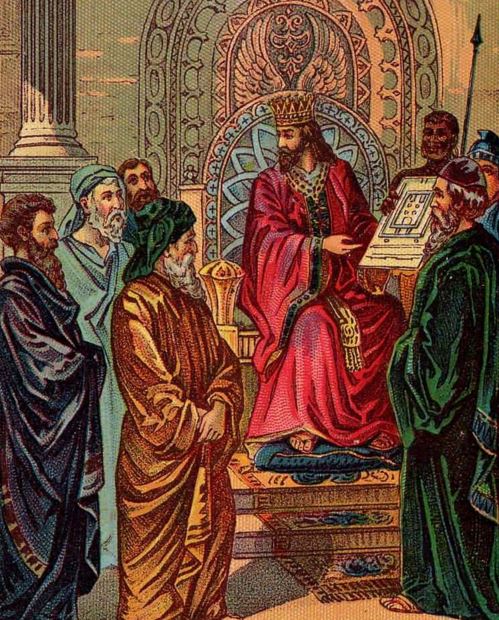
1896 Illustration of King Solomon Drafting the First Temple
In this week’s parasha, Chayei Sarah, we read about the final years of Abraham’s incredible life. Following this, we read the Haftarah which explores the arrangements made for the ascendance of King Solomon to the throne. We know that the Sages carefully selected the Haftarot due to their intrinsic connection to the parasha. A superficial look might suggest that the Haftarah for Chayei Sarah was chosen because it begins with King David being described as “old, advanced in days” (I Kings 1:1) exactly as Abraham is described in Chayei Sarah (Genesis 24:1). However, the Haftarah is not really about David, it is about Solomon and his status as the rightful heir to the throne.
What does Solomon’s kingship have to do with Abraham’s life? At first glance, they seem to be completely unrelated. Yet when we look carefully, we find some stunning connections between Abraham and Solomon. In fact, it quickly becomes clear that Solomon was the reincarnation of Abraham, and fulfilled the life of the first patriarch. Continue reading