
Tag Archives: Torah Scholars

The Spiritual Significance of Fruits

This Sunday evening brings Tu b’Shevat, the “New Year for Trees” and the start of a new agricultural and fruit-tithing season. Fruits play a huge role in Judaism, starting right at the beginning of the Torah with a special double-blessing on Day Three of Creation when fruit-bearing trees emerged. Then comes the Forbidden Fruit of the Tree of Knowledge, setting in motion all of history as we know it. The importance of fruits carries over into the Talmud, where the Sages teach that a Torah scholar should not live in a place that does not have a wide variety of fruits! The passage (Sanhedrin 17b) begins like this:

וְתַנְיָא: כׇּל עִיר שֶׁאֵין בָּהּ עֲשָׂרָה דְּבָרִים הַלָּלוּ אֵין תַּלְמִיד חָכָם רַשַּׁאי לָדוּר בְּתוֹכָהּ: בֵּית דִּין מַכִּין וְעוֹנְשִׁין, וְקוּפָּה שֶׁל צְדָקָה נִגְבֵּית בִּשְׁנַיִם וּמִתְחַלֶּקֶת בִּשְׁלֹשָׁה, וּבֵית הַכְּנֶסֶת, וּבֵית הַמֶּרְחָץ, וּבֵית הַכִּסֵּא, רוֹפֵא, וְאוּמָּן, וְלַבְלָר, וְטַבָּח, וּמְלַמֵּד תִּינוֹקוֹת. מִשּׁוּם רַבִּי עֲקִיבָא אָמְרוּ: אַף מִינֵי פֵירָא, מִפְּנֵי שֶׁמִּינֵי פֵירָא מְאִירִין אֶת הָעֵינַיִם

And it is taught: A Torah scholar is not permitted to reside in any city that does not have these ten things: A court that has the authority to flog and punish transgressors; and a charity fund for which monies are collected by two people and distributed by three. And a synagogue; and a bathhouse; and a public restroom; a doctor; and a craftsman; and a scribe; and a ritual slaughterer; and a teacher of young children. They said in the name of Rabbi Akiva: The city must also have varieties of fruit, because fruits illuminate the eyes.

It’s easy to see how the ten requirements neatly parallel the Ten Sefirot: a charity fund is Chessed, while a beit din is Gevurah (or Din). A doctor (rof’e) is tied directly to Tiferet, the root of balance and healing. A beit knesset is a place to connect and communicate with the Eternal One, Netzach. The bathhouse is tied to the Sefirah of Hod (as explained in detail in the recent class on health). Today’s equivalent of the Roman bathhouses they used to have in Talmudic times is probably something like a country club or fitness room (with amenities like pool, sauna, and hot tub). A restroom corresponds to Yesod for obvious reasons. Thankfully, we live in an age where there are restrooms everywhere, including in our own homes. A craftsman who can construct things ties to the “kingdom” of Malkhut. (In fact, numerically, the value of “craftsmanship”, אמנות, is 497, one more than Malkhut, מלכות, which is 496.) Rashi says that “craftsman” here is referring to a bloodletter (also discussed in the same class on health linked to above). Kabbalistically, blood parallels the lowest level of soul, the nefesh, which parallels Malkhut.
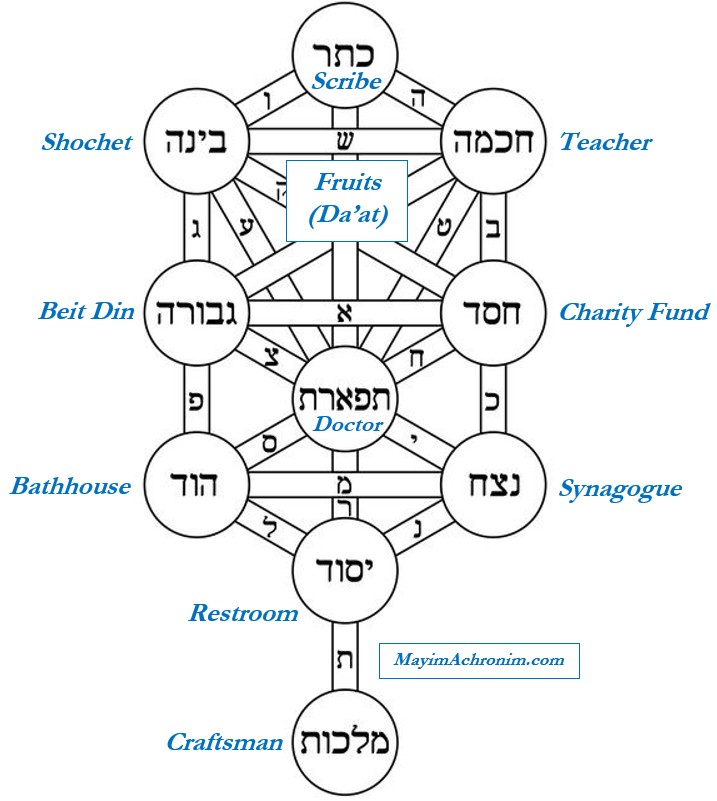
The remaining three correspond to the upper three Sefirot, the Mochin. The shochet to Binah (since he must be both God-fearing and Torah-learned, but also knowledgeable in the biology and physiology of the animals), the teacher to Chokhmah (as his job is to spread wisdom and educate others), and the scribe to Keter (for reproducing the Word and Will of God). Then Rabbi Akiva adds an eleventh requirement, which is appropriate since there is a hidden “eleventh” Sefirah, too, the opposite face of Keter, called Da’at. The requirement corresponding to Da’at is having fruits, fittingly reminding us of the Etz haDa’at, the Forbidden Fruit of the Tree of Knowledge. The big question is: why are fruits so important that they are a fundamental requirement for a Torah scholar?

The simple answer that Rabbi Akiva gives is that fruits are good for the eyes. Indeed, fruits are very nutritious and have things like vitamin A (retinol) which is helpful for vision, as well as different pigments that help with eye health. Today we know that carotenoids (which give fruits and vegetables their yellow and orange colours) protect the eye’s retina, while anthocyanins (which make fruits and flowers blue or purple) have been shown to boost rhodopsin proteins which allow one to see. Evidence suggests that both lycopene (the red pigment) and vitamin C reduce cataracts, the leading cause of blindness. So, modern science confirms Rabbi Akiva’s teaching. And it’s all the more important for Torah scholars to have good vision since they spend so many hours a day pouring over books and fine print.

Fruits are also important for Jewish practice, and are intricately tied to the Jewish calendar. We need various fruit and tree varieties for Rosh Hashanah simanim, and for the four species of Sukkot; to fulfil mitzvot like orlah and bikkurim, to recite a bor’e pri ha’etz blessing, to make charoset for Pesach, and to conduct a proper Tu b’Shvat seder. So, of course, having access to fruit is absolutely vital for a Torah scholar. That said, how can we understand Rabbi Akiva’s teaching on a deeper level?

Rabbi Akiva says that fruits are meirin et ha’eynaim, “illuminate the eyes”. This is a clear allusion to the Garden of Eden, where the Serpent told Eve that if she eats of the Fruit, “your eyes will be open and you will become like Elohim” (Genesis 3:5). The next verse says that Eve now saw that the Fruit was good to eat and “desirable for the eyes”. And the following verse says that once Adam and Eve consumed the Fruit, “the eyes of both of them were opened”. There is a constant repetition of “opening eyes” in relation to the Fruit, taking us right back to Rabbi Akiva’s teaching of fruits being good for opening one’s eyes. Because, ultimately, what is the purpose of the Torah scholar? The goal is cosmic tikkun, rectification, restoring the world to its primordial holy state, as it was in the Garden of Eden. That means reversing the “primordial sin” of the Forbidden Fruit—and the curses that came about as a result—and recreating a reality where Hashem is openly revealed.

So a Torah scholar needs ten things to facilitate this work and to accomplish that ultimate goal. What follows is “illuminating” one’s eyes as it was originally for Adam and Eve, where they could see Hashem openly revealed and communicate with Him directly. Recall that Rabbi Akiva’s primary disciple, Rabbi Meir, taught that Adam and Eve were originally clothed with “garments of light” (כׇּתְנוֹת אוֹר), and only after did that get replaced with “garments of skin” (כׇּתְנוֹת עוֹר), or “garments of leather” (3:21). Rabbi Akiva specifically uses the expression meirin et ha’eynaim, reminding us of Rabbi Meir’s teaching about being able to see the divine light openly revealed. This is the world we are working towards—and something deeper to meditate on as we consume our illuminating Tu b’Shevat fruits.

Chag Sameach!  
Every Jew is a Tzadik

What did Isaiah mean when he described the entire nation of Israel as “righteous” and inherting the World to Come? What can a person do to guarantee their place in the World to Come? Which sins of a person actually count in the Heavenly Court? And how can we stimulate more love and unity among our people to bring about the Final Redemption?

Can a Husband and Wife Speak Lashon HaRa To Each Other?

This week’s parasha, Metzora, is primarily concerned with the laws of various skin diseases. Jewish tradition holds that the main reason for a person to contract these skin afflictions is for the sin of evil speech. The term metzora, loosely translated as “leper”, is said to be a contraction of motzi ra or motzi shem ra, “one who brings out evil” or gives someone a “bad name”. The Sages described lashon hara, a general category referring to all kinds of negative speech (even if true), as the gravest of sins.

The Ba’al HaTurim (Rabbi Yakov ben Asher, 1269-1343) comments on the parasha (on Leviticus 13:59) that the word “Torah” is used in conjunction with words like tzaraat or metzora five times, alluding to the fact that one who speaks lashon hara is likened to one who has transgressed all five books of the Torah! The Talmud (Arakhin 15b) famously states that one who speaks lashon hara “kills” three people: the subject of the evil speech, the speaker, and the listener. The same page states that lashon hara is equal to the three cardinal sins: murder, idolatry, and adultery. Other opinions (all supported by Scriptural verses) include: one who speaks lashon hara is considered a heretic, deserves death by stoning, and God personally declares that He and the speaker of lashon hara cannot dwell in the same space.

Having said that, the Talmud’s definition of lashon hara is quite narrow. It doesn’t include general tale-bearing, but specifically refers to slandering another person. It also states that lashon hara is only applicable when two people are speaking in private, secretly. If one slanders before three or more people, then it is evident that he doesn’t care that the subject will know he said it. It is like saying it publicly, or to the person’s face directly, which does not constitute lashon hara. (It is still a horrible thing to do, of course.) This is why God says (Psalms 101:5) that “Whoever slanders his fellow in secret, him I will destroy.” It is specifically when done in secret that it is such a terrible, cowardly sin.

Since Talmudic times, the definition of lashon hara has broadened considerably. It has come to include rechilut, “gossiping”, saying negative things about another person that are true, saying them publicly, and even to suggest or imply something disparaging about another, without naming a person specifically. When it comes to gossiping, one can find an allusion to its severity from the Torah itself, which states “You shall not go as a talebearer among your people, neither shall you stand idly by the blood of your fellow” (Leviticus 19:16). In a single verse, the Torah juxtaposes gossiping with failing to prevent bloodshed. One can learn from this that one who listens to gossip (specifically where another person is spoken of unfavourably) without trying to stop it is like one standing idly while the “blood” of another is being shed.

One question frequently asked about this is whether lashon hara applies between a husband and wife. We saw that the Talmud states lashon hara is especially horrible when spoken in secret between two people. Does this include a married couple as well? On the one hand, we want to distance ourselves from negative speech as much as possible, at all times. On the other hand, we expect a married couple to be allowed to speak freely between one another as they wish. After all, they are two halves of one soul and considered a singular unit.

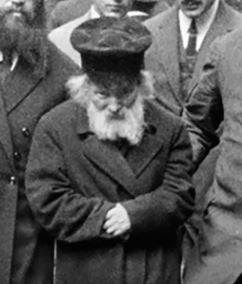
A still of the Chafetz Chaim from a rare, recently released video of the great rabbi. Click the image to see the video.

The Chafetz Chaim (Rabbi Israel Meir Kagan, 1839-1933), generally considered the greatest authority on lashon hara, forbids such speech even between husband and wife. However, many other great authorities before and after him (including Rav Shlomo Zalman Auerbach, 1910-1995, and the Chazon Ish, Rabbi Avraham Isaiah Karelitz, 1878-1953) ruled on the contrary, and permitted a husband and wife to speak about whatever is on their mind, particularly if something bothers them. Technically, even the Chafetz Chaim is lenient in a case where a spouse is in distress and needs to get something off their shoulders.

Still, all agree that we should limit negative words as much as possible, and certainly keep gossip to a minimum. Of course, when negative words have a constructive purpose, it is not considered lashon hara at all, whether between spouses or fellows. This is the case if a person undoubtedly knows, for example, that a particular contractor or salesman is dishonest, and tells a friend in order to protect them from harm.

Repairing Evil Speech, Repairing the World

In the days of the Temple, the kohanim would bring about atonement for the nation through sacrifices and various offerings and rituals. The most important time for atonement was Yom Kippur, and the greatest atonement ritual of the day was when the Kohen Gadol, the high priest, would enter the Holy of Holies (just once a year) and fill it with incense smoke. What was the ultimate purpose of this? The Talmud (Arakhin 16a) states that it served to atone for lashon hara! This was especially necessary because, elsewhere, the Talmud (Bava Batra 165a) states: “Many transgress the law of stealing, few transgress the prohibition of adultery, and all transgress lashon hara.” Everyone is guilty of negative speech, at least to some degree. How do we repair this sin, especially when we don’t have a Temple today?

The Talmud (Arakhin 15b) states that if one is a Torah scholar, they should learn more Torah, and if one is not a Torah scholar, they should strive to be more humble. Like all the other statements, support is brought from verses in Tanakh. King Solomon said “A healing tongue is a tree of life” (Proverbs 15:4). The Sages see the use of the word tongue (lashon) as alluding to lashon hara, and therefore if one wants to heal their lashon hara, they should cleave to the Tree of Life. What is the Tree of Life? King Solomon himself said in another place (Proverbs 3:18) that the Torah is a Tree of Life! Therefore, to rectify the sin of lashon hara one should study Torah.

Upon closer examination, we see that Torah study is actually the perfect remedy for lashon hara. When a person speaks lashon hara they are using their tongue in a negative way and infusing bad energy into the world. When a person learns Torah (which is traditionally done vocally), they are using their tongue in a positive way and infusing good energy into the world. The balance is thereby restored, measure for measure. On top of this, the purpose of Torah study is ultimately to make a person better. The Torah is the best tool to counter the yetzer hara, the evil inclination, as God Himself declared: “I have created the evil inclination, and I have created the Torah as its remedy” (Sifre Devarim, 45). Thus, a person who learns Torah simultaneously neutralizes the evil speech they have spoken and refines their inner qualities so that they will not participate in evil speech in the future.

On that note, there are two kinds of people when it comes to lashon hara: those that like to speak it, and those that love listening to it. The latter often quell their conscience by telling themselves that they never speak lashon hara, God forbid, but only passively, faultlessly, hear it. As we’ve seen above, the listener is almost as culpable as the speaker. Thankfully, there is a remedy for this, too. While many don’t necessarily learn Torah directly from a sefer or on their own, today we have unlimited potential to learn Torah by listening to lectures. These are shared widely on social media, and through digital devices, on apps, and over the radio. Every person today is a click away from Torah learning.

This takes us back to the Talmud, which stated that a Torah scholar can repair lashon hara by learning, while one who is not a Torah scholar should become more humble. The big question here is how can a person just “become more humble”? Humility is one of the most difficult traits to attain! We might even say that the Talmud should have required the Torah scholar—who is constantly learning, growing, and working on themselves—to “become more humble”, not the other way around! How can we make sense of the Talmud?

To prove the point about the non-Torah scholar, the Talmud uses that same verse from Proverbs: “A healing tongue is a tree of life, while perverseness through it will break the spirit.” The plain reading of the verse is that a person who uses their tongue for positive, healing purposes is likened to a Tree of Life, while one who uses their tongue for perverseness is destroying their soul. The Sages take the latter half of the verse to mean, on a simple level, that one who uses their tongue for perverseness should “break their spirit”, ie. become more humble, in order to rectify the sin. There is also a deeper way to read that same verse.

To solve the puzzle, one needs to re-examine what “it” (bah, in Hebrew) refers to. The simple meaning is that “it” refers to the tongue, and one who speaks perverseness through it (the tongue) will break their spirit. However, the verse can just as easily be read so that “it” refers to the Tree of Life. If so, the verse is read this way: “A healing tongue is a tree of life while perverseness, through it [the Tree of Life] will break the spirit.” What is it that will “break” one’s spirit and cause them to become humble? The Tree of Life itself!

Therefore, it is specifically the learning of Torah, the Tree of Life, that brings one to more humility. With this in mind, if we go back to the Talmudic statement of our Sages, what they are saying is: The Torah scholar should rectify their sin by learning more Torah, as they have yet to attain the proper level of holiness, while a non-Torah scholar should learn by listening to more Torah, for this will have the same effect of bringing a person to humility, and rectifying lashon hara.

At the end, this rectification is what will bring Mashiach. In Kabbalistic texts, the generation before Mashiach is in the sefirah of Yesod, which is concerned primarily with sexuality. It is not a coincidence that this is one of the major global issues today. The time following Mashiach’s coming is that of the final sefirah, Malkhut, “Kingdom”. One of the most famous passages from the Tikkunei Zohar is “Patach Eliyahu”, customarily recited before the prayers. There we are told that “Malkhut is the mouth, the Oral Torah.” While Yesod is the sexual organ, Malkhut is the mouth; it is Torah sh’be’al Peh, the Oral Torah, literally “Torah on the mouth”. The key path to realizing Mashiach, Malkhut, is by rectifying the mouth, which is done through the study of Torah.*

As we prepare for Pesach, we should remember the Midrash (Vayikra Rabbah, ch. 32) which states that the Israelites were redeemed from Egypt in the merit of four things: for not changing their names, not forgetting their language, not engaging in sexual sins, and not speaking lashon hara. The same is true if we wish to bring about the Final Redemption. Not engaging in sexual immorality is a direct reference to Yesod, while the other three all deal with the holy tongue, with proper speech and Malkut: using holy names, speaking the Holy Language, and making sure to speak only positive words.

‘Going Up To The Third Temple’ by Ofer Yom Tov


*More specifically, the first rectification is that of the “lower mouth”, Yesod, a tikkun that will be fulfilled by Mashiach ben Yosef. This is followed by the tikkun of the upper mouth, Malkhut, fulfilled by Mashiach ben David (of whom the Prophet says he will slay evil with his mouth, Isaiah 11:4) bringing about God’s perfect Kingdom on Earth.