Tag Archives: Twelve Tribes

Why Tu B’Av Is More Important Than Yom Kippur

This week’s Torah portion is Va’etchanan, which begins with Moses’ many prayers to God, and famously includes both an account of the Ten Commandments, and the Shema. It also happens that this Friday we celebrate the little-known holiday of Tu B’Av (literally, the fifteenth day of the month of Av). Upon closer examination, the parasha and the holiday are quite deeply related.

The Talmud (Ta’anit 26b) states:

Rabban Shimon ben Gamaliel said: there were no days more joyful in Israel than the fifteenth of Av and Yom Kippur. On these days, the daughters of Jerusalem used to go out in white garments, which they borrowed in order not to put to shame anyone who had none… The daughters of Jerusalem came out and danced in the vineyards exclaiming at the same time, “Young man, lift up your eyes and see what you choose for yourself. Do not set your eyes on beauty, but set your eyes on [good] family…”
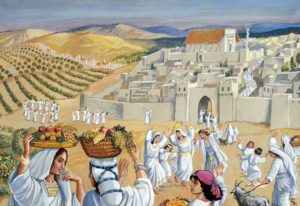
Young Girls Dancing on Tu B'Av (Courtesy: Temple Institute)

Young Ladies Dancing on Tu B’Av (Courtesy: Temple Institute)

In ancient times, Tu B’Av was a day of speed-dating, matchmaking, and engagements. It is easy to see why Tu B’Av has become associated with love and romance, and is often referred to today as a “Jewish Valentine’s Day”. While this is true, a careful reading will reveal that the holiday actually has far more to do with the fact that the daughters of Jerusalem loved one another, going out in the same white garments to avoid shaming each other. Tu B’Av celebrates a much greater power of love, one that holds the cure for the ails of the solemn Tisha B’Av that was commemorated just days earlier.

Why is Tu B’Av Special?

The Talmud (Ta’anit 30b-31a) asks: why does the Mishnah above compare Tu B’Av to Yom Kippur? We can understand why Yom Kippur is a special day – since it was then that God forgave the Israelites for the sin of the Golden Calf and gave a new set of Tablets – but why Tu B’Av? The question is answered with a list of significant historical events that happened on the 15th of Av.

First among them is the day when the prohibition for people of different Israelite tribes to marry each other was repealed. Initially, during the settlement of the Holy Land, people married only within their own tribe to avoid situations where parcels of land might unfairly be transferred to a different tribe. Eventually, this ban was lifted, allowing anyone to marry whomever they wanted. Once again, we see the theme of love associated with Tu B’Av.

The Talmud goes on to list a number of other events, the most salient of which is that on this day, the “generation of the Wilderness ceased to die out.” After the sin of the Spies, God decreed that the Israelites would wander in the Wilderness for forty years until the entire adult male generation passed away. In the fortieth year, the last of that generation passed away on the fifteenth of Av, allowing the nation to finally move on from the sin of the Spies. (Some say the last group of men was actually spared from death on Tu B’Av, turning that day into a celebration.)

Here, the Talmud cites a teaching that ever since the sin of the Spies, God had stopped speaking to Moses directly. Instead, Moses received visions from God just like any other prophet. On Tu B’Av, after nearly forty years, God once more resumed speaking to Moses “face-to-face”. Tu B’Av was the day Moses reclaimed his status as the greatest of prophets, the only one who spoke to God in a fully conscious state.

Where in the Torah do we see that God resumed speaking to Moses in this way? The Pnei Yehoshua comments that this happened in our weekly parasha, Va’etchanan. After Moses’ incessant prayers, God finally reappeared to him. And so, we see yet again the theme of love on Tu B’Av; this time, though, not love between people, but between God and man.

One Love

It is in this week’s parasha that we are commanded to “love Hashem, your God, with all of your heart…” Earlier in Leviticus we were given the mitzvah to “love your fellow as yourself.” While the latter is understandable, how exactly is one supposed to love God? God is the eternal, all-encompassing, omnipotent, omniscient, omnipresent force within all of Creation, and everything that infinitely lies beyond. The Kotzker Rebbe once rightly observed that “one who does not see God everywhere, does not see God anywhere.” How does one love such a transcendent Being?

Our Sages teach something incredible. The full verse in Leviticus states, “And you shall love your fellow as yourself, I am Hashem.” Why finish with “I am Hashem”? The verse would have stood well on its own without that last part! The juxtaposition of words can teach us that that loving your fellow is loving Hashem. In fact, the numerical value of the whole verse (ואהבת לרעך כמוך אני יי) is 907, equivalent to “love Hashem, your God” (ואהבת את יי אלהיך)! If God is found within each person, and within each creation, then loving every person and every creation is loving God.

This is all the more important on Tu B’Av which, not coincidentally, comes immediately after Tisha B’Av, a day commemorating a Temple destroyed because of sinat chinam, baseless hatred, and absence of love between fellows. When the Jews of the Second Temple period stopped loving each other, it was clear that they had stopped loving God, and God destroyed His Temple.

Tu B’Av is the antidote to Tisha B’Av. It is quite ironic that while many mourn and wail on Tisha B’Av, few pay much attention to the far more significant message of Tu B’Av. It is Tu B’Av that should be carefully observed and loudly celebrated. After all, the Mishnah goes so far as to place Tu B’Av on the same pedestal as Yom Kippur! That makes it even more ironic, as the majority of Jews observe Yom Kippur in some way, yet have little knowledge of Tu B’Av which, in reality, is just as important as Yom Kippur, and perhaps even more so:

The Mishnah ends by suggesting that while the Temple was destroyed on Tisha B’Av, it will be rebuilt on Tu B’Av, for just as the “daughters of Zion” would go out on Tu B’Av, they will go out once more in the “day of the building of the Temple, may it be rebuilt speedily and in our days.”


The article above is adapted from Garments of Light – 70 Illuminating Essays on the Weekly Torah Portion and Holidays. Click here to get the book!
The Stones, Symbols, and Flags of the Twelve Tribes of Israel

Bamidbar is the fourth book of the Torah, and the name of its first parasha. It is known in English as “Numbers”, since it begins with a detailed census of the Jewish population in the wilderness. We are given a description of how the nation was organized in their camps: the tribes of Yehuda, Issachar, and Zevulun were positioned towards the East; Reuven, Shimon, and Gad to the South; Ephraim, Menashe, and Binyamin to the West; and Dan, Asher, and Naphtali to the North. The Levites and kohanim were in the centre. We are told that each of the tribes had their own flag, just as in a large military formation. What did these flags look like? Which colours did they bear, and what symbols graced them?

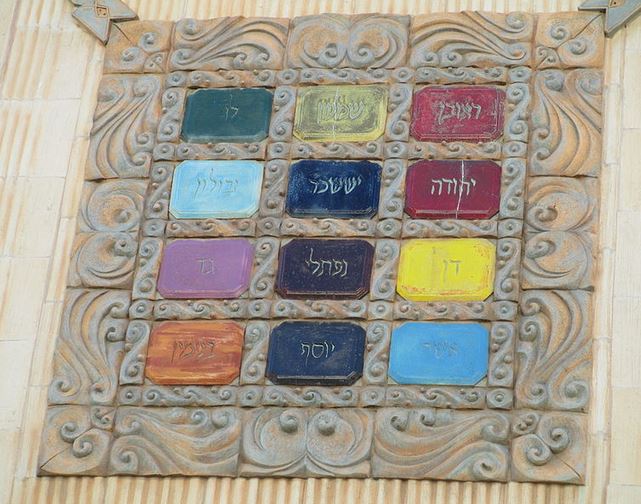
Modern Rendition of the Choshen, the High Priest's Breastplate

Modern Rendition of the Choshen, the High Priest’s Breastplate

In an intriguing passage, the Midrash (Bamidbar Rabbah 2:7) provides a summary of the flags’ appearance. It begins by telling us that the colours of the flags corresponded to the colours of the stones that were on the Choshen (or Breastplate) of the High Priest. The High Priest was commanded to wear a special breastplate that had twelve precious stones, one for each of the twelve tribes. Each stone had a symbolic meaning unique to that particular tribe.

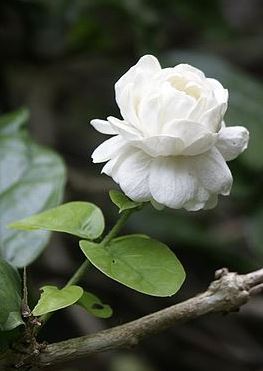
Jasmine flower

Jasmine flower


Reuven’s was the odem, a ruby, and so his flag was red. The symbol on the flag was the duda’im, flowers that Reuven had picked for his mother Leah (Genesis 30:14). It was on account of these flowers that Leah went on to have three more children. Duda’im is often translated as “mandrakes”, though according to Rashi they were of the Jasmine plant.

Shimon had the pitdah, probably topaz, and his flag was green. The symbol upon the flag was an image of the city of Shechem. This is in memory of the episode where Shimon (together with his younger brother Levi) took up swords to decimate the Shechem population after the abduction and rape of their sister Dinah (Genesis 34).

Levi’s was bareket, possibly an emerald or onyx, and the flag had three bands of colours: white, black, and red. Upon the flag was an image of the Urim V’Tumim, the mystical objects kept within the High Priest’s breastplate that were apparently used for communication with the Divine.

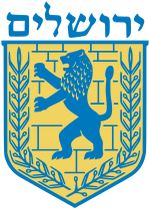
Modern-day Coat of Arms of Jerusalem, with the Lion of Judah

Modern-day Coat of Arms of Jerusalem, with the Lion of Judah

Yehuda had nofech, a stone more difficult to identify, with different opinions holding that it was either red, green, or blue. The Midrash here describes the flag as blue like the skies. Emblazoned upon it was the image of a lion. Before his passing, Jacob blessed each of his twelve sons, and in his blessing, he described Yehuda as a lion (Genesis 49:9). The lion would later become associated with the Davidic dynasty of kings (which hails from the tribe of Yehuda), and with the seat of their throne in Jerusalem, a city that goes by a number of names, including Ariel (“God’s lion”).

Issachar’s was a sapphire (or lapis lazuli) stone, and his flag was of a very dark blue colour. Upon it was the image of the sun and moon. The Midrash explains why, citing I Chronicles 12:33, which describes the people of Issachar as being wise in astronomical and chronological matters.

Zevulun had a yahalom, today’s Hebrew word for diamond, though there may be other possibilities. Zevulun’s flag was white, and bore a depiction of a ship, again based on Jacob’s blessing to the tribe to be successful sea-going merchants, and live along the Israeli coastline (Genesis 49:13).

Dan had leshem, amber, with a flag of a sapphire-like colour (despite the fact that amber is typically golden-red). Upon the flag was the symbol of a snake, once more based on Jacob’s blessing (v. 17). Likewise, Gad’s flag bore the image of a military camp (v. 19), on a black and white background, based on Gad’s stone of shevo, a black agate or obsidian.

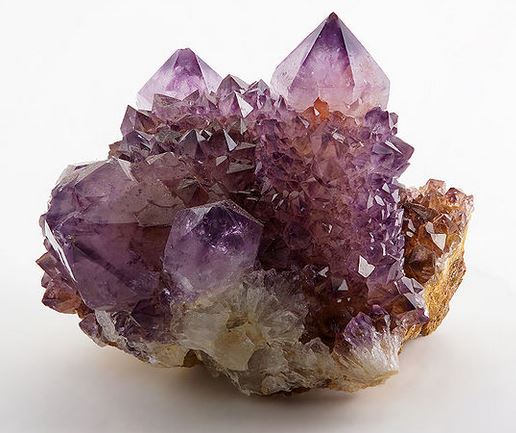
Amethyst, the Greek root of which is literally "not intoxicating"

Amethyst, the Greek root of which is literally “not intoxicating”

Naphtali had achlamah, the purple amethyst. His flag was of a similar colour, described by the Midrash as pure wine that isn’t too strong. It is interesting that the Midrash should compare it to wine, since amethyst was believed in ancient times to keep one sober and prevent drunkenness. Upon the flag was an image of a gazelle, also from Jacob’s blessing (v. 21).

Asher’s stone of tarshish is certainly the least identifiable of the dozen. Opinions range from chrysolite and coal to flint and hyacinth. The Midrash doesn’t help in clarifying the matter, describing the flag as similar to the colour of an expensive jewel stone worn by women. Whatever the case, the image upon the flag was that of an olive tree, since Jacob blessed Asher with fatty riches and delicacies (v. 20).

In the encampment, the tribes of Ephraim and Menashe were counted separately. On the breastplate, however, they were counted as one, under the banner of their father Yosef. This is because Ephraim and Menashe were not Jacob’s sons, but his grandsons, and on his deathbed, Jacob elevated their status to that of his own sons. Thus, we always maintain that there are twelve tribes: if we include the priestly Levites in the count, then Ephraim and Menashe are combined into one, Yosef, to ensure twelve. If we do not include the Levites since, after all, they are in a different class (and did not inherit any land for that matter), Ephraim and Menashe are counted independently of each other.

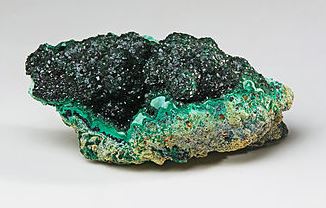
Malachite

Malachite

The stone of Yosef was shoham, which also has a number of opinions to its identity. The Midrash tells us that the flag was black, which supports the suggestion that shoham is malachite, a stone that has dark green and black colours. Ephraim’s black flag had a bull depicted on it. This is drawn from Moses’ final blessing to the tribes of Yosef (Deuteronomy 33:17), which the Midrash quotes. (Jacob’s blessing also mentions the word for a bull, but it is translated differently there.) The Midrash also tells us that the bull represents Joshua, who was of the tribe of Ephraim.

Based on the same verse in Moses’ blessing, Menashe’s black flag had a re’em, a horned animal sometimes translated as a unicorn, or perhaps an ox or even a rhinoceros. Again, the Midrash points out that this represented the Biblical judge Gideon, who was of the tribe of Menashe.

Last but not least, Binyamin’s flag famously depicted a wolf, based on Jacob’s description (Genesis 49:27). The stone of Binyamin was the yashfe, another unidentified one. The Midrash tells us that Binyamin’s flag had a mix of the colours of all the other tribal flags. This is likely due to the fact that Binyamin was the beloved little brother of the family, and all of his older siblings, though sometimes at odds with one another, always united to protect him. It is said that this is the reason why the Holy of Holies in the Temple was specifically in the territory of Binyamin (while the rest of the Temple was in the land of Yehuda), since the whole nation put aside their differences and united as one when it came to the smallest of their brothers.


This is an excerpt from Garments of Light: 70 Illuminating Essays on the Weekly Torah Portion and Holidays. Click here to get the book!