
Category Archives: Kabbalah & Mysticism

The Bone of Resurrection and the City of Immortals

This week’s parasha, Vayetze, begins with Jacob’s famous vision of the Heavenly Ladder. This occurred at a place called Beit-El (literally “House of God”), which our Sages identified with the Temple Mount, where the House of God would be built in the future. The Torah makes sure to point out that the place was originally called “Luz” (Genesis 28:19). The same word appears one more time in this week’s parasha, when Jacob stimulates his sheep to produce different spots, and uses luz as a visual cue for them (Genesis 30:37). Rashi comments that luz is a type of nut, and says that in (Old) French it is called “coldre”. The Old French Anglo-Norman Dictionary defines “coldre” as a hazelnut. In Modern Hebrew, egozei luz refers to hazelnuts, too. Alternatively, it may refer to an almond, as the Midrash (Kohelet Rabbah 12:5) says:

“…and the almond shall blossom” (Ecclesiastes 12:5) Rabbi Levi says this refers to the luz of the vertebrae. Hadrian (may his bones be crushed and his name blotted out) asked Rabbi Yehoshua ben Chananiah: “From what will man ‘blossom’ in the future?” He replied: “From the luz of the vertebrae.” He said to him: “Prove it to me.” [Rabbi Yehoshua] had one brought; he placed it in water but it did not dissolve; he put it in fire, but it was not burnt; he put it in a mill but it was not ground. He placed it on an anvil and struck it with a hammer; the anvil split and the hammer was broken but all this had no effect on the luz.

The wicked Roman emperor Hadrian (who crushed the Bar Kochva Revolt, during which Rabbi Akiva was executed, among countless others) once questioned Rabbi Yehoshua as to how people could be resurrected in the future if their bodies completely decompose. Rabbi Yehoshua answered that there is a special, tiny, nut-like bone in the human body, along the vertebrae, that is indestructible. From this bone, God will rebuild the entire person. Anatomically-speaking, which bone is this? Continue reading
Superheroes in Judaism, the First Multiverse

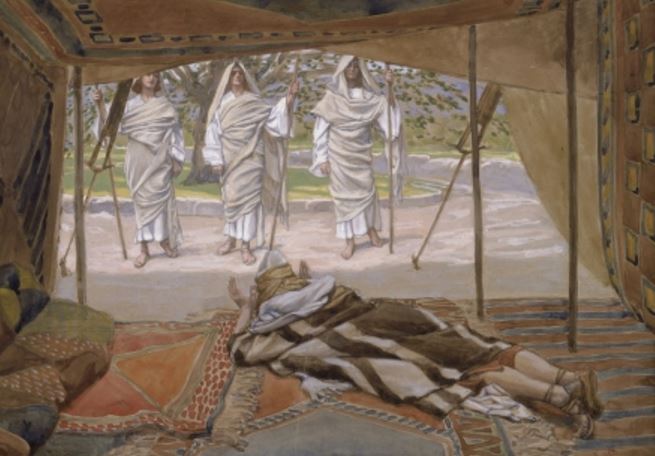
This week’s parasha, Vayera, begins with Abraham sitting outside his tent just days after circumcising himself at the age of 99. We would expect him to be weak and frail at this moment, yet he is spry and full of energy. The Torah tells us that it was a very hot day (Genesis 18:1), and the Sages explain (as cited by Rashi on the verse) that God deliberately made it hot so that Abraham should not have any visitors bother him during his recovery. Yet, Abraham was more pained by the lack of visitors than he was from the circumcision! So, God sent him three angelic guests.

‘Abraham and the Three Angels’ by James Tissot

Abraham immediately sprung into action, bringing water for his guests to wash their feet, and cooking up a feast. Abraham served his guests “cream and milk and the calf that he had made, and he placed [them] before them, and he was standing over them under the tree, and they ate.” (Genesis 18:8) As discussed in the past, the Sages were puzzled at the fact that Abraham served both dairy and meat at the same meal. Although he lived before the official giving of the Torah, and therefore was not bound by Torah law, nonetheless we would expect him to observe the eternal Torah anyway. Jewish tradition holds that the Patriarchs also observed the Torah through an oral tradition and through their direct prophetic knowledge from God.

One solution to the problem comes from another tradition that Abraham had received the secret wisdom of Creation, and was actually the originator of Sefer Yetzirah, the “Book of Formation”. He knew how to use mystical powers to create things out of thin air. Hence, when the Torah says “the calf that he had made [asher asah]” it means that he literally made the calf! Since he had made this hunk of meat, it was never a living animal, and possessed no soul, so it was totally pareve, and he could serve it with “cream and milk”. The Talmud (Sanhedrin 65b) tells us that Rav Chanina and Rav Oshaia would study Yetzirah and similarly create a calf out of thin air which they then consumed.

Meanwhile, in last week’s parasha we saw how Abraham took on the united armies of four powerful kings. The Torah tells us that he fought them off with just 318 of his men (Genesis 14:14). If this wasn’t enough of a miracle, the Sages say (as cited by Rashi on the verse) that Abraham really didn’t have 318 men. Rather, 318 is the gematria of “Eliezer” (אליעזר), Abraham’s devoted servant. It was just Abraham and Eliezer taking on an entire army! How could they do this? The Talmud (Sanhedrin 109a) says that when Abraham would throw dust and straw it would transform into swords and arrows in mid-air. That’s quite the superpower!

Judaism is full of such feats of superpower, whether it’s Jacob pushing off a well-stone on his own (Genesis 29:1-10)—when normally it required a team of shepherds—or Samson crushing a thousand Philistines with a jawbone (Judges 15), or figures like Eliezer and Eliyahu employing kefitzat haderekh, “leaping” or “teleporting” across vast distances (see Sanhedrin 95a-b and Kiddushin 40a). It therefore isn’t surprising that the modern “pantheon” of superheroes was crafted almost entirely by Jewish writers and artists. Continue reading

The Zohar’s Amazing Scientific Knowledge of the Eyes

Within the Zohar’s commentary on this week’s parasha, Ha’azinu, is the treatise known as the Idra Zuta. This text describes the well-known narrative of the passing of Rabbi Shimon bar Yochai, and includes his very last discourse to his students. It is one of the most profound and penetrating teachings in the Zohar. It isn’t a coincidence that it was wedged within Ha’azinu, which our Sages similarly described as the deepest and most cryptic parasha of the Torah. A significant part of the Idra Zuta concerns matters of light and vision. Incredibly, the Zohar describes things that scientists only uncovered centuries later. In fact, one of these famous scientists may have used the Zohar as the inspiration for his discovery! Continue reading