Category Archives: Mysteries & Origins

Sefer Yetzirah and the 32 Paths of Creation

The first chapter of the Torah famously describes God’s creation of the universe. Although the text is quite brief, our Sages had much to say about the events of Creation. This is an especially important topic in Kabbalah, traditionally divided into two main headings: Ma’ase Beresheet, “the Work (or Narrative) of Creation”, and Ma’ase Merkavah, “the Work (or Narrative) of the Chariot”. The former explores the genesis and nature of the universe, along with a host of metaphysical concepts, while the latter is primarily focused on various aspects of God, and the mechanism of prophecy.

One of the most ancient Kabbalistic texts is Sefer Yetzirah, the “Book of Formation”. This book outlines in more detail how God created the universe. Since the Torah tells us that God created the world by speaking it into existence (“God said, ‘Let there be light…’”), it is taught that the building blocks of the universe are the very letters of the Hebrew alphabet. Everything that exists was fashioned out of unique combinations of these special letters.

Along with the 22 letters were the Ten Sefirot, divine energies that imbue everything within Creation. These Sefirot are sometimes said to parallel the 10 base numerical digits, from 0 to 9 (the word sefirah also means “counting”). Just as modern physicists might argue that the entire universe can be reduced to mathematical equations, Sefer Yetzirah reduces all of Creation down to these foundational numbers and letters. And so, Sefer Yetzirah begins by stating that God created the universe through lamed-beit netivot, thirty-two paths.

The Power of Sefer Yetzirah

Sefer Yetzirah is first explicitly mentioned over 1500 years ago in the Talmud (Sanhedrin 65b), where Rabbi Chanina and Rabbi Oshaia studied it together on Friday afternoons. Using the secrets described in the text, the two rabbis apparently learned how to create ex nihilo, like God. Each Friday, they would team up to create a calf out of thin air—and eat it!

It is said that the patriarch Abraham was capable of the same feat. In the well-known narrative of the three angels visiting Abraham, we read how Abraham “took butter and milk, and the calf which he had made, and set it before them…” (Genesis 18:8). Many have asked: how is it possible that the forefather of the Jewish people gave his guests a mixture of dairy and meat products? The simplest answer is that, of course, Abraham preceded the giving of the Torah and at that time there was still no prohibition on consuming dairy and meat together. However, Jewish tradition maintains that although the forefathers lived before the giving of the Torah, they still fulfilled its precepts through an oral tradition, and from the prophecies they received directly from God. So, how did Abraham put both dairy and meat before his guests?

The Malbim (Rabbi Meir Leibush ben Yechiel Michel Wisser, 1809-1879) comments on the verse by citing earlier mystical teachings that say Abraham knew the secrets of Sefer Yetzirah and fashioned the calf from scratch! This is why the verse clearly says “…and the calf which he had made [asher asah]”. Since Abraham made the calf, it was only a hunk of flesh with no divine soul (which only God can infuse), and was therefore pareve, neither dairy nor meat. In fact, many believe that Abraham was actually the author of Sefer Yetzirah. Others maintain that it was written by Rabbi Akiva, based on teachings that were initially revealed by Abraham.

A Brief Overview of the 32 Paths

Where exactly are the 32 Paths of Creation derived from? A careful analysis of the Genesis text shows that God (Elohim) is mentioned 32 times in the account of creation. Each of these 32 parallels the 32 paths. There are ten cases where the Torah says vayomer Elohim, “And God said…” in the first chapter. These 10 correspond to the Ten Sefirot. The remaining 22 mentions of God correspond to the 22 letters in the following way:

Sefer Yetzirah breaks down the Hebrew alphabet into three groups: the “mothers” (ima’ot), the “doubles” (kefulot), and the “elementals” (peshutot). There are three mother letters: Aleph (א), Mem (מ), and Shin (ש). These are the “mothers” because each is associated with one of the three primordial elements of Creation: Aleph is the root of air (avir, אויר), Mem is the root of water (mayim, מים), and Shin is the root of fire (esh, אש). These three correspond to the three times that the Torah says “God made” (Genesis 1:7, 16, and 25).
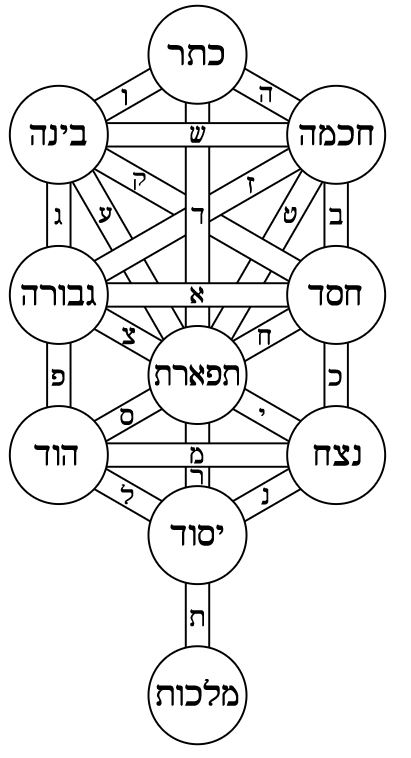
The “Tree of Life” depicting the Ten Sefirot, intertwined by the 22 Letters of the Hebrew Alphabet. Together, they make up the 32 Paths of Wisdom.

There are then 7 “doubled” letters, those that have two sounds in Hebrew:  Beit (ב), Gimel (ג), Dalet (ד), Khaf (כ), Pei (פ), Reish (ר), and Tav (ת). The double sounds of beit and veit, khaf and haf, pei and phei are well-known to us today, while the other four are a little more mysterious (see below on parashat Noach, ‘Shabbat or Shabbos: What’s the Correct Pronunciation?’)  The seven kefulot correspond to the seven times that the Torah says “God saw” (Genesis 1:4, 10, 12, 18, 21, 25, 31). The remaining 12 letters, the peshutot, correspond to the remaining 12 times that God is mentioned.

To summarize, the 32 paths derive from the 32 times that God is mentioned in Genesis, and further broken down into their groupings of 10, 3, 7, and 12 based on the specific type of verb used in relation to God.

Finally, all of these are embedded in the most famous of Kabbalistic diagrams, the Etz Chaim, “Tree of Life”. The 10 circles on the diagram correspond to the Ten Sefirot. The Sefirot are interconnected by 22 lines, corresponding to the 22 letters. There are three horizontal lines, corresponding to the three mother letters; seven vertical lines, corresponding to the seven doubled letters; and twelve diagonal lines, corresponding to the twelve elemental letters. This simple diagram amazingly captures a great deal of information, and is a key tool in Kabbalah—as well as the first step towards creating your very own calf!


The above is an excerpt from Garments of Light, Volume Two. Get the book here! 
How Did Adam Live 930 Years?

This week’s parasha is Vayelech, which begins with Moses’ statement that “Today I am one hundred and twenty years old” (Deut. 31:2). It was the 7th of Adar, Moses’ birthday, and also his day of passing. Moses goes on to conclude his final speech to the people, then sings a deeply prophetic farewell song in next week’s portion Ha’azinu, followed by his blessings to the people in the last parasha of the Torah, V’Zot HaBracha.

Moses was the greatest of all prophets, the humblest man to walk the earth, and the central founding figure of Judaism. He was blessed with living a full and healthy life spanning exactly 120 years. It has become common today for people to wish each other 120 years of life. Why is this the specific figure? Can humans not live longer? Don’t we see in Genesis that Adam lived 930 years, Noah lived 950 years, and Methuselah (Metushelach) lived a record 969 years? What happened?

The Flood Generation

Ten generations from Adam, the world had descended into endless sin and immorality. God decreed that man’s days “will be numbered at one hundred and twenty” (Genesis 6:3). Many believe this to mean that God decreed humans will no longer be able to live past 120 years. Indeed, when looking at modern records of longevity, the vast majority of the world’s oldest people die close to 120 years. There has only been one official case of anyone exceeding 120, a Frenchwoman named Jeanne Calment who lived 122 years.

However, the traditional Jewish interpretation is that the Genesis verse above does not mean man is unable to live past 120. After all, our forefathers Abraham, Isaac, and Jacob lived long after this decree, and they lived 175, 180, and 147 years, respectively. Rather, the Jewish Sages state that God decreed the arrival of the Great Flood 120 years hence. God gave mankind 120 years to repent, and possibly avert the Flood. Noah was commissioned to go around and inspire people to mend their ways, and he had 120 years to do it.

Unfortunately, Noah failed in this endeavour, unable to bring even a single person to righteousness (as the Ark only carried his own family at the end). This is one reason for why the Flood is known in Hebrew as mabul Noach, literally “Noah’s Flood” (or mei Noach, “Noah’s waters”), as if he was partially responsible for not doing enough to inspire people to change. Because of this, many (including Rashi) have commented on the verse “Noah was a righteous and pure man in his generation” (Genesis 6:9) to mean that Noah was only righteous in his faulty generation. Had he lived in another generation, such as that of Abraham, he would not have been deemed so righteous!

We see from the Biblical chronology that after the Flood, people’s life spans steadily shorten. Moses’ older siblings Aaron and Miriam lived 123 and 126 years. Moses died at 120, and this appears to have become the new limit. After Moses, there are only a few people noted to have lived longer, one of which is Yehoyada the High Priest, who lived 130 years (II Chronicles 24:16).

What accounts for this steady degeneration in longevity?

Yeridat HaDorot

The Talmud (Shabbat 112b) states: “If the earlier [scholars] were sons of angels, we are sons of men; and if the earlier [scholars] were sons of men, we are like asses…” This is one of many passages that attests to the well-known concept of yeridat hadorot, “the descent of the generations”. It is said that each passing generation falls lower and lower in its wisdom and spiritual greatness. This concept can solve the puzzle of longevity.

The body is a finite lump of matter. It is only animated and vitalized by the infinite soul within it. Thus, the greater the soul, the longer the body can live. As the spiritual potential in each generation falls, so too does the lifespan.

Moreover, it is taught that Adam contained essentially all of the souls of humanity within him (Sha’ar HaGilgulim, ch. 11). As more and more people were born over the centuries, this single universal soul broke down further and further into smaller and smaller fragments. With the exception of a number of “new souls”, the vast majority of the world’s 7 billion people are all parts of the soul of Adam. It is therefore not surprising that today’s spiritual capabilities (and with that, the lifespans) are severely limited.

At the Speed of Light

Science may offer another intriguing possibility. According to modern physics, time as we know it doesn’t really exist. The universe is one interwoven fabric of both time and space. The faster one moves through space, the slower the effects of time for that person. There is actually a formula to measure the impact of this time dilation, known as the Lorentz transformation. It is given by the equation ΔT = t√1-v2/c2 [or: t = t0 ÷ √(1-v2/c2)], where v is one’s speed and c is the speed of light.

Theoretically, the speed of light is the absolute maximum in our universe. At light speed (just under 3.00 x 10⁸ m/s, or 300,000 km/s), time will totally stop for the traveller (if plugging it into the formula, one gets a value of zero). This seems impossible. However, if we plug in a value very close to light speed, such as 2.99 x 10⁸ m/s, we get a very interesting result.* A person who has perceived living 80 years will have actually lived 980 earthly years! That makes Adam’s 930 years a more palatable 76, and Methuselah’s record 969 as 79. This fits in well with the verse in Psalms that a normal lifespan is 70 to 80 years (Psalms 90:10). But how could Adam and Methuselah have lived at near-light speed?

Beautifully, the Sages teach us that Adam was not a human like us. In many texts (such as Bereshit Rabbah 20:12), Adam is described not simply as a being of flesh, but rather as a being of light. Though most will interpret this metaphorically, there are those sages, such as the Arizal (for example, in Sefer HaLikutim, Bereshit, ch. 3) that interpret this quite literally. It remains to be seen what this means exactly, and if it has anything at all to do with physics, but perhaps there is much more to the idea of Adam being a man of light than we can imagine.


The article above is an excerpt from Garments of Light: 70 Illuminating Essays on the Weekly Torah Portion and Holidays. Click here to get the book! 

——–

*To be fair, choosing a value such as 2.99 x 10⁸ m/s may be deemed quite arbitrary. One can also plug in finer values even closer to the speed of light, such as 2.997 or 2.9972, and so on, each of which would give a more refined result. The point of this exercise is simply to illustrate the relativity of time, and what might explain the difference in perceived years between our generations and those of the first people, through a scientific perspective.

What Are the Jewish People “Chosen” For?

This week’s very powerful Torah portion is Va’etchanan. In it, Moses continues his farewell speech to the nation before his death. Among other important points, he recaps the Ten Commandments, and proclaims the text of the Shema. Included in this speech are a number of significant prophecies and statements.

Moses reminds the people that what they witnessed at Mt. Sinai was a totally unique, once-in-history event, where God brought forth a divine revelation to the entire nation, with every single individual experiencing a prophetic vision. Moses tells us to always remember that this has never happened elsewhere in history (Deuteronomy 4:32-34). Although modern Biblical critics will immediately point out that there is no proof that such a national revelation ever took place, Moses tells us that no other people has ever even claimed such a thing! To this day, there is no nation or religion that claims to have started with a national revelation. Strangely, only the Jewish people make such a claim.

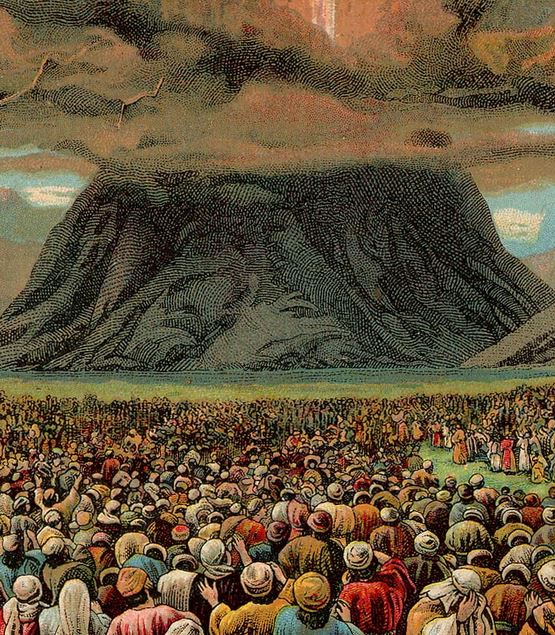
National Revelation at Sinai (Providence Lithograph Company, 1907)

A 1907 Illustration of the National Revelation at Sinai

(Although some point out that the Aztecs seem to have a similar story of their god guiding them through a Wilderness to their very own promised land in Mexico, most modern scholars agree that this myth is very recent, adopted from the Jewish story in the Torah. The Aztecs picked it up from Christian missionaries and made it their own.)

Another prophecy in this week’s portion is that the Jewish people will be scattered around the world, and will always remain small in number (4:27). Three thousand years later, the prophecy still holds true, with just 0.2% of the world’s population being Jewish. That’s quite amazing, as it defies normal growth patterns. There are roughly two billion Christians in the world, and their religion emerged over a thousand years after Judaism. The number of Muslims is also steadily nearing two billion, and they came around even later, roughly 1400 years ago. Hindus, Buddhists, Sikhs, and virtually all other major religions outnumber the Jews. Even the Bahai faith, which started just 160 years ago is quickly catching up, and will soon outnumber Judaism, too.

Moses suggests that it is precisely because we are small in number that God chose us (7:7). Perhaps this can be explained with simple economics of supply and demand. The more of something that there is, the less value it is perceived to have. (Note the word perceived; all human life is of course equal.) The sworn enemies of the Jews seem to agree: Hamas thought it was totally fair to demand 1000 Palestinians to be freed in exchange for one Jew – Gilad Shalit!

The big question is: why did God “choose” us?

The Chosen People

To understand why God chose the Jewish people, and what exactly we are chosen for, one must look back to the beginning of the whole story. Originally, there were no Jews and no Torah. There were only Adam and Eve, in a perfect world, living with God’s revealed presence. The problem of this “perfect” world was that Adam and Eve were essentially unable to truly enjoy it. Having never experienced anything “bad”, they had no concept of what is “good” either. Life was just bland.

In the middle of Eden, God placed the Tree of Knowledge of Good and Evil. By consuming of its fruit, Adam and Eve would be introduced to these new concepts. They would now have to experience hardship and confront evil, but measure for measure, they would now also be able to enjoy goodness and pleasure. After all, it is only because we have had negative experiences that we can truly understand, appreciate, and strive for the positive ones.

Adam and Eve had a choice. They chose the Tree of Knowledge. With that, their perfect world was over. However, this was only temporary. God’s intention was for mankind to live in a world of goodness, not one of suffering. Yet, in order to make the most of the Garden of Eden, mankind first had to experience evil, overcome it, and transcend it. Ever since Adam and Eve were banished from the Garden, their mission has been to remove evil from their midst, restore goodness, and finally return to that Garden.

Adam and Eve were unable to do this, and neither were their children, or grandchildren. As humans multiplied, they only become more and more sinful, pushing themselves further away from Godliness and goodness. After ten generations, God hit the “restart” button to try again with Noah. Noah ultimately failed as well, and once more each passing generation only fell further into immorality. It took another ten generations before things started to change.

Abraham’s Revolution

Abraham was the first person to properly recognize what the universe was all about. He understood that the current state of the world was wrong. Life was never meant to be this way. Abraham thus made it his life’s mission to repair the world. He travelled across the Middle East and spread monotheism, righteousness, and Godliness wherever he went. Abraham embodied all of the traits necessary to restore the world to a state of Eden. And so, it wasn’t so much that God chose Abraham, but rather, that Abraham chose God.

To complete the task of repairing the world would require more than just one man. This huge mission would require a nation. Thankfully, Abraham’s son Isaac continued in his father’s path, as did Jacob the grandson, and his own twelve sons. From these twelve sons an entire nation was born – a nation whose mission would be to restore the world to the Garden of Eden.

History shows that the Jewish people have indeed done so. The Jews’ moral contributions to the world have been vast, and described in books like Ken Spiro’s WorldPerfect – The Jewish Impact on Civilization and Thomas Cahill’s The Gifts of the Jews, among others. The Jews’ contributions to science, medicine, and technology may be even greater. Some of the most important minds behind breakthroughs like the personal computer and the internet, the cellphone and lasers, vaccines and automobiles were Jews, as were some of the greatest figures in biology, chemistry, mathematics, and physics. It is also important not to forget the immeasurable spiritual contributions of the Jews to the world.

Of course, Jews are not perfect. The Torah itself attests to this many times, even in this week’s parasha that admonishes the nation on multiple occasions. At the end of the day, the name of our nation is Israel, which literally translates as “struggles with God.” Our history has been a difficult one, full of struggles and challenges. It is clear, though, that we are nearing the end of this period, and we will soon see the restoration of the Garden of Eden, as God originally intended.


The article above is adapted from Garments of Light – 70 Illuminating Essays on the Weekly Torah Portion and Holidays. Click here to get the book!