Chanukah: Did the Jews Really Defeat the Greeks?

“No two cities have counted more with mankind than Athens and Jerusalem. Their messages in religion, philosophy and art have been the main guiding light in modern faith and culture. Personally, I have always been on the side of both…”

– Winston Churchill

Chanukah is perhaps the most famous of Jewish holidays. The nine-branched candelabrum, the chanukiah, is instantly recognized by people around the world. One reason for this is because of the halakhah of pirsumei nissah, literally “publicising the miracle”. Although just about every Jewish holiday revolves around some kind of miracle, it is particularly with regards to Chanukah that there is a special mitzvah to publicize its wonder. And so, one can find a glowing, public chanukiah on display in pretty much every major city on the planet.

Chanukah Around the World

The purpose of the chanukiah is well-known: after defeating the Greeks and recapturing Jerusalem, and its Holy Temple, the Jewish warriors led by the Maccabees discovered only one cruse of oil for the Temple menorah (this one with seven branches, as the Torah commands). Although the oil was meant to last only for one day, it miraculously burned for eight, the amount of time necessary to produce a fresh batch of olive oil.
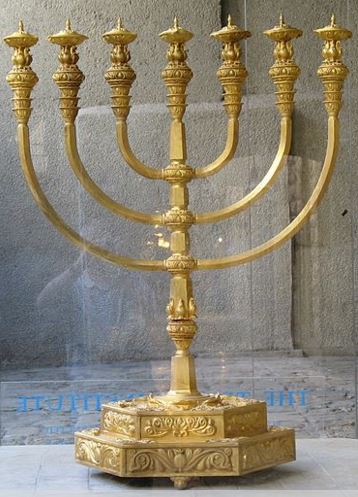
Temple Menorah Replica by Jerusalem's Temple Institute

Temple Menorah Replica by Jerusalem’s Temple Institute

This is the story as recounted in the Talmud. However, the more ancient Book of Maccabees (which is part of the apocrypha, scriptural texts that did not make it into the official Biblical canon) provides a different reason for the eight-day festival. Here, we are told that since the Temple was still in the hands of the Greeks two months earlier, the Jewish nation was unable to celebrate the Torah festival of Sukkot. Of all the Torah-mandated holidays, Sukkot is most associated with the Temple, and was celebrated with many offerings on the altar, along with water libations, and eight days of revelry. Since the people were unable to commemorate Sukkot properly in the month of Tishrei, they decided to commemorate it in the month of Kislev instead, now that the Temple was back in Jewish hands. So, they kept an eight-day festival, with offerings, libations, and revelry, both in honour of the belated Sukkot, and to celebrate their victory over the Greeks.

A David and Goliath Story

Chanukah is a beautiful underdog narrative. The mighty Syrian-Greeks (better known as the Seleucids, to differentiate them from the mainland Greeks in Europe) are imposing their Hellenism upon the conquered and impoverished Jewish people, still struggling to rebuild after the decimation of the First Temple period. The Greek king, Antiochus, demands the sacrifice of a pig upon a Jewish altar, and the Jews refuse. Well, at least some of them do.
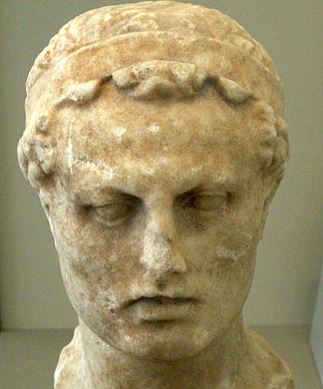
Bust of Antiochus IV Epiphanes, of Chanukah fame, at the Altes Museum in Berlin (Credit-Jniemenmaa)

Bust of Antiochus IV Epiphanes, of Chanukah fame, at the Altes Museum in Berlin (Credit: Jniemenmaa)

At the time, there were many Hellenized, assimilated Jews among the masses that were very much okay with a pig on the altar. (It seems that history repeats itself: the first graduation ceremony in 1883 of Hebrew Union College, a Reform seminary, consisted of frog legs, crabs, and shrimp, among other non-kosher foods, earning it the nickname, “the treif banquet”.) Matityahu the High Priest wouldn’t have any of it, and together with his five sons—soon to be known as the “Maccabees”—started a revolution.

More than anything else, this was a civil war between traditional Jews and the Hellenized ones. Of course, the Hellenized Jews had support from the Greek government, which soon brought in some 60,000 troops, together with war elephants, according to the Book of I Maccabees (4:28-29). The Maccabee forces managed to scramble 10,000 mostly-untrained, guerrilla warriors. Ultimately, the 10,000 overpower the professional Greek army. The Seleucid Empire would never be the same again, and less than a century later, would totally come to an end.

Spiritual vs. Physical

Today, the Chanukah story often carries the same message: the Greeks were materialistic, promiscuous, Godless people, while the Jews were moral, spiritual, and God-fearing. Chanukah, then, celebrates the triumph of righteousness over licentiousness, religion over secularism, spirituality over physicality.

While the above description of the Seleucid-Syrian-Greeks may be true, it presents a false image of the Greeks as a whole, and one that isn’t at all consistent with traditional Jewish holy texts, especially the Talmud. In truth, the great Jewish sages of the Talmud valued and respected the Greeks. They stated (Megillah 8b) that it is forbidden to translate the Torah into any language, except Greek, which the rabbis considered a rich and beautiful tongue. The rabbis also adopted the Greek style of democratic government, with elected officials sitting on the Sanhedrin, from the Greek root synedrion, meaning “sitting together”.

One of the earliest known synedrions was established by Alexander the Great, made up of representatives from across his vast empire to assist him in government. The Talmudic sages spoke highly of Alexander the Great. According to legend, Alexander saw a vision of the Jewish High Priest before coming to conquer Jerusalem. There are several versions of this story, but all agree that Alexander was grateful to the High Priest, and spared Israel from his destructive conquests (as well as from paying tribute, according to some sources). In turn, the rabbis adopted “Alexander” as an honorary Jewish name. Indeed, one of the sages of the Talmud is Rabbi Alexandri, and many other rabbis have Greek names, such as Hyrcanus, Teradion, Antigonus, Dosa, Papa, Symmachus, and Tarfon.

These rabbis gathered in various learning academies across Israel and Persia (producing the Jerusalem and Babylonian Talmuds, respectively). Their academies were very similar to the Greek academy. In fact, the successors of a Greek academy spoke very much like the rabbis of the Talmud, quoting teachings from previous generations and debating them, while citing an uninterrupted chain of tradition all the way back to Plato, much the same way that rabbis cite an uninterrupted tradition back to Moses. Many of their modes of reasoning and dialectics were the same, too, even lesser-used forms such as gematria, another Greek word adopted by Judaism. The Greeks had also used their alphabet for numerology (an art that they called isopsephy).

Greek traditions appear to have even found their way into Jewish holidays. In ancient Greece, families would get together for symposia, parties in which they would recount the history of Greece and its great victories. According to the Greek philosophers, it was best to drink three cups of wine at a symposium, while drinking five cups was considered excessive and inappropriate. Thus, most people drank four cups. They would lie on couches, specifically on their left side. Recounting history while drinking four cups of wine and lying on one’s left—sound familiar? Let’s not forget that afikoman is itself a Greek word (epikomon, literally “that which comes after” or “that which comes last”, referring to either dessert or the concluding festive songs).

While the ancient Greeks certainly held onto a number of abhorrent beliefs and practices, to suggest that all the Greeks were atheistic, unjust, or not spiritual is certainly untrue. Socrates was killed for criticizing Athenian injustice, Plato preached how illusory this physical world is, and Aristotle described metaphysics and theology as the “first philosophy” and most important of subjects. One of the earliest known preachers of reincarnation was Pythagoras, who also wrote of three souls, much like the Jewish conception of nefesh, ruach, and neshamah. Nor is it a secret that some of the angels mentioned in the Talmud bear Greek titles, among them Sandalfon and Metatron.

So, did the Jews really defeat the Greeks? We certainly defeated the immoral and oppressive Seleucid Greeks in battle, but definitely not the Greek spirit as a whole. In fact, some might argue that Judaism is the best preservation of ancient Greek culture in the modern world! Whereas the rest of society has moved on to other methods of education, we still have a yeshiva system like the ancient Academy. While others celebrate their holidays with gifts and formal dinners, we gather in symposia, reliving the words of our Sages, who openly bore their Greek names. And of course, while most of society is primarily concerned with what’s happening on television, we’re still trying to be philosophers, debating the finest points of reality.

The Greeks had a profound impact on all of civilization, and Judaism was not immune from it. Perhaps this is why, over time, the holiday became less about defeating Greeks and more about the miracle of light. Chanukah is a holiday celebrating Jewish resilience, and symbolizing the power of light over darkness, and hope over despair. It is a lesson in resisting assimilation and being true to ourselves; in standing up for what’s right and upholding our customs; and most importantly, in the longest, blackest nights of winter, Chanukah teaches us that although the world may be full of evil, one tiny flame can break through all the darkness.

[This is part one of a three-part series. See here for part two.]


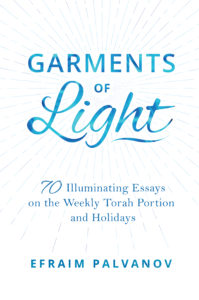
The article above is adapted from Garments of Light: 70 Illuminating Essays on the Weekly Torah Portion and Holidays. Click here to get the book! 
What It Really Means to Be “Israel”

This week’s parasha, Vayishlach, begins with Jacob’s return to the Holy Land following a twenty-year stay in Charan. The most famous passage of this parasha is Jacob’s battle with a certain angel. After its defeat, the angel gives Jacob a blessing and renames him Israel. What is the meaning of “Israel”? What was the purpose of this battle to begin with? And what does it all have to do with Jacob’s difficult twenty years in servitude to his deceiving father-in-law Laban?

Jacob vs. Esau

The Torah describes in quite some detail the conception, birth, and early lives of the twins Jacob and Esau. We see that Jacob was an “innocent man, sitting in tents” while Esau was a “hunter, a man of the field.” As twins, and the only children of Isaac and Rebecca, they were meant to work together in carrying on the divine mission started by their grandfather Abraham. The mission was to rectify the world, and fill it with true Godliness and righteousness. Such work mainly consists of educating others, doing good, and spreading the light. However, when that doesn’t work, it is also necessary to fight evil head-on. This was exemplified well by Abraham, who was both a wonderful preacher and, occasionally, a fearless warrior (as in the “War of the Kings” in Genesis 14).

Jacob and Esau were meant to take this to the next level. Thus, Jacob was blessed with extra intellect, wit, and spirituality, while Esau was blessed with extra strength, physical abilities, and ambition. In an ideal world, Jacob would have acted as the peaceful teacher, while Esau would defeat any remaining evil in battle. As partners, they would have been unstoppable in bringing light, morality, and a new God-consciousness to the world.

Unfortunately, the two couldn’t channel their blessings in the right direction. Esau’s physicality got the better of him, and he descended into a never-ending spiral of materialism. At the same time, Jacob used his cunning to take Esau’s birthright instead of using his intellect to put his brother back on the right path. Nonetheless, Jacob remained dedicated to fulfilling his divine mission, while Esau “despised his birthright” (Genesis 25:34).

By taking Esau’s birthright and blessing, what Jacob had done was to take Esau’s mission upon himself. He, too, would have to become a fighter. However, Jacob was born soft and meek—not fit for battle—while Esau was the one born muscular and hairy, as if already a grown man (hence his name Esav, literally “complete”). Could Jacob really become that holy warrior that Esau was meant to be? Jacob had to be put to the test.

Becoming Israel

Right after receiving Esau’s blessings, Jacob was told that his brother was out to get him. The soft Jacob immediately fled the Holy Land, as far away from his brother as he could. This was true to his character as a docile man, “sitting in tents”. But this was clearly not what a holy warrior would do.

Jacob ended up in the home of his uncle and future father-in-law, Laban. He instantly fell in love with Laban’s younger daughter Rachel, and agreed to work for Laban for seven years to be able to marry her. After seven years, Jacob was tricked into marrying the elder Leah instead of his beloved Rachel. It is hard to miss the irony of it all: Jacob, the one who tricked his father into getting his older brother’s blessing, is now tricked by his father-in-law into marrying his beloved’s older sister!

Laban forces Jacob to work for another seven years. This is, of course, completely unjust. A man such as Esau would have surely taken on Laban in combat, but the spineless Jacob simply agrees, and slaves away for seven more years. Following this, Laban finds more ways to trick Jacob out of an honest wage. Thankfully, Jacob is starting to learn, and begins to counter Laban’s wits with his own, soon building even greater wealth than his father-in-law.

At this point, Jacob hears that Laban is not very pleased with Jacob, and Jacob fears for himself and his family once again. As he did twenty years earlier, he decides to flee. While Laban was away shearing his sheep, Jacob takes the opportunity to run, taking the whole family with him. It appears that Jacob fails the test yet again, and is unable to confront his evil enemies.

Ten days later, Laban and his men find Jacob, and everything begins to change. Laban waltzes in to Jacob’s camp and begins threatening his son-in-law as he’d always done in the past. But this time Jacob has had enough, and realizes he can’t run away anymore. “And Jacob was angered, and battled with Laban” (Genesis 31:36). Jacob succeeds, and Laban seeks a peace treaty (v. 44). The two make a pact and part ways, never to see each other again. Jacob is becoming a fighter.

Jacob vs. Israel

This sets up parashat Vayishlach, where Jacob has to face off with Esau twenty years after running away from him. The night before, Jacob goes off on his own and is confronted by a mysterious figure (see ‘With Whom Did Jacob Wrestle? in Volume One of Garments of Light). The two battle it out all night long, and Jacob finally prevails. He is certainly no longer that weak, passive man he was two decades earlier. He has earned his badge of being a holy warrior. And with this, he is given a new name: Israel, one who “battles with God”; not against God, but alongside God, to defeat evil and make the world a better place. Jacob finally proves that he can indeed be Esau, and is worthy of having taking Esau’s birthright and blessing.

The Sages tell us that this is the real reason why Jacob had to marry both Rachel and Leah. Originally, since Rebecca had two sons and Laban had two daughters, the plan was for the younger Jacob to marry the younger Rachel, while the older Esau would marry the older Leah (Bava Batra 123a). Truly, these two couples were soulmates. However, Esau lost his spiritual essence to Jacob, and with it, his spiritual counterpart, Leah. The problem is that the Torah forbids a man from marrying two sisters! The Arizal (Sha’ar HaPesukim on Vayetze) tells us that, in fact, Rachel and Leah did not marry one man, for Jacob and Israel were really two souls in one body, and while Jacob married Rachel, it was Israel that married Leah. After all, Israel was the new Esau, the part of Jacob that wasn’t just “sitting in tents” but was capable of being a “man of the field”, too.

We later see that Israel was Jacob’s true self, his more-elevated inner being, and what he was really meant to be all along. God confirms this with a prophetic blessing (Genesis 35:10): “‘You shall no longer be called Jacob, but Israel shall be your name.’ And He named him Israel.”

This brings a tremendous lesson for all of us: we are not meant to be the weak Jacob, passively sitting in tents and being pushed around. Rather, we are meant to be Israel, who can balance study and prayer with strength and might; who can balance the physical with the spiritual, science with religion, and who knows both when to seek peace and when to pursue war. It is most fitting that the founders of the modern Jewish State decided to call it “Israel”. (In fact, they had originally planned to call it “Judah”, then “Zion”, and even “Tzabar”, before voting 7 to 3 in favour of “Israel”). If Israel is to fulfill its divine task, it should live up to its name: battling alongside God, as holy, righteous warriors, to repair the world—physically and spiritually—restoring it to its original, perfected state.


The above is an excerpt from Garments of Light, Volume Two. Get the book here

Sefer Yetzirah and the 32 Paths of Creation

The first chapter of the Torah famously describes God’s creation of the universe. Although the text is quite brief, our Sages had much to say about the events of Creation. This is an especially important topic in Kabbalah, traditionally divided into two main headings: Ma’ase Beresheet, “the Work (or Narrative) of Creation”, and Ma’ase Merkavah, “the Work (or Narrative) of the Chariot”. The former explores the genesis and nature of the universe, along with a host of metaphysical concepts, while the latter is primarily focused on various aspects of God, and the mechanism of prophecy.

One of the most ancient Kabbalistic texts is Sefer Yetzirah, the “Book of Formation”. This book outlines in more detail how God created the universe. Since the Torah tells us that God created the world by speaking it into existence (“God said, ‘Let there be light…’”), it is taught that the building blocks of the universe are the very letters of the Hebrew alphabet. Everything that exists was fashioned out of unique combinations of these special letters.

Along with the 22 letters were the Ten Sefirot, divine energies that imbue everything within Creation. These Sefirot are sometimes said to parallel the 10 base numerical digits, from 0 to 9 (the word sefirah also means “counting”). Just as modern physicists might argue that the entire universe can be reduced to mathematical equations, Sefer Yetzirah reduces all of Creation down to these foundational numbers and letters. And so, Sefer Yetzirah begins by stating that God created the universe through lamed-beit netivot, thirty-two paths.

The Power of Sefer Yetzirah

Sefer Yetzirah is first explicitly mentioned over 1500 years ago in the Talmud (Sanhedrin 65b), where Rabbi Chanina and Rabbi Oshaia studied it together on Friday afternoons. Using the secrets described in the text, the two rabbis apparently learned how to create ex nihilo, like God. Each Friday, they would team up to create a calf out of thin air—and eat it!

It is said that the patriarch Abraham was capable of the same feat. In the well-known narrative of the three angels visiting Abraham, we read how Abraham “took butter and milk, and the calf which he had made, and set it before them…” (Genesis 18:8). Many have asked: how is it possible that the forefather of the Jewish people gave his guests a mixture of dairy and meat products? The simplest answer is that, of course, Abraham preceded the giving of the Torah and at that time there was still no prohibition on consuming dairy and meat together. However, Jewish tradition maintains that although the forefathers lived before the giving of the Torah, they still fulfilled its precepts through an oral tradition, and from the prophecies they received directly from God. So, how did Abraham put both dairy and meat before his guests?

The Malbim (Rabbi Meir Leibush ben Yechiel Michel Wisser, 1809-1879) comments on the verse by citing earlier mystical teachings that say Abraham knew the secrets of Sefer Yetzirah and fashioned the calf from scratch! This is why the verse clearly says “…and the calf which he had made [asher asah]”. Since Abraham made the calf, it was only a hunk of flesh with no divine soul (which only God can infuse), and was therefore pareve, neither dairy nor meat. In fact, many believe that Abraham was actually the author of Sefer Yetzirah. Others maintain that it was written by Rabbi Akiva, based on teachings that were initially revealed by Abraham.

A Brief Overview of the 32 Paths

Where exactly are the 32 Paths of Creation derived from? A careful analysis of the Genesis text shows that God (Elohim) is mentioned 32 times in the account of creation. Each of these 32 parallels the 32 paths. There are ten cases where the Torah says vayomer Elohim, “And God said…” in the first chapter. These 10 correspond to the Ten Sefirot. The remaining 22 mentions of God correspond to the 22 letters in the following way:

Sefer Yetzirah breaks down the Hebrew alphabet into three groups: the “mothers” (ima’ot), the “doubles” (kefulot), and the “elementals” (peshutot). There are three mother letters: Aleph (א), Mem (מ), and Shin (ש). These are the “mothers” because each is associated with one of the three primordial elements of Creation: Aleph is the root of air (avirאויר), Mem is the root of water (mayimמים), and Shin is the root of fire (esh, אש). These three correspond to the three times that the Torah says “God made” (Genesis 1:7, 16, and 25).

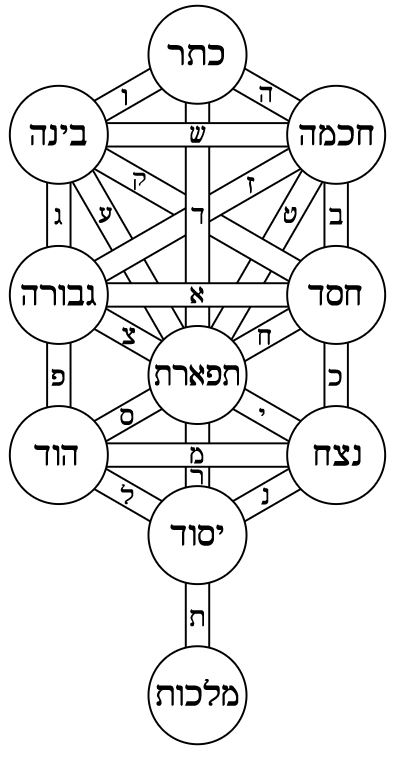
The “Tree of Life” depicting the Ten Sefirot, intertwined by the 22 Letters of the Hebrew Alphabet. Together, they make up the 32 Paths of Wisdom.

There are then 7 “doubled” letters, those that have two sounds in Hebrew:  Beit (ב), Gimel (ג), Dalet (ד), Khaf (כ), Pei (פ), Reish (ר), and Tav (ת). The double sounds of beit and veit, khaf and haf, pei and phei are well-known to us today, while the other four are a little more mysterious (see below on parashat Noach, ‘Shabbat or Shabbos: What’s the Correct Pronunciation?’)  The seven kefulot correspond to the seven times that the Torah says “God saw” (Genesis 1:4, 10, 12, 18, 21, 25, 31). The remaining 12 letters, the peshutot, correspond to the remaining 12 times that God is mentioned.

To summarize, the 32 paths derive from the 32 times that God is mentioned in Genesis, and further broken down into their groupings of 10, 3, 7, and 12 based on the specific type of verb used in relation to God.

Finally, all of these are embedded in the most famous of Kabbalistic diagrams, the Etz Chaim, “Tree of Life”. The 10 circles on the diagram correspond to the Ten Sefirot. The Sefirot are interconnected by 22 lines, corresponding to the 22 letters. There are three horizontal lines, corresponding to the three mother letters; seven vertical lines, corresponding to the seven doubled letters; and twelve diagonal lines, corresponding to the twelve elemental letters. This simple diagram amazingly captures a great deal of information, and is a key tool in Kabbalah—as well as the first step towards creating your very own calf!


The above is an excerpt from Garments of Light, Volume Two. Get the book here