
Pinchas is Eliyahu—and So Much More
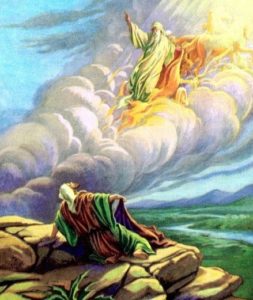
‘Elijah Taken Up to Heaven’
The Midrash famously comments on the eponymous subject of this week’s parasha that “Pinchas is Eliyahu” (Yalkut Shimoni I, 771). This statement is echoed throughout rabbinic texts and, with minor exceptions, all agree that Pinchas and Eliyahu were one and the same person. There are many reasons for this. With Pinchas, we read that God gave him a blessing of peace and “eternal priesthood”, suggesting that Pinchas would forever be a kohen. We go on to read how Pinchas was the kohen gadol for centuries, throughout the period of Judges, and the Tanakh never records his death. Meanwhile, Eliyahu appears in the Tanakh quite suddenly without any background information, genealogy, or patronymic. He goes on to avoid death and be taken up to Heaven in a fiery chariot.
Most tellingly, we find a unique Scriptural statement used in relation to these two figures, and no one else. Pinchas is described as having stood up zealously for God (בקנאו את קנאתי, Numbers 25:11), and Eliyahu uses the same words when speaking to God, saying he was zealous for God (קנא קנאתי, I Kings 19:10). The Sages conclude that they must be one and the same zealot! If that’s the case, why and how did Pinchas become Eliyahu? Continue reading
The Secret of HaMotzi Lechem
This week’s parasha is Balak, named after the Moabite king who sought to curse Israel. The Zohar spends a significant amount of time on the mysteries of this parasha. Included within it is a distinct mystical text known as the Yenuka, the “Child”, describing some fateful encounters between the Sages and an angelic youth, who reveals to them profound Torah secrets. (The identity of this child and some of his teachings were explored in the second edition of Secrets of the Last Waters.) In the first encounter (Zohar III, 186a), Rabbi Yitzchak and Rabbi Yehudah are travelling and make a stop at the home of the famous mystic Rav Hamnuna Saba. They meet the Rav’s wife and child, then settle down to rest and eat. This sets the stage for the youth to reveal the secrets of things like netilat yadayim, mayim achronim, and zimun.
In another encounter (III, 188a), Rabbis Elazar, Abba, and Yose make a stop at the same home. The Yenuka senses that the Sages are perplexed by an issue regarding Ammon and Moav (which ties to this week’s parasha, Balak being the king of Moav). The youth segues into a discussion of the mystical secrets of grains and breads. These teachings help us understand why the hamotzi blessing is so powerful and “covers” all other foods. It also explains why the Sages described bread as the most wholesome food, and one that can save a person from many illnesses: In Bava Metzia 107b, for instance, we read that the gematria of “illness” (מחלה) is 83, while “bread” (לחמה) is its anagram, with the same value. This is to teach that eating a simple meal of bread and water—with the right blessings and meditations in mind—can cure a person of 83 illnesses. Continue reading