Tag Archives: Arizal

What It Really Means to Be “Israel”

This week’s parasha, Vayishlach, begins with Jacob’s return to the Holy Land following a twenty-year stay in Charan. The most famous passage of this parasha is Jacob’s battle with a certain angel. After its defeat, the angel gives Jacob a blessing and renames him Israel. What is the meaning of “Israel”? What was the purpose of this battle to begin with? And what does it all have to do with Jacob’s difficult twenty years in servitude to his deceiving father-in-law Laban?

Jacob vs. Esau

The Torah describes in quite some detail the conception, birth, and early lives of the twins Jacob and Esau. We see that Jacob was an “innocent man, sitting in tents” while Esau was a “hunter, a man of the field.” As twins, and the only children of Isaac and Rebecca, they were meant to work together in carrying on the divine mission started by their grandfather Abraham. The mission was to rectify the world, and fill it with true Godliness and righteousness. Such work mainly consists of educating others, doing good, and spreading the light. However, when that doesn’t work, it is also necessary to fight evil head-on. This was exemplified well by Abraham, who was both a wonderful preacher and, occasionally, a fearless warrior (as in the “War of the Kings” in Genesis 14).

Jacob and Esau were meant to take this to the next level. Thus, Jacob was blessed with extra intellect, wit, and spirituality, while Esau was blessed with extra strength, physical abilities, and ambition. In an ideal world, Jacob would have acted as the peaceful teacher, while Esau would defeat any remaining evil in battle. As partners, they would have been unstoppable in bringing light, morality, and a new God-consciousness to the world.

Unfortunately, the two couldn’t channel their blessings in the right direction. Esau’s physicality got the better of him, and he descended into a never-ending spiral of materialism. At the same time, Jacob used his cunning to take Esau’s birthright instead of using his intellect to put his brother back on the right path. Nonetheless, Jacob remained dedicated to fulfilling his divine mission, while Esau “despised his birthright” (Genesis 25:34).

By taking Esau’s birthright and blessing, what Jacob had done was to take Esau’s mission upon himself. He, too, would have to become a fighter. However, Jacob was born soft and meek—not fit for battle—while Esau was the one born muscular and hairy, as if already a grown man (hence his name Esav, literally “complete”). Could Jacob really become that holy warrior that Esau was meant to be? Jacob had to be put to the test.

Becoming Israel

Right after receiving Esau’s blessings, Jacob was told that his brother was out to get him. The soft Jacob immediately fled the Holy Land, as far away from his brother as he could. This was true to his character as a docile man, “sitting in tents”. But this was clearly not what a holy warrior would do.

Jacob ended up in the home of his uncle and future father-in-law, Laban. He instantly fell in love with Laban’s younger daughter Rachel, and agreed to work for Laban for seven years to be able to marry her. After seven years, Jacob was tricked into marrying the elder Leah instead of his beloved Rachel. It is hard to miss the irony of it all: Jacob, the one who tricked his father into getting his older brother’s blessing, is now tricked by his father-in-law into marrying his beloved’s older sister!

Laban forces Jacob to work for another seven years. This is, of course, completely unjust. A man such as Esau would have surely taken on Laban in combat, but the spineless Jacob simply agrees, and slaves away for seven more years. Following this, Laban finds more ways to trick Jacob out of an honest wage. Thankfully, Jacob is starting to learn, and begins to counter Laban’s wits with his own, soon building even greater wealth than his father-in-law.

At this point, Jacob hears that Laban is not very pleased with Jacob, and Jacob fears for himself and his family once again. As he did twenty years earlier, he decides to flee. While Laban was away shearing his sheep, Jacob takes the opportunity to run, taking the whole family with him. It appears that Jacob fails the test yet again, and is unable to confront his evil enemies.

Ten days later, Laban and his men find Jacob, and everything begins to change. Laban waltzes in to Jacob’s camp and begins threatening his son-in-law as he’d always done in the past. But this time Jacob has had enough, and realizes he can’t run away anymore. “And Jacob was angered, and battled with Laban” (Genesis 31:36). Jacob succeeds, and Laban seeks a peace treaty (v. 44). The two make a pact and part ways, never to see each other again. Jacob is becoming a fighter.

Jacob vs. Israel

This sets up parashat Vayishlach, where Jacob has to face off with Esau twenty years after running away from him. The night before, Jacob goes off on his own and is confronted by a mysterious figure (see ‘With Whom Did Jacob Wrestle? in Volume One of Garments of Light). The two battle it out all night long, and Jacob finally prevails. He is certainly no longer that weak, passive man he was two decades earlier. He has earned his badge of being a holy warrior. And with this, he is given a new name: Israel, one who “battles with God”; not against God, but alongside God, to defeat evil and make the world a better place. Jacob finally proves that he can indeed be Esau, and is worthy of having taking Esau’s birthright and blessing.

The Sages tell us that this is the real reason why Jacob had to marry both Rachel and Leah. Originally, since Rebecca had two sons and Laban had two daughters, the plan was for the younger Jacob to marry the younger Rachel, while the older Esau would marry the older Leah (Bava Batra 123a). Truly, these two couples were soulmates. However, Esau lost his spiritual essence to Jacob, and with it, his spiritual counterpart, Leah. The problem is that the Torah forbids a man from marrying two sisters! The Arizal (Sha’ar HaPesukim on Vayetze) tells us that, in fact, Rachel and Leah did not marry one man, for Jacob and Israel were really two souls in one body, and while Jacob married Rachel, it was Israel that married Leah. After all, Israel was the new Esau, the part of Jacob that wasn’t just “sitting in tents” but was capable of being a “man of the field”, too.

We later see that Israel was Jacob’s true self, his more-elevated inner being, and what he was really meant to be all along. God confirms this with a prophetic blessing (Genesis 35:10): “‘You shall no longer be called Jacob, but Israel shall be your name.’ And He named him Israel.”

This brings a tremendous lesson for all of us: we are not meant to be the weak Jacob, passively sitting in tents and being pushed around. Rather, we are meant to be Israel, who can balance study and prayer with strength and might; who can balance the physical with the spiritual, science with religion, and who knows both when to seek peace and when to pursue war. It is most fitting that the founders of the modern Jewish State decided to call it “Israel”. (In fact, they had originally planned to call it “Judah”, then “Zion”, and even “Tzabar”, before voting 7 to 3 in favour of “Israel”). If Israel is to fulfill its divine task, it should live up to its name: battling alongside God, as holy, righteous warriors, to repair the world—physically and spiritually—restoring it to its original, perfected state.


The above is an excerpt from Garments of Light, Volume Two. Get the book here

How Did Adam Live 930 Years?

This week’s parasha is Vayelech, which begins with Moses’ statement that “Today I am one hundred and twenty years old” (Deut. 31:2). It was the 7th of Adar, Moses’ birthday, and also his day of passing. Moses goes on to conclude his final speech to the people, then sings a deeply prophetic farewell song in next week’s portion Ha’azinu, followed by his blessings to the people in the last parasha of the Torah, V’Zot HaBracha.

Moses was the greatest of all prophets, the humblest man to walk the earth, and the central founding figure of Judaism. He was blessed with living a full and healthy life spanning exactly 120 years. It has become common today for people to wish each other 120 years of life. Why is this the specific figure? Can humans not live longer? Don’t we see in Genesis that Adam lived 930 years, Noah lived 950 years, and Methuselah (Metushelach) lived a record 969 years? What happened?

The Flood Generation

Ten generations from Adam, the world had descended into endless sin and immorality. God decreed that man’s days “will be numbered at one hundred and twenty” (Genesis 6:3). Many believe this to mean that God decreed humans will no longer be able to live past 120 years. Indeed, when looking at modern records of longevity, the vast majority of the world’s oldest people die close to 120 years. There has only been one official case of anyone exceeding 120, a Frenchwoman named Jeanne Calment who lived 122 years.

However, the traditional Jewish interpretation is that the Genesis verse above does not mean man is unable to live past 120. After all, our forefathers Abraham, Isaac, and Jacob lived long after this decree, and they lived 175, 180, and 147 years, respectively. Rather, the Jewish Sages state that God decreed the arrival of the Great Flood 120 years hence. God gave mankind 120 years to repent, and possibly avert the Flood. Noah was commissioned to go around and inspire people to mend their ways, and he had 120 years to do it.

Unfortunately, Noah failed in this endeavour, unable to bring even a single person to righteousness (as the Ark only carried his own family at the end). This is one reason for why the Flood is known in Hebrew as mabul Noach, literally “Noah’s Flood” (or mei Noach, “Noah’s waters”), as if he was partially responsible for not doing enough to inspire people to change. Because of this, many (including Rashi) have commented on the verse “Noah was a righteous and pure man in his generation” (Genesis 6:9) to mean that Noah was only righteous in his faulty generation. Had he lived in another generation, such as that of Abraham, he would not have been deemed so righteous!

We see from the Biblical chronology that after the Flood, people’s life spans steadily shorten. Moses’ older siblings Aaron and Miriam lived 123 and 126 years. Moses died at 120, and this appears to have become the new limit. After Moses, there are only a few people noted to have lived longer, one of which is Yehoyada the High Priest, who lived 130 years (II Chronicles 24:16).

What accounts for this steady degeneration in longevity?

Yeridat HaDorot

The Talmud (Shabbat 112b) states: “If the earlier [scholars] were sons of angels, we are sons of men; and if the earlier [scholars] were sons of men, we are like asses…” This is one of many passages that attests to the well-known concept of yeridat hadorot, “the descent of the generations”. It is said that each passing generation falls lower and lower in its wisdom and spiritual greatness. This concept can solve the puzzle of longevity.

The body is a finite lump of matter. It is only animated and vitalized by the infinite soul within it. Thus, the greater the soul, the longer the body can live. As the spiritual potential in each generation falls, so too does the lifespan.

Moreover, it is taught that Adam contained essentially all of the souls of humanity within him (Sha’ar HaGilgulim, ch. 11). As more and more people were born over the centuries, this single universal soul broke down further and further into smaller and smaller fragments. With the exception of a number of “new souls”, the vast majority of the world’s 7 billion people are all parts of the soul of Adam. It is therefore not surprising that today’s spiritual capabilities (and with that, the lifespans) are severely limited.

At the Speed of Light

Science may offer another intriguing possibility. According to modern physics, time as we know it doesn’t really exist. The universe is one interwoven fabric of both time and space. The faster one moves through space, the slower the effects of time for that person. There is actually a formula to measure the impact of this time dilation, known as the Lorentz transformation. It is given by the equation ΔT = t√1-v2/c2 [or: t = t÷ √(1-v2/c2)], where v is one’s speed and c is the speed of light.

Theoretically, the speed of light is the absolute maximum in our universe. At light speed (just under 3.00 x 10⁸ m/s, or 300,000 km/s), time will totally stop for the traveller (if plugging it into the formula, one gets a value of zero). This seems impossible. However, if we plug in a value very close to light speed, such as 2.99 x 10⁸ m/s, we get a very interesting result.* A person who has perceived living 80 years will have actually lived 980 earthly years! That makes Adam’s 930 years a more palatable 76, and Methuselah’s record 969 as 79. This fits in well with the verse in Psalms that a normal lifespan is 70 to 80 years (Psalms 90:10). But how could Adam and Methuselah have lived at near-light speed?

Beautifully, the Sages teach us that Adam was not a human like us. In many texts (such as Bereshit Rabbah 20:12), Adam is described not simply as a being of flesh, but rather as a being of light. Though most will interpret this metaphorically, there are those sages, such as the Arizal (for example, in Sefer HaLikutim, Bereshit, ch. 3) that interpret this quite literally. It remains to be seen what this means exactly, and if it has anything at all to do with physics, but perhaps there is much more to the idea of Adam being a man of light than we can imagine.


The article above is an excerpt from Garments of Light: 70 Illuminating Essays on the Weekly Torah Portion and Holidays. Click here to get the book! 

——–

*To be fair, choosing a value such as 2.99 x 10⁸ m/s may be deemed quite arbitrary. One can also plug in finer values even closer to the speed of light, such as 2.997 or 2.9972, and so on, each of which would give a more refined result. The point of this exercise is simply to illustrate the relativity of time, and what might explain the difference in perceived years between our generations and those of the first people, through a scientific perspective.

Bilaam: The Last Prophet

This week’s Torah portion, Balak, is named after the Moabite king who sought to curse the Jewish people in the Wilderness. Seeing how the Hebrew nation had grown so large and powerful, and had earned God’s favour, Balak feared the Jews. He knew that taking them on physically would fail, so he decided on a spiritual solution to his problem. He summoned Bilaam (or Balaam), the greatest prophet among the gentiles, to curse the Jewish people in return for vast riches. Bilaam, however, refused the generous offer, knowing that there was no way he could curse the Jews if God did not wish it. Bilaam admitted that as a genuine prophet, he could only pronounce what Hashem would put in his mouth, and nothing more. Nonetheless, Balak continued to entice Bilaam until the prophet acquiesced, and agreed to give it a shot. Every single one of his attempts failed, and each time that Bilaam would open his mouth to curse the Jews, a blessing would emerge instead. Frustrated, Balak and Bilaam give up.

The story does not end there, though. Having failed to curse the Jews, Balak and Bilaam come up with another plan. Knowing that God’s favour only rests upon the Jews when they act righteously and in a holy manner, the two realized that they could tempt the Jews towards sin. Once the people are mired in sin, God’s divine protection would be lost, and the nation would in effect be cursed. This time, their plan worked like a charm.

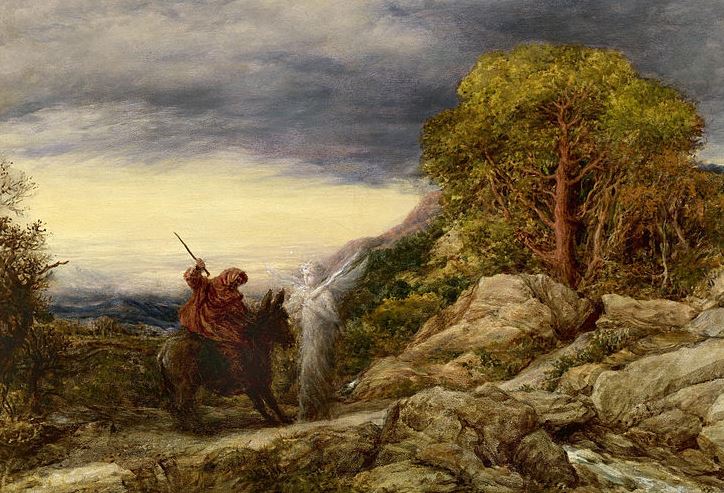
'Balaam and the Angel' by John Linnell

‘Balaam and the Angel’ by John Linnell

Balak and Bilaam sent a great number of gentile women to bring the Jewish men into sexual immorality and licentiousness. From there, they enticed them further into idolatry. Everything spins out of control, and Moses seems powerless to stop the endless cycle of sin. This reaches a climax when Zimri, the prince of the tribe of Shimon, publicly engages in sexual acts with a Midianite woman.

It is Pinchas, the grandson of Aaron, who finally steps in to end the tragedy. He slays Zimri, shocking the nation and waking the people. Pinchas is given an everlasting blessing for bringing an end to the immorality. According to some opinions, he later slays Bilaam as well. The Talmud (Sanhedrin 106a) states that it was precisely when Bilaam went to redeem his reward that he was killed.

Interestingly, all of the ancient texts agree that Bilaam was a true prophet, and was even equal in prophecy to Moses! How did Bilaam attain the merit for prophecy, and how did he fail so miserably?

The Origins of Bilaam

The Midrash relates how the gentiles brought a complaint against God. They argued that had God given them a leader like Moses, they too would have surely become holy and righteous nations. So, God did indeed send them a prophet like Moses. This was Bilaam.

In fact, the Arizal states that Moses and Bilaam stem from the same spiritual root: they were both reincarnations of Abel, the son of Adam (Sha’ar HaGilgulim, ch. 29). The spiritual spark corresponding to the letter Hei in Abel’s name (הבל) was given to Moses (משה), while the sparks corresponding to the letters Bet and Lamed in Abel’s name (הבל) were given to Bilaam (בלעם). So, it isn’t surprising that the two are often described as being of equal greatness in prophecy.

Unfortunately, the gentiles’ request for a prophet did not bring the result they had expected. Instead of using their prophet as a leader for goodness, they adopted him to further their own evil ends.  And this began long before Balak summoned him.

The Talmud (ibid.) recounts how Bilaam was once one of the three main advisors and soothsayers to the Pharaoh in Egypt. The other two were Iyov (Job) and Yitro (Jethro). When Pharaoh’s astrologers saw that the Redeemer of the Hebrews would soon be born, it was Bilaam who advised that all the male firstborn be drowned. Job was against the idea, but remained silent. For this, he was so severely punished (as described in the Book of Job). Jethro was the only one who spoke up and tried to avert the decree. For his opposition to the Pharaoh, he was forced to flee the kingdom. In poetic fashion, the very redeemer he was trying to save at birth ended up being his own son-in-law! Bilaam, meanwhile, ended up working with Balak to try and finish the job he started over a century earlier. Once again, he failed.

A Balance in the Universe

The Midrash (Tanchuma on Balak, Passage 1) elaborates that for every great leader, king, or prophet that God had sent the Jews, he equally sent one to the non-Jews. King Solomon’s counterpart was Nebuchadnezzar. While the former used his talents to build the First Temple, a House for God and a place of holiness and unity, the latter used those same talents to destroy that very same holy place. King David’s counterpart was Haman. Both were blessed with wealth and success. The former used these resources to bring the people together and unify all the tribes, bringing peace to the region; the latter used his resources to incite a genocide. Moses’ counterpart was Bilaam. The former used his prophecy to bring God’s message of holiness, peace and goodness; the latter used his prophecy for idolatry, destruction, and immorality. The passage in the Midrash concludes that God subsequently took away all forms of prophecy from non-Jews. Bilaam was the last true prophet among the gentiles.