
This week’s parasha, Metzora, introduces us to the laws of menstrual purity, or niddah. Over the centuries, these laws expanded considerably and became so complex that they required a whole tractate in the Mishnah and Talmud, followed by many more halakhic texts. In the Torah, however, the law is quite simple and straightforward:
When a woman has a flow, her flow being blood from her body, she shall remain in her menstrual separation seven days; whoever touches her shall be impure until evening. Anything that she lies on during her menstrual separation shall be impure; and anything that she sits on shall be impure. Anyone who touches her bedding shall wash their clothes, bathe in water, and remain impure until evening… (Leviticus 15:19-21)
Once a woman’s period starts, she becomes ritually impure for a seven-day period. Things she touches become impure as well, and anyone who touches those things will contract the impurity. This was really only relevant during Temple times, and mattered particularly for those who wanted to go to the Temple. Therefore, since the destruction of the Temple, we are not concerned with contracting impurity by touching the bedding or others items that a niddah touched. That said, there is still a halakhic prohibition for a man to touch his wife while she is niddah, not because of the concern of contracting impurity, but because of the concern that it will lead to more intimate contact.
The Torah says that the total period of impurity is seven days. At the conclusion of seven days, the woman needs to immerse, and then she is permitted to her husband. (The Torah does not explicitly say that a woman has to immerse after her period is over, but since it says that anyone that touches her or her bedding needs to immerse, we derive from this that the woman herself needs to immerse as well. Yehudai Gaon, in the late 8th century, wrote it succinctly in his responsa that the tevilah immersion requirement is a kal v’homer, an a fortiori derivation, from one that touches a niddah, קל וחומר ממגעה).
So, according to the Torah, for a regular period the total time of husband-wife separation is seven days, counting from the start of the period. Scientifically, the average length of a woman’s period is 5.2 days, so by day 7 the period is over in the vast majority of cases, and the woman can be purified. What happens if the period runs longer than 7 days? Or what if there is unexpected bleeding at a time when a period is not imminent? The Torah continues:
When a woman has a flow of blood for many days, not at the time of her menstrual separation, or when she has a discharge beyond her period of menstrual separation, she shall be impure, as though at the time of her menstrual separation, as long as her discharge lasts… When she becomes purified of her discharge, she shall count off seven days, and after that she shall be pure. (Leviticus 15:25-28)
In this case, the requirement is to wait until the bleeding stops, and then count seven “clean” days. This is not a regular case of menstrual niddah (also called davah in the Torah), but rather a case of zavah, an irregular flow of blood. At some point in history, a switch was made where every case of a regular period was treated as a zavah, and henceforth a woman has to wait for her period to end, and only then start the count of seven clean days. When, and why, did this happen?
The Mystery of a Halakhic Leap
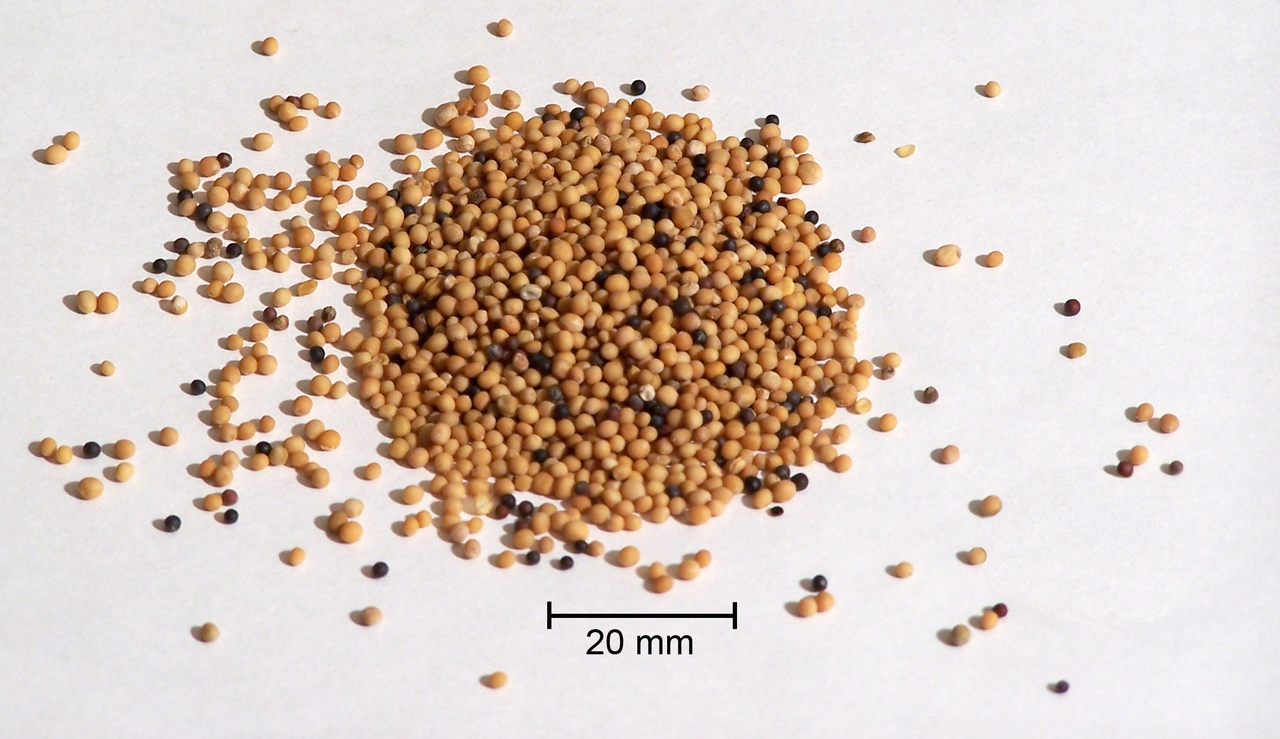
Mustard seeds
Neither the Torah (the Written Law) nor the Mishnah (the Oral Law) says anything about waiting an additional week for a regular period. So when did this leap occur? The standard answer is that it occurred in the Talmudic era (roughly 200-500 CE). The Talmud (Niddah 66a) famously quotes Rabbi Zeira saying that “Jewish women were stringent with themselves to the extent that even if they see a drop of blood the size of a mustard seed, they sit seven clean days for it.” Presumably this is the justification for waiting seven more clean days after a period. However, this statement is taken entirely out of context!
What’s actually going on is that the Talmud here is discussing various strange cases of irregular bleeding, zavah, not cases of regular periods. We are then told that Rabbi Yehuda haNasi (compiler of the Mishnah) made a decree for those Jews living in rural areas who did not have much Torah wisdom or access to a qualified rabbi. For those Jews “in the fields”, if a woman saw irregular bleeding for one day, she should wait six more “clean” days before being intimate again. If she saw bleeding for two days, she should also wait six more clean days. And if she saw blood for three straight days, then she should essentially be considered a zavah and wait the full seven clean days.
Immediately after this we are told by Rabbi Zeira that Jewish women took upon themselves to wait the full seven clean days even for a mustard seed of a blood. In context, the conversation is clearly referring to irregular and unexpected bleeding, not to regular menstruation. Shortly after on the same page of Talmud, Rav Pappa cites Rabbi Zeira’s dictum, but Rava (who lived c. 280-352 CE) objects and says “I speak to you of a prohibition, and you speak to me of a custom?! Where the Jewish women were stringent, they were stringent; where they were not stringent, they were not stringent!” Rava confirms that this was actually not a universal custom.
Elsewhere (Berakhot 31a), the Talmud states that Rabbi Zeira’s position eventually did become the “conclusive halakhah” everywhere, not to be disputed. Yet, that discussion was clearly about cases of irregular bleeding, not regular menstruation. For any unexpected and irregular bleeding, even if it was just a mustard seed, or just for a day, the halakhah was to wait an extra seven clean days just in case. This is pretty reasonable and makes sense. Presumably, it wouldn’t happen too often anyway. It had nothing to do with regular, expected menstruation.
In fact, we are also told that Rabbi Ishmael had asked Rabbi Yehuda haNasi (the same one who made the “decree in the fields”) to take upon himself three additional stringencies (Pesachim 112b). One of them was to wait an extra night after his wife goes to the mikveh before being intimate. And Rav confirms here that this is referring to niddah d’oraita, to the total seven days from the start of a period, as the Torah commands. Meaning, in the times of Rabbi Yehuda haNasi women undoubtedly still kept one week total from the start of the period, and there was no extra seven clean days for regular menstruation. Rabbi Yehuda haNasi took upon himself an added stringency of waiting an extra day, ie. eight days total. So when did waiting seven clean days for a regular period really emerge?
By the time of the Rishonim (c. 1000-1500 CE), everyone seems to understand that Rabbi Zeira’s position includes regular periods, too. Rashi says it (on Berakhot 31a, for instance) and Rambam, too (multiple times, including Hilkhot Issurei Biah 11:4). It’s not clear how that leap occurred. At some point between the Talmud and the Rishonim, the understanding of Rabbi Zeira’s dictum changed. But was it really universal for the “daughters of Israel” to keep seven clean days for periods? That was certainly not the case in Talmudic times (as we saw above), and the historical record suggests that it wasn’t even the case in the times of the Rishonim. In fact, we can prove it from the Rambam himself, based on a surprising edict he decreed in 1176 CE.
The Rambam Decree
In the 12th century, Egypt was home to probably the largest Jewish population in the world. A strong and relatively tolerant government made it a generally good place to live for Jews. The Rambam (Rabbi Moshe ben Maimon, 1138-1204) himself found refuge there, after first fleeing Cordoba in Spain, then fleeing Fez in Morocco, and failing to settle in Israel. Did the Jewish women of Egypt at the time keep seven clean days? Not at all. And we know this because the Rambam actually gathered nine other big rabbis in Egypt and composed a decree that they all signed. We have the full text of the decree available to us today. Amazingly, one original copy was even found in the Cairo Genizah.
The decree chastises Jewish women for not keeping the seven clean days, and for also not immersing properly in a mikveh. Instead, most women at the time waited seven days from the start of the period (like the Torah says) and then did a washing called sakb, where they sat in a bath and water was poured over them by a woman who was pure. In an attempt to eliminate this practice, and compel women to keep seven extra clean days after their period, the Rambam ruled that any woman who does not follow the rabbinic stringencies forfeits her ketubah.
… Every Jewish woman who does not immerse in mikveh water after counting seven clean days according to the laws of the daughters of Israel, or who performs the aforementioned sakb—this woman may be divorced without a dower [ketubah] and retains no (right) either to a dower or to any marriage contract [ketubah] stipulations…
The Rambam and his colleagues didn’t stop there. They had to force the men to comply, too, so they decreed:
Likewise, we resolved that any man proven to have had intercourse with his wife while [violating] one of these three sins, and knew that (this was the case) and remained silent, and did not state this in court until the time of divorce—the court should excommunicate this man, humiliate him, expel him from the congregation, and fine him, according to the court’s capacity to deal with this man, and as the judge sees fit and as the times permit.
What do we learn from this? That even as late as the 12th century, in the largest Jewish community in the world, the vast majority of women did not wait seven clean days after their periods. The stringency had to be enforced by rabbinic decree, with strict and harsh penalties for anyone who resisted. In the Talmudic era, no such stringency existed—the Talmud was clearly referring to waiting seven clean days for irregular bleeding in potential cases of zavah, not for regular periods. By the time of the Rishonim, the switch was made to include all cases of bleeding, and henceforth was imposed by the rabbis. The Ramban (Rabbi Moshe ben Nachman, 1194-1270) confirms this, writing “that stringency that the daughters of Israel initiated was approved by the Sages so they made it the halakhah in all places, and therefore it is forbidden for a person to ever be lenient with it.” (Hilkhot Niddah 1:19)
Looking for Answers
Is there any way to explain the great halakhic niddah leap? One suggestion, as proposed by Shai Secunda in his The Iranian Talmud and The Talmud’s Red Fence, is that it came out of “religious competition” with neighbouring Zoroastrians in the Persian Empire. Recall that the Talmud was composed in the Persian Empire, and the Savoraim and early Geonim who compiled, finalized, and published the Talmud all lived under Persian-Zoroastrian authority. The Zoroastrians were also very strict with niddah laws, so it could well be that their stringencies rubbed off on Jewish communities and on Jewish practice. In fact, we are even told in the Talmud (Niddah 20b) that the Zoroastrian queen Ifra Hormiz tested Rava for his knowledge and expertise on menstrual blood. (For lots more on this, see the third installment of the Judaism vs. Zoroastrianism class, that focused on the development of niddah laws in the Zoroastrian context.) Moreover, the Zoroastrian Old Persian word for niddah, dastana or dashtana, appears multiple times in the Talmud (such as in Avodah Zarah 18a). It’s quite possible that Jews and Zoroastrians took on ever-stricter niddah stringencies in a case of religious oneupmanship, to outdo one another in holiness.
Another possibility is that it emerged simply out of confusion and lack of education. The time period between the Talmud and the Rishonim (roughly 500-1000 CE) is referred to by historians as the “Dark Ages”. In comparison to the eras before and after, there was relatively little science and progress going on at the time, with widespread illiteracy and ignorance. War, poverty, disease, and catastrophes of every kind were rampant. Shockingly, the year 536 CE saw the eruption of a massive volcano (some say several volcanoes) that blacked out much of the sky across the Northern Hemisphere, causing “volcanic winters”, plunging temperatures, low sunlight, and massive crop failures. We have abundant evidence of terrible famines from Western Europe all the way to Eastern China. Some historians have described 536 as the “worst year in human history”. The effects reverberated for many decades. One of the negative effects was that scholarship and education was at a bare minimum. Of course, the Jewish world was just as affected as the rest of the world. Indeed, we find during this time practically no major Jewish scholarship, and few great works emerging.

Timeline of rabbinic eras from 200 BCE to the present.
Think about it: we know a great deal about Jews and rabbis in the Talmudic period (and have thousands of pages and volumes of Talmud and Midrash from this era), and we know a tremendous amount about Jews and rabbis in the era of Rishonim, with so many great sefarim, halakhic codes, mystical texts, and other brilliant works. But what about the period 500-1000 CE? We know hardly anything about it, and have few texts from this era, save for some Geonic responsa and a handful of others. Today, the typical religious Jew has definitely studied Mishnah, Talmud, and Midrash (from the pre-500 CE era) and can list dozens of rabbi names from this time period; and the typical religious Jew has definitely studied Rashi, Tosfot, and Rambam (from the post-1000 CE era) and can name dozens more rabbis from this time period. But how many have studied something from between 500-1000 CE? How many can describe the life of a great rabbi from this time period? (Maybe one, like Saadia Gaon.) How many can even name a famous sefer from this period? How many can name a single one of the Savoraim? If the Talmud was completed around 500 CE, why did it take over five centuries for someone (Rashi) to write a complete commentary on it? Why did it take nearly seven centuries for someone (Rambam) to codify it?
Rabbinic Jewish history clearly had a “Dark Age” as well. There is a gap of several centuries of great scholarship, and the recovery appears to only start in the 800s. (Interestingly, the Rambam credits Saadia Gaon, who lived in the 9th century, with saving Judaism at a time when it hit a particularly low nadir.) It’s probably also in this Dark Age when authentic semikhah ordination was lost, when tekhelet dye stopped being used on tzitzit, and likely many other things forgotten. I believe it’s possible that one of the things that was forgotten or confused were niddah laws, particularly the understanding to distinguish between zavah and a regular niddah.* Perhaps it was during this time that rabbis started to “play it safe” or just make it simpler by demanding seven clean days for any case of blood, regular or irregular, expected or unexpected.** (The widespread malnutrition and famine in the 6th century might have played a role, too, since we know that malnutrition and irregular periods are strongly linked.) The rabbis of that time could justify the expanded prohibition retroactively based on Rabbi Zeira’s old dictum. By the time of the Rishonim, that became the accepted halakhah. Unfortunately, this raises major issues and difficulties.
A Host of Issues
One of the infamous problems that emerges from an extra seven days is “halakhic infertility”. For most women, ovulation begins one week after menstruation ends. For some women, however, ovulation comes early. By the time “mikveh night” comes around it is too late, and the woman is unable to get pregnant. Some women end up going months struggling with infertility and thinking there is something wrong with them, when it is really just a biological quirk of time. If they figure it out (hopefully), they then need to seek a heter from a rabbi to give them permission to immerse earlier. (It’s hard to miss the painful irony of a woman needing a man’s permission to go around a stringency that women allegedly took upon themselves!) Most rabbis are sympathetic, some are not. Things can get particularly complicated in the Ultra-Orthodox world, and women have shared terrible stories of being told nothing can be done, or to try IVF, or to go on pills or hormones to change their cycle.
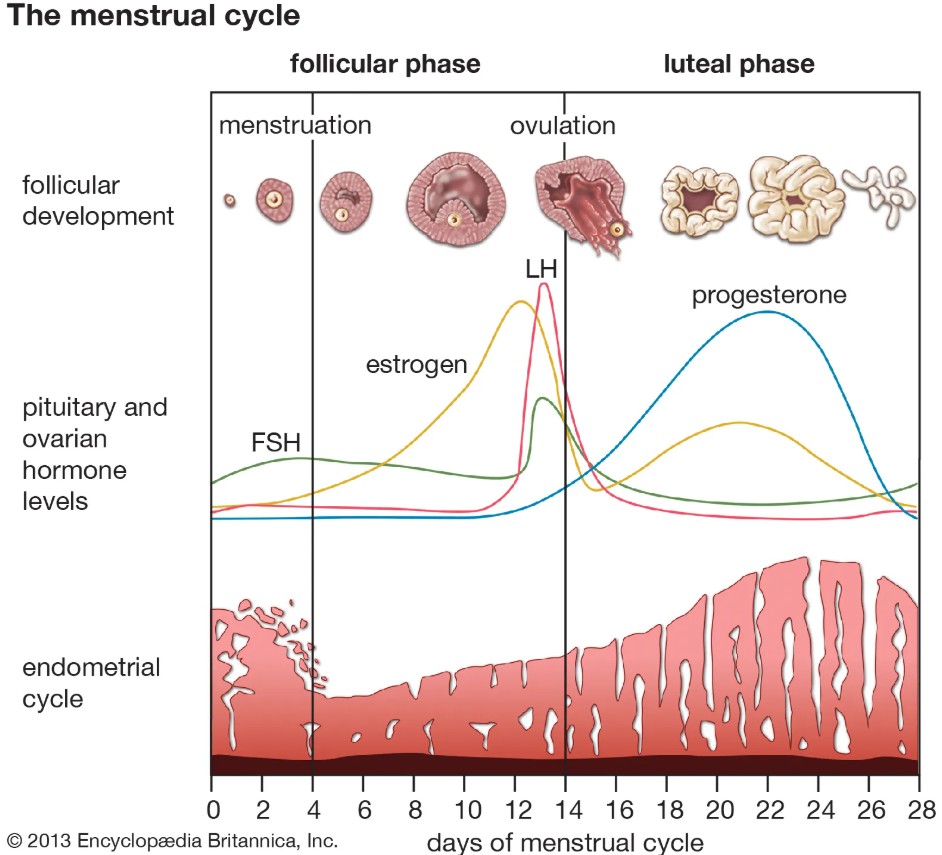
Note how estrogen (and testosterone) levels peak right before ovulation. Progesterone levels rise after ovulation to prevent another egg from being released. This is why synthetic progesterone is used for birth control or to delay or stop the cycle.
Meanwhile, women who have already fulfilled the mitzvah of reproduction might choose to go on pills or get hormonal IUDs to eliminate their menstrual cycle entirely. There are many women out there who simply don’t want to deal with niddah laws and restrictions at all (understandably), and resort to modern technology to absolve themselves. This leads to a whole new host of issues, including side-effects from the hormones (lower libido, bodily changes and imbalances, weight gain, headaches, to name a few), possible increased risks of illnesses (blood clots and cardiovascular disease, cancer, chas v’shalom), and the spiritual loss of not fulfilling the Torah’s mitzvahs. In an attempt to avoid rabbinic stringencies, women choose to forgo the Torah itself.
For the many women that the above does not apply to, other issues emerge. One is a lack of desire. Biologically, it is after menstruation that estrogen and testosterone levels rise in a woman’s body, peaking at ovulation and then rapidly declining. This can result in more desire during the seven clean days when intimacy is forbidden, and much less when intimacy is permitted. For men, too, there could be a big challenge, having to go nearly two weeks without contact. (While it might sound excessive, the Talmud does state in Ketubot 61b that for a regular free man, daily cohabitation is normal, and for a hard labourer, twice a week is normal. Torah scholars, meanwhile, should limit to once a week, preferably on Shabbat.) It’s not uncommon for men to succumb to temptations during the period of niddah separation, and then commit much worse sins. Again, trying to keep rabbinic stringencies could well lead to violation of actual Torah laws that Hashem commanded. Besides intercourse, the prohibition of any contact at all for an extra week—including a comforting hug after a bad day, or a playful peck on the cheek, or even just passing an object directly to one another; not to mention sleeping in separate beds or separate rooms—makes things all the more difficult, and can put major strain on a marriage.
When we go back to the Torah, Hashem only commanded seven days of separation total for a regular period, which makes perfect sense biologically. He created us and knows what’s best for us. Rabbi Meir adds (Niddah 31b) that the one week of separation is the ideal amount of time for rekindling the passion between husband and wife (אָמְרָה תּוֹרָה: ״תְּהֵא טְמֵאָה שִׁבְעָה יָמִים״, כְּדֵי שֶׁתְּהֵא חֲבִיבָה עַל בַּעְלָהּ כִּשְׁעַת כְּנִיסָתָהּ לַחוּפָּה). What we have before us is not a case of just adding a “fence”, what we have is totally changing how a God-given Torah mitzvah is practiced and fulfilled. And it’s not even based on anything concrete in the Mishnah or Talmud! The consequences of this are troubling and unfortunate. These are all extremely important matters to think about and discuss. The topic is sensitive, yes, and for that reason many avoid it entirely. But that should be all the more reason to have these important conversations, both with spouses and rabbis.
It is worth concluding with Midrash Tehilim on Psalm 146:7, which says that Hashem is matir asurim, “freeing the bound” or “imprisoned” but also, literally, “permitting the forbidden”. The Midrash explains that “There is no greater prohibition than the niddah, when a woman sees blood and God forbids her to her husband. And in the future, He will permit it.” (ומהו מתיר אסורים אין איסור גדול מן הנדה שהאשה רואה דם ואסרה הקב”ה לבעלה. ולעתיד לבוא הוא מתירה.) The Midrash goes on to say that surely not all laws of niddah will be suspended, and that actual cohabitation with a woman on her period will still be forbidden, as the eternal Torah says. Rather, then, in the soon forthcoming time of Mashiach, all of the niddah stringencies and extras will be lifted, and we will go back to a purer observance of the mitzvah, as Hashem commanded in the Torah.
For further discussion of the development of niddah laws (including the connection to the Garden of Eden, and to the case of Sarah and Abraham), see the following class:
*A regular niddah is called a davah in the Torah (as at the start of parashat Tazria, Leviticus 12:2). The irregular case is called a zavah. I wonder if some of the confusion was linguistic. After all, Aramaic words typically replace the letter zayin in Hebrew words for a dalet. For example, the Hebrew mizbeach (מזבח) is Aramaic midbacha (מדבחא), while Hebrew zakhar (זכר) is Aramaic dakhar (דכר). Following the same rule, the Hebrew zavah (זבה) would be the Aramaic davah (דבה)! Does this have something to do with the confusion of a regular niddah, ie. a davah, with the irregular zavah?
**Another confusion that solidified by the time of the Rishonim is the length of a niddah cycle. Rashi (on Berakhot 31a), Rambam (Issurei Biah, Ch. 6), and others describe that there are “11 days between one niddah and another”. That would imply a menstrual cycle of no more than 18 days, which is impossible, and at no point in human history was this the case biologically. Rabbis and scholars have puzzled over this for centuries, and tried to make sense of it. It is based on the Talmudic dictum that the 11 days following menstruation are days when bleeding would make a woman zavah. This statement is repeated countless times throughout tractate Niddah, but what it originally meant is not exactly clear. It probably only meant that unexpected bleeding during the eleven-day window following menstruation makes a woman zavah, but bleeding after this eleven-day period would not. Bleeding that followed the zavah window, but came before the next period, would be a different case altogether. It seems that by the time of the Rishonim, the gap was shortened and it was assumed that a cycle is 18 days, with the Rambam, for instance, saying that a woman is always vacillating between seven and eleven, seven and eleven, and that “such is a woman’s life: seven days of niddah and eleven days of zivah, etc.”