Tag Archives: Jacob

What It Really Means to Be “Israel”

This week’s parasha, Vayishlach, begins with Jacob’s return to the Holy Land following a twenty-year stay in Charan. The most famous passage of this parasha is Jacob’s battle with a certain angel. After its defeat, the angel gives Jacob a blessing and renames him Israel. What is the meaning of “Israel”? What was the purpose of this battle to begin with? And what does it all have to do with Jacob’s difficult twenty years in servitude to his deceiving father-in-law Laban?

Jacob vs. Esau

The Torah describes in quite some detail the conception, birth, and early lives of the twins Jacob and Esau. We see that Jacob was an “innocent man, sitting in tents” while Esau was a “hunter, a man of the field.” As twins, and the only children of Isaac and Rebecca, they were meant to work together in carrying on the divine mission started by their grandfather Abraham. The mission was to rectify the world, and fill it with true Godliness and righteousness. Such work mainly consists of educating others, doing good, and spreading the light. However, when that doesn’t work, it is also necessary to fight evil head-on. This was exemplified well by Abraham, who was both a wonderful preacher and, occasionally, a fearless warrior (as in the “War of the Kings” in Genesis 14).

Jacob and Esau were meant to take this to the next level. Thus, Jacob was blessed with extra intellect, wit, and spirituality, while Esau was blessed with extra strength, physical abilities, and ambition. In an ideal world, Jacob would have acted as the peaceful teacher, while Esau would defeat any remaining evil in battle. As partners, they would have been unstoppable in bringing light, morality, and a new God-consciousness to the world.

Unfortunately, the two couldn’t channel their blessings in the right direction. Esau’s physicality got the better of him, and he descended into a never-ending spiral of materialism. At the same time, Jacob used his cunning to take Esau’s birthright instead of using his intellect to put his brother back on the right path. Nonetheless, Jacob remained dedicated to fulfilling his divine mission, while Esau “despised his birthright” (Genesis 25:34).

By taking Esau’s birthright and blessing, what Jacob had done was to take Esau’s mission upon himself. He, too, would have to become a fighter. However, Jacob was born soft and meek—not fit for battle—while Esau was the one born muscular and hairy, as if already a grown man (hence his name Esav, literally “complete”). Could Jacob really become that holy warrior that Esau was meant to be? Jacob had to be put to the test.

Becoming Israel

Right after receiving Esau’s blessings, Jacob was told that his brother was out to get him. The soft Jacob immediately fled the Holy Land, as far away from his brother as he could. This was true to his character as a docile man, “sitting in tents”. But this was clearly not what a holy warrior would do.

Jacob ended up in the home of his uncle and future father-in-law, Laban. He instantly fell in love with Laban’s younger daughter Rachel, and agreed to work for Laban for seven years to be able to marry her. After seven years, Jacob was tricked into marrying the elder Leah instead of his beloved Rachel. It is hard to miss the irony of it all: Jacob, the one who tricked his father into getting his older brother’s blessing, is now tricked by his father-in-law into marrying his beloved’s older sister!

Laban forces Jacob to work for another seven years. This is, of course, completely unjust. A man such as Esau would have surely taken on Laban in combat, but the spineless Jacob simply agrees, and slaves away for seven more years. Following this, Laban finds more ways to trick Jacob out of an honest wage. Thankfully, Jacob is starting to learn, and begins to counter Laban’s wits with his own, soon building even greater wealth than his father-in-law.

At this point, Jacob hears that Laban is not very pleased with Jacob, and Jacob fears for himself and his family once again. As he did twenty years earlier, he decides to flee. While Laban was away shearing his sheep, Jacob takes the opportunity to run, taking the whole family with him. It appears that Jacob fails the test yet again, and is unable to confront his evil enemies.

Ten days later, Laban and his men find Jacob, and everything begins to change. Laban waltzes in to Jacob’s camp and begins threatening his son-in-law as he’d always done in the past. But this time Jacob has had enough, and realizes he can’t run away anymore. “And Jacob was angered, and battled with Laban” (Genesis 31:36). Jacob succeeds, and Laban seeks a peace treaty (v. 44). The two make a pact and part ways, never to see each other again. Jacob is becoming a fighter.

Jacob vs. Israel

This sets up parashat Vayishlach, where Jacob has to face off with Esau twenty years after running away from him. The night before, Jacob goes off on his own and is confronted by a mysterious figure (see ‘With Whom Did Jacob Wrestle? in Volume One of Garments of Light). The two battle it out all night long, and Jacob finally prevails. He is certainly no longer that weak, passive man he was two decades earlier. He has earned his badge of being a holy warrior. And with this, he is given a new name: Israel, one who “battles with God”; not against God, but alongside God, to defeat evil and make the world a better place. Jacob finally proves that he can indeed be Esau, and is worthy of having taking Esau’s birthright and blessing.

The Sages tell us that this is the real reason why Jacob had to marry both Rachel and Leah. Originally, since Rebecca had two sons and Laban had two daughters, the plan was for the younger Jacob to marry the younger Rachel, while the older Esau would marry the older Leah (Bava Batra 123a). Truly, these two couples were soulmates. However, Esau lost his spiritual essence to Jacob, and with it, his spiritual counterpart, Leah. The problem is that the Torah forbids a man from marrying two sisters! The Arizal (Sha’ar HaPesukim on Vayetze) tells us that, in fact, Rachel and Leah did not marry one man, for Jacob and Israel were really two souls in one body, and while Jacob married Rachel, it was Israel that married Leah. After all, Israel was the new Esau, the part of Jacob that wasn’t just “sitting in tents” but was capable of being a “man of the field”, too.

We later see that Israel was Jacob’s true self, his more-elevated inner being, and what he was really meant to be all along. God confirms this with a prophetic blessing (Genesis 35:10): “‘You shall no longer be called Jacob, but Israel shall be your name.’ And He named him Israel.”

This brings a tremendous lesson for all of us: we are not meant to be the weak Jacob, passively sitting in tents and being pushed around. Rather, we are meant to be Israel, who can balance study and prayer with strength and might; who can balance the physical with the spiritual, science with religion, and who knows both when to seek peace and when to pursue war. It is most fitting that the founders of the modern Jewish State decided to call it “Israel”. (In fact, they had originally planned to call it “Judah”, then “Zion”, and even “Tzabar”, before voting 7 to 3 in favour of “Israel”). If Israel is to fulfill its divine task, it should live up to its name: battling alongside God, as holy, righteous warriors, to repair the world—physically and spiritually—restoring it to its original, perfected state.


The above is an excerpt from Garments of Light, Volume Two. Get the book here

The Stones, Symbols, and Flags of the Twelve Tribes of Israel

Bamidbar is the fourth book of the Torah, and the name of its first parasha. It is known in English as “Numbers”, since it begins with a detailed census of the Jewish population in the wilderness. We are given a description of how the nation was organized in their camps: the tribes of Yehuda, Issachar, and Zevulun were positioned towards the East; Reuven, Shimon, and Gad to the South; Ephraim, Menashe, and Binyamin to the West; and Dan, Asher, and Naphtali to the North. The Levites and kohanim were in the centre. We are told that each of the tribes had their own flag, just as in a large military formation. What did these flags look like? Which colours did they bear, and what symbols graced them?

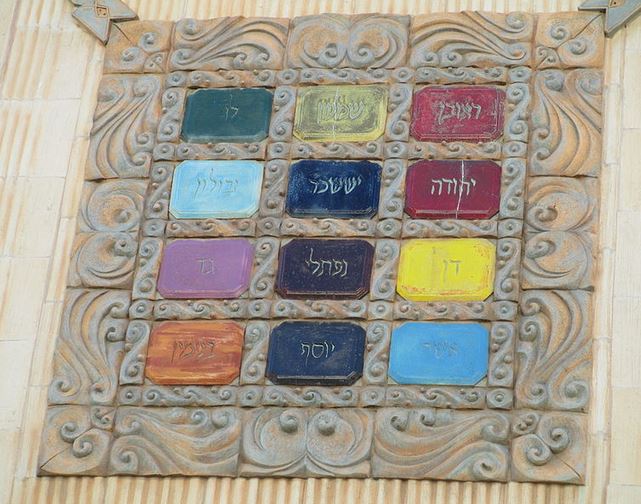
Modern Rendition of the Choshen, the High Priest's Breastplate

Modern Rendition of the Choshen, the High Priest’s Breastplate

In an intriguing passage, the Midrash (Bamidbar Rabbah 2:7) provides a summary of the flags’ appearance. It begins by telling us that the colours of the flags corresponded to the colours of the stones that were on the Choshen (or Breastplate) of the High Priest. The High Priest was commanded to wear a special breastplate that had twelve precious stones, one for each of the twelve tribes. Each stone had a symbolic meaning unique to that particular tribe.

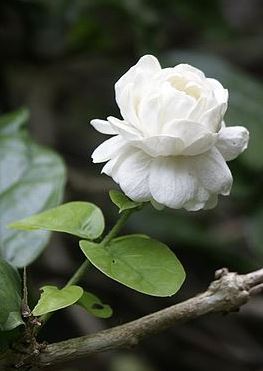
Jasmine flower

Jasmine flower


Reuven’s was the odem, a ruby, and so his flag was red. The symbol on the flag was the duda’im, flowers that Reuven had picked for his mother Leah (Genesis 30:14). It was on account of these flowers that Leah went on to have three more children. Duda’im is often translated as “mandrakes”, though according to Rashi they were of the Jasmine plant.

Shimon had the pitdah, probably topaz, and his flag was green. The symbol upon the flag was an image of the city of Shechem. This is in memory of the episode where Shimon (together with his younger brother Levi) took up swords to decimate the Shechem population after the abduction and rape of their sister Dinah (Genesis 34).

Levi’s was bareket, possibly an emerald or onyx, and the flag had three bands of colours: white, black, and red. Upon the flag was an image of the Urim V’Tumim, the mystical objects kept within the High Priest’s breastplate that were apparently used for communication with the Divine.

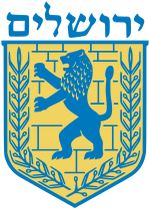
Modern-day Coat of Arms of Jerusalem, with the Lion of Judah

Modern-day Coat of Arms of Jerusalem, with the Lion of Judah

Yehuda had nofech, a stone more difficult to identify, with different opinions holding that it was either red, green, or blue. The Midrash here describes the flag as blue like the skies. Emblazoned upon it was the image of a lion. Before his passing, Jacob blessed each of his twelve sons, and in his blessing, he described Yehuda as a lion (Genesis 49:9). The lion would later become associated with the Davidic dynasty of kings (which hails from the tribe of Yehuda), and with the seat of their throne in Jerusalem, a city that goes by a number of names, including Ariel (“God’s lion”).

Issachar’s was a sapphire (or lapis lazuli) stone, and his flag was of a very dark blue colour. Upon it was the image of the sun and moon. The Midrash explains why, citing I Chronicles 12:33, which describes the people of Issachar as being wise in astronomical and chronological matters.

Zevulun had a yahalom, today’s Hebrew word for diamond, though there may be other possibilities. Zevulun’s flag was white, and bore a depiction of a ship, again based on Jacob’s blessing to the tribe to be successful sea-going merchants, and live along the Israeli coastline (Genesis 49:13).

Dan had leshem, amber, with a flag of a sapphire-like colour (despite the fact that amber is typically golden-red). Upon the flag was the symbol of a snake, once more based on Jacob’s blessing (v. 17). Likewise, Gad’s flag bore the image of a military camp (v. 19), on a black and white background, based on Gad’s stone of shevo, a black agate or obsidian.

Amethyst, the Greek root of which is literally "not intoxicating"

Amethyst, the Greek root of which is literally “not intoxicating”

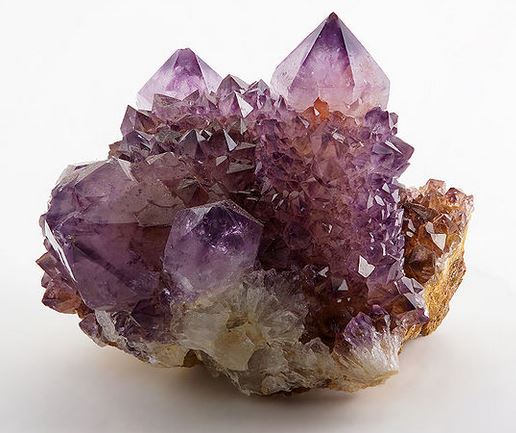
Naphtali had achlamah, the purple amethyst. His flag was of a similar colour, described by the Midrash as pure wine that isn’t too strong. It is interesting that the Midrash should compare it to wine, since amethyst was believed in ancient times to keep one sober and prevent drunkenness. Upon the flag was an image of a gazelle, also from Jacob’s blessing (v. 21).

Asher’s stone of tarshish is certainly the least identifiable of the dozen. Opinions range from chrysolite and coal to flint and hyacinth. The Midrash doesn’t help in clarifying the matter, describing the flag as similar to the colour of an expensive jewel stone worn by women. Whatever the case, the image upon the flag was that of an olive tree, since Jacob blessed Asher with fatty riches and delicacies (v. 20).

In the encampment, the tribes of Ephraim and Menashe were counted separately. On the breastplate, however, they were counted as one, under the banner of their father Yosef. This is because Ephraim and Menashe were not Jacob’s sons, but his grandsons, and on his deathbed, Jacob elevated their status to that of his own sons. Thus, we always maintain that there are twelve tribes: if we include the priestly Levites in the count, then Ephraim and Menashe are combined into one, Yosef, to ensure twelve. If we do not include the Levites since, after all, they are in a different class (and did not inherit any land for that matter), Ephraim and Menashe are counted independently of each other.

Malachite

Malachite

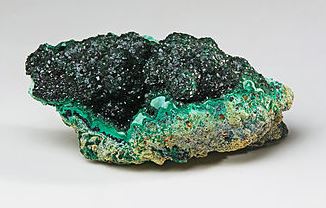
The stone of Yosef was shoham, which also has a number of opinions to its identity. The Midrash tells us that the flag was black, which supports the suggestion that shoham is malachite, a stone that has dark green and black colours. Ephraim’s black flag had a bull depicted on it. This is drawn from Moses’ final blessing to the tribes of Yosef (Deuteronomy 33:17), which the Midrash quotes. (Jacob’s blessing also mentions the word for a bull, but it is translated differently there.) The Midrash also tells us that the bull represents Joshua, who was of the tribe of Ephraim.

Based on the same verse in Moses’ blessing, Menashe’s black flag had a re’em, a horned animal sometimes translated as a unicorn, or perhaps an ox or even a rhinoceros. Again, the Midrash points out that this represented the Biblical judge Gideon, who was of the tribe of Menashe.

Last but not least, Binyamin’s flag famously depicted a wolf, based on Jacob’s description (Genesis 49:27). The stone of Binyamin was the yashfe, another unidentified one. The Midrash tells us that Binyamin’s flag had a mix of the colours of all the other tribal flags. This is likely due to the fact that Binyamin was the beloved little brother of the family, and all of his older siblings, though sometimes at odds with one another, always united to protect him. It is said that this is the reason why the Holy of Holies in the Temple was specifically in the territory of Binyamin (while the rest of the Temple was in the land of Yehuda), since the whole nation put aside their differences and united as one when it came to the smallest of their brothers.


This is an excerpt from Garments of Light: 70 Illuminating Essays on the Weekly Torah Portion and Holidays. Click here to get the book! 

The Eighth Day of Pesach: Isaac, the Afikoman, and Mashiach ben Yosef

Of the three patriarchs, the holiday of Passover is most intimately tied to Isaac. According to tradition, Isaac was born on Passover. Commenting on Genesis 18:10, Rashi explains that the angels’ visit to Abraham and Sarah occurred on Passover, and the angels promised a son to be born – Isaac – exactly one year from that time. This important detail helps to solve a key chronological problem. Earlier, God had told Abraham that his offspring would be subjugated for 400 years. However, when one makes an accounting of the timeline, they will find that the Jews were only in Egypt for a total of 210 years! How could this be?

Commenting on that verse (Genesis 15:13), Rashi calculates how the Exodus occurred exactly 400 years from the birth of Isaac. Thus, God’s word was perfectly fulfilled, since Isaac was the very first of Abraham and Sarah’s offspring. Although Isaac was not subjugated in the sense that the Jews in Egypt were, nonetheless he was certainly troubled by the Canaanites and Philistines, as the Torah records, and was considered a “foreigner” in the Holy Land throughout his life, since God had not yet officially granted the land to the Jews, nor did Isaac settle it permanently.

Digging further, if Isaac was born on the first day of Passover, then his brit milah (circumcision) would have been on the eighth day of Passover. Though the eighth day is not celebrated in Israel, it is celebrated in the diaspora. According to Chassidic custom, as initiated by the Baal Shem Tov (the founder of Chassidism) the eighth day of Passover is associated with Mashiach. In fact, it is customary to hold a Seudat Mashiach, a “Mashiach Feast” on the final afternoon of the holiday, complete with matzahs and four cups of wine. Just as Passover celebrates the First Redemption (led by Moses), the last day of Passover is meant to represent the Final Redemption (led by Mashiach). And it is only commemorated in the diaspora since, after all, it is diaspora Jewry that needs the Final Redemption and the Ingathering of the Exiles more than anyone.

Finally, during the Pesach seder we have three matzahs to go along with the Pesach platter. It is taught that these three matzahs represent the three patriarchs: Abraham, Isaac, and Jacob. One of the fifteen steps in the seder is yachatz, where the middle of the three matzahs is broken in half. The larger half is covered and hidden as the afikoman, while the smaller half remains at the seder table. Thus, the matzah which we break is specifically the one associated with Isaac.

So then, what is the deeper connection between Mashiach and the Redemption, Passover and the Afikoman, and the forefather Isaac?

Who is Mashiach?

The Jewish mystics teach that there are actually two messiahs: Mashiach ben Yosef, and Mashiach ben David. This is derived from a number of texts and principles. One of these is the fact that the Tanakh has a clear pattern when it comes to major national events: first comes a descendant of the matriarch Rachel to usher it in, and then comes a descendant of the matriarch Leah to complete the mission. For example, Yosef (a son of Rachel) came to Egypt first to set the stage, and then came Yehuda (a son of Leah) to prepare the land for the actual arrival of the rest of the family (see Genesis 46:28). First, Joshua (of the tribe of Ephraim, and a descendant of Rachel) brought the Jews into the land of Israel following the Exodus, then Othniel (from the tribe of Yehuda) finished the job of conquering and settling the land. The first king of Israel was Saul (from the tribe of Benjamin, and a descendant of Rachel) and only then came King David (again of Yehuda). Thus, in every major event, we see clearly that first comes a descendant of Rachel to prepare the way and fight the battles, and only afterwards comes a descendant of Leah to finish the job.

In the same way, the Sages teach that first comes Mashiach ben Yosef (a descendant of Rachel), whose mission is to fight all the battles on behalf of Israel, and only after this comes Mashiach ben David (a descendant of Leah), who completes the messianic role. And who is Mashiach ben Yosef? Amazingly, the Sages say that this is none other than Isaac, reincarnated!

Of all the patriarchs and major Torah figures, Isaac is spoken of the least in Scripture. Hardly anything is said of him. It is explained that this is because Isaac has not completed his mission, and his story is not over. He has yet to fight many battles. The Sages permute his name – Itzchak (יצחק) – into the words Ketz Chai (קץ חי), literally that he “will live [again] at the End”. This is one reason why Itzchak (which means “will laugh”) is in the future tense. Isaac is Mashiach ben Yosef, who will come at the End to fight the final battles. Beautifully, the gematria of Itzchak (יצחק) is 208, equivalent to Ben Yosef (בן יוסף), also 208.

This brings us back to Passover and the afikoman. The middle matzah is broken in half. One half – the one associated with the patriarch Isaac – remains on the seder plate, together with the other matzahs that symbolize the other patriarchs. The other half – the larger one – is hidden away, only to be revealed at the very end. This is symbolic of Isaac’s final role as that of Mashiach, whose arrival is also concealed until the very ‘End of Days’. And on the eighth and final day of the Passover holiday – the day on which Isaac was circumcised and entered into the Covenant – we hold a ‘Mashiach Feast’ to celebrate the coming Final Redemption, may it arrive speedily and in our days.

Chag sameach!