
Tag Archives: Mashiach

Eliyahu’s Immortality, Passover, and Shabbat HaGadol

This week’s Torah reading is Tzav, detailing many of the priestly laws that applied to the Kohanim. It begins with God telling Moses to instruct Aaron (the first Kohen) and his children in the proper sacrificial rites, starting with the olah, a type of offering that is wholly consumed by the flames (as opposed to being roasted and eaten). Rashi comments that the term “tzav” – command – has the connotation of commanding not just Aaron, but all of his future descendants, and all generations of kohanim.
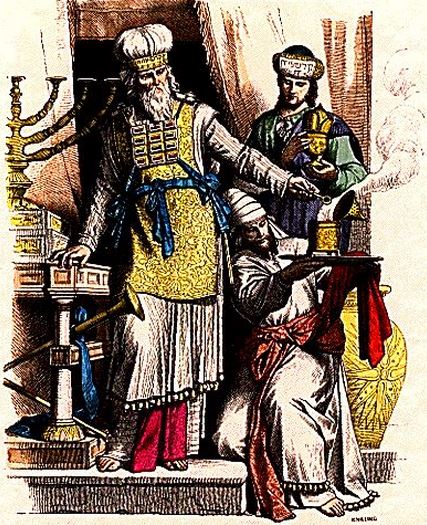
Kohen Gadol (High Priest) and Levites. (Braun & Schneider)

Kohen Gadol (High Priest) and Levites. (Braun & Schneider)

One of those descendants is Pinchas, the grandson of Aaron (through his son Elazar). For his heroic efforts, as described in Numbers 25, God blessed him with an eternal priesthood. Pinchas is mentioned as the Kohen Gadol (High Priest) in the book of Joshua (who was the first of the Biblical Judges). According to the Sages, he remained in this role until the times of Yiftach, one of the last Judges. This would mean he served as the High Priest for several hundred years! The Sages suggest that when God promised him an “eternal priesthood”, He literally meant it.

Due to the scandal that concluded the story of Yiftach (Judges 11-12), the commentaries state that Pinchas resigned as the High Priest. He then disappears from the narrative, only to reappear again a couple of centuries down the road. This time, he comes back as Eliyahu HaNavi, Elijah the prophet, as the Sages state: Pinchas ze Eliyahu, “Pinchas is Eliyahu”. The Arizal (Sha’ar HaGilgulim, 33, 2b) explains that Eliyahu was the reincarnation of Pinchas, while many others say it was literally one and the same person, since God’s blessing connoted everlasting life.

Eliyahu himself never passed away, further proving the point that Pinchas was meant to live forever. The Tanakh describes how Eliyahu was taken up to Heaven alive in a whirlwind of flames (II Kings 2:11). It is said that Eliyahu transformed into an angel, and thus lives on. This is why he appears (spiritually speaking) at certain times in the Jewish calendar and life cycle, including during a brit, and for the fifth cup during the Passover seder. Ultimately, it is prophesized that he will return in physical form once more at the End of Days to herald the coming of Mashiach, as it says: “Behold, I will send you Eliyahu the prophet before the coming of the Day of Hashem, the great and awesome” (Malachi 3:23).

The commentary of Abudraham (or Abu Dirham, Rabbi David ben Yosef of 14th century Spain) explains that this is why the Sabbath before Passover is called Shabbat HaGadol, “the Great Sabbath”. The verse in Malachi ends by saying “the great and awesome”, hagadol v’hanora. After all, this passage from Malachi is the Haftarah portion that we read at the synagogue on Shabbat HaGadol!

The basic purpose of Shabbat HaGadol is to get us into the “Pesach spirit” and prepare us for Passover. On this Sabbath, It is customary to review the Haggadah and the pertinent laws of the holiday. Similarly, the Haftarah portion is also designed to get us into the Passover mindset. The Haftarah ends by juxtaposing the first redemption under Moses with the coming redemption ushered in by Eliyahu:

“Remember the Law of Moses, My servant, whom I commanded at Horev [Mt. Sinai] for all Israel, statutes and ordinances. Behold, I will send you Eliyahu the prophet before the coming of the Day of Hashem…” (Malachi 3:23-24)

The Sages tell us that after the final redemption we will no longer need to recall the first redemption, which will pale in comparison. This is based on the verse in Jeremiah 23:7 which prophesizes that in the End of Days, people will no longer describe God as the One who took the children of Israel out of Egypt, but as the One who saved Israel from oppression all over the world, and restored them to their Promised Land.

This is one reason why during the Pesach seder, while commemorating the first redemption, we end by pouring a fifth cup for Eliyahu, who will come to usher in the final redemption. Is it then that Jews will no longer be misunderstood and oppressed, our exile will end, and we will all return to live in the Holy Land in peace, as we say at the conclusion of the seder: “Next year in Jerusalem”.

Abraham’s Revolution & the Purpose of the Jewish People

This week in the parasha of Lech Lecha we begin reading the story of Abraham, the principal forefather of the Jewish people. Abraham is considered history’s first Jew, being the one to whom the covenant of circumcision was first given, together with the Promised Land. The most pertinent question to ask is: why Abraham? What exactly was it that Abraham did to merit being the first Jew? What was so unique about him that made him the forefather of an entire nation, not to mention a multitude of other nations, too? (This is the meaning of his Hebrew name, as Rashi explains on verse 17:5 that Avraham stands for Av Hamon Goyim – “father of many nations”.)

The most common answer that is suggested is that Abraham was the first monotheist, and introduced monotheism to the world. A quick look through the Torah negates this argument very quickly. For instance, we know that Abraham’s life overlapped with that of Noah, who was obviously a monotheist, having communicated directly with God. Jewish tradition holds that Noah’s son Shem had a yeshiva, together with his grandson Ever, where our forefathers studied, and which long pre-existed Abraham’s arrival onto the scene. Earlier, we see that Enoch “walked with God”, too. There are many more examples we can bring to show that Abraham was certainly not the first monotheist, nor was he the first to teach monotheism to the world.

We must find another answer then, and to do this it may be easier to begin with another question: why is there a Jewish people at all? Why is there a need for a “Chosen People”, and what exactly are the Jewish people chosen for?

Back to the Garden of Eden

Originally, God had created man in a perfect world of no evil. There was no Judaism in the Garden of Eden; Adam and Eve were certainly not Jews. They chose to introduce evil into the world, and man was thus “expelled” from the Garden. Henceforth, it has been our mission to return to a perfect world—to repair the damage that was done, to remove evil from our midst, and to restore Godliness to the universe. We are in the world of tikkun, “repair”, and since the time of Adam, it has been man’s mission to recreate an immaculate world of pure goodness.

Unfortunately, Adam and Eve were unsuccessful in this task, and so were their immediate descendants. By the third generation, the Torah tells us that people began to profane the name of God. By the tenth, the world was full of corruption and immorality. Instead of repairing the world, people were only damaging it further. In last week’s parasha, we read how God essentially hit the “restart” button, yet promised to never do so again. The reason for this is fairly plain: God created the world for us; an infinite God requires nothing for Himself. It makes little sense for God to continue recreating the world if Man will keep destroying it. In effect, God was saying that henceforth it is up to man to take care of our own world.

Another ten generations after the Flood, the world was corrupt once more. Since God wouldn’t be destroying it again, from where would the solution come? Who would rise to the challenge? This is where Abraham comes into the picture.

Abraham’s Revolution

From a very young age, Abraham recognized the cruelty that permeates the planet, and made it his life mission to make the world a better place. He quickly deduced that there must be one singular God, and made the effort to find the answers to life’s big questions. But it didn’t end there.

Unlike Shem, Ever, and their kind, Abraham actually wanted to do something about it. Shem and Ever could not confront the rampant idolatry and corruption of their society, so they fled and opened their own secluded yeshiva. All who were interested were welcome to join, but otherwise Shem and Ever were silent.

Abraham, meanwhile, was far more proactive. He understood that man’s mission is to perfect the world. He understood that there is nothing to wait for. Abraham actively entered the battle, fighting the immorality of the day head-on and starting a massive education campaign. Jewish tradition teaches that Abraham built his home along a busy intersection, with a door on each side to make it as easy as possible for people to enter. Food and drink were both abundant and free of charge for all who were willing to listen. Abraham is even said to have written a book of several hundred chapters outlining his arguments against idolatry, immorality, and corruption, while presenting a summary answering the biggest questions of life. Abraham was so passionate about his work that he even risked his life for it. It came to a point where his movement threatened King Nimrod, and the latter threw him into a flaming furnace.

It was only at this point that God stepped in. It is incredible that until this moment, Abraham had done all of that without ever having communicated directly with Hashem. Until then, he was in the same boat as all of us are today—in a world with no prophecy or revealed Godliness; in a world full of immorality and atheism. Nonetheless, his knowledge and faithfulness in God never wavered, nor did he abandon his mission. This is precisely why God chose Abraham. In many ways, it is more appropriate to say that Abraham chose God.

The Chosen People

And this is the true purpose of the Jewish people. We are meant to continue the work that Abraham started nearly four thousand years ago. Like Abraham, the Jews as a whole have always been on the side of righteousness, and morality, regardless of what society said, or how much we were persecuted. A “light unto the nations”, the Jews have revolutionized the world in each generation, moving civilization forward, and bringing it ever closer to a perfect world.

It is no surprise that roughly 25% of Nobel Prize winners are Jewish (despite being just 0.2% of the world’s population!) nor is it surprising that in 2013, the UN passed 21 out of 25 resolutions against Israel. One of the world’s tiniest countries, with a population that makes up just 0.1% of the planet, somehow earns 84% of the world’s resolutions! The world’s eyes are constantly focused on Israel. The Jewish State is held to a far higher standard than any other. The world looks to us for moral guidance, and for higher consciousness (and they are rightly upset when we fail to uphold this ideal).

This is our task as Jews, just as it was the task of Abraham. This is why Abraham was different, and why Abraham was chosen. We are continuing his work in repairing this world and bringing it closer to the primordial state of Eden. And we are finally living in a time where this is no longer just a dream. Technology has brought the world together in a way that was never possible before. Jewish teachings say that every person on Earth will one day hear the shofar of Mashiach. This was once relegated to the category of miracles. Today, it is possible for anyone with a smartphone and an internet connection. The prophets Isaiah (11:9) and Habakkuk (2:14) both state how the era of Mashiach will be one where the world is saturated with knowledge. We are indeed living in a world where we are constantly bombarded with information, and any question can be answered within seconds by a simple Web search. In other words, we are now living these ancient prophecies.

The fulfilment of man’s original mission—the one that Abraham took upon himself, and that the Jewish people have continued throughout the millennia—is nearly upon us.


The above essay is adapted from Garments of Light, Volume Three.
Get the book here!